
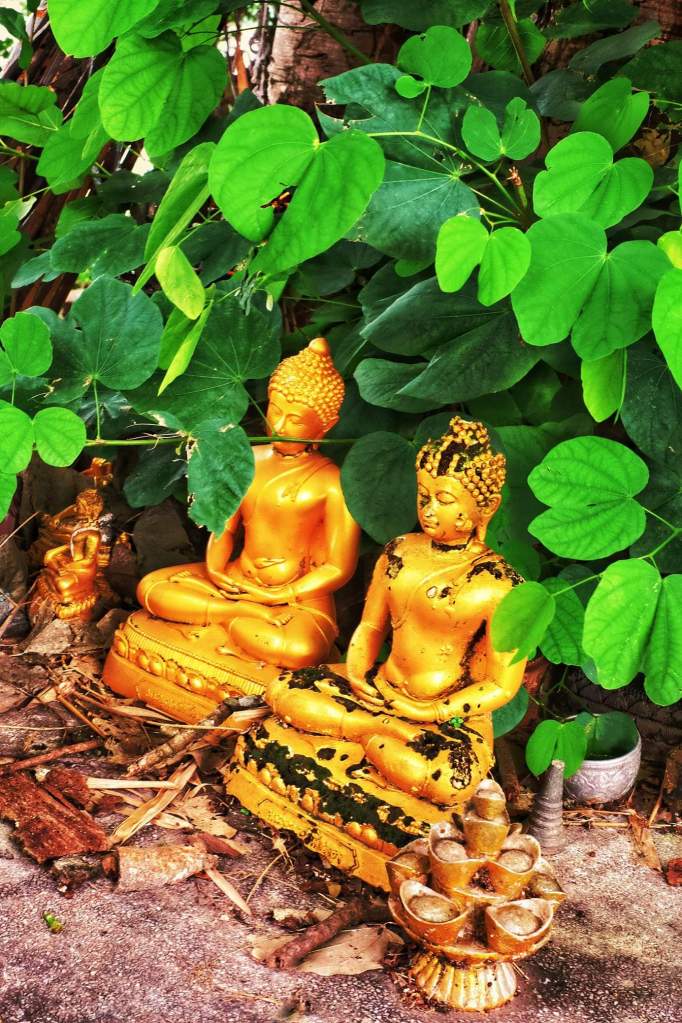
There is a little shrine at the foot of a huge and ancient tree, outside a Buddhist temple above the banks of the Mekong River in a little town called Chiang Khong in the far north of Thailand. As I looked at this obviously highly revered sacred site, through the viewfinder of my camera, I knew what I would call the photo:
Lokah Samastah Sukhino
Now, I already knew that this translates to: May all beings everywhere be happy and free. A friend of my son’s used to use this ancient Sanskrit mantra a lot and I’d long since discovered its meaning. Or so I thought.
Anyway, later as I readied this (what turned out to be quite a lovely image in my ever so humble opinion) I thought I would look up the mantra again. Just to make sure I had the right spelling and so on.
It was then I had a surprise. May all beings everywhere be happy and free is only the first part of this beautifully expressive mantra. I quickly discovered that this mantra is not simply some vague wish or prayer for universal peace and happiness; it is also a call to action. Here’s the complete translation as I found it:
May all beings everywhere be happy and free, and may the thoughts, words, and actions of my own life contribute in some way to that happiness and to that freedom for all.
But, wait. There’s more.
As I read more deeply into the meaning of all the words in the mantra, I discovered that it’s more than a call to action or a simple invocation. I learned that the mantra as I knew it was missing a final word: Bhavantu. So with this word missing, a vital element of the mantra was lost: the use of the suffix antu at the very end in the original Sanskrit turns the whole thing into a solemn promise. Antu means it must be so.
This all got me thinking: How? I mean, how do we transform our ‘thoughts, words, and actions’ so that they will contribute to the happiness of all beings? And how can we actually make it a promise?
Then it suddenly occurred to me: the action required was summarised very nicely by the Buddha in what he called The Eightfold Path. We are meant to start living according to the principles in that teaching.
Now, The Eightfold Path is, on the face of it, a fairly straightforward set of life principles that, when understood and integrated into one’s life and being, will lead to the cessation of suffering.
Now, this sounds all very well and good, but I’ve been wondering if there was a way I could sum it up in just a few words.
Something succinct, and to the point.
Then I found myself (again suddenly, right out of the blue) scribbling a note on my phone:
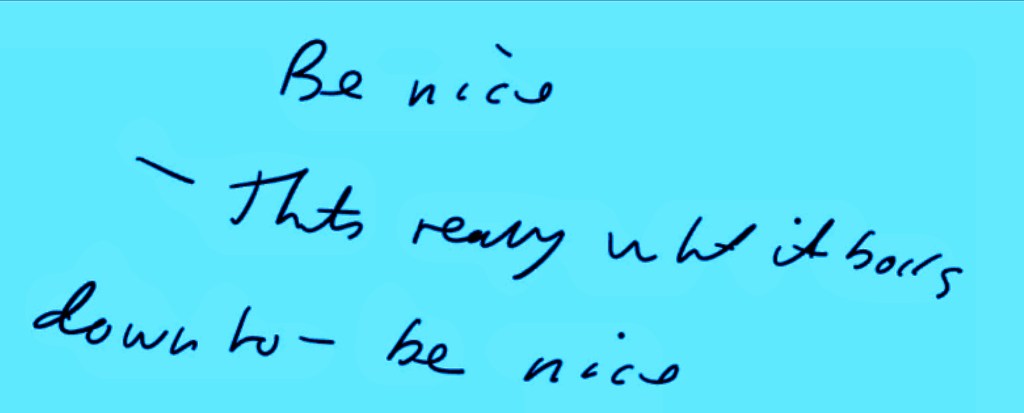
Be nice.
That’s really what it boils down to
Kindness in all our intereractions with all the forms that life has taken: other humans; other animals; plants; Earth herself; the rivers; the oceans; the forests. You name it. All forms that life has taken.
So, how do we be nice?
When I say it like that, it almost sounds silly; I mean, how hard can it be? Be nice? Easy.
Well, I guess I can say for myself that it’s true, sort of, sometimes. Yes it is often extremely easy for me to be nice. And, then, other times I have to try to be nice. And then there are those times when try as I might, nice just doesn’t happen.
Which means, I guess, that it might not be quite that simple after all.
There are so many wonderful explanations of the Buddha’s teachings, including The Eightfold Path, on the Internet. On the face of it, that might seem confusing. However Buddha himself advised that each person should question the teachings and come to their own conclusions. In other words, he said, don’t take my word for it, check it out for yourself.
The Eightfold Path. I might know that lovely list by name (Right Understanding, Right Thought, Right Speech, and so on), and I’ve read a little about them, but maybe it’s time to dig a bit deeper.
I’m going to make a start with Right Understanding simply because it’s the first on the list, and has always seemed to be a pretty important starting point.
So, next post (or perhaps a later one) that’s what I’m going to do. Just sit and see what comes out of my heart and onto the page (or screen). Please join me then and we’ll see what happens.
Peace and love from me to you
 Notes from the Hermit's Cave
Pingback: Right Understanding:First Step on The Eightfold Path | Notes from the Hermit's Cave