Anyone who has tried to meditate for more than a minute, knows very well that the mind right away jumps into overdrive, trying its hardest to keep us nice and distracted; anything but quiet and peace is the mind’s aim. Speaking for myself, all I want to do is get rid of that mind altogether.
But, I know, that would be a mistake. I may not like how my mind behaves sometimes, but I do actually quite like having one, a mind that is. I guess, for me, it’s about realising that my mind is here to stay, and can be either my friend or my foe.
Trouble is, when trying to meditate, I can easily believe it’s my worst enemy. Another mistake, I think, that arises from a not so discerning attitude to the thoughts that flood in seemingly at random.
But, sometimes in that quiet and still space – and even if that quiet and peaceful space hasn’t yet been reached – a thought comes from the mind friend, not the foe. It seems I must learn discernment. Here’s a good example.
Not long into my meditation earlier today, but already bombarded with random thoughts, memories, and other distractions to said peace and quiet, an idea came that just caught my attention. Suddenly, there seemed to be a full-blown idea for what sounded like a great blog post.
I din’t have this notebook with me, and though I had my phone handy, I thought, no, be firm, don’t let interruptions in. Of course, I thought that I’d remember the idea, but sure enough, I didn’t. Now, it’s nowhere to be found. I mean it must be in some tiny neuron in my brain, but it’s hiding pretty well!
Later, after my meditation session, I thought to myself, how come I could make a list of all the less than useful thoughts, memories, ideas and random mental craziness that tried its best to keep me distracted, yet I have no idea what that one wonderful blog post idea was?
I think it might possibly be about attachment; a lesson I’m giving myself in discerning between what thoughts are from my friend mind which ones from my foe mind, the mind running wild with its accomplice, my ego.
It’s a lesson I badly need, I think. Endless thoughts of little or no use to me have stayed, while the one that might have been helpful is gone, seemingly forever.
Yes indeed. Perhaps ny perspective on what ideas ad thoughts are useful to me and what ones aren’t, needs to be contemplated upon.
Actually, it’s not really needing a lot of contemplation: I mean, the one idea I thought would be great is gone. But looking at it the other way around, the fact that the great pile of not so good thoughts staying with me has given us this post I am now writing, and you are reading.
Perspective. It’s all about perspective. And discernment.
Did you know that Thoreau, when he was staying at Waldon Pond would sometimes sit on the front steps of his cabin right after sunrise.
Often he would look up and discover that it was already midday or even late afternoon; he’d spent those several hours in a reverie.
Being in a reverie is most often described as being a pleasant experience, just like a nice day-dream. It is also universally (at least in the context of my short Google searches) described as being ‘lost in thought’, as well as being a place of fantasy, a place in which fanciful and impractical ideas are born.
In other words, a reverie while being pleasant, does not seem to be looked upon as a useful, productive, or worthwhile experience.
The outcome of this contemplation and the above-mentioned little bits of Googling, is that I don’t agree at all with the dictionaries when they tell us that reveries are almost useless and have little or no benefits.
Even the Hourihans dismiss the value of reveries when compared to the practice of formal meditation. Listen to what they say:
There is a difference between the two. Meditation means effort, concentration of the total mind. What Thoreau has experienced is reverie – passive, beautiful and enchanting, but not true meditation.
My reaction to this dismissal? Well, I say, what’s wrong with an experience that is passive (there might be a book in the idea that reveries might not be all that passive after all) beautiful and enchanting?
And on the other side? Why is it seen as virtuous to be always making efforts and concentrating the total mind all the time? Speaking for me and I suspect several billion other people, I get tired, always trying, making effort, always concentrating and the rest.
I’m not saying at all that I’m not in favour of meditation. Indeed, I spend hours each day (in theory that is) in some kind of effortful, concentrated meditation. But, really, isn’t it nice now and again to just give up the effort, lose concentration, just for a bit? Just rest.
Of course when one’s mind wanders in reverie, fanciful ideas and thoughts will arise. Mind you it’s equally likely that some of those thoughts and ideas won’t be fanciful, but be helpful. And you know, I doubt there’s a meditator in the universe who would not report exactly the same thoughts and fancies come up despite all their meditatory efforts and concentration That’s just how our minds work.
The notion of being ‘lost in thought’ is interesting to look at too. I don’t think it’s quite the right way to refer to what happens in reveries. At least not completely.
Was Thoreau really lost in thought when he would suddenly realise that several hours had passed without him being aware?
Perhaps it’s more likely that at least a proportion of those hours were spent in a thought free state, just as in deep sleep when our mind is absent.And we all know how restful and satisfying deep, dreamless sleep can be. Maybe that’s why reveries are described as ‘pleasant’ experiences.
My teacher talks about how sometimes when we’re listening to a favourite piece of music, we can become ‘lost in the music’. We all know how that feels. He then asks us to consider, what is it exactly that ‘gets lost’?
Well, just as with deep sleep or when in a state of Samadhi or deep meditation, it is the mind that disappears – along with its self-idenifying ego sense. In other words, whoever we think we are goes missing or absent for a while.
When I’ve experienced that state when listening to music, I would describe it as losing track of time, or rather not being aware of time at all. Thoughts come and go but don’t often stay long, ‘just floating by like clouds’ as someone recently described it to me. And afterwards when I return to ‘normal’ I sometimes have a sense that for a time I and the music were one, no separation or judgements, non-different.
And so it is when ‘lost’ in a reverie: the ego disappears; thoughts come and go. What’s left is the space between thoughts – a bit like the silence that exists between notes in a musical composition.
Some say that it is this silence, this space when mind and ego are absent, is where the divine is to be found. It is said, by some, that it is in this space, this silence, one may experience God, or Absolute Reality.
So, no ego; no monkey mind jumping about; no ‘I’ to interfere with the state of silence, stillness, and peace. And quiet!
And if one removes the letter ‘I’ from the word reverie? We are left with revere. Perhaps those who tell us that the silence is God, those who say that the absence of thoughts, ego and so on, allows us to detect the Divine, are onto something. That silence, and the process by which it is realised, are to be revered.
Being ‘lost’ (the dictionary’s word not mine) in a reverie might just be the most useful and the most productive (not the world’s definition, but more in the sense of the actions that make for the betterment of Self) thing we can do when the mood, the moment, and the inclination strike.
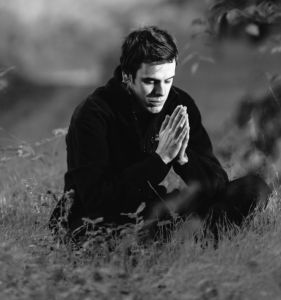
Everyday I affirm, I pray with longing and with hope, these words:
Let me keep silence in this world
Some days, like today for instance, the prayer feels empty, devoid of any hope, or faith on my part, that I will at some point really be able to attain at least a degree of silence.
Yes, I know, prayer is not some kind of magic formula by which one utters the words of the prayer as in some kind of incantation, then in due course that which has been prayed for appears or comes to pass as if by magic.
Prayer, rather, is affirmation in which the one praying places full attention on the words prayed and their meanings. And more importantly on the notion that the Universe is in perfect balance all of the time, and that things – all things – are manifesting how and where and when and why, and in precisely the manner that they’re supposed to.
Prayer is more a kind of wake-up call, a reminder notification to Self that everything is exactly as it is, and is meant to be that way.
Fine theory. Yet it’s a theory I sometimes know to be much more than a theory.
Other times, this being one of those times, I have a hard time, or I should say my mind can’t accept that silence does indeed exist. My mind is simply not able to grasp that silence is already within me, ready and able to give me peace.
Closed Cafe at the End of Lonely Street: Silence comes in many and varied forms
It is obvious to all of us I think, that silence is not simply the mere absence of words, of speech. Not talking is simply one aspect of silence; it’s like silence is a thing, an entity or state of being that doesn’t only imply an absence but suggests an adding on of a new state of being.
When I pray Let me keep silence, it is true that I am seeking the silence of the mind, the inner silence that can bring calm and quiet to the heart and whole of Self too. But, to be truly upfront as they say, it is the silence or quiet that emerges from time spent not speaking that I long for.
Long for? I use that word quite often and it’s occured to me that, while to long for something is to have a desire for that thing, a longing is actually more than a simple desire. It’s a very strong desire, a kind of desperate wanting or wishing for that thing. You might even call it a compulsion.
Now I think about it, what is the desire or drive that keeps me doing exactly the opposite? Why do i feel the need to be talking (thinking too, but here I’m thinking about talking too much) all the time? It is clearly also a compulsion. That’s the only conclusion I can come to.
So then, why the compulsion to talk all the time?
Well, to once again be frank, upfront, I don’t really care about the reasons for or causes of, this compulsion. Probably stems from deep-seated anxiety, long-standing low self-esteem, old habits, fear. The list of explanations could go on and on, but what would be the point of that?
The real point, for me, is that compulsive talking is no mere bad or inconvenient habit. Personally it can actually cause physical symptoms of the ‘feeling sick’ variety, as well as guilt, shame, even sadness and regret.
And even far worse still is that this compulsion causes at the very least for those around me annoyance and frustration. Incessant talking distracts them from their own thoughts and activities, disturbs their own desire for silence. It’s all very obvious to me.
So, while I am compelled to talk all the time and too much, at the same time I have a strong aversion to that very act of talking too much (and all the time). The talking too much causes suffering to myself and others, while my inability to change also causes suffering. A kind of no-win situation arises, has risen, is always present.
Okay then, what is the solution? Or, more to the point,is there a solution? Well, I didn’t start making these notes with the hope that I would somehow come up with a solution to this dilemma . But, having said that, I’ve been thinking while writing that I do seem hugely attached to the idea that I talk too much, and too often.
As well, I also seem desperately attached to the desire to stop talking so much and so often.
While doing all this (possibly excessive) thinking, I was reminded that the Buddha didn’t say that the cause of suffering is desire; what he said was (allow me to paraphrase): the cause of suffering is attachment to desires.)
You know, another thing I write and think of a lot, is the idea that things work out exactly as they’re meant to. Of course not so easy to actually believe all the time, especially when things aren’t going according our personal wants, desires, and wishes. But it’s another of the prayers if you like, the affirmations which speak of the truth of the balance of the workings of the Universe.
In a way then, despite the lack of intention, I may have nevertheless stumbled upon at the very least a hint of a solution to my dilemma.
We ourselves are merely one more manifestation or result of those workings of the Universe, of that natural order, of those laws of nature that keep it all (including us) in motion.
So, I’m back where I started when I described what I believe prayer to be: an affirmation and a statement of faith in the reality that the Universe is unfolding exactly as it should.
Perhaps if I spent more time (not to forget more heart, more mind, more love) in reminding myself of that reality, and less in toying with my compulsions and aversions and with all my efforts to shift and maneuver the natural order of things to my liking, then I might find that equilibrium , that – what’s the word? – equipoise – in which I may actually realise the balance that I know already and always exists. Maybe then I can finally attain silence.
Deep with the still centre of my being, may I find peace.
Silently within the silence of the grove, may I share peace.
Gently & powerfully within the greater circle of humankind, may I radiate peace.
Just a quick final note: my idea that the universe is working out exactly as it’s supposed to is not mine and it’s not new. I’ve quoted the beautiful poem/prayer Desiderata (the word is from Latin for things desired) before, but there’s a line from it that I’ve borrowed heaps of times:
No doubt the Universe is unfolding as it should
Thank you for allowing me the privilege of sharing all of this, which is really one long prayer, with you.
















 Notes from the Hermit's Cave