No posts for a while. There isn’t one today either actually. I simply felt the need to reach out, connect, write.
Blogging requires a continually refilling reservoir of ideas. And it is then necessary to reflect on those ideas (or at least one of them at a time) and then to commit them to paper – or screen.
And despite my, at times desperate longing to actually write a blog post and to share it here, the fact is that no ideas, and not a lot of energy and mental space to reflect and write have made available to me.
There’s the problem right there isn’t it: ‘at times desperate longing? Talk about attachment to outcomes, to a clinging desire for results. So much for my claim to not being ‘goal oriented’. Hardly.
And it’s not as if I’ve not had a lot of other stuff going on in my life. While I mostly manage to carry on with my spiritual practices and routines, it seems that along with physiotherapy exercises daily, medical appointments, and the rest, I haven’t been left with much physical, mental, or creative energies left over for much else.
But, really, it’s the attachment and clinging that’s the real bugbear. The ‘reasons’ for not writing and posting may well be good and true, but still I get frustrated, not being able to jot down and send my notes out into the world.
So, just be. Don’t worry about it. That would seem to be the sensible advice.
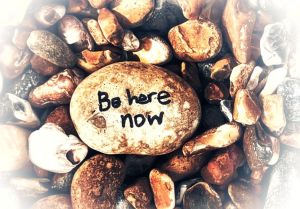
And I am trying to take that advice – thank you. Be patient. Be present. Be quiet – keep silence. Be still and listen.
That’s all there is to it really. Ideas and energies are there. Or do I mean here?
Today I’d like to share with you a short cautionary tale. It’s a true story, relating events that took place very recently.
There was a blogger, a serious student on the spiritual path; a monk whose mission in publishing his blog was – is – to share that path with others, to share the lessons he’s learned/learning. He sees it as one important aspect of his ‘doing God’s work’, reaching out to others of like heart and like mind.
Anyway, this blogger, he suddenly felt an intuition: he thought, I’ll set up an account on (insert here very popular platform) social media. That’s how to promote my blog he thought, and attract more readers.
So, dutifully, he set up an account and began posting. One or two poems, a couple of photos with commentary, that sort of thing. The plan was, post whatever seemed might be enlightening, whenever the feeling was there.
The blogger felt that this was a sort of ‘next step’. He thought that bringing more readers to his blog would help him with his quest to love more, and to share love.
But. Something wasn’t quite right. Sure, he, the blogger was excited by this new venture, this expansion of his service to the Divine and to the world. But he felt – literally and physically – a bit sick. A kind of nervousness gnawed at his guts; he just felt yuck.
‘I can’t do this,’ he thought to himself. ‘It’s not right’
So, there and then he resolved to delete the account, to close that chapter forever, and bring his focus back more fully to his blog. That’s where, he realised, was where God’s work could be done, as well as where his own passions lay.
But, the resolve, didn’t last long. He just had to act immediately. So, again right there and then, he deleted the account.
Instantly, a wave of relief swept over our blogger friend. He felt free, back on track. He now felt less burdened by a burden he’s made for himself, a burden that there really was no need to be carrying.
Okay, I confess: the blogger of whom we speak is in fact me. I know, you guessed that already, but it’s a disturbing saga and I guess I had some need to distance myself a little, at least to start with.
So, why the big relief? Why did it feel so right at the outset, but – almost immediately – felt so wrong to the extent of putting me ‘out of sorts’ physically and mentally?
Funny. That ‘out of sorts’ expression. That’s exactly the root of the issue right there I think. Years ago I withdrew from all social media – though I am on a photo sharing platform that is simply for that purpose and only that purpose, sharing photos.
You see, I thought (and still think) that social media generally had become a ground for conflict, and the celebration of conflict; it was a ground for corruption, gossip and sensation, for all the worst of the news (I know, the best too). Anyway, you know wht I mean: I’m not alone in giving it all up.
And, yet, here I was, feeling led to reopen that particular social media account. An example, I think, of an ego-driven desire for gain disguising itself as a genuine heart or soul intuition or calling.
I choose not to criticise or comdemn any social media platform. They are what they are. All I can say is that it’s not for me, not my ‘sort of thing’, not my cup of tea as it were. No wonder I was feeling out of sorts!
In my selfish, ego-driven compulsion to ‘increase traffic’ (what a horrible expression), I forgot entirely – as we so often do when blinded by desire – that this blog is seen and read by exactly those who are meant to see and read it – you!
So, I apologise to you for that sudden blindness, and for ignoring the absolute reality that it’s all working out just as it’s supposed to.
Anyone who has tried to meditate for more than a minute, knows very well that the mind right away jumps into overdrive, trying its hardest to keep us nice and distracted; anything but quiet and peace is the mind’s aim. Speaking for myself, all I want to do is get rid of that mind altogether.
But, I know, that would be a mistake. I may not like how my mind behaves sometimes, but I do actually quite like having one, a mind that is. I guess, for me, it’s about realising that my mind is here to stay, and can be either my friend or my foe.
Trouble is, when trying to meditate, I can easily believe it’s my worst enemy. Another mistake, I think, that arises from a not so discerning attitude to the thoughts that flood in seemingly at random.
But, sometimes in that quiet and still space – and even if that quiet and peaceful space hasn’t yet been reached – a thought comes from the mind friend, not the foe. It seems I must learn discernment. Here’s a good example.
Not long into my meditation earlier today, but already bombarded with random thoughts, memories, and other distractions to said peace and quiet, an idea came that just caught my attention. Suddenly, there seemed to be a full-blown idea for what sounded like a great blog post.
I din’t have this notebook with me, and though I had my phone handy, I thought, no, be firm, don’t let interruptions in. Of course, I thought that I’d remember the idea, but sure enough, I didn’t. Now, it’s nowhere to be found. I mean it must be in some tiny neuron in my brain, but it’s hiding pretty well!
Later, after my meditation session, I thought to myself, how come I could make a list of all the less than useful thoughts, memories, ideas and random mental craziness that tried its best to keep me distracted, yet I have no idea what that one wonderful blog post idea was?
I think it might possibly be about attachment; a lesson I’m giving myself in discerning between what thoughts are from my friend mind which ones from my foe mind, the mind running wild with its accomplice, my ego.
It’s a lesson I badly need, I think. Endless thoughts of little or no use to me have stayed, while the one that might have been helpful is gone, seemingly forever.
Yes indeed. Perhaps ny perspective on what ideas ad thoughts are useful to me and what ones aren’t, needs to be contemplated upon.
Actually, it’s not really needing a lot of contemplation: I mean, the one idea I thought would be great is gone. But looking at it the other way around, the fact that the great pile of not so good thoughts staying with me has given us this post I am now writing, and you are reading.
Perspective. It’s all about perspective. And discernment.
You know, for all my prayers; for all my mental discipline – efforts at mental discipline – for all my meditations, chanting, and other practices, I still just talk way too much for my liking, and often it feels like it’s only talking for the sake of talking.
I still just open my mouth and let come out any old thing that keeps the noise going. Oh, it’s worse than that: sometimes when I talk it’s rambling and waffling that I cleverly (or not so cleverly) disguise as intelligent, rational, and based logically on knowledge that I either have or haven’t got. Either way, I somehow seem to think I’m offering words of well thought out wisdom.
Whereas, as I said, the noise I make is so often rambling, contradictory , ill-informed, thoughtless waffle.
Enough! Blimey, that’s enough. Talk about opening a post on a calm, relaxed, optimistic, and compassionate note.
Here’s the thing: I want to devote my entire life to devotion and prayer. And that requires at least some silence. Yet, instead, I merely talk about the joys of silence, about the joys of full-on devotion to the divine, and as well I occupy so much time and energy to just voicing random thoughts that come and go, go and come, without rhyme, without reason.
Okay, here’s the second thing: I long with my deepest longing to be silent – to not simply stop talking, though that would be an excellent beginning. No, I want to be quiet; I want my vocal chords to have a break and let my true voice speak through my life, through this blog, my photographs and in whatever way I am lead.
So, what to do? Well, here’s the third thing, thing number three: all I need to do in order to both stop talking so much and be silent is to just sit. Sit and do nothing. There is no thing that I can do that will magically turn me into an oasis of silence and peaceful calm.
Sometime in the dim distant path I read someone paraphrasing The fouth Noble Truth in two words, Just sit. Buddha did indeed know what he was talking about. And I do get the irony: when I talk, I need to say something that helps, not just make noise and try to avoid silence.
Along with many other spiritual seekers across many world cultures and over time as well, I have a more or less daily practice of opening a spiritual book, scripture, or other text ‘at random’ (as if there is such a thing) to receive a message, a lesson, or a little bit of guidance for the day.
In my case, that text has for ages now been the Bhagavad Gita. And over I think the last two or three years, one verse in particular has come up time and again, sometimes on two or three days in a row.
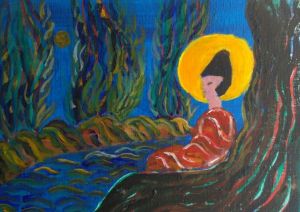
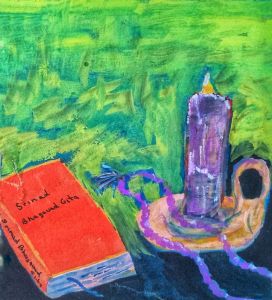
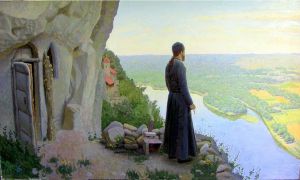
Much thanks to the Hermit Pilgrim who created this beautiful painting
So frequently has this occured that not only have I neglected to examine the verse in any depth, I actually began to ignore it when it came up and went right away to pick another one at random.
Well, this morning, I opened my Gita and there was that verse again – for the second day in a row. However, today, for some reason, I realised that this verse has been calling out to me. Or put it more sensibly: the Divine has been calling on me to take some notice of this verse and its meaning.
So, first of all, allow me to share with you the verse in question.
The Lord of Sri said:
It is said there is an eternal Banyan tree with its roots growing upwards and branches downwards, whose leaves are the Vedic hymns. One who knows this tree knows the Vedas
For me at least, this verse has always appeared quite complicated, complex really, and full of symbolism. Of course, being from an ancient religious text, it’s likely to be all those things isn’t it?
Still, despite reading the verse many times and studying and hearing a few commentaries on it, for some reason it has remained for me rather daunting. At least I can say that I was convinced of the notion that this verse confused me, entangling me in convoluted and sometimes upside down thinking.
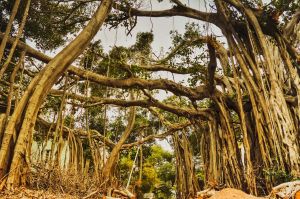
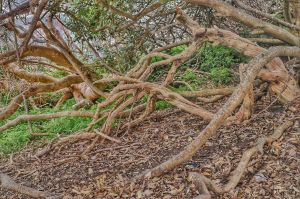
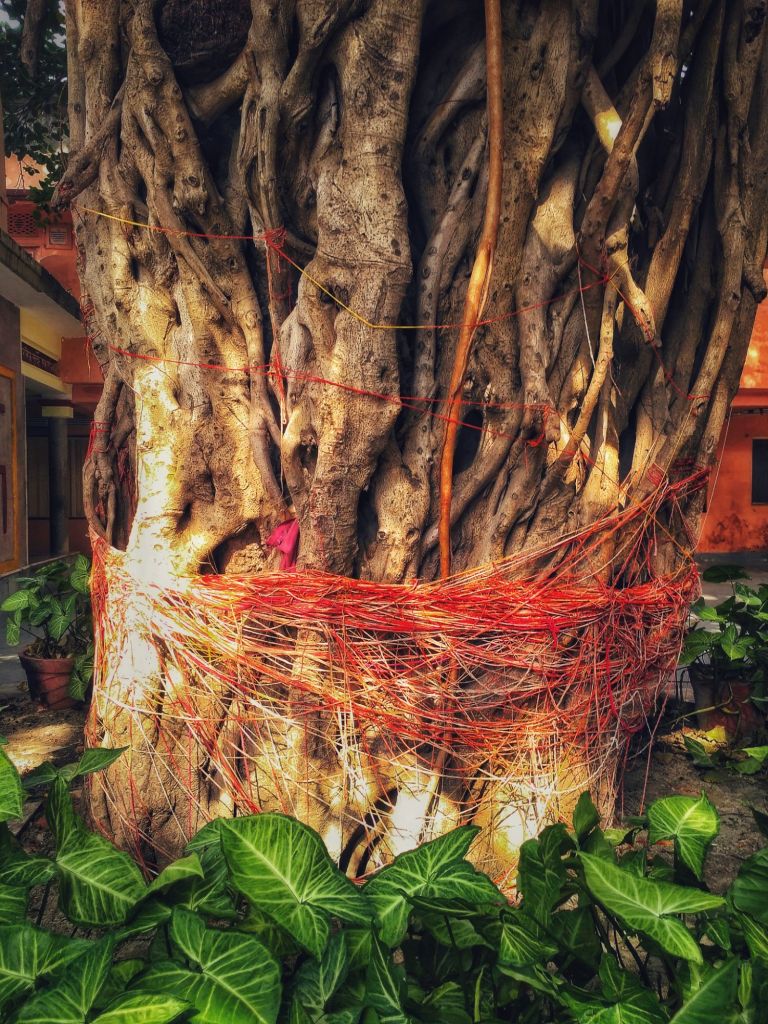
Like the Banyan tree itself I guess. Considered especially sacred among all other sacred trees in India, the Banyan is well known for its way of growing willy nilly, every which way, until the whole thing becomes a complete and dense tangle.
And it is this tangle that is at the heart of the metaphor used to illustrate the lesson in this chapter of the Bhagavad Gita: The tree is Samsara, the illusion that is the material universe in which all of us living beings are entangled. It’s as if we’ve walked into that tangle of branches and roots believing that’s where we will achieve our desires.
A major city in the middle of tourist season is another neat metaphor for this tangle we’re talking about. We look for worldly pleasures there, but find chaos, confusion, and often unhappiness
We are so attached that we identify completely with that physical world (convinced we are merely physical beings ourselves) and are convinced that this is where we can fulfill all our needs.
As the verse says, the leaves of the tree are the Vedas, and one who knows the tree, knows the Vedas. The Vedas are the sacred Hindu scriptures which in this context can be said to represent knowledge. But not knowledge of a mundane ‘ordinary’ kind.
The knowledge to realise (because we already possess this knowledge, we just aren’t aware of it yet) is that we are not the body, so we have no need to be bound to the tree of Samsara with its suffering and its endless entanglements. It is Self Knowledge.
This Self Knowledge leads us to develop what a following verse calls ‘the weapon of detachment’ with which we can chop down this very strong tree of attachments and illusions
A little note: I don’t like this weapon and chopping metaphor at all. I simply pass it on to you as written.
As we begin and progress with this process of truly realizing we aren’t the body, and therefore have no need to identify with or be attached to worldly objects and desires, then slowly the tangle binding us begins to clear, to fall away bit by bit.
I din’t think we need to actually get to that point of cutting down the whole tree before we begin to see results. to reap the benefits if you want to put it that way.
Each and every small thing, desire, compulsion or aversion we no longer feel ourselves bound to, frees us just that much more.
As with any tangle we get ourselves caught up in, once we loosen that first thread (to switch metaphors), the task of unravelling becomes easier.
It’s true – and I think I’ve mentioned it previously – some of my attachments and compulsions are loosening. Some (small ones I admit) have fallen away completely.
As you read in my little note, I’m not comfortable with the whole cutting down trees with weapons metaphor. Perhaps the loosening of threads, the unravelling of tangles and knots sits better with us.
Perhaps my – our? – efforts at detaching from the desires and aversions, from the compulsions for worldly things and objects, and for sense pleasures, can be achieved by a more gentle untying we could call it. A kinder, gentler, calmer, friendlier, means to realizing we are already free.
Today I scrapped a planned post that I’d been meditating on, angsting over, and making notes for, over the last several days. And now, I’m thinking about my reactions to this startling event. Startling in that it’s not as if this is the first time. Not even close. So what’s the situation with this not so rare occurence? Let me try to explain.
To begin, let me say that I haven’t quite subdued my Ego. Not in the sense of both my attachment to my own actions as well as not in my false identification with this body and mind. Both are still going quite strong.
Mind you, having said that I need to be honest and confess that I don’t feel like I’m an ego maniac (in either meaning of the word as I see it).
Stop! Get to the point will you?
Okay sorry. The point is I still get affected by having to dispose of a project I’ve worked long and hard on. There: I’ve said it.
Of course it’s not that such an event bruises my ego (the attachment and ‘pride’ meaning this time). So why? Why does such a thing still get to me? I think it is simply a sense of disappointment that I’ve failed at an endeavour that I had thought important.
Ah, so it is ego then? Yes, I suppose it’s true. Ego and attachment. Both are of the mind and they love playing those old old mind games in which they have the final word.
I’ve written before about my attachment to the desire to write more often, in more quantity , and with more quality. So, no need to revisit that topic. Unless of course you want to.
Anyway, why do I write what and how I do? Why do I publish this blog?
Well, if you have read the Welcome and About the blog page, you will learn that this blog is an element in my ongoing quest to fully realise the oneness of all life – which of course means all of you, me and everything that exists.
Also on that page I think I say that I, as a hermit retreating more and more from the entanglements of the world, nevertheless feels a strong sense that I need to share my life with the world – again, that’s you.
So, my writing is about my life. It’s about me opening up about my experiences, my learnings, my ideas, and any occasional insight I might be blessed with. As well, I write to share my aspirations for, and my reflections on, the spiritual journey – at least my little bit of it.
And I do that by thinking, meditating, sometimes writing then posting the conclusions. Or as happened today, I think, meditate, write, throw away writing, then don’t post.
In a sense there is no need for disappointment when that happens. I’m always aspiring to write from my heart, and share what I hope is in alignment with the Absolute Reality, or if you like, the Divine, or the will of God.
In other more straightforward words what comes out onto the page is supposed to, and, if at some point along the path what emerges ceases to ‘feel right with the Universe’, then throwing it all away is easy and ego and attachment free. Well that’s the theory I’m going to try to work from.
What I’m trying to say is that my writing in general and this blog in particular, is not my property; I don’t own any of it. All of it belongs to that Absolute Reality in the form of the natural order and flowing or unfoldment of the Universe.
Belonging to that Absolute Reality, to the Universe in other words, then it is yours too. Everbody’s and everything’s. So I thank you for allowing me to share my life with you.
PS If my ego ever pops up again, just ignore it. One day I hope to do just that!
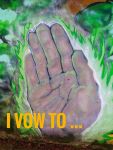
Frustrated, depressed, annoyed, and even angry at times. All because I know for certain sure that it’s God’s will that I write more – as in more often, more volume, and more quality too. And I’ve vowed to do God’s will in all things to the best of my ability.
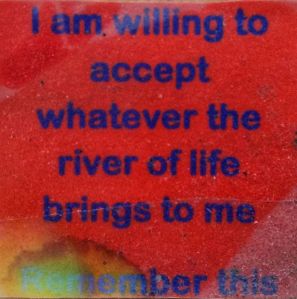
No, actually those extremely un-monklike emotional reactions are not because of this knowledge of the will of the Universe or my vow to obey; I have those unhappy emotions because of the other vow I’ve yet to mention: I have vowed to find ways to content myself with how the universe unfolds for my life, and for the world.
I’m not saying that I have promised to resign myself to ‘fate’ or ‘destiny’ or whatever one might call it. No. And it’s a big no because while what happens in the material world is working out according to the laws of nature, it’s equally true that I am in that mix: I have my part to play in the universal scheme of things, just like we all do. It’s a matter of I do my bit, and the Universe (or God) does its bit.
And then it struck me. Blew my mind is more like it. All my frustration, depression, anger, and whatever, over not writing to my own desired level, is really nothing more than a raging against God’s will. Needless to say, this reaction is really quite a distance from obedience!
Another thought on the topic of God’s will – the laws of nature and the natural order of the Universe: By obvious definition those laws and order must (obviously again) apply to all things in what we call the Cosmos or Universe.
All material things, such as bodies, as well as non-material things like minds, emotions and the like. You name it; All there is is bound by the same set of natural laws.
So, speaking for myself alone, not being able to write to my expected or desired for level is only one – and quite a minor one it has to be said – of numerous areas in my life and the world that cause me frustration and all the rest, as I struggle to to be content with the will of the Universe.
Too big a topic, or should I say too many topics to get into here. In any case, shall we set aside that not so little aside for now?
So, where were we? Right: Raging against God’s will; resisting the ways in which the natural laws of the universe are working themselves out. Sounds terrible when you see it writen down like that doesn’t it?
Anyway, it’s clear to me that the Universe , the will of God, is trying to say something to me, which sounds something like this:
‘Look you may very well want to write, you might even be desperate to get those words and ideas out of your head and onto the page, but that’s just not the way things are right now is it?
‘Of course the smooth running of the Universe involves you, and in a big big way too, but you are still just one element in what is really quite a complex, not to mention gigantic, system.’ Nature can put you in your place for sure sometimes.
‘In fact it might be,’ this spokesperson for the Universal order continued, ‘that the Universe is trying to get a none too subtle message across to you? Do you think that desperately clinging to some outcome you want or desire that strongly but can’t seem to get, is causing you pain? Of course it is. Anger, depression, all those sad and negative emotions, they are just not necessary.’
The Universe (in its manifestation as my discursive mind) can be very vocal sometimes, but I think I sort of get it. Essentially what that Universal spokesperson is saying is that the order of the Universe is working out just as it’s supposed to. Actually it can’t do otherwise. I play my part (which according to the spokesperson is bigger than I imagine), and really that’s all there is to it.
In other words, If I’m not writing, then that is precisely what is supposed to be happening (or not happening) right now. And not only that, but because I am an active participant in the way the Universe looks and behaves right now, then it’s also pretty obvious that I already know – deep down somewhere – that it’s really alright. It’s all just as it’s meant to be.
Once again speaking just for myself, I find it quite tricky finding the balance between what part I am to play, and what’s the Universe’s bit, in controlling the direction my life takes or in affecting the conditions that impact me.
Perhaps the best way, indeed it might be the only way, to have a positive impact on my own happiness, peace, contentment, and having a calm mind, is to give up any desires for things that won’t contribute to my spiritual and personal growth or the wellbeing of other beings, while at the same time acting upon without attachment to the outcomes, those desires that seem to me to be for the good of all, including Self.
Being attached – driven by compulsions or aversion – to the outcome of our desires, however, simply leads to more desires even when fulfilled. And when they are not fullfilled, there is suffering due to clinging to those compulsions.
Bottom line? I am seriously attached to my desire to write more (as well as so many other things as I alluded to earlier), that not being able to do that right now is causing a lot of suffering. Enough of that I say! Oh, that balance thing: it’s about discernment isn’t it? Okay I get it, story for another day.
PS I’m so glad I got that all out of my head and onto the page. Thanks for listening friends.
There is a sacred song by Krishna Das that I am especially fond of and find very uplifting. I’d like to share the lyrics of that song with you, as well as what it means to me. It’s called By Your Grace.
Closer than breath, you are the air Sweeter than life itself, you are here I am a wanderer, you are my peace I am a prisoner, you are release
Jai Gurudev…
I am a pilgrim, your road so long I am the singer, you are the song Held in the open sky, so far above I am the lover, you are the love
Jai Gurudev…
I follow your footsteps through the flame All that I ever need is in your name Carry your heart in mine, vast as space All that I am today is by your grace. By your Grace… I live by your grace.
And if you’d like to hear him as he sings the song (I guess you could call it a hymn?) then just go here.
Grace traditionally refers to a gift or blessing from God, or from the Divine, the Universe; whatever we call it. Generally it seems to only have a positive or even happy connotation. It’s as if grace, like love, in Bette Midler‘s The Rose, is only for the lucky and the strong.
But I think it can be looked at another way. Or rather, in a similar way but with a twist.
Krishna Das is onto something when he sings:
All that I am today is by your grace
And
All that I ever need is by your grace
He’s not saying ‘Well that was by your grace, but that other thing wasn’t. He says everything .The good, the bad and the ugly, as they say.
There’s an old expression that I like: By your leave. It means with your permission, with your power and authority you can (do) grant this or that. In this sense Das’s song is a prayer to his guru for the granting of all that has made his life what it is today, as well as giving him all that he needs and will ever need regardless of the nature of the things granted or not.
Life can be a bumpy and bruising ride, always is really. Simple way to put it, go with the flow
To me the song is not so much, or rather not just, about a prayer in order to be granted something; it is a hymn of gratitude. It’s both really. Das is expressing his gratitude to his Guru in the broadest sense of the world: the divine or the universe.
The laws of nature determine how the universe operates, how nature works itself out, which it always does, though of course, it isn’t always to our liking.
But if we are able to look at with an objective outlook, with no notion of good and bad, right and wrong, desired or not desired, then it can be seen as an elegant order that simply works. The Universe has no agenda, it simply is.
This way of looking at grace as being the natural order of the universe requires our surrender. Surrender in the sense of acceptance of the fact the the Universe unfolds exactly as it is supposed to.
This surrender, this acceptance of that natural order is not about being resigned, or fatalistic. It is the way to rid ourselves of irrational and wishful attachments to outcomes. Outcomes and results, that when they don’t work in ‘our favour’ cause us suffering.
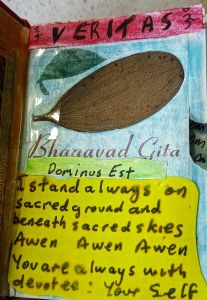
Right at the front of my Bhagavad Gita (the only book aside from the notebook I’m writing this in, that I personally own), I have recorded and inserted sayings and various words , that are important to me. Among those things is a statement I first heard many many years ago, that is common among the First Nations’ peoples of this country:
I [We] stand always on sacred ground and beneath sacred skies.
It is not an affirmation of ownership or possession. It is, instead, an affirmation of belonging to the land, to nature. It is a prayer of thanks, and it is a declaration of the knowledge of unity with the rest of the natural world, that is the hallmark and foundation for Indigenous cultures throughout the world and through time.
I’ve valued – treasured – this sentiment for a very long time – probably from even before I first heard it, which was so long ago as to be lost to memory. Perhaps I always knew it because I’ve somehow always thought this idea was a fundamental truth concerning my existence as a being living on this planet.
Well, now I have heard another statement that for me makes a perfect compliment for this one. The other day, during a lecture, my teacher mentioned that in his student days a fellow student said:
Wherever you are, you are walking through Ishwara
(Ishwara being her preferred name for the divine – for all that is.)
There is a feeling or sense of ‘belonging’, of awe and wonder when we attempt to immerse ourselves in what we term the natural world.
Once again I immediately felt the bell of Truth ringing clearly through this statement. Yes, I thought, everything is divine – including our own selves – so of course it follows that wherever we go, whatever we do, we are always in the divine.
You’ve probably read a number of times me quoting my teacher quoting his teacher:
Emphasis very much on only. Meaning of course, that it’s not that God is within us, or that we are within God; we are not surrounded by God; and it’s not that God ‘sits in our hearts’. The reality (for my teacher’s teacher) was that all that is, everywhere, everything, every thought, every word and deed, everything there is, is the divine.
Another way to describe the divine or God, that appeals to me is that Ishwara (also my own preferred name for the Divine) is in reality the natural order of the universe as dictated by the laws of nature. Those laws of nature, the rules that govern how the universe works, are also Ishwara, as are all that is manifest or in existence as a consequence of the workings of those laws.
In other words, the Divine is the sum total of what some would call the entirety of creation.***
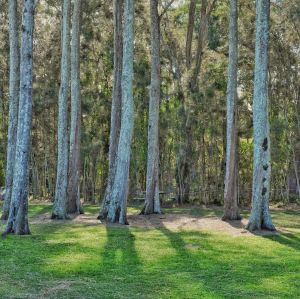
For the hermits a sacred site. Part of a grove we named The Sentinels. A place of experience of unity and oneness of creation
For me this an enormously comforting and reassuring concept. Of course, for me at least, it is also an extremely difficult one to wrap my head around. But here’s a small summary of what I think I’ve grasped so far.
Ishwara – the Divine – is all there is; everything. Also divine is the natural order of the Universe as governed by the laws of nature. These laws are neither good or bad – there is no duality. They are neutral.
You and I, as one more entity among who knows how many others, act as we do and are subject to the laws of nature, just like everything else. We can’t change or influence those laws; we can only live our lives as they unfold.
To quote from Desiderata: No doubt the Universe is unfolding as it should
And, well, then things just work out as they do. While we can’t change the laws of nature, or bend the universe to always suit our liking, it is also true to say that every action we take, every thought we think, every word we utter, even our very presence as a living being in our time and place, do indeed contribute to ‘how things work out’. Another way of saying this is to say, we do our bit, and the universe does its bit and what happens, well, happens.
For me, this is not at all as simple or as straightforward as it sounds. Naturally we see ourselves as individual selves, as entities on our own. After all, to state the obvious, we live and operate in a material (dualistic) world. So automatically we see ourselves as individuals living in, but always separate from all the other individual entities, as well as being disconnected from the world itself.
It is part of human nature (for the most part) to long for connection; there is so often a drive within us pushing us to create family, enter relationships, feel we belong to a community or communities, and for many but not all, there is the almost instinctive urge to seek connection with the rest of nature.
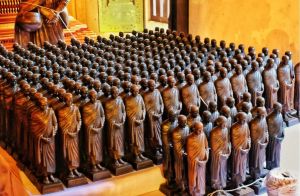
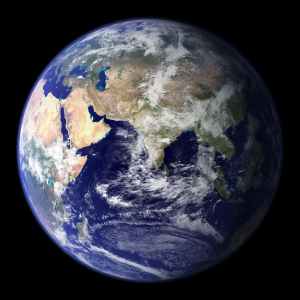
Many forms, One reality
We often think of these longings as goals to achieve, as something outside of ourselves to attain, to reach for. Consequently, so very often we tend to focus our attention outwards, towards other people, or material things.
But, instead, all these inclinations, desires and longings are simply our Self (note the capital?) endeavoring to open itself to discovering (or rediscovering?) that which already exists: our oneness with, and our non-separation, and non-difference from, The All That Is.
Peace and Love from Paul the Hermit
FOOTNOTE
***Just a few thoughts about naming, or giving labels to the Universe and its laws. Obviously it’s a personal choice for each of us what we choose to call that creation. Then, on the other hand, we don’t have to call it anything at all. For me personally it is very difficult, even near impossible to not name it. By naming the creation, I don’t think I am attributing the manifestation of the Universe to some distant entity living in some heavenly abode (as my teacher likes to say). Rather I am acknowledging the intelligence and order, beauty, complexity of all that is and how it all works, as its own reality. At the same time, I am learning to understand that I as my true nature am not separate from the rest of creation, and I feel the need to have a name towards which I am able to focus my thanks and my reverence.
These last few days I’ve been researching and thinking about an idea for a blog post. But I’ve come to realise that I am grossly underqualified to write about the topic I had in mind. Let me put it another way: I am completely and utterly unqualified in any way whatsoever to go there. In fact, after all the research, I think I’m going to disqualify myself from ever going there in writing.
However, I’m a great believer in the idea that no quest for knowledge is ever a waste of time or effort; there is always something to be learned. During my research I came across a topic I believe I am qualified to discuss, as it forms an integral and vital part of my own personal spiritual practice.
Why I’ve decided to write this post, though, is because I made a discovery that lead to an insight that I know will lead to a great progress in that practice. It’s nothing new, not really, but it was one of those occasions we’ve all experienced of ‘I knew that, but now I really know it.’ For me, it was a realisation of something that till then had been a nice cosy theory and belief.
Bhakti Yoga is that practice. It is really a key foundation, a valuable component of my spiritual life.
Wikipedia opens its entry on Bhakti Yoga (see the link just above) with a description of the practice that mirrors what I think is the traditional understanding of Bhakti Yoga:
Bhakti Yoga (also called Bhakti Marga, literally the path of Bhakti) is a spiritual path or practice within Hinduism focused on loving devotion towards any personal deity.
In the same entry there is a description of the origins and meanings of the two words, Bhakti and Yoga:
The Sanskrit word Bhakti is derived from the root bhaj, which means “divide, share, partake, participate, to belong to”. The word also means ‘attachment, devotion to, fondness for, homage, faith or love, worship, piety to something as a spiritual, religious principle or means of salvation’.
The term Yoga literally means “union, yoke”, and in this context connotes a path or practice for ‘salvation, liberation’. yoga referred to here is the ‘joining together, union’ of one’s Atman (true self) with the concept of Supreme Brahman (true reality).
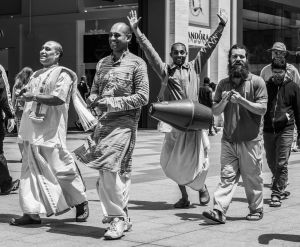
For some, dancing while chanting the names of their God, demonstrates their devotion and celebrates their union with each other and with God
In other words, those called to a religious or spiritual life, practise Bhakti Yoga whenever they pray or otherwise express devotion towards their personal conception of God, or the Divine. This particular definition seems to be saying that such a conception of the Divine, or God, is in the form of a personal deity who is a kind of representative of true reality, which the devotee is aspiring to join with.
Some Bhakta Yogis are full-time, full-on practitioners. People like contemplative nuns or monks, hermits who retire from the world into seclusion. Anyone basically whose entire life and activities are spent in devotion.
So, when I discovered all this, I became intrigued; I decided to go off on a tangent and explore the word Bhakti itself. Wikipedia has a separate entry for the word on its own:
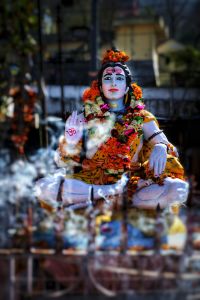
Bhakti is a term common in Indian religions which means attachment, fondness for, devotion to, trust, homage, worship, piety, faith, or love. In Indian religions, it may refer to loving devotion for a personal God
…
is often a deeply emotional devotion based on a relationship between a devotee and the object of devotion.
…
In ancient texts the term simply means participation, devotion and love for any endeavor.
May refer to devotion to a personal god? While I thought this entry doesn’t contradict our first quote above, it does seem to broaden, and deepen, the meaning of Bhakti. Expand might be the better word.
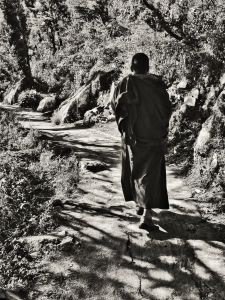
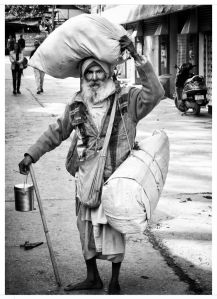
In some traditions a simple life on the road is a way to commit full time to Bhakti or devotion.
It struck me that that object of devotion might be anything. Or even everything. You see? I told you it wasn’t a new idea. It’s just that it’s resonated deeply within me now. It appears that the object of Bhakti Yoga practice doesn’t necessarily have to be a ‘personal god’.
Many many people would say ‘I like animals’ or ‘I think we should save the world’. But, while that may imply a kind of love for or at least a fondness for, I think Bhakti is something more – actually several somethings more!
For example, some people have a particular attraction to and love for, the ocean, or it might be a river they view as, if not sacred in a religious sense, then as special to them in some deep, comforting, even therapeutic way. Others have similar relationships with and feelings for trees, or even a particular tree.
Animals as either individuals or as a species or group, can have the same appeal and call to other people. Then there are those who feel strongly in their hearts you could say, that Earth itself is a sacred object, or others have a knowing that the planet is a living entity and worthy of our devotion.
Bhakti begins with love and devotion, which is about caring for, affection towards, loyalty to, emotional engagement with the object of devotion. But even more than that, there is faith in that object of devotion; faith as in trust, confidence that the love is real, that the ‘relationship’ is sound and real.
Homage and worship too are key aspects of Bhakti. The deep inner feeling we have towards a thing, person, or other being, that is beyond what we normally call ‘love’. It’s about seeing and actually realizing ‘in our hearts’ our desire to be merged or united with that thing, person, or other being.
Actually, seeing that word other just now got me thinking. I had to go back and reread our definition of Yoga up there near the beginning. It says Yoga means ‘union, yoke’. It goes on to add: yoga refers to a ‘joining together, union’.
This passage seems to be suggesting that Yoga (in our case Bhakti Yoga) is both an already existing union, and a process of joining together to achieve union. One thing I would say here is that in my practice of Bhakti (and love as a general thing to strive for and be) it’s both.
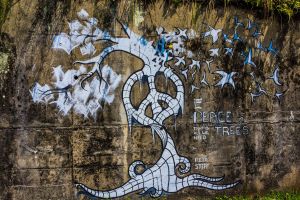
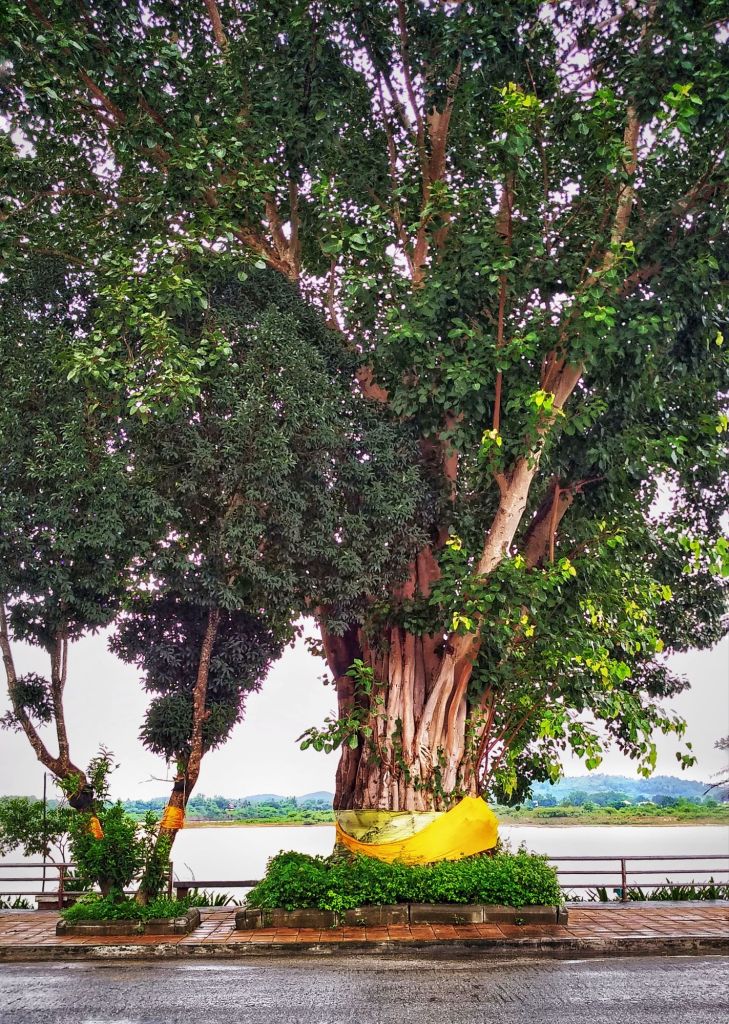
Trees are special beings for many people from a whole variiety of cultures all over the world
But, in the end, it seems to me that the process or practice, the path of Bhakti, serves to awaken us, to assist us to acknowledge, recognise, and realise in that really knowing way, our pre-existent true nature.
That true essential nature can be said to be the reality of our oneness with all things, living and non-living. And their oneness with us too of course. In fact, by putting it that way, I’m saying there is only one, or oneness. What’s that expression? One without a second.
May you be a Bhakta Yogi. Or, perhaps you already are one?
Love and peace from Paul the Hermit
Life has manifested itself as the multitudinous forms that comprise the universe. It is the one Universal Life, Power or Shakti (the laws of the universe or natural laws) that controls, guides and actuates all movements and activities in all beings, creatures and things.































 Notes from the Hermit's Cave