A Nail Biter of a Post

I’ve been biting my nails lately. A lot. At least that’s the thought that occured to me just now as I sat hunched over chewing on my right thumbnail.


Truth be told, there isn’t a time I remember when I didn’t chew my fingernails and pick at my toe nails. When I was a child my mother would coat my fingernails with an allegedly foul tasting liquid meant to curb my appetite for fingernail.

Alas, I came to like the taste so much that it had the opposite effect. Rather than put me off biting and chewing, this strategy simply served to make me want more.

Thinking back on it now, that liquid was likely some kind of poison. Not much health and safety oversight in those days. But I’m still here – and still biting my nails.

Why? It is actually a very good question. I know it’s very often looked upon as being a ‘bad habit’. Especially if youv’e left childhood behind and are still chewing. To me nail biting has been a response to anxiety, worry, fear and uncertainty.

Maybe as children we find comfort in biting nails at those times of trouble, and it doesn’t take long for the habit to become ingrained and we have turned into nail biting adults – perhaps still finding the same comfort.

Actually, it does seem to me to be a habit I would like to leave behind: nails made deformed, ragged, and unsightly from a lifetime of chewing.

‘Stop biting into yourself’, my mother would constantly remind me. ‘Stop chewing on yourself.’

Maybe it’s a self esteem thing, a means of self harm in a sense: ‘I don’t feel good about myself, so if I start eating bits of this ugly thing, I might eventually erase myself completely.’

Mmm. Perhaps. It’s a clue. Headed in the right direction, But what if it’s not an attempt to erase ‘this ugly thing’, the physical body, the thing we mistake for ‘me’ and with which we engage with the world?

What if, instead, it is some kind of misguided or unconscious way we try to dig deeper inside of ourselves? Could it be an attempt to get past the physical and right to the core of the ‘real’ me? To our ‘inner’ Self?

After all, I’ve often discovered myself happily chewing nails while thinking hard, deep in reverie, reading intently, or trying to get ‘to the root’ of something. Sound familiar?

Mind you, I’m not saying now that chewing nails is a ‘good habit.’ As a strategy to strip away the physical body in order to get to the real me deep down somewhere there inside, it hasn’t proven particularly effective.

Perhaps there will come a day when I no longer chew my nails. Maybe there will be time when my other more legitimate self enquiry practice will allow me to access that inner Self, when I will finally realise my true nature and discover who I truly am.
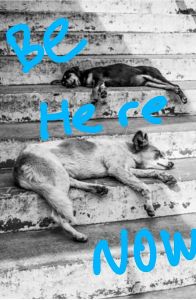
First step on this path is to remember that there is no ‘good or bad’, no ‘one day’, no ‘future time’. There’s only what is and there is only the eternal now.

The other advice to give myself as I end this post is – when trying to change a behaviour – is don’t fight against or resist the behaviour itself. Instead I need to propose viable alternatives.

I need to make new habits.

A Pause (or two) for Reflection

Physiotherapy, formal exercises as well as the myriad of day-to-day activities required to maintain a physical body, is prescribed as the way forward for people like me who have experienced a stroke.

Quite right too. Exercises and activities to build and strengthen muscle to help recover mobility; to repair broken – and develop new – brain pathways to help recover dexterity and increase both micro and macro motor functioning.

But what of psychotherapy? Not the talking, talking and more talking kind that aims to uncover past traumas, root out the cause of current psychological and emotional issues in an attempt to ‘fix’ you. While talking can be hugely helpful, (I mean it. Talking to a trusted friend, relative or professional, provides not only emotional support, but can give you new perspectives and fresh insights into even the most intractable issues).

What I’m getting at here is more about therapy for the complete psyche: the emotions and the mind and including the spirit or soul.

It is about the rebuilding of confidence – the ‘I am able’ attitude – and it is about filling the void to evolve a meaningful life.

The refuge that each day I commit to take in the divine will of the universe is where this care of the psyche -the inner me, if you like – begins.

Pause for reflection #1: If I take refuge in the will of that which is on the face of it ‘a higher power’ than my own, then why the big efforts at ‘filling the void’. Sounds like I’m resisting that divine will, or somehow refusing to acknowledge the reality of my life as it is.

Of course the ‘making of effort’ and doing our bit is absolutely vital and necessary. So I pray, I meditate, I read, I sit quietly, I create what and when I can. And I make blog notes like this and they also count.

But it doesn’t feel enough. It’s like I’m trying too hard to get to some point I’ve actually acknowledged I’m already at: in the shelter of the will of the universe.

I don’t like to say it, but I’m bored, and I think it is the constant ‘trying’ that is the big obstacle to having a more rounded and holistic approach and attitude to living here and now with life as it actually is for me at this moment.

‘Trying’ suggests the going outside of the present. Making huge straining efforts to make things other than they are. Hardly living in the moment is it?

There are long periods when I find myself sitting with ‘nothing to do’ (I cant read, write, create and pray all the time as in 24/7 can I?)

Pause for reflection #2: Why not? You may very well be asking, as indeed I am asking myself right now. Perhaps these spaces and times are the will of the Divine specifically designed for me to learn to sit in silence and to simply be.
Maybe they offer spaces and times for me to be quiet; opportunities to simply be open to receive, lessons in presence.

Not only that, perhaps they are healing times when all the fragments of my psyche can settle back into their rightful place.

So, the problem is the solution, is what I seem to be saying here. The times I am describing here and which I often face and experience with dread, are precisely gifts of grace granted to me to help me heal, and teach me to sit in silence learning to listen.

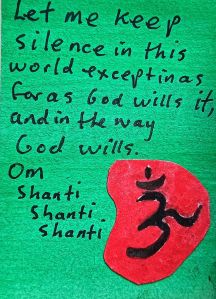
Yes, keeping silent except when and how it is the divine will of the universe might be quite nice.

Note To Self: Keep Chanting

What I want to talk about today, what I’d like to share, isn’t new. By that I mean the ideas are well known in the world – and they’ve even occured to me from time to time.

But, today, the thought seems new. Clearer and more obvious somehow. Perhaps when a little bit of knowledge finally ‘sinks in’, and is fully realised for what it is, then maybe that’s the beginnings of wisdom. Or an enlightenment. Perhaps we can say simply that a profound insight was had.

The thoughts I’m talking about concern prayer. More specifically the thoughts were prompted by my experience this morning chanting mantra – in this case, the Hare Krishna Maha Mantra, my mainstay you might call it; My main focus of devotion and meditation.

Hare Krishna Hare Krishna

Krishna Krishna Hare Hare

Hare Rama Hare Rama

Rama Rama Hare Hare

As so often happens, as I chanted today, I found myself thinking other thoughts, following mental stories invented as they went. I carried on chanting, but I was thinking other stuff at the same time.

I stopped the mental recitation of the mantra so I could focus on the emerging thoughts.
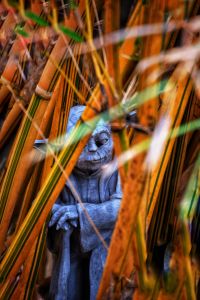
Yes, it’s true I was, chanting but it was merely at ‘lip level’ as I’ve heard it described. My intention may well have been to focus my full attention on the words of the mantra, on my means of devotion, and the repeating of God’s names. But clearly my mind had other plans as it wandered and skipped around on other paths.
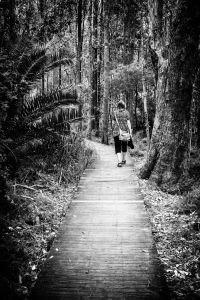
I guess it’s a problem for anyone who prays in whatever form the prayer takes; it’s very easy to be distracted my experience tells me. I’ve read that people may have chanted a mantra for decades – twenty or more years – and feel that they still can’t ‘get it’, that while the intention is there and strong, they just can’t seem to fully immerse themselves in the mantra. Nothing of it reaches the heart. It’s a lonely feeling, I know.

They, like me quite often, will feel frustrated, empty, and as if their devotion is not devotion at all but simply a mouthing of supposedly holy words. Just an exercise, another spiritual practice to simply get through. Some, give up.

That’s why I stopped chanting this morning: I felt the insight coming on. That new revelation that’s hardly new at all.

Here it is then, the insight. If I become aware that my mind is straying and the mantra is being recited rote fashion, then so long as I gently bring my attention back to the words of the mantra, then in fact, all is well.

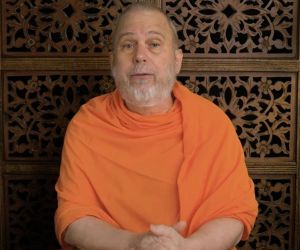
Swami Tadatmanda Resident teacher at Arsha Bodha Centre

My teacher, Swami Tadatmananda has said when speaking about meditation, that the very act of bringing the mind, our attention back to the object of meditation when we notice it’s wanderings, is in itself an integral component of the meditation itself.

So, if I’m chanting and my mind begins to jump about, and I notice those mental antics and bring my focus back to the words of the mantra, then in truth, in the reality of the thing, I’ve actually not ceased my chanting at all. There hasn’t been any interruption.

As I said, it’s not a new idea; it’s not my own idea. But it feels new, it feels as if it’s an idea meant for me.

Intention, effort, resolve, persistence (or is it perseverance?) – and love. The only other necessity is that I continue chanting, both in that moment of supposed interruption and generally in my life.

In other words, if it feels like I’m only mouthing words that aren’t reaching my heart, don’t worry.

Just keep chanting

Hare Krishna!

A Case of Mixed Feelings & Questions of Identity

Yesterday, after getting back to the Hermitage from a walk around the block, I went to take off my shoes.

Actually, I thought, while I’ve got my shoes on I may as well spray the weeds out the front and out the back in the courtyards of the Hermitage.

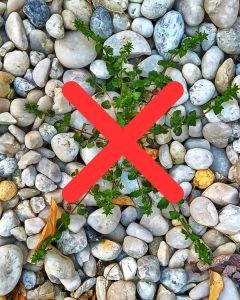
Sounds like an innocent and innocuous thing to say and do doesn’t it? Well, in fact it is a far from innocuous euphemism which in reality has me saying: I’ll apply some poison through a spray bottle to the leaves and stems of plants somebody or other has classified weeds, in order to kill them slowly over a few days.

Needless to say, this activity always evokes mixed feelings in me. Like everything else in the material life, this issue has two sides concerning the rightness and wrongness of ‘spraying the weeds’.

On the one hand, I understand that we humans are merely one more species along with so many others. We have to do what we need to do in order to feed, clothe, and shelter ourselves.

Weeds, I know, interfere with humans’ ability to grow food for example. In this context weeds are those plants that threaten to overrun, damage, or reduce supplies of ‘acceptable’ food plant species. Thinking about it now, it strikes me that the decisions about is it a weed or is it not a weed, can be pretty subjective.

On the other hand I personally do not want – nor do I think it right – to kill other living things. Of course, and clearly obvious too, it’s a bit more nuanced than a simple choice between do I? or don’t I?

I eat plants of many varieties, and in many forms, and I understand very well that they are all living beings. And, add to that, how many insects, lizards, snails, small mammals, birds, and other animals are displaced, injured, or killed in the planting, growing, harvesting, packaging, transport, and sale of the fruits, vegetables, nuts and so on that I eat?

Like I said earlier, the human species, like all others, must do what it has to to survive. Obviously, again being human, we have minds capable of discernment and decision making that can help us minimise the harm we cause as we pursue survival.

For me, a major component of that harm minimization takes the form of not eating the flesh of animals, as well as my choice to not utilise items made from animals.

Even with this there is a problem: Who’s to say what life forms are acceptable as food, and which aren’t? Humans have invented the scary idea of the Food Chain. We simply decide who is higher and who is lower on that chain and eat accordingly.

Needless to say, humans have appointed themselves to be the highest species on that ‘food chain’. Meaning of course, anything else is lower and hence okay as food.

Anyway, I digress a bit. Getting away from food questions, to look specifically once again at the ‘weeds’ to be sprayed in the Hermitage garden.

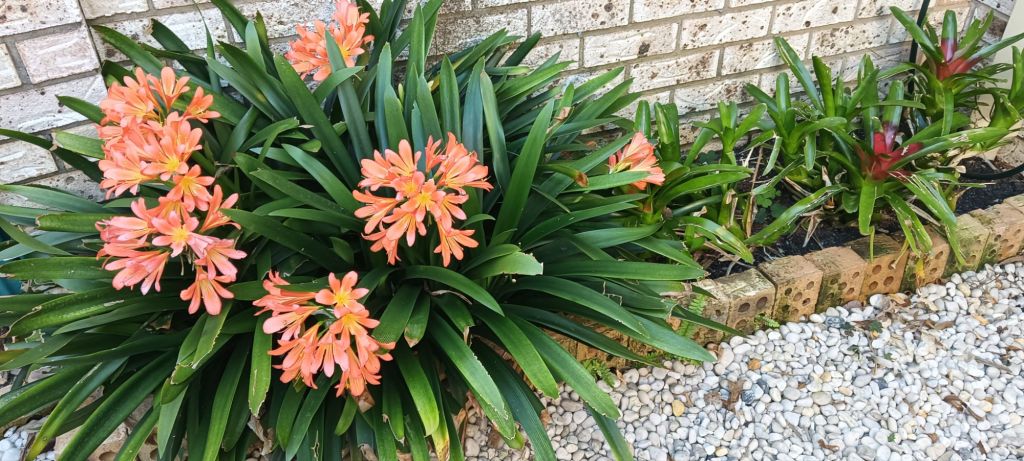
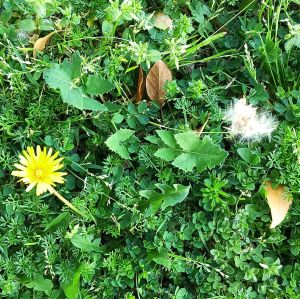
I often ask myself what is it that makes one plant with big orange flowers acceptable as a garden plant? Of course it’s beautiful, ornamental, and a pleasure to have nearby, but what else?

But, what is it that makes another plant, with its delicacy and little flower that are equally beautiful and as pleasing to be around in my view, not acceptable as a garden plant? What makes this one a weed, while that first one we met in the previous paragraph not?

Well, it seems to me that the first answer has to do with necessity dictated by circumstances or conditions beyond one’s control.

As I’ve said, when it comes to growing food, it’s necessary to control plants that threaten that growth. Discernment comes in when we decide how to eliminate that threat with the least harm. One aspect of discernment is actually related to that subjectivity I mentioned before: one person’s weed, is another person’s delicious and nutritious food – and vice versa.

At the Hermitage we don’t grow our own food, so we don’t face that dilemma. Here, at the Hermitage, it is a condition of living here that we control the weeds. And the plants classed as weeds are well known to us due to this condition being a routine clause in most rental contracts.

Besides, it seems that another major factor that makes a plant a weed, is where it grows, how hard it is to keep in bounds and behave.

I guess it’s not only a requirement, that we control the weeds. It’s an issue for our discernment as we try to find ways to share this little patch of the world with the other life forms who also live in this space with us.

It is a wise discernment that tells us to follow the rules of the contract. And our discernment also shows us that, in this human built environment we live in, we can’t allow the space to be taken over by plants that would then provide a safe harbour for insects, rodents, and other creatures that might or would threaten our health and wellbeing and that of our neighbours.

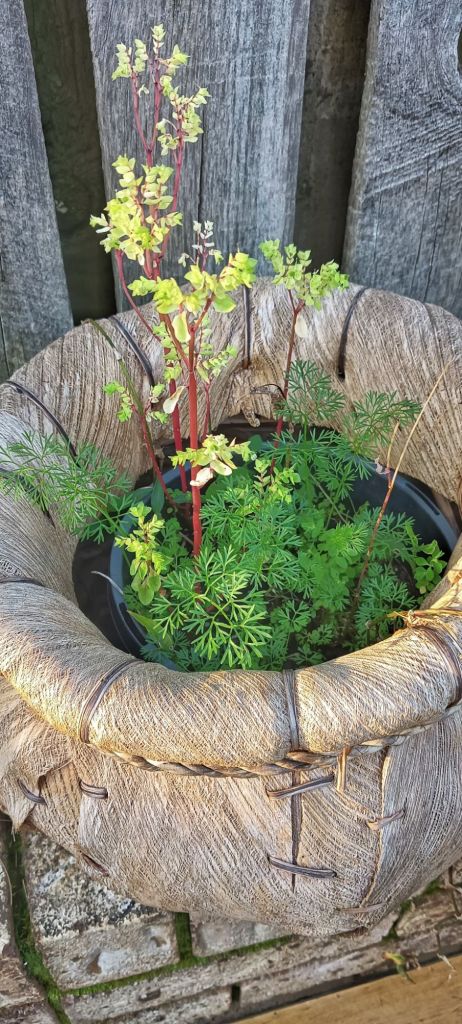
In a pot rescued from a roadside pile of domestic discards, a variety of plants – weeds also rescued over a few months of ‘spraying the weeds’ as a kind of offering to and celebration of life – grow in a group.

It’s a pretty group, I think, of delicate, yet sturdy little lifeforms.

Are they still weeds? Now that I’ve placed them to grow in an ‘approved’ space? Now that they are confined by bounds within which I can control them?

Confined? Controlled? Perhaps for now, but not for long. It’s a comforting thought, realising they all have allies: the sun, the rain – and the wind.

At the same time, we consider all life forms, including humans, to be manifestations of the Divine. All life is one, as I assert so often. Speaking personally, I am sad that any lifeform that is harmed because of my actions and my material needs.

Discernment, compassion, love and mindful action. As we seek to coexist in peace with those beings we share our world and lives with, these things are all required. Empathy too: We are the weeds, the weeds are us.

And the inner editor is insisting I finish by reminding myself  that life, the universe, and all that happens, is unfolding exactly as it’s meant to; all we can do is play our part in that unfolding.

Taking it Slowly, Taking it Mindfully

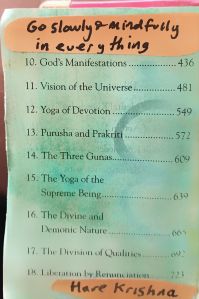
A small irony revealed itself to me just now as I prayed my way through the prayers inserted in the front of my Bhagavad Gita.

I’d completed one prayer and turned the page to the next. Then, without a pause or thought, I quickly turned the page again. I stopped, thought better of it, and turned back to attend to the prayer I’d skipped over.

Now, here’s the irony: The prayer on the first side of that carelessly and mindlessly leafed past page read simply:

Go slowly and mindfully in everything.

Well, that’s not the ironey itself. But, given that this was the page I had simply passed over without a thought, with no pause, the words written there obviously were a lesson for me.

A message to contemplate, to actually stop and pause with, mull over, meditate on, and perhaps make resolutions over. Advice to me to stop, to slow down.

Couldn’t be clearer really.

There’s no telling why I skimmed past that page, that prayer, without a pause. Could be a simple case of absent-mindedness, or a rush to see what was on the next page; a grass is greener type of thing.

Why I was rushing through the pages isn’t the point. What is to the point is here I am, doing morning prayers, praying some, then skipping others. The other point is that in this instance, for some reason I stopped, went back, and prayed the skipped prayers.

So, moving to the resolution.

It’s extraordinary to me when that kind of thing happens. (It does happen quite a lot, but unfortunately I only notice it occasionally) We will have an intuition, or receive a message from ourself that helps to us get back on track when we mess up.

In any case, it’s obvious that I’ve found what I might call the prayer of the day, the mission statement, so to speak, informing whatever activities I undertake today.

Slow and mindful in everything I do, say, and think. For now, for the present, that will the guide on the path of today that I will follow. Keeping in mind the adage that practise makes perfect, for when I falter.

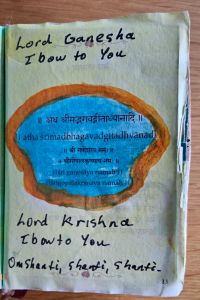
Oh, another irony wrapped up with this one. The prayer on the facing page was also skipped, and in itself sheds another light on the message from that first one. That second prayer actually puts forward one, important, way in which I can actually set about achieving  that first one:

In other words: place more focus on, pay more attention to, the Divine in whatever form, and by whatever name, I encounter it today.

Works both ways I think: Making the effort to go slowly, to be mindful, puts us in the present moment. And, the present moment is the only place we’re going to be able to become aware of the Divine.

Then, as we become aware of the presence of the Divine, we are right where we need to be, when we need to be there in order to actually slow down and be more mindful.

PS These notes were made a few hours ago. Since then, I have on the whole practised being slow and mindful. Not perfectly, mind you, but then as I say, practise makes perfect. Even now as I type this – very attentively – my mind wanders, so there is a way to go for me. The day is not over yet!

Self Enquiry: Listen to Your Self

This last little while I’ve been going through some serious contemplation, some deep questioning, on how to be ‘more of a monk’. Things like how to pray more deeply, and often; how to have a more focused and concentrated devotional practice; how to be a nicer person. Things like that.

Actually, that’s not exactly right is it? These are questions, enquiries, that for a number of years (is all my life too big a stretch?) habe occupied me. I’ve consistently been making enquiries, addressing questions, to Self – as well as to God or the Divine.

Still, like all things in life, self-enquiry goes through more intense, then less intense phases or periods. Let’s just say that lately I’ve been immersed – sometimes to the point of distraction – in one of those more intense periods.

(note from internal editor: Do I have to remind you once again to get on with the story you are here to tell?)

Okay then; let me see. Oh yes, right. Last night I was looking forward to beginning a new book. I’d read the introduction and thought that it was going to be just my cup of tea as it were, that it was something I would enjoy and learn from.

Anyway, as I opened the book on my tablet, I was suddenly stopped by a sort of wordless warning. The sense I had was that this book would indeed be a little piece of the answers I’ve been seeking.

Not so much in the contents I felt, it was more about approaching the book with more openness, less skepticism, more generosity of spirit and mental attitude. And the idea seemed to also include taking these qualities with me later as I thought about what I had read (or was about to read I should say).

You see, being more open, less skeptical, and more generous, come under the umbrella of being nicer. Still given the subject I was about to read about, I was a bit surprised by this ‘warning’.

As it turned out, I finished the entire book, so enthralled was I by the contents. The only things that tested my resolve to ‘be nicer’ was a number of occasions when the author’s worldview and interpretation of events, stretched my patience.

But, I managed. I didn’t become inpatient or outraged or irritable . When threatened by such responses I simply reminded myself that I was reading about another person, and I didn’t have to have an opinion one way or the other about what they believed or how they lived. Not only do I not have to have an opinion, I’m not sure I really have the right to an opinion about someone else’s life at all.

Besides, haven’t I just got through describing how I am myself deeply engaged in a process of self-enquiry? And wouldn’t such a process involve exposing myself to ideas, worldviews, kinds of information, new to me or not in alignment with my own beliefs? Surely bursts of impatience, indignance, judgement, and the like, would close me off in my search for answers?

Anyway, as I said I was so enthralled by the book – my reading informed by a little more generosity, a little less judgement, a renewed attempt at openness – that I finished the book in that one sitting.

Mind you it was only one hundred and something pages long. Still, for me, it was pretty good going.

PS Speed reading wasn’t – isn’t, nor ever will be – a part of my ongoing self-enquiry into the depths of my monkhood. Perhaps I need to add something like ‘Transcend the ego’ to my list.

Foster Your True Self: It’s A Big Deal

Today I finished watching  a beautiful and extremely fascinating documentary.  It was about life in a Trappist monastery as well as a fascinating history of that movement. I was struck by something one of the monks said.

He was referring to what he and his fellow monks are actually doing with their lives in the monastery. He said their lifestyle was helping them to:

‘foster who we truly are before God.’

Hearing this, I had to pause the video, make notes, and do some thinking. What had actually struck me, my first thought on pausing, was that this is exactly what I’m doing as a hermit monk dwelling in our Hermitage. Exactly what I’m doing. Well, at least it’s what I’m aspiring to.

There are two aspects or primary intentions that inform the life I try to live as a hermit and monk that are in fact integral one to the other; they merge actually to become one primary focus of my life.

I practice an ever evolving and I hope intensifying devotion to the divine, with the upliftment of the world and all beings as its central theme.

The other, integral focus, is an equally ever evolving and intensifying quest for self-knowledge, for the answer to the question, who am I?

In other words, I am attempting to foster who I truly am before God. Foster as in ‘encourage the development of …’ (as one definition puts it).

In this case, the development is the growth of the knowledge of my true nature – who I am above and beyond this physical (and mental) creature running around madly trying to figure things out.

In my life there is much effort devoted to the cultivation – a synonym for foster – of that knowledge: meditation, prayer, contemplation, study, just sitting, being still. Did I mention the aspirational nature of all this? It’s an ongoing project to say the least.

Speaking of aspirational: Two more synonyms for foster that I like are nurture and support. Both are even more in that aspirational category; at least it feels like that sometimes. Actually, maybe there’s a more accurate way for me to be putting this.

After all, as I think about it now, even I would agree that my whole lifestyle, my entire way of being in the world supports and nurtures me.

Except for me, myself, and I, that is: Lest the inner grammarian sends me mad in a search for antonyms for foster, let me just say that I am overly skilled in the self-critical and self-destructive departments. My ability to put myself down and to tear myself apart is legendary.

Anyway, with overwhelming nurture and support coming from my partner hermit all the time reinforcing my sense of Self, all I have to do is work on ridding myself of these self-destrucitive and self-critical tendencies.

So, the conditions for the banishment of self-loathing are there; all that’s missing is discipline on my own part in seeing the Divine in myself as I profess to be trying to see it in everyone else.

I need to be rid of the forgetfulness  that blinds me to the Truth that is actually very plain to see.

Speaking of the Divine, the ‘before God’ is the vital element for me. God is all there is, so it is always before God that I act, whether in a positive or in a not so great manner.

The best prescription is for me to remember. To remember that God is everywhere and everything (did I say that already?). To remember that me, myself, and I, are also included in that everything and everywhere.

I think that once I do remember these truths even for the odd moment now and again, then the real fostering of who I truly am will have begun.

The Hermits Visit a Coffee Shop

Namaste and Greetings

Welcome to another poetic sharing post. There have been a few lately haven’t there? I had thought that once I had the new page Poems of Devotion up and running that I would only feature one every now and again in its own post.

However the one I feel inclined to share with you today is slightly different. Well, not really: it’s still a devotional piece, but for some reason feels a little other than that.

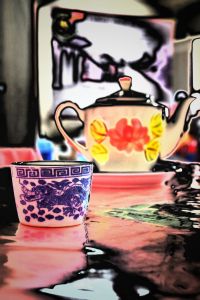
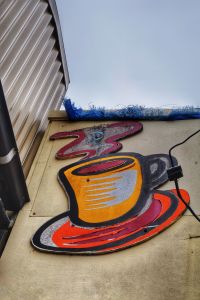
This hermit’s choice: the number 1 coffee shops in the Hermitage neighbourhood

For a start, it’s set in a café and features the thoughts of a hermit monk (me), and is about what’s going on in that space at that moment. As well as what’s in his mind and heart. Oh yes, almost forgot: the action takes place on Election Day.

So, what is it that makes me feel this poem is ‘still devotional but slightly other’? Well, aside from the setting, timing, and so on I just described, I sense that, in its words, in its composition, the hermit has sought to record (through the poem) that moment in the café as the reaching out to all those fellow beings sharing the space, to recognise, and to celebrate the divine in them all.

May that intention shine through to you too, dear reader

THE HERMITS HAVE COFFEE ON ELECTION DAY

I feel like I’m sitting
in a Hopper painting.
Just off the village green
at a coffee shop, in the Toukley Mall.

There are people; aren’t there always?
Coming and going.
This one catching gossip; that one seeking connection;
One or two heads down, backs bent
over newspapers assimilating myriad tales of woe.
It’s election day.

Of little interest to the hermits,
out of the hermitage for coffee.
A treat that comes at a cost.

Voices – of people and of headlines –
speak, some even shout,
of worldly things. To us not real.

Leaves me hollow.
That’s the vibe,
the feeling inside
– And that’s not real either.

Don’t Stick Your Feet Out

Just now (as in earlier today) I had some perfectly natural, normal, and expected thoughts about my prayer life. If I’m to be honest though, and perhaps a tad overly tough on myself, the thoughts I had felt slightly ridiculous given my professed commitment to praying constantly, and my supposed understanding of the meaning and function of prayer.  In other words, there I was again: putting some kind of unrealistic expectations on myself – again!

Anyway, enough of that. To sum up those thoughts: I was thinking they – my prayers – aren’t working. Nothing is happening. And I was asking myself questions: What’s been achieved? What’s coming from all the effort? Where are the results?

And then, exactly at the moment I was writing down those thoughts and questions, I lifted my eyes from my notebook to see my partner-hermit approaching.

‘It’s my blessing at the moment,’ she said walking by my chair.

Why did she say that?

Because, right there before my eyes was evidence that none of my ridiculous thoughts and questions on my prayer life, had any meaning whatsoever. There was the answer, walking past me.

As I said, right there before my eyes.

A Little Bit of Self Knowledge Hard Won

You know, for all my prayers; for all my mental discipline – efforts at mental discipline – for all my meditations, chanting, and other practices, I still just talk way too much for my liking, and often it feels like it’s only talking for the sake of talking.

I still just open my mouth and let come out any old thing that keeps the noise going. Oh, it’s worse than that: sometimes when I talk it’s rambling and waffling that I cleverly (or not so cleverly) disguise as intelligent, rational, and based logically on knowledge that I either have or haven’t got. Either way, I somehow seem to think I’m offering words of well thought out wisdom.

Whereas, as I said, the noise I make is so often rambling, contradictory , ill-informed, thoughtless waffle.

Enough! Blimey, that’s enough. Talk about opening a post on a calm, relaxed, optimistic, and compassionate note.

Here’s the thing: I want to devote my entire life to devotion and prayer. And that requires at least some silence. Yet, instead, I merely talk about the joys of silence, about the joys of full-on devotion to the divine, and as well I occupy so much time and energy to just voicing random thoughts that come and go, go and come, without rhyme, without reason.

Okay, here’s the second thing: I long with my deepest longing to be silent – to not simply stop talking, though that would be an excellent beginning. No, I want to be quiet; I want my vocal chords to have a break and let my true voice speak through my life, through this blog, my photographs and in whatever way I am lead.

So, what to do? Well, here’s the third thing, thing number three: all I need to do in order to both stop talking so much and be silent is to just sit. Sit and do nothing. There is no thing that I can do that will magically turn me into an oasis of silence and peaceful calm.

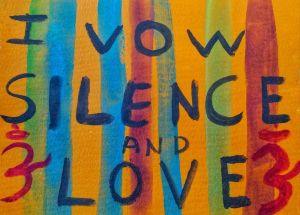
Sometime in the dim distant path I read someone paraphrasing The fouth Noble Truth in two words, Just sit. Buddha did indeed know what he was talking about. And I do get the irony: when I talk, I need to say something that helps, not just make noise and try to avoid silence.

Just sit