Pray & Work

One of the topics I like to explore on YouTube (my ‘break’ is over and I don’t think I’m scrolling quite do much as I was before I took that break) is the lives of hermits; the monastic life as lived by nuns, monks and priests of any and all religious traditions or none.

That’s more than one topic isn’t it? Well, you get the drift. In any case, last night I rediscovered a nice documentary on a monastery in the United States I had already seen but decided to watch it again. Here’s the link.
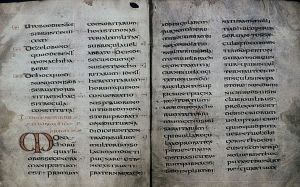
Courtesy Wikipedia

A monk on the doco talks about The Rule of Benedict. Just as the name suggests this is the rule (of life) written by Saint Benedict of Nursia in the 6th Century to help guide monks and nuns living in monastic communities in all aspects of a shared life dedcated to God.

Benedict had a good insight into such a life (and human nature) and the ‘Rule” is in fact a text containg many instructions and a great deal of advice on monastic life centred around what he termed Ora et Labora  –  the very essence of the contemplative life in his view.

It’s Latin of course and translates to Pray and Work and is followed by many monasteries in the Christian traditon. Of course, monastic communities in most traditions have similar sts of guidelines or ‘Rules’.
The primary focus and function of monastics is to pray. That’s what they are there for. But Benidict figured that some kind of balance was needed; not only so the monasteries could support themselves but so monks and nuns actually got some physical activity. Hence the equal emphasis on work.

So, the two ideals work together in a way supports a balanced, ordered, harmonious and peaceful community (in theory). Pray and work are intertwined. Even the Latin for pray, Ora is embedded in Labora, the word for work.

We don’t do rules here at the hermitage, not into them at all actually, but I do like this Pray and Work idea very much. It is, after all, what we do too, and why we are here. In fact, I try to approach everything I do as a prayer. It doesn’t always work in the sense that, while prayer and work may be one and the same, I tend to sometimes forget that fact. So having this pray and work principle as a central tenet of my life reminds me to remember that I am actually doing both.

I pray – quite a lot actually. Chanting mantra, reciting set prayers I’ve gathered into my practice over the years or that I’ve written myself. Then there is the prayer that comes from within silence, the contemplation of the texts I study, the things I see, hear, or talk about.
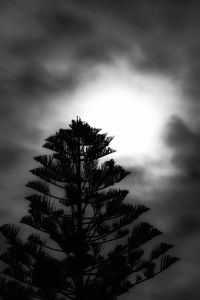
There is the cultivation of ‘good thoughts’ and feelings of compassion. Just sitting, being still and quiet with an open mind. Simply stopping to look at a flower, a tree or another person and sense the beauty. All these and more are prayer.

Which leads us to the ‘Work’ side of the equation. What exactly is my work? First thing to say is, I am a hermit and a monk and my primary job is to pray. If  It sounds like a closed system, that’s because it is.

My work includes my studies and practices which are aimed at cultivating those good thoughts and open mind we talked about, and that attempt to ‘create good vibes in the world’. (Which, as I’ve written many times, is best achieved when I am secluded at least a little from the busyness of the world.

Lest you imagine that I am missing out on the physical activity seen by Benedict as essential to balance, let me assure you I do get quite a lot of exercise – more all the time as I recover.  It’s my yoga practice, an integral aspect of my prayer and work life.
This blog is a part of my work. Though, to be honest, publishing this blog and engaging with our little community, gives me so much pleasure, joy, and ‘good vibes’, that I really can’t call it ‘work’. Writing and posting does me good!

When it comes to work, it’s not so much about what you do (we gotta do what we gotta do), but more about how you approach that work.

What transforms work into prayer is doing it for the right reasons. But who’s to say what are ‘right reasons’? Well that’s easy: you. Or me. Or any other individual deciding for themselves and for themselves alone.

As I said my work – and prayer – is to try to create good vibes in the world. I don’t always succeed but I think it really is the effort and intention that is most important. And not being attached to the outcomes. As in: ‘Aren’t I so holy and virtuous praying for the world all the time’. Hardly.

No. Create the vibe, let it go, and let it do its thing.
A Pause (or two) for Reflection

Physiotherapy, formal exercises as well as the myriad of day-to-day activities required to maintain a physical body, is prescribed as the way forward for people like me who have experienced a stroke.

Quite right too. Exercises and activities to build and strengthen muscle to help recover mobility; to repair broken – and develop new – brain pathways to help recover dexterity and increase both micro and macro motor functioning.

But what of psychotherapy? Not the talking, talking and more talking kind that aims to uncover past traumas, root out the cause of current psychological and emotional issues in an attempt to ‘fix’ you. While talking can be hugely helpful, (I mean it. Talking to a trusted friend, relative or professional, provides not only emotional support, but can give you new perspectives and fresh insights into even the most intractable issues).

What I’m getting at here is more about therapy for the complete psyche: the emotions and the mind and including the spirit or soul.

It is about the rebuilding of confidence – the ‘I am able’ attitude – and it is about filling the void to evolve a meaningful life.

The refuge that each day I commit to take in the divine will of the universe is where this care of the psyche -the inner me, if you like – begins.

Pause for reflection #1: If I take refuge in the will of that which is on the face of it ‘a higher power’ than my own, then why the big efforts at ‘filling the void’. Sounds like I’m resisting that divine will, or somehow refusing to acknowledge the reality of my life as it is.

Of course the ‘making of effort’ and doing our bit is absolutely vital and necessary. So I pray, I meditate, I read, I sit quietly, I create what and when I can. And I make blog notes like this and they also count.

But it doesn’t feel enough. It’s like I’m trying too hard to get to some point I’ve actually acknowledged I’m already at: in the shelter of the will of the universe.

I don’t like to say it, but I’m bored, and I think it is the constant ‘trying’ that is the big obstacle to having a more rounded and holistic approach and attitude to living here and now with life as it actually is for me at this moment.

‘Trying’ suggests the going outside of the present. Making huge straining efforts to make things other than they are. Hardly living in the moment is it?

There are long periods when I find myself sitting with ‘nothing to do’ (I cant read, write, create and pray all the time as in 24/7 can I?)

Pause for reflection #2: Why not? You may very well be asking, as indeed I am asking myself right now. Perhaps these spaces and times are the will of the Divine specifically designed for me to learn to sit in silence and to simply be.
Maybe they offer spaces and times for me to be quiet; opportunities to simply be open to receive, lessons in presence.

Not only that, perhaps they are healing times when all the fragments of my psyche can settle back into their rightful place.

So, the problem is the solution, is what I seem to be saying here. The times I am describing here and which I often face and experience with dread, are precisely gifts of grace granted to me to help me heal, and teach me to sit in silence learning to listen.

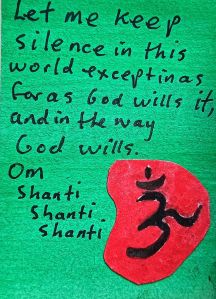
Yes, keeping silent except when and how it is the divine will of the universe might be quite nice.

Flee, Be Silent, Pray Always: A Revisit

Courtesy Wikipedia

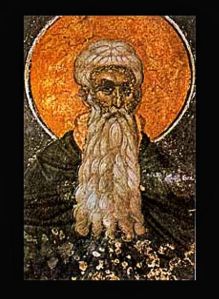
Recently I came across the story of Abba Arsenius – one of the early Christian desert fathers. I’d originally written about him a year ago in what became a short series of posts.

Coming across him and his story again prompted me to revisit those posts – the first of which you can read here – and I reread them again, though as if for the first time. Anyway, here’s a short recap before we move on.

Arsenius was a high ranking official for the Roman Empire, working for many years as a tutor to the sons of the Emperor.

Over time he grew tired of the glamour lifestyle, the politics, corruption and court intrigues, and looked for a way to free himself from the whole material trap he was in.

So he prayed, ceaselessly, the story goes. He prayed for salvation, for freedom.

And, in time the answer, according to the story came in just a few words:

Flee, be silent, and pray always.

And he did. Flee I mean. He headed for the Egyptian deserts which is where he found that silence, and the space, peace, and calm to fulfil  his desire to be praying constantly. And, with some comings and goings, ups and downs, he stayed for the rest of his life.

Now, while Arsenius and his story are fascinating (in fact now I’ve rediscovered him, I’m going to look around  for a biography or something  so I can learn more), what I want to think about here is something I wrote in the first of those previous posts, and how it ties in with our decision (almost a year ago now) to stay in this one place for the present.

For these Hermit Pilgrims ‘fleeing from the world’  has meant a nomadic lifestyle, few possessions and material needs, a hermit life where our engagement or entanglement with the world is kept to a minimum, and in which we feel less of a pressure to conform, to ‘be shaped’ by the world around us.

The notion of staying in this one place – as fully now and in the present as we can be – is actually  paradoxically a fleeing of its own kind. The world of Samsara, the material world ‘out there’ continues to become less and less appealing to these Hermit Pilgrims.

Alongside this growing detachment to the world (as well as the loss of desire to move about in the world geographically speaking), is the deepening realisation that the real and true pilgrimage is within, through and to our own mind and heart.

Complimenting all this, is the growing contentment we are experiencing in this actual place, this hermitage of ours that we are creating on a daily basis. More and more it feels to be the exact place in which that inner pilgrimage is to continue.

Does this mean we have given up on that ‘nomadic lifestyle’? No, not at all. Or, more accurately, we are not niether giving up or not giving up. The present is all there is and we don’t – can’t – know anything beyond that. As the saying goes, What can we say about tomorrow?

We are here, and it is now.

with love
Paul the Hermit