Even a Leaf: Another Chapter

Namaste Friends

A little note to begin with

Last January I published a post inspired by a favourite verse from the Bhagavad Gita:

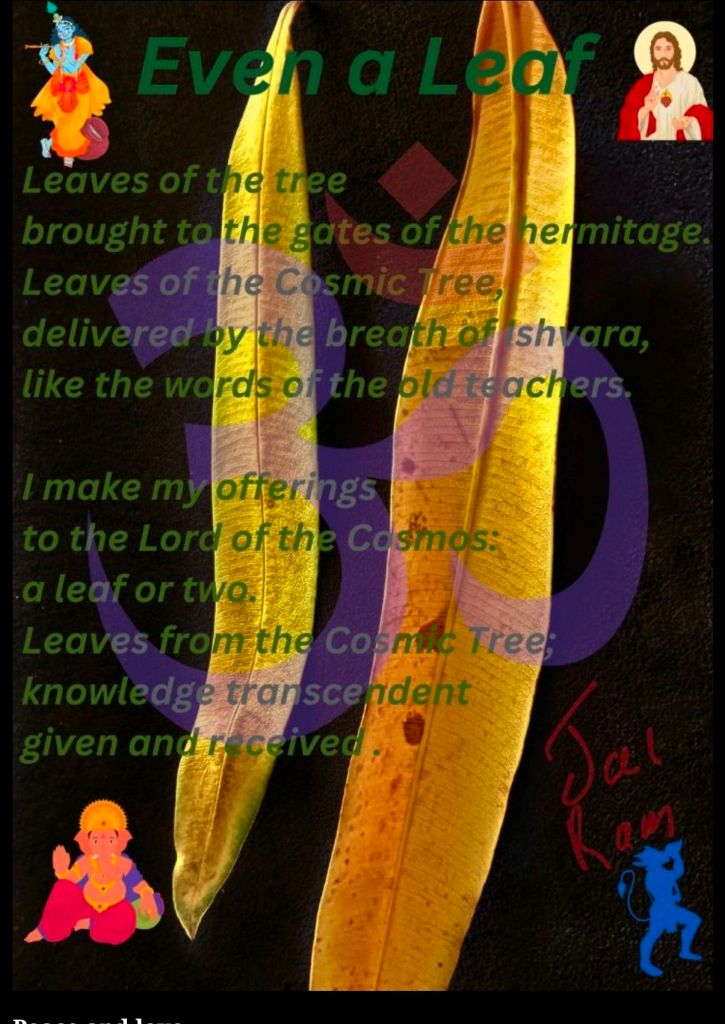
If anyone with love and devotion offers me a leaf, a flower, a fruit, or water, I will accept it.                                                        Bhagavad Gita 9:26

If you like you can read the post here, but I will be including the poem that made up that post in this one which shares the same topic,

Today’s post was in fact written during my more recent hospital stay as a record of a very nice encounter with my Bhagavad Gita and a nurse. I’ll only make changes to tidy it up a bit and to make it clearer for you, the reader.

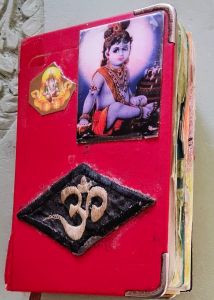
A ministering angel, in the guise of a nurse happened to notice my beloved little Bhagavad Gita sitting on my bed-side cupboard as she went about her healing duties. Picking it up, pausing to gaze at the image of the Lord on the cover, she then exclaimed excitedly:

‘You love Krishna!’ She was already opening and closing my book at random, with a rapt expression on her face.

‘I do love Krishna,’ I replied, happy to connect with a fellow devotee.

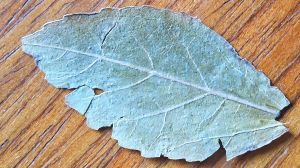
‘O my God,’ she cried even more excitedly, ‘you even have leaf. She held up one of the small leaves I’d slipped between the pages. It was as if she was making of it an offering, just as I had when first putting it there, in remembrance of that verse I love.

I think there are at least half a dozen such leaves offered at various times over the years.

Gently, reverently, she put the leaf back in its pages, closed the book carefully, and replaced it in the exact same position on the bed-side table.

‘I am very glad you love Krishna,’ she smiled as she tuned to leave and headed to serve the next one in need of healing.

love and peace

Paul the Hermit

PS

The poem from last January’s post:

Pray & Work

One of the topics I like to explore on YouTube (my ‘break’ is over and I don’t think I’m scrolling quite do much as I was before I took that break) is the lives of hermits; the monastic life as lived by nuns, monks and priests of any and all religious traditions or none.

That’s more than one topic isn’t it? Well, you get the drift. In any case, last night I rediscovered a nice documentary on a monastery in the United States I had already seen but decided to watch it again. Here’s the link.

Courtesy Wikipedia

A monk on the doco talks about The Rule of Benedict. Just as the name suggests this is the rule (of life) written by Saint Benedict of Nursia in the 6th Century to help guide monks and nuns living in monastic communities in all aspects of a shared life dedcated to God.

Benedict had a good insight into such a life (and human nature) and the ‘Rule” is in fact a text containg many instructions and a great deal of advice on monastic life centred around what he termed Ora et Labora  –  the very essence of the contemplative life in his view.

It’s Latin of course and translates to Pray and Work and is followed by many monasteries in the Christian traditon. Of course, monastic communities in most traditions have similar sts of guidelines or ‘Rules’.

The primary focus and function of monastics is to pray. That’s what they are there for. But Benidict figured that some kind of balance was needed; not only so the monasteries could support themselves but so monks and nuns actually got some physical activity. Hence the equal emphasis on work.

So, the two ideals work together in a way supports a balanced, ordered, harmonious and peaceful community (in theory). Pray and work are intertwined. Even the Latin for pray, Ora is embedded in Labora, the word for work.

We don’t do rules here at the hermitage, not into them at all actually, but I do like this Pray and Work idea very much. It is, after all, what we do too, and why we are here. In fact, I try to approach everything I do as a prayer. It doesn’t always work in the sense that, while prayer and work may be one and the same, I tend to sometimes forget that fact. So having this pray and work principle as a central tenet of my life reminds me to remember that I am actually doing both.

I pray – quite a lot actually. Chanting mantra, reciting set prayers I’ve gathered into my practice over the years or that I’ve written myself. Then there is the prayer that comes from within silence, the contemplation of the texts I study, the things I see, hear, or talk about.

There is the cultivation of ‘good thoughts’ and feelings of compassion. Just sitting, being still and quiet with an open mind. Simply stopping to look at a flower, a tree or another person and sense the beauty. All these and more are prayer.

Which leads us to the ‘Work’ side of the equation. What exactly is my work? First thing to say is, I am a hermit and a monk and my primary job is to pray. If  It sounds like a closed system, that’s because it is.

My work includes my studies and practices which are aimed at cultivating those good thoughts and open mind we talked about, and that attempt to ‘create good vibes in the world’. (Which, as I’ve written many times, is best achieved when I am secluded at least a little from the busyness of the world.

Lest you imagine that I am missing out on the physical activity seen by Benedict as essential to balance, let me assure you I do get quite a lot of exercise – more all the time as I recover.  It’s my yoga practice, an integral aspect of my prayer and work life.

This blog is a part of my work. Though, to be honest, publishing this blog and engaging with our little community, gives me so much pleasure, joy, and ‘good vibes’, that I really can’t call it ‘work’. Writing and posting does me good!

When it comes to work, it’s not so much about what you do (we gotta do what we gotta do), but more about how you approach that work.

What transforms work into prayer is doing it for the right reasons. But who’s to say what are ‘right reasons’? Well that’s easy: you. Or me. Or any other individual deciding for themselves and for themselves alone.

As I said my work – and prayer – is to try to create good vibes in the world. I don’t always succeed but I think it really is the effort and intention that is most important. And not being attached to the outcomes. As in: ‘Aren’t I so holy and virtuous praying for the world all the time’. Hardly.

No. Create the vibe, let it go, and let it do its thing.

Everything & Everywhere

Namaste friends

In the High Holy Lands Where Magic Sometimes Happens

For the last while (long while really. Actually many years), I have dreamed a few times a month, sometimes more, that I am in, about to arrive in, or just about to leave Rishikesh in India.

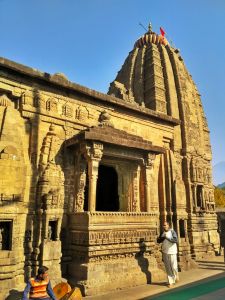
Rishikesh is a small town straddling the Ganges River, and nestled in the foothills of the Himalayas. For millennia it has been considered a sacred place. Its history replete with stories of divine beings, ancient sages and saints, not to mention its status as a major pilgrimage destination for at least a thousand years and the town becoming ever more popular in recent years for pilgrims and ordinary pleasure seeking tourists from around the world.

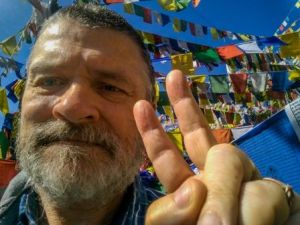
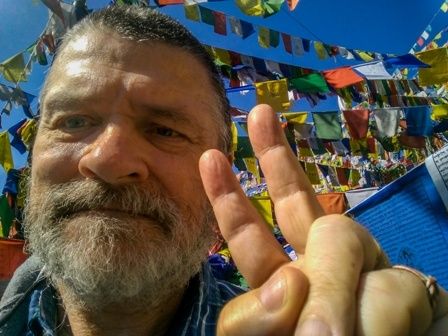
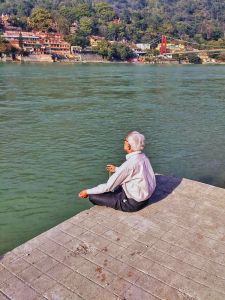
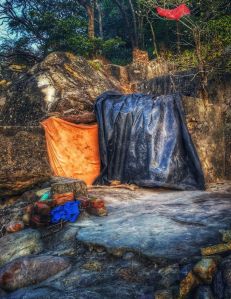
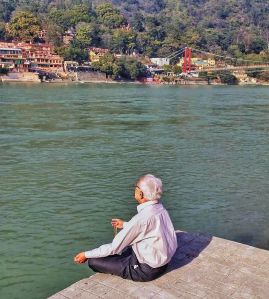
This isn’t me but it could be

I last visited Rishikesh in 2016-17 (having previously spent time there in 2006) when my partner hermit and I stayed for several months. I associate that stay with the strengthening and deepening of my spiritual practice as well as the gaining of a kind of clarity in terms of my outlook on the world particularly on the spiritual path that had been calling to me – as it does still.

Putting aside health issues that hinder our mobility, I think it’s fair to say that my attachment to Rishikesh and my longing to return have more or less faded away almost completely over recent years.

Rishikesh has always been a busy, crowded place with the associated traffic, noise, pollution, and inflated prices. Rampant commercialism has long threatened the town’s ‘spiritual ‘ or ‘sacred’ vibe. These days it is the fourth most visited place in India for overseas travellers  so it’s likely to be more busy, choked with traffic, noisy, more commercial and material focused than ever, with the associated degradation of its appeal for some.

But, even if I were also  able to put all this aside, I think the core of the letting go of my longing for Rishikesh has more to do with the turning inward that has accompanied our eventual recognition of our calling to the hermit life with its quiet, secluded, contemplative lifestyle (or the aspiration for that life).

So, why the dreams? Why so often? Well, as I’ve mentioned, Rishikesh has played a significant role in my life. And despite the dropping away of those longings and attachment, I’m not saying going there again is totally out of the realm of possibility, but it no longer has that ‘I’m home’ kind of feeling. No longer has that magnetic attraction for me.

Now, here’s the missing information about these dreams I’ve neglected to mention thus far: Not one of the dreams has been set in the ‘real’ Rishikesh; never have they been ‘geographically correct’ for wont of better description.

Sometimes the dream town is nothing more than a small clump of houses sitting on a hill or in a field with a dirt track passing by.

Other times it is a sizeable town with temples, streets, cafes and shops masquerading as an Indian town. Sometimes it’s simply a story taking place inside a shop or restaurant that, in the dream, I know is in Rishikesh though not in the terrestrial town. There have been dreams in which the town is more like a city with highrise buildings, multi-lane roadways, and all the rest.

The most recent dream had me in a bus headed for another bus connection to Rishikesh. Worried about missing the connection, I was told that the Rishikesh bus wasn’t due ‘for weeks’.

Many and varied settings all standing in for the ‘real’ Rishikesh. But I don’t think I need Carl Jung to tell me the meaning of these dreams. All of them are my internal sacred or significant ‘Rishikesh’. It’s as if the actual geographic location in India called Rishikesh is the illusion and these dreams are the reality for me. All emanating from the cave in my heart

My inner or true Self, you might say, telling me that my being concerned with my specific geographical location is missing the point. A message for me that I am always in Rishikesh, that I am always in sacred space and with saints and sages, and that the Divine is everything and everywhere.

Om Tat Sat

Note To Self: Keep Chanting

What I want to talk about today, what I’d like to share, isn’t new. By that I mean the ideas are well known in the world – and they’ve even occured to me from time to time.

But, today, the thought seems new. Clearer and more obvious somehow. Perhaps when a little bit of knowledge finally ‘sinks in’, and is fully realised for what it is, then maybe that’s the beginnings of wisdom. Or an enlightenment. Perhaps we can say simply that a profound insight was had.

The thoughts I’m talking about concern prayer. More specifically the thoughts were prompted by my experience this morning chanting mantra – in this case, the Hare Krishna Maha Mantra, my mainstay you might call it; My main focus of devotion and meditation.

Hare Krishna Hare Krishna

Krishna Krishna Hare Hare

Hare Rama Hare Rama

Rama Rama Hare Hare

As so often happens, as I chanted today, I found myself thinking other thoughts, following mental stories invented as they went. I carried on chanting, but I was thinking other stuff at the same time.

I stopped the mental recitation of the mantra so I could focus on the emerging thoughts.

Yes, it’s true I was, chanting but it was merely at ‘lip level’ as I’ve heard it described. My intention may well have been to focus my full attention on the words of the mantra, on my means of devotion, and the repeating of God’s names. But clearly my mind had other plans as it wandered and skipped around on other paths.

I guess it’s a problem for anyone who prays in whatever form the prayer takes; it’s very easy to be distracted my experience tells me. I’ve read that people may have chanted a mantra for decades – twenty or more years – and feel that they still can’t ‘get it’, that while the intention is there and strong, they just can’t seem to fully immerse themselves in the mantra. Nothing of it reaches the heart. It’s a lonely feeling, I know.

They, like me quite often, will feel frustrated, empty, and as if their devotion is not devotion at all but simply a mouthing of supposedly holy words. Just an exercise, another spiritual practice to simply get through. Some, give up.

That’s why I stopped chanting this morning: I felt the insight coming on. That new revelation that’s hardly new at all.

Here it is then, the insight. If I become aware that my mind is straying and the mantra is being recited rote fashion, then so long as I gently bring my attention back to the words of the mantra, then in fact, all is well.

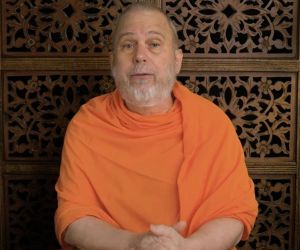
Swami Tadatmanda Resident teacher at Arsha Bodha Centre

My teacher, Swami Tadatmananda has said when speaking about meditation, that the very act of bringing the mind, our attention back to the object of meditation when we notice it’s wanderings, is in itself an integral component of the meditation itself.

So, if I’m chanting and my mind begins to jump about, and I notice those mental antics and bring my focus back to the words of the mantra, then in truth, in the reality of the thing, I’ve actually not ceased my chanting at all. There hasn’t been any interruption.

As I said, it’s not a new idea; it’s not my own idea. But it feels new, it feels as if it’s an idea meant for me.

Intention, effort, resolve, persistence (or is it perseverance?) – and love. The only other necessity is that I continue chanting, both in that moment of supposed interruption and generally in my life.

In other words, if it feels like I’m only mouthing words that aren’t reaching my heart, don’t worry.

Just keep chanting

Hare Krishna!