What Should I Do?

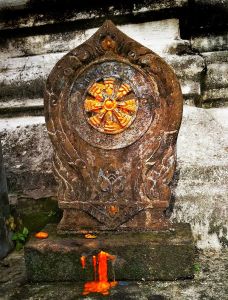
Dharma as a wheel

Many times during the years I’ve been exploring so-called Eastern religions  I’ve come across the concept of Dharma.

Very broadly, my studies tell me it could be said to represent the Truth of all things, though apparently there is no exact English translation and the word has many other uses as well.

Personally I’ve chosen to think of Dharma as much more than merely an abstract philosophical concept that only exists ‘out there’ in the world, or – worse – as some vague notion in my mind.

For me, Dharma is personal. It’s a guide that assists me in my aspiration to take more complete responsibility for myself and my actions.

Dharma, as a guide to taking personal responsibility, requires me to try live a life informed by Ahimsa – the path of least harm.

Many sources will tell you that Ahimsa means absolute non-violence or doing no harm. There’s nothing wrong with describing it in these terms, but this definition ignores the fact that any material being living in a material world is always taking action. All the time. And it is impossible to take any action at all without doing harm. To other beings, to the world, or even to oneself.

Putting it simply, the best I can do, in order to live a righteous – or Dharmic – life, is to consistently and continually enquire of myself What should I do? in any and all  situations, that will do the least harm. Or one can look at it the other way round: What action do I avoid because it would cause more harm?

Sounds simple written down like this. But, even with the apparently small issues that crop up all the time in everyday life, I find there are very often conflicting interests; the choices we are faced with aren’t always clear-cut

I don’t eat animals, nor do I use items made from them or explot them in any way. But I do eat fruit, vegetables, nuts etc which does cause harm to many living things in the process of growing, harvesting, transporting, and even eating such a diet. All I can do is try as much as I can to minimise the harm done by my lifestyle choices. I know, there are still many unresolved questions, but the point is to make the best choices I can given my circumstances.

I really dislike telling lies, even so-called ‘white-lies’ –  the lies we tell or the truth we avoid revealing, to cover up something that we think will do more harm if told to another – or to ourselves. While these white lies, or half truths, are sometimes not really about protecting others from harm, and often are about politeness, most of us have used them to protect others or self at one time or another.

As I said, for me it’s about taking personal responsibility. A way for me to at least try to ensure I’m doing the least harm possible.

The other day I heard Dorothy Day in an interview use the expression Works of war or Works of peace (though I think the words themselves come from The Bible but I couldn’t find it).
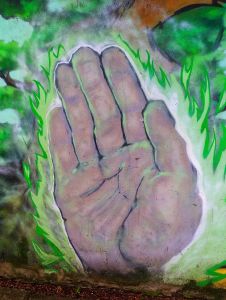
When it comes down to the personal level – the only realm over which I have any meaningful control is me and how I choose to live – a work of war is when I choose deliberately or through avoidable ignorance to do or cause harm; a work of peace is when I make a choice that does or causes the least harm for everyone and everything involved.
Everything & Everywhere

Namaste friends

In the High Holy Lands Where Magic Sometimes Happens

For the last while (long while really. Actually many years), I have dreamed a few times a month, sometimes more, that I am in, about to arrive in, or just about to leave Rishikesh in India.

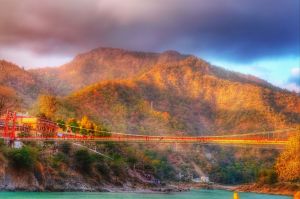
Rishikesh is a small town straddling the Ganges River, and nestled in the foothills of the Himalayas. For millennia it has been considered a sacred place. Its history replete with stories of divine beings, ancient sages and saints, not to mention its status as a major pilgrimage destination for at least a thousand years and the town becoming ever more popular in recent years for pilgrims and ordinary pleasure seeking tourists from around the world.

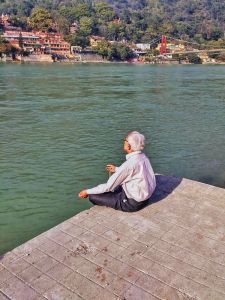
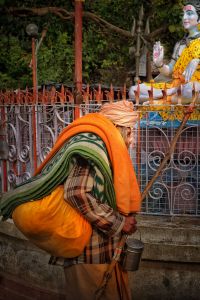
This isn’t me but it could be

I last visited Rishikesh in 2016-17 (having previously spent time there in 2006) when my partner hermit and I stayed for several months. I associate that stay with the strengthening and deepening of my spiritual practice as well as the gaining of a kind of clarity in terms of my outlook on the world particularly on the spiritual path that had been calling to me – as it does still.

Putting aside health issues that hinder our mobility, I think it’s fair to say that my attachment to Rishikesh and my longing to return have more or less faded away almost completely over recent years.

Rishikesh has always been a busy, crowded place with the associated traffic, noise, pollution, and inflated prices. Rampant commercialism has long threatened the town’s ‘spiritual ‘ or ‘sacred’ vibe. These days it is the fourth most visited place in India for overseas travellers  so it’s likely to be more busy, choked with traffic, noisy, more commercial and material focused than ever, with the associated degradation of its appeal for some.

But, even if I were also  able to put all this aside, I think the core of the letting go of my longing for Rishikesh has more to do with the turning inward that has accompanied our eventual recognition of our calling to the hermit life with its quiet, secluded, contemplative lifestyle (or the aspiration for that life).

So, why the dreams? Why so often? Well, as I’ve mentioned, Rishikesh has played a significant role in my life. And despite the dropping away of those longings and attachment, I’m not saying going there again is totally out of the realm of possibility, but it no longer has that ‘I’m home’ kind of feeling. No longer has that magnetic attraction for me.

Now, here’s the missing information about these dreams I’ve neglected to mention thus far: Not one of the dreams has been set in the ‘real’ Rishikesh; never have they been ‘geographically correct’ for wont of better description.

Sometimes the dream town is nothing more than a small clump of houses sitting on a hill or in a field with a dirt track passing by.

Other times it is a sizeable town with temples, streets, cafes and shops masquerading as an Indian town. Sometimes it’s simply a story taking place inside a shop or restaurant that, in the dream, I know is in Rishikesh though not in the terrestrial town. There have been dreams in which the town is more like a city with highrise buildings, multi-lane roadways, and all the rest.

The most recent dream had me in a bus headed for another bus connection to Rishikesh. Worried about missing the connection, I was told that the Rishikesh bus wasn’t due ‘for weeks’.

Many and varied settings all standing in for the ‘real’ Rishikesh. But I don’t think I need Carl Jung to tell me the meaning of these dreams. All of them are my internal sacred or significant ‘Rishikesh’. It’s as if the actual geographic location in India called Rishikesh is the illusion and these dreams are the reality for me. All emanating from the cave in my heart

My inner or true Self, you might say, telling me that my being concerned with my specific geographical location is missing the point. A message for me that I am always in Rishikesh, that I am always in sacred space and with saints and sages, and that the Divine is everything and everywhere.

Om Tat Sat