What Should I Do?

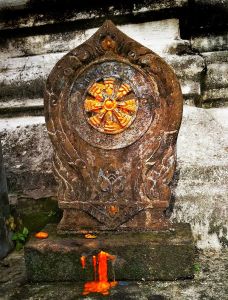
Dharma as a wheel

Many times during the years I’ve been exploring so-called Eastern religions  I’ve come across the concept of Dharma.

Very broadly, my studies tell me it could be said to represent the Truth of all things, though apparently there is no exact English translation and the word has many other uses as well.

Personally I’ve chosen to think of Dharma as much more than merely an abstract philosophical concept that only exists ‘out there’ in the world, or – worse – as some vague notion in my mind.

For me, Dharma is personal. It’s a guide that assists me in my aspiration to take more complete responsibility for myself and my actions.

Dharma, as a guide to taking personal responsibility, requires me to try live a life informed by Ahimsa – the path of least harm.
Many sources will tell you that Ahimsa means absolute non-violence or doing no harm. There’s nothing wrong with describing it in these terms, but this definition ignores the fact that any material being living in a material world is always taking action. All the time. And it is impossible to take any action at all without doing harm. To other beings, to the world, or even to oneself.

Putting it simply, the best I can do, in order to live a righteous – or Dharmic – life, is to consistently and continually enquire of myself What should I do? in any and all  situations, that will do the least harm. Or one can look at it the other way round: What action do I avoid because it would cause more harm?

Sounds simple written down like this. But, even with the apparently small issues that crop up all the time in everyday life, I find there are very often conflicting interests; the choices we are faced with aren’t always clear-cut
I don’t eat animals, nor do I use items made from them or explot them in any way. But I do eat fruit, vegetables, nuts etc which does cause harm to many living things in the process of growing, harvesting, transporting, and even eating such a diet. All I can do is try as much as I can to minimise the harm done by my lifestyle choices. I know, there are still many unresolved questions, but the point is to make the best choices I can given my circumstances.

I really dislike telling lies, even so-called ‘white-lies’ –  the lies we tell or the truth we avoid revealing, to cover up something that we think will do more harm if told to another – or to ourselves. While these white lies, or half truths, are sometimes not really about protecting others from harm, and often are about politeness, most of us have used them to protect others or self at one time or another.

As I said, for me it’s about taking personal responsibility. A way for me to at least try to ensure I’m doing the least harm possible.

The other day I heard Dorothy Day in an interview use the expression Works of war or Works of peace (though I think the words themselves come from The Bible but I couldn’t find it).
When it comes down to the personal level – the only realm over which I have any meaningful control is me and how I choose to live – a work of war is when I choose deliberately or through avoidable ignorance to do or cause harm; a work of peace is when I make a choice that does or causes the least harm for everyone and everything involved.
Openness, Another Name for God

Openness is the least blasphemous name for God.

            Rainer Maria Rilke (14 Dec 1875-29 Dec 1926)

While watching a lecture the other day, the speaker flashed a written quote across the screen:

Openness. A name – or more than a name – for God, for the Divine, for the universal consciousness, for love, Spirit, the Self. For the life force. The names are endless.

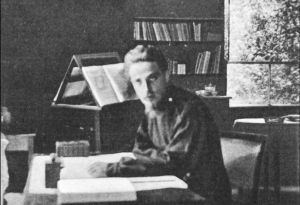
Rilke in his studio (Courtesy Wikimedia Commons)

Rilke was an Austrian poet who held as a core belief that the divine can’t be defined, contained, or limited by the use of human concepts or language . And that to give names or forms to ‘God’ or the divine is blasphemous because it reduces a limitless, evolving, mystery to a small, rigid projection.

Of course openness is also a human concept, an attribute ascribed by a human mind to a space, person, thing and so on. And it’s also a word – that is, it’s a bit of human language with all the baggage that brings with it.

So, do we simply have just one more human concept and word to add to an ever-growig list of names and forms of ‘God’? Not to forget that God is in itself a human invented concept and word.

But I get Rilke’s point: he was trying to move on from the tendency for us to use limiting names and forms. In his view the application of names and forms to the divine only serves to build walls that hide or obscure the divine, allowing the development of many and very often conflicting doctrines and dogma that have often been the cause of division and strife between the peoples of the world.

He thought dogma and doctrines of all kinds were meaningless and irrelevant when it comes to knowing the divine.

‘The Open’, he described as a state of pure existence unbounded and unfiltered by memory, fear or any other mental constructs we humans use to divide reality.

In other words a ‘good experience ‘ or a ‘bad experience ‘ are mental concepts that we come up with to label our experiences based on our fears, our memories or on the speculations of our minds and input from our senses.

Of course, being human beings in a material body living in a material world, we really do need to name, describe, label and judge our relationship to and experience of the world. The problem arises because we finally decide that these subjective experiences are in fact absolute reality and thus blind ourselves to any other options.

Openness is both the path to the goal and the goal itself. The way forward is to keep asking the big Who am I? questions – without insisting on getting hard and fast answers we then proceed to cast in concrete.

Embrace our own subjective experience without allowing it to become our apparent reality that only serves to keep us separated and subject to even more suffering.

Transcend it all. You are all.

All that is.

Reaching for Freedom?

Reaching for Freedom

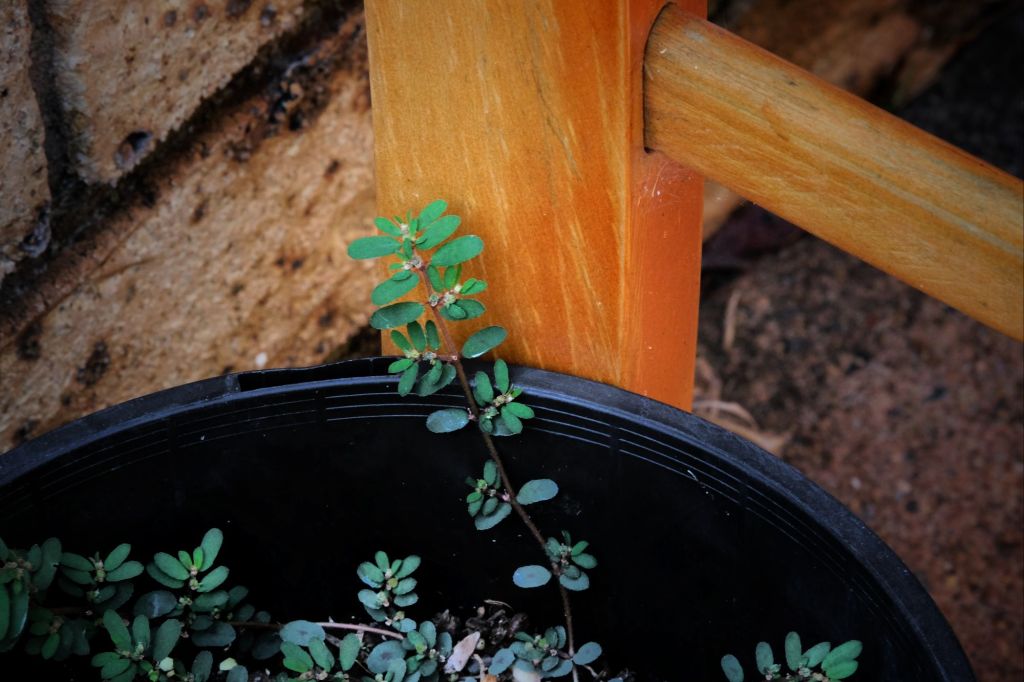
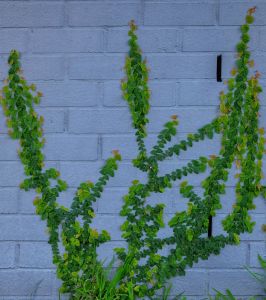
Reaching for freedom is what I called this photograph that I made today. But, is it really? I  mean is the plant actually in reality ‘reaching for freedom’?

Well, thus far, science can only tell us something like: This plant is programmed by its DNA to grow upwards towards the light.

Another climbing plant, in another place. Kind of looks like a painting, but it’s real

True, of course, but, here in this scene, that one shoot in the centre does appear to be reaching for the chair leg – perhaps for support? It’s quite common for me to see plants using all kinds of supports to do their upward growing (think Ivy on a wall). I think that in a few weeks, that tiny shoot might just be half way up that chair leg – or maybe higher!

So, as I came across this little scene, I questioned. No, questioned isn’t the right word. When I saw this reaching happening only a day after placing that plant pot in that spot, I made a declarative  statement: I said, ‘There is an intelligence at work here.’

Am I saying that this little plant has a brain that is continually figuring out strategies for the plant’s growth and other behaviours?

Am I saying that there is a ‘god’ up there in some heavenly domain who is in charge of getting plants down here on Earth to grow in the right direction?

No, to both questions. I don’t and can’t accept either of these supposed ‘possibilities’.

But, are there some kind of universal laws that regulate and control how the Universe flows, behaves, evolves and the rest? More likely I think.

Again I am not suggesting there is some kind of controlling ‘entity’ separate from the material universe, or a supercomputer somewhere that’s running the whole thing. More a kind of energy or essence that’s built into all material things, and that is an element of the very existence  of things.

A regulatory principle, I guess you could call it. But not some imposed or externally dictated regulations, laws, or controls. I think it’s more natural than that: existence is its own regulator and controller. Or so it seems to me in my good moments – such as when I witnessed this unfolding and evolving life drama.