Openness, Another Name for God

Openness is the least blasphemous name for God.

            Rainer Maria Rilke (14 Dec 1875-29 Dec 1926)

While watching a lecture the other day, the speaker flashed a written quote across the screen:

Openness. A name – or more than a name – for God, for the Divine, for the universal consciousness, for love, Spirit, the Self. For the life force. The names are endless.
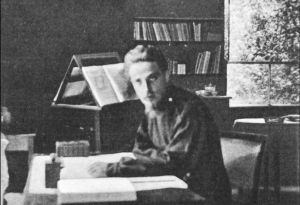
Rilke in his studio (Courtesy Wikimedia Commons)

Rilke was an Austrian poet who held as a core belief that the divine can’t be defined, contained, or limited by the use of human concepts or language . And that to give names or forms to ‘God’ or the divine is blasphemous because it reduces a limitless, evolving, mystery to a small, rigid projection.
Of course openness is also a human concept, an attribute ascribed by a human mind to a space, person, thing and so on. And it’s also a word – that is, it’s a bit of human language with all the baggage that brings with it.

So, do we simply have just one more human concept and word to add to an ever-growig list of names and forms of ‘God’? Not to forget that God is in itself a human invented concept and word.

But I get Rilke’s point: he was trying to move on from the tendency for us to use limiting names and forms. In his view the application of names and forms to the divine only serves to build walls that hide or obscure the divine, allowing the development of many and very often conflicting doctrines and dogma that have often been the cause of division and strife between the peoples of the world.

He thought dogma and doctrines of all kinds were meaningless and irrelevant when it comes to knowing the divine.

The Open’, he described as a state of pure existence unbounded and unfiltered by memory, fear or any other mental constructs we humans use to divide reality.

In other words a ‘good experience ‘ or a ‘bad experience ‘ are mental concepts that we come up with to label our experiences based on our fears, our memories or on the speculations of our minds and input from our senses.
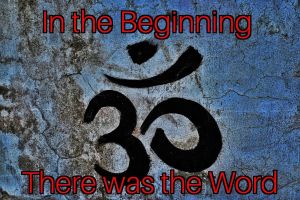
Of course, being human beings in a material body living in a material world, we really do need to name, describe, label and judge our relationship to and experience of the world. The problem arises because we finally decide that these subjective experiences are in fact absolute reality and thus blind ourselves to any other options.

Openness is both the path to the goal and the goal itself. The way forward is to keep asking the big Who am I? questions – without insisting on getting hard and fast answers we then proceed to cast in concrete.

Embrace our own subjective experience without allowing it to become our apparent reality that only serves to keep us separated and subject to even more suffering.

Transcend it all. You are all.

All that is.

How Shall I Live?

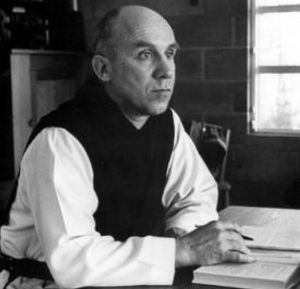
Thomas Merton in his hermitage (Courtesy Wikipedia)

The great study of the monk is to have an awakened heart

      Thomas Merton


There would be some – including me – who would say that all human beings, and not just monks, need to learn to awaken their hearts, to cultivate attitudes and a life of love, compassion, empathy, and kindness.

Who would disagree with such a suggestion?

Well, I’ve already said that I am one of the ‘some’ who would welcome such an evolution in human consciousness. But, at the same time, I don’t want to make pronouncements, form judgements, hold opinions, on what anybody should do, or be like. Only me. I am only responsible for my own behaviours, attitudes, ideas, thoughts, speech, and the rest of how to live my life. I just can’t – as in I’m not entitled – to tell anyone else what to do, what to think, what to say and so on.

Actually I’d even speculate that Merton is in fact talking about just the one monk: himself; he’s not preaching a prescription for the behaviour  of others.

I’ve read so much Merton that it’s impossible now for me to remember exactly where I read this statement of his, but I do know that when I first saw it and made a note, the concept resonated deeply for me as a great aspiration for my own life as a monk, and as a trying to be decent human being.

In other words, this monk – me, myself, and I – has a task to carry on with: to cultivate an awakened heart. And being a ‘great study’ it’s bound to be at least a lifetime’s project.

It’s an effort though, awakening one’s heart. It’s even a bit of a mystery at times what the phrase actually means in real terms.

Love, obviously, tops the list for any aspirant on the awakened heart path. And, yes, I do feel, express, and act out love – so deeply sometimes to the point of being overwhelmed or ‘flooded’; sometimes speechless (that’s the good bit), sometimes full of words.

But then there are times (oftentimes is the word) when that love is clouded or shrouded completely by angers and irritations, by regrets of what should be or shouldn’t be, could be or cant’t be, what isn’t.

The great study of the monk is to have an awakened heart
          Thomas Merton

All attachments to what is not as I think it should be. All barriers to love. All ways and means of keeping the heart asleep – or at best semi-awake, and still sleepy: slow to respond, slow to act, and with ongoing blockages to seeing how things actually are.

The quest to acquire an awakened heart and the outpourings of love, kindness, gentleness, generosity, that such a state would allow, is probably at the root, the foundation, of my life as a hermit monk, of my life as a pilgrim journeying through and to Self.

Living quietly and simply; developing a contemplative way of being in the world while definitely being not of the world; cultivating silence, peace and calm; all are activities and attitudes directed at cultivating an awakened heart.

All that generosity, patience, love, kindness, empathy, and all the rest are definitely all characteristics of an awakened heart. Here’s my dilemma  (only one among many that riddle my crazy monkey mind): they are also precisely the elements that need to be practised in order for one to acquire an awakened heart. What’s the expression? Catch 22?

Of course, it just occurs to me now, everything that is, is exactly as it’s meant to be, happening just as it ‘should’. So, in other words, all these words of reflection are simply a commentary on what has been and gone already, that which is in the past, and is no longer existing.

All that matters – all that exists – now is that at this moment, in its ongoingness, I am as loving, as kind, as patient, and as generous (not to forget compassionate, empathetic) as I’m able. To others obviously, as well as to myself.

All that wonderful list of characteristics of an awakened heart all exist right now within me. Perhaps I need to wake up my mind a bit more so I might see that reality. Then I might actually realise that I already have an awakened heart and that I simply got forgetful somewhere along the way.

with love
Paul the Hermit