
What Should I Do?

Dharma as a wheel

Many times during the years I’ve been exploring so-called Eastern religions  I’ve come across the concept of Dharma.

Very broadly, my studies tell me it could be said to represent the Truth of all things, though apparently there is no exact English translation and the word has many other uses as well.

Personally I’ve chosen to think of Dharma as much more than merely an abstract philosophical concept that only exists ‘out there’ in the world, or – worse – as some vague notion in my mind.

For me, Dharma is personal. It’s a guide that assists me in my aspiration to take more complete responsibility for myself and my actions.

Dharma, as a guide to taking personal responsibility, requires me to try live a life informed by Ahimsa – the path of least harm.

Many sources will tell you that Ahimsa means absolute non-violence or doing no harm. There’s nothing wrong with describing it in these terms, but this definition ignores the fact that any material being living in a material world is always taking action. All the time. And it is impossible to take any action at all without doing harm. To other beings, to the world, or even to oneself.

Putting it simply, the best I can do, in order to live a righteous – or Dharmic – life, is to consistently and continually enquire of myself What should I do? in any and all  situations, that will do the least harm. Or one can look at it the other way round: What action do I avoid because it would cause more harm?

Sounds simple written down like this. But, even with the apparently small issues that crop up all the time in everyday life, I find there are very often conflicting interests; the choices we are faced with aren’t always clear-cut
I don’t eat animals, nor do I use items made from them or explot them in any way. But I do eat fruit, vegetables, nuts etc which does cause harm to many living things in the process of growing, harvesting, transporting, and even eating such a diet. All I can do is try as much as I can to minimise the harm done by my lifestyle choices. I know, there are still many unresolved questions, but the point is to make the best choices I can given my circumstances.

I really dislike telling lies, even so-called ‘white-lies’ –  the lies we tell or the truth we avoid revealing, to cover up something that we think will do more harm if told to another – or to ourselves. While these white lies, or half truths, are sometimes not really about protecting others from harm, and often are about politeness, most of us have used them to protect others or self at one time or another.

As I said, for me it’s about taking personal responsibility. A way for me to at least try to ensure I’m doing the least harm possible.

The other day I heard Dorothy Day in an interview use the expression Works of war or Works of peace (though I think the words themselves come from The Bible but I couldn’t find it).

When it comes down to the personal level – the only realm over which I have any meaningful control is me and how I choose to live – a work of war is when I choose deliberately or through avoidable ignorance to do or cause harm; a work of peace is when I make a choice that does or causes the least harm for everyone and everything involved.


Let Me Tell You a Story: It’s a Good One!


Has anyone seen Walk the Line? It’s a great movie that tells the story (or a version thereof) of the life of Johnny Cash. Yes, I know: not everyone is into country music. This movie, however, is an intriguing insight into the life and work of a  gifted but troubled artist. He was a prolific and inspired singer and songwriter.

There is a scene in the movie in which Johnny is about ten or so. He’s talking to his brother who is maybe 14. The brother is studying the Christian scriptures (he wants to be a preacher when he grows up, but dies soon after in an horrific accident) and Johnny says, ‘Why you studying so hard?’ His brother looks up from his reading and says,

‘You can’t help nobody if you don’t tell ´em the right stories.’

Yes, I thought when I heard that, you have to tell them the right stories. But, what are the right stories? It’s a good question but, fortunately, there is a simple answer: they are all the right stories. That is if they are told from and with the heart, and if they are created and shared with the intention of conveying Truth, promoting harmony, and doing or causing to be done, what’s right.

The ‘them’ of poor brother Cash’s reply are those who get to hear/see/feel the stories we tell. And we all tell stories don’t we? I mean I’m telling you a story right now. As a (cringe) blogger, that’s what I do.

But we all share stories of all kinds. Sometimes they are stories of our lives, sometimes they are from memories passed down the generations. Other times they might be something we ‘make up’ to help someone to understand a point or idea. Pretty much all of us, most of the time communicate in one kind of story or another.

Of course there’s the other kind of stories; the ones meant to spread rumour or gossip, to hurt someone, to mislead. We all know how that works, and it’s not today’s topic anyway, so let’s just leave it there.

Those we share stories with may be those we intend to share with, and they might be others who at the time are distant from us both in time and space. Just as the stories we tell each other might be decades or even centuries old, so might our stories keep on reverberating through time and space.

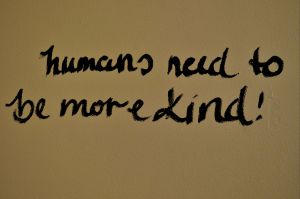
A true story written on a wall somewhere

It’s also true that the stories that ‘help’ people come in all shapes and forms and are about an unlimited variety of subjects and topics. Then there’s the matter of timing. How often have you ‘just by chance’ read something inspirational when you were needing some guidance or advice?

Or what about those times when you are feeling a bit low or under the weather and you come across a story that makes you smile or otherwise lifts your spirits? I’ve often been in need of a good cry only to come across a sad movie or story or a moving tale of one kind or another. (Just last night I read a wonderful phrase I’d never seen before: Transformational Weeping. Probably a story or two there do you think?)

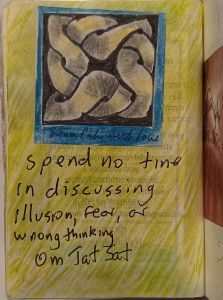
A story I tell myself literally every day. One that’s a prayer and an affirmation

So, let’s keep telling stories. They are all the right ones for us to tell – if they come from the heart and told with the intention of serving Truth. Someone once wrote:

If there is a way to improve the world, it is by telling a good story.

Okay then.

Once upon a time on a dark but not so stormy night …

PS I saw the movie in Dharamsala India. On a postcard home I wrote a little rhyme about some writing work I was doing on some of the town’s environmental issues for a local magazine:

He walked the line
did Johnny Cash.
But here in Dalai Lama Land
my words will help reduce trash.

I did say stories come in all shapes and forms didn’t I?