
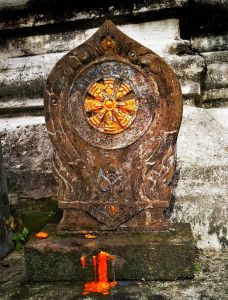
Many times during the years I’ve been exploring so-called Eastern religions I’ve come across the concept of Dharma.
Very broadly, my studies tell me it could be said to represent the Truth of all things, though apparently there is no exact English translation and the word has many other uses as well.
Personally I’ve chosen to think of Dharma as much more than merely an abstract philosophical concept that only exists ‘out there’ in the world, or – worse – as some vague notion in my mind.
For me, Dharma is personal. It’s a guide that assists me in my aspiration to take more complete responsibility for myself and my actions.
Dharma, as a guide to taking personal responsibility, requires me to try live a life informed by Ahimsa – the path of least harm.

Many sources will tell you that Ahimsa means absolute non-violence or doing no harm. There’s nothing wrong with describing it in these terms, but this definition ignores the fact that any material being living in a material world is always taking action. All the time. And it is impossible to take any action at all without doing harm. To other beings, to the world, or even to oneself.
Putting it simply, the best I can do, in order to live a righteous – or Dharmic – life, is to consistently and continually enquire of myself What should I do? in any and all situations, that will do the least harm. Or one can look at it the other way round: What action do I avoid because it would cause more harm?
Sounds simple written down like this. But, even with the apparently small issues that crop up all the time in everyday life, I find there are very often conflicting interests; the choices we are faced with aren’t always clear-cut
I don’t eat animals, nor do I use items made from them or explot them in any way. But I do eat fruit, vegetables, nuts etc which does cause harm to many living things in the process of growing, harvesting, transporting, and even eating such a diet. All I can do is try as much as I can to minimise the harm done by my lifestyle choices. I know, there are still many unresolved questions, but the point is to make the best choices I can given my circumstances.
I really dislike telling lies, even so-called ‘white-lies’ – the lies we tell or the truth we avoid revealing, to cover up something that we think will do more harm if told to another – or to ourselves. While these white lies, or half truths, are sometimes not really about protecting others from harm, and often are about politeness, most of us have used them to protect others or self at one time or another.
As I said, for me it’s about taking personal responsibility. A way for me to at least try to ensure I’m doing the least harm possible.
The other day I heard Dorothy Day in an interview use the expression Works of war or Works of peace (though I think the words themselves come from The Bible but I couldn’t find it).
When it comes down to the personal level – the only realm over which I have any meaningful control is me and how I choose to live – a work of war is when I choose deliberately or through avoidable ignorance to do or cause harm; a work of peace is when I make a choice that does or causes the least harm for everyone and everything involved.
 Notes from the Hermit's Cave