Lighting Candles, Learning Lessons

Not many people know this, but I’m a big fan of clichés. Not always, only when they serve a purpose, make a point, illustrate an idea, or have some other relevance or meaning. I remember an occasion when I witnessed a perfect illustration of a favourite cliché.

Once, many years ago I was sitting in a café in the Himalayas on a late monsoon afternoon when the clouds hung low and the lights were on so people could see. Suddenly, the lights went out.

A collective groan from the full café: people writing in journals, reading books and so on (no smartphones or laptops in those days), had to stop what they were doing. Although not an uncommon occurrence in those parts, lights going off was a bit of a pain for us spoiled tourists.

Anyway, one of the waiters fetched some candles, and began lighting one on each table. I think there were perhaps ten tables. I watched him as he moved slowly around the packed, but tiny café. As he lit the candle on the very last table, the electricity came back on.

Again the collective sighed, this time in relief, as light flooded the café. I heard one voice say something to the effect of: ‘he shouldnt have bothered, I mean the lights came on eventually’ .

‘Well, you know, if he hadn’t made the effort to make some light for us, maybe the power wouldn’t have come back so quickly’, I commented casually.

Another collective sigh and murmurs of, ‘Yes true’, and ‘far out’, ‘never thought of that’ and ‘so profound’. All this as response to some off the cuff, random remark by me.

And the cliché?

Its better to light a candle than to curse the darkness.

This cliché goes so well with something I like to say that has become a bit of cliché in itself (because I say it so often):

Just look at what you can do, not what you can’t do.

Of course, I didn’t invent this one, but still, to me it makes sense. For example, In the little scene described above, we couldn’t do anything to turn the electricity back on, but one of us (the waiter) could fetch and light some candles.

At Dictionary.com, it tells me that a cliché is:

a trite, stereotyped expression; … usually expressing a popular or common thought or idea, that has lost originality, ingenuity, and impact by long overuse.


Rubbish I say! Overuse? Why does using something a lot make it bad? Why should an idea or thought be robbed of its meaning or power, simply because its been around for a long time? There’s no need to overthink the topic; I’m not saying we should always use clichés. But at the same time, clichés have usually become clichés because they are true, or say something in a succinct and accessible way.

Anyway, this post isn’t about grammar, it’s about lighting candles and looking at and realising what you can do, and not cursing the darkness and being pulled down by thinking about what you can’t do.

Does it help? The lighting of candles? The realising of what you can do? Sometimes yes, sometimes no. Nothing, not even a cliché, is perfect.

Love and blessing from me to you.

Don’t Worry: You’re Not Late


One morning recently I opened my Journal, ready to write: ‘I woke up late today.’ But I didn’t (well I did get up late) I stopped as the thought went through my mind: what does late actually mean.

Well, I know what late means as I suppose we all do, but I Iooked it up anyway. And, of course it means exactly what we think it means: ‘after the expected, proper, or usual time.’

Expected, usual, or proper. Three words guaranteed to get me thinking. After all, who is it exactly that prescribes (or proscribes) what is the expected, usual or proper time or what is not?

Then the lyrics of a song called A Blessing in Disguise by singer-songwriter Graham Connors came to me. One particular blessing he lists in the song is a watch that runs backwards. The watch owner’s friends all offer to have it fixed, but he says no thank you; it suits me just fine:

It reminds me that time is a state of mind
a restriction we place on our lives.

Yes, exactly. I’m sure we all sometimes see time as a restriction. How many of us are tired of (not to mention exhausted by) appointments, schedules, alarms waking us up, too many hours at ‘waste of time’ jobs, too many hours when we’re not at that job, the endless hours spent hypnotized by one screen or another?

In other words, we live bound by restrictions we place (or allow others to place) on ourselves and then we wonder why we’re unhappy, frustrated, exhausted, angry, sad and in need of a break; in need of more time.

Well, time, as the song says, is a state of mind. It’s how we look at time; that’s the point. Forget the restrictions. No, I don’t mean quit your job (though I never suggest to anyone they not quit their job), ignore family or other ‘obligations’ (same disclaimer). What I am suggesting is that you find ways to look at time as the ongoing present, a state of mind to be in, to be in presence. Not future. Not past. And never ever static.

One can never be late. One can only ever be here and now, in that previously mentioned ongoing present. You are the one to decide what is ‘proper’ for you; it’s up to you to create your own unique ‘usual’

And as for ‘expectations’: well, if you have to have them (and expectations are really only imaginings about events, situations, and circumstances that aren’t real yet and may never be), at least make them your own.
Peace

Controlling the Mind: It ‘Ain’t Easy

Namaste friends

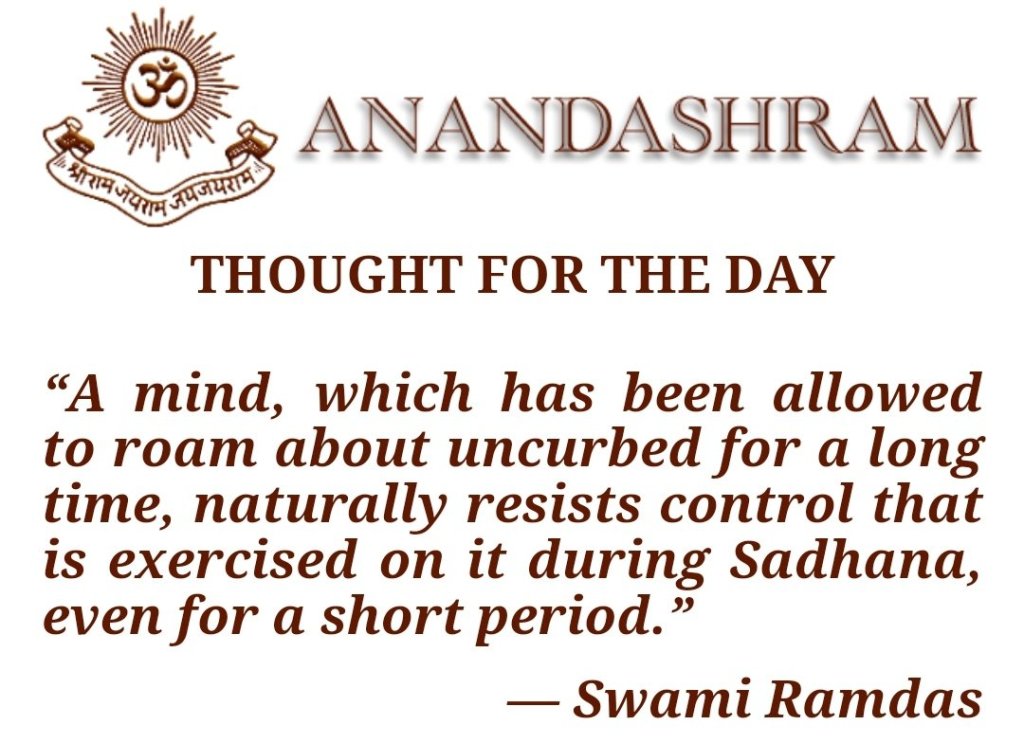
It’s so true isn’t it? The second you sit down, close your eyes and try to relax (or sleep, meditate, or just to get a little quiet) your mind jumps into high gear and suddenly there are all kinds of thoughts zapping all over.

Well, of course it is perfectly normal and nothing to become frustrated or annoyed about. Certainly you shouldn’t go thinking you’ve failed or are ‘doing it wrong’.

That’s been my trouble for a long time: if I wasn’t able to ’empty’ my mind then obviously it was something about the way I was going about it. I was the one making a mess of it.

In the last while I’ve started to realize that it’s the mind’s job to keep itself busy. In other words you’re never going to stop it thinking.

The best we can hope for, I’m learning, is that we come to the point where we see where the thoughts are headed, and we’re able to gently, kindly and without fuss, refocus attention back onto our breath or whatever aid we use to help us focus. It’s not so much about pushing the thoughts away or trying to stop thinking. It’s really about putting our attention somewhere else

And then what might happen every so often is a time, usually only a few moments, when you’ve reached beyond your mind’s reach.

Meanwhile, don’t worry about where you are headed. I can’t find the exact quote, but Swami Ramdas also said something to the effect of

Once you set your feet upon the path you are already at your goal

Like most things in life, the journey itself is where it’s really at.

Pouring tea can help focus the attention