If You … Don’t Quote Me on This

I don’t remember when I began to collect quotes; my early teens I think. I just started making notes of quotes from books (even comics in those far off younger days), from conversations overheard. Then, later, little excerpts from my own journals and other writings. Even slogans I’d see on t-shirts, billboards, or wherever else.

This doesn’t mean much in these times when you can type in a search for quotes on any subject, for any occasion, by anyone from anytime in history. But, in those long ago days before computers were in our hands, and certainly way before the Internet, it wasn’t so quick and easy.

Anyway, fast forward to the not so distant past;One day I sat at the computer (it was time for computers, thank goodness) and typed up all those collected quotes stored in several boxes full of little notebooks and scraps of paper.
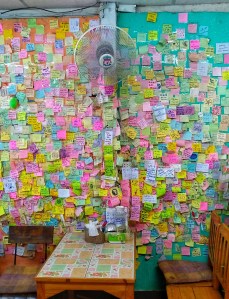
The result is literally hundreds of pages of tightly typed quotes. That typing (which in fact took me quite a bit longer than one day) was in fact the genesis of a book that has remains half written.

You see, as I typed I saw so many great words of wisdom that I just felt compelled to put some of them together somehow.
Ive now been at that task for many years: its a very intense process and takes so much energy and, as any writer will tell you, the muse has to strike before we can begin to strike those keyboard keys! Anyway, it will be done when its done; the very notion of presence, of there only being now, is actually one of the major themes of the book.

As I got to the end of that original typing marathon, I noticed that, strangely, the very last quote in that long long list reads simply, If you. Clearly a sentence begun but left hanging. Who will ever know what would or should or could have come next but never did?

Some time ago I remembered that interesting little fact and began to think about its meaning. I decided to do a quick search of the whole collection for that little conditional phrase. The search revealed that there are 139 instances of quotes beginning with If you.
So, dear readers, dear friends and fellow travellers on life’s journey, here are eight (why pick ten like everyone else would?) of those quotes, chosen at random (is there such a thing really?).

No commentary or comment from me; you, the reader, can do very nicely without my two cents worth thrown in. Well, okay, just 2c worth: I have often learned a lot from quotes such as these (not necessarily these ones specifically); sometimes a simple quote has led to a healing or an important insight.

So, I thought it would be a great idea to share some of my collection with you and perhaps there will be one or more that strikes a chord:
If You …

  • If you allow things to surprise you, you will get easily confused.
  • If you always do your best, you will be free from regrets.
  • If you follow the eternal law, you can understand how to love.
  • When you forget who you are, and dont know what to do, act the way you would if you did.
  • If you really dont care, you arent going to know if something is wrong. The thought would never occur to you. The act of pronouncing something wrong is a form of caring.
  • If you have to ask questions all the time, you never get time to just know.
  • If you are not interested in this, then why are you here?
  • If you deny even one person entrance to your life, youll never get their uniqueness from anyone else.

So, there you are. Theres much to reflect on here. Lots to focus on, to meditate on, and contemplate.

Love and blessings from me to you
Dear Diary: The Story of Your Birth

Namaste friends and Welcome

I wrote this little remembrance about the birth of my journaling life some time ago. I thought it might be nice to share it here on my new Notes from the Hermit’s Cave blog as keeping a journal has been such an important aid to my own ongoing healing, and has been key to my spiritual journey.

See the fascinating update at the end!

For many of us keeping a journal is a key element in our efforts to live a good life, or even to have a life: it can be a tool for healing, a means to bring some order to the chaos in our hearts and heads, and a venue for reflections on life, the Universe, and everything. For me, it’s been all of these things and more.

I guess for most people Henry David Thoreau is best known for the book he wrote about his time living alone in a small cabin on Walden Pond in Massachusetts, titled funnily enough Walden. And I suppose most people would have no idea that all, or pretty much all, his writings, lectures and so on, came from his Journal. Note the capital: he himself called it The Journal.

A few years ago I read a very cool book called The Book of Concord: Thoreau’s Life as a Writer, which is an examination of, yes you guessed it, his life as a writer. What made it extra interesting was the way the author (William Howarth) used The Journal as his way into Thoreau’s writing and life.

Let me tell you one of the many things that jumped out at me from this fascinating book: the reason Thoreau started keeping The Journal in the first place. It seems that one of his neighbours in Concord was Ralph Waldo Emerson (imagine that if you can). Anyway, one day Emerson says to Thoreau,

‘What are you doing? Do you keep a journal?’

Now, it seems that Thoreau had been running around telling everyone he was a writer and that he was examining nature and studying the life of the town. All that writerly kind of stuff. But he hadn’t been keeping a journal.

So, he answered Emerson’s challenge by beginning The Journal. And, as I said, all his writing from then on came right out of that journal. Sometimes, believe it or not, he literally ‘cut and pasted’ from The Journal; he actually tore out pages or cut up passages and stuck them together to form the final manuscripts. Now, that is called having supreme confidence in your own work.

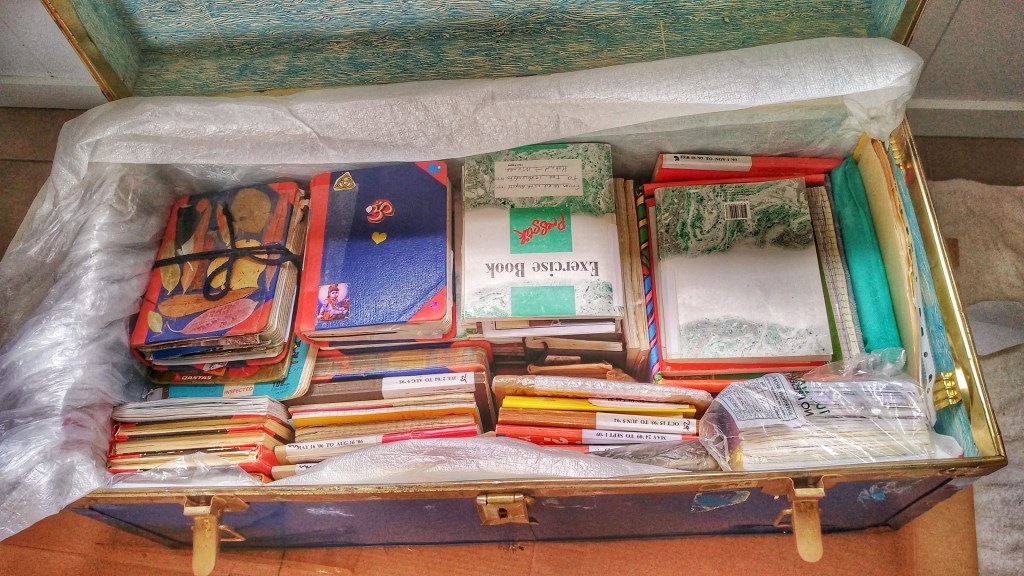
Anyway, after I read that, it got me thinking about my own journal and how I came to begin it. As I sit typing this, my journal is safely stored away in a trunk in my sister’s garage. (See the update at the end. Strange syncronicity indeed)

There are close to one hundred separate volumes, mostly school type notebooks (called exercise books in Australia), some exotic volumes from travel in India and a few odd looking specimens of varying shapes and sizes. Hard to believe really: so many words.

This is my personal journal; my art journals are another matter. Just wanted to make that distinction, though oftentimes it’s hard to tell the difference.

In late 1980, I returned to Australia after a few months in New Zealand. I wasn’t in great shape and was hanging around at my parents’ house and feeling like a ‘wet week in a thunderstorm’ (if you get my meaning). One day, my mother out of the blue said,

‘Why don’t you start keeping a diary?’

Of course you don’t know my mother, but believe me when I say that this is most definitely not the kind of thing I’d have ever expected her to suggest to her son as a way for him to deal with his very poorly mental condition.

But, just like Thoreau after his chat with Emerson, I headed to the shops without delay, bought a school exercise book, and began my diary (I often interchange the terms diary and journal). And I’m still at it, as I’ve said.

And you know what? Thinking about my journal now, I feel a sense of pride. I don’t mean arrogant, ego driven ‘pride’: my heart is glad. I have consistently for over forty years kept a record of my life which goes deep into my psyche and beyond. Well that’s what it often feels like.

Sometimes it’s been an extremely detailed account and written every day; other times there have been gaps with just scant little notes to record my doings, thoughts, feelings, and so on. But, at least it is there. I have a profound sense of achievement when I think of my journal. Maybe I need to adopt the capital like Thoreau: My Journal.

My final words must be then, thanks Mum. I know I thanked you when you were still in this world with us, but it can’t hurt to announce my thanks to the world (as much of it as reads this blog anyway) can it?


Update

The trunk containing The Journal has left my sister’s garage (thank you little sister) and is as I type this update, on a truck heading this way and will arrive late tonight or early tomorrow.

The timing is completely serendipitous: By ‘chance’ I came across the above piece of writing today as I was looking for other things, then a little while later got a call from the shipping company with the news! Pickup wasn’t scheduled for a few more days.

Of course I still regularly spend time with The Journal, perhaps more than ever, and it will be very nice indeed to have the whole thing with me once again.

Yet Another Update

Yes indeed, it certainly is, nice I mean. Here is The Journal in its full glory (one volume missing but will be here soon)

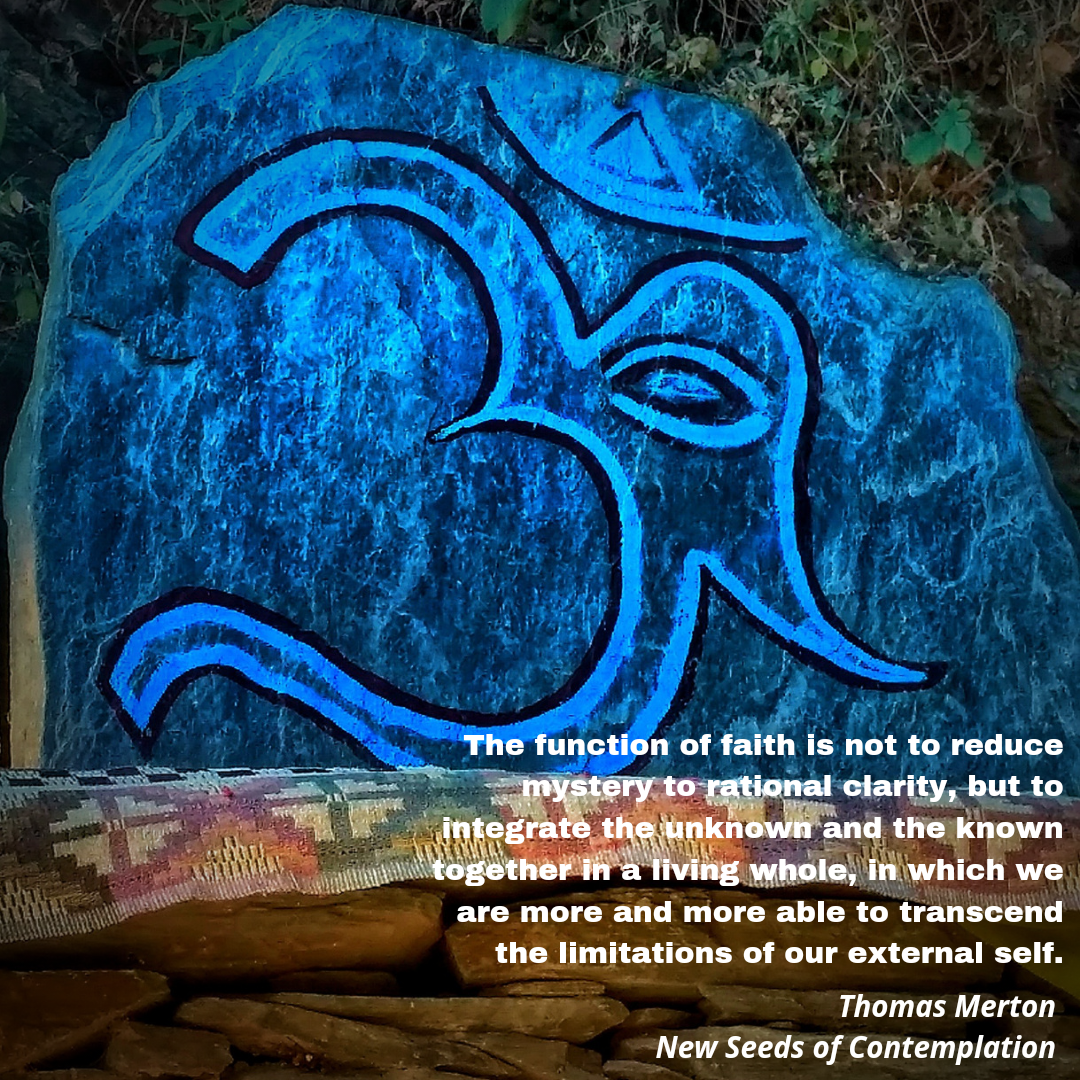
The Function of Faith

With These Words … Part 5

Well my friends, here we are at Part 5 of my little mini series. As it happens, it’s also the final part.

It’s been a fascinating trip, this little journey we’ve shared. Reflecting on the set of vows usually made by nuns and monks, and how my way of living fits with these undertakings. How well do I live these vows? As a philosophy directing my life, do they work?

Let’s get on shall we? The final vow is Presence, which is the new interpretation on the vow of Stability taken when a person makes a life commitment to a particular place and or community. Obviously for one who moves as much as I do, presence is probably the appropriate concept to take its place

Presence

Just now I was thinking that by far the easiest of the topics we’re looking at here, is Presence. Yet at the same time it is the absolute hardest to write about – even worse to think about.

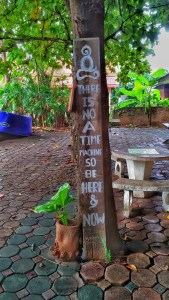
Why easy? Well, because in a very real sense there is nothing we can say about presence or the present. Of course I could spend the rest of my life reading books, studying, and even writing about it myself; how to live here and now. But all the time the obvious would be staring me in the face.

How can we be anything but present? How is it possible to be anywhere but here? And surely it’s always now? A thing called ‘the past’ doesn’t exist except in memory, and the future? Well, where is it? it doesn’t exist. Never will. I know it’s kind of common to hear things like ‘We’re living in the future’, but are we really? Of course not. So, end of story right there I guess.

Except that it’s not, is it? This is where it gets to be the hardest topic to talk about. It seems none of us – us humans anyway – can get our heads around the aforesaid obvious fact of life: we are always here, and it is always now. Why is this so?

Well, speaking only for myself, you understand, I think about it too much. I seem to have convinced myself (courtesy of my ever-busy mind) that there is a way to learn to be present; a how to guide, that I can read or invent myself that will finally allow me to put myself into the present, in the here and now.

And all Along I am sitting here, thinking and writing about how to be present or put another way, how to sit in this spot right now.Do you see where this is going? If I’m not here and it isn’t now, then where am I? And when is it?

Sorry, but I have no answers. Even asking the questions is denying the obvious: I am here, it is now. The trouble is my mind isn’t at all ever content and happy with the present, regardless of how I might feel about it.

In that case, can I say that in my way of living I am committed to presence? To be in the present? Well, speaking for me personally – whoever that me is – perhaps the better question might be: Do I fully realise that I can only be here and now because that’s all there is?

To that I would have to say definitely not. My mind is continually on the run between the deep past and the unreal and unknowable future and all points in between. And my mind loves repeat journeys too!

So how do I intend to come to that place of the realisation of presence? Well, before we go on, you can’t actually intend to be present. Intention is about …

Enough!!!! Enough mind stuff. Please

The truth is, there is nothing for me to DO. I am here; it is now. That’s all there is.

Except one more thing to do: I just have to wake up

The Pilgrims’ Way

It is an old belief, and it is a good belief, that our life is a pilgrims progress.

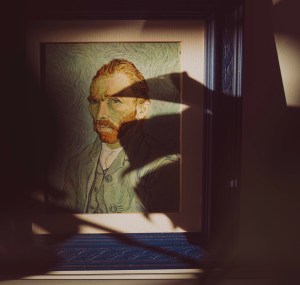
Vincent Van Gogh

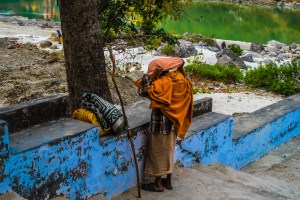
The usual definition of a pilgrim is a person who goes on a journey to a special place, a place that has significance for them, often as a spiritual exercise or quest. Sometimes the journey can be over long distances and a difficult road.

The key characteristic of a pilgrimage is that it is to be undertaken on foot, or put another way, a pilgrimage is a journey we (as the pilgrim) travel on by our own efforts, under our own steam as they say.

In this quote Vincent is talking about that other pilgrimage: the one that goes on on the inside. It’s referring to the idea that our lives can be an inner spiritual journey (or pilgrimage) from our present imperfect condition to a place or state of beatitude. Or as some might say Heaven or Nirvana. Others call it Self or God Realisation. And some other people call it Enlightenment.

You could say that Vincent is suggesting that a pilgrim is one who goes on a special quest to find the answers to life’s big questions; a pilgrim is a person who travels (either out there in the world, or inside on a journey of the heart, mind, and soul) to see, to learn, to do and to grow as a human being.

And, if all goes well, we end up in Nirvana, or a state of spiritual advancement as a kind of nice bonus at the end of the road

Spiritual for me in this context refers to the things that affect or relate to the human spirit or soul and might not be concerned simply with the physical or material aspects of life.

But here is the funny paradox about this kind of inner spiritual pilgrimage: as we learn, as we discover new ways of being and relating to people; as we find answers for ourselves and as we grow as people, we find that changes start to take place in our physical world.


From simply directing the wheres and whens of our activities in the material world, to pushing us in a direction of study, to influencing what people we meet, to the type of work we end up doing and to the actual state of our mental and physical health. It’s that inner pilgrimage that really is running the show of our lives.

So, as we travel the long road of our lives, let’s continue to learn. Let’s keep alert for those insights that come with a desire to grow and to work out what our lives and the world are all about. Above all, let’s keep on pilgriming down that road, and allowing ourselves to be open to new experience, new people, new ways of being.

Another quote from Vincent that I particularly resonate with. This time from a letter to his brother Theo and talking about the lot of the pilgrim:

We must continue quietly on our way.

Vincent Van Gogh

Thank you Vincent for the pictures you gave us; thank you for the words you wrote; thank you for being you.