A Day of Silence Observed

A few days ago we observed a day of silence here in the Hermitage. Our initial idea was to have a day of less talking, more quiet, which we hoped would help us reach a state of silence. We timed our little effort to coincide with a similar event being observed in an ashram in India whose foundation teacher we admire very much. A way for us to perhaps associate with others on a similar path out there (in there?) in the invisible community.

It’s not that we don’t experience periods of quiet (no talking) and even the aspired to silence, we do. Quite often they can be reasonably extended periods too, when meditating, chanting, studying, and so on.

But, it does have to be said, that we do spend a lot of time talking with its associated thinking – and unthinking too; with its listening – and not listening.

Of course, there are things we actually want or need to talk about; just that for us, sometimes we end up talking about stuff that’s not needed, as well we fall into what we call the adharmic trap of gossip, judgement, needless repetition, and the rest of the not so right speech.

Anyway, we wanted our day of quiet to be as complete as possible, so we agreed to not even discuss mundane and practical things unless it was absolutely essential. (Who gets to decide what’s ‘essential’ and not? Good question).

Around midday on the day in question I made a few notes on how my day was going so far. I had a vague notion I would make notes periodically through the day as a kind of ‘casual log. Needless to say, an approach of such vague casualness resulted in the notes made at midday being the only ones to actually come into existence.

Still, even though the notes were made relatively early in the day, I do think that they are a pretty good summary of my feelings on the day as a whole. So, let me share those brief reflections with you now:

Thus far (about 12) we are keeping silence (or at least not talking) – mostly. Practical things are sometimes tricky, sometimes not. It’s easy for example to point to a cup which translates to ‘Would you like a cup of tea?’. The reply which was ‘no thank you but I would like half a cup of soya drink’ took a bit more translational effort. Due of course to an almost complete lack of experience in speaking without umm, speaking.

Mind you,only three or four actual words spoken, along with a ton of hand gestures and facial expressions, did result in the transmitting and receiving  of understanding.

PLUSES SO FAR  

A sample of what it is like to be quiet, and actually being in quiet. And a happy anticipation (along with a sense of relief experienced in the present) of not having to talk about all the tired old things: the weather, the world, the ins and outs of teachings, teachers or writers, as well as ‘other people’, which often end up in judgements, criticisms, and plain simple gossip.

Alongside this overall positive vibe, there is a kind of nervousness. Where it comes from, I can’t say; probably an anxiety to do with not talking about the usual things. Though of course it’s only been a few hours.

While there has been little out loud talking, my mind has been running crazy, and I’ve had a strong compulsion to keep busy. Put these issues with the nervousness? To be expected really I think given my lack of experience with intentional quiet.

One step at a time.


Well, clearly that compulsion to keep busy didn’t extend to further note keeping, but, yes I have to say I did keep busy. Ironically some of that ‘busyness’ did in fact result in a few glimpses of silence.

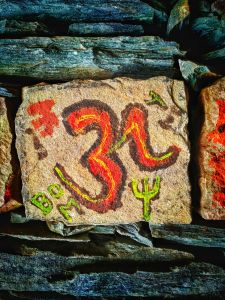
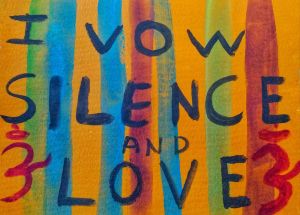
I spent time working on an art piece in a prayerful manner, and in a quiet state; none of the all too usual chatter. Silence. I meditated for longer periods than usual, which allows for a deepening of a quiet mind (in theory that is). And when I chanted mantra, I think I may have been a little calmer and quieter of mind than usual.

Clearly the cultivation of silence – and even the seemingly straightforward task of simply not talking – is a practice that requires more practise, quite a lot of practise in my case.

We need to develop alternative communication strategies – hand signals, signs, gestures – to minimise speaking even more. Having said that if we’re to develop silence then even communicating about mundane stuff in other ways would get in the way. Too much talking!

Well, I occasionally make photos out there in the world

One very pleasing outcome is that I feel slightly less inclined to ‘talk about the outside world’ and other people. Less idle chatter. It’s a good start and it can only get better with some of the aforementioned practice.

Actually, thinking about it now, you’d think that a hermit who rarely goes out of the Hermitage except for a walk or occasional visits to a shop, who doesn’t watch the news or social media and the rest, wouldn’t have a lot to gossip or blah blah about.

That’s why, you see, I say that I really do need quite a lot more practice. Making silence is a long term project, an aspiration if you like, to find inner peace and make myself more able to radiate love to the world.

Love and Peace

Paul the Hermit
The Time is Always Right for Niceness

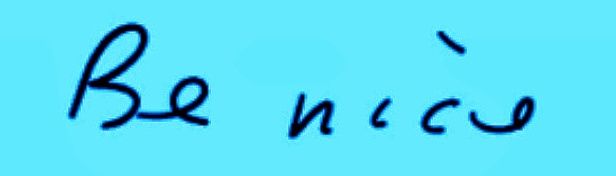
Scrawled in the margin of a page in my notebook are two words: Be nice. Nothing else on the page to suggest a context, source, or inspiration. But, here’s the interesting thing: Just below those two lonely words, and in brackets, I’ve written:

Do nice, Consume nice, Share Nice.

Most likely we’ll never know what prompted me to write that particular series of words. I mean, they’re not exactly new ideas are they? Still, discovering (or is it rediscovering) them today, I thought that, while not original, they do present us with a neat little package of behaviours, attitudes and actions; a perspective or way of looking at things that might just help us (or I should say me) along the road to spiritual growth, for being better, doing better; oops! You get the idea.

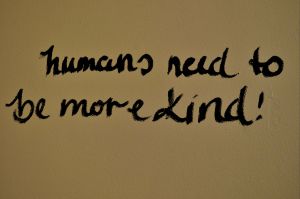
Be nice. All of us long to be nice to others, to family, friends, work colleagues, strangers, the world as a whole. Some of us would even feel better if we could only be nice to ourselves now and again.

Speak softly, go slowly in my interactions with others – loved ones or strangers, it doesn’t matter. While we all wish for others to be nice to us, we are all very aware that life doesn’t always work that way. But at the very least if we can be nice in every situation, then it’s better for everyone.

So, when slighted by another, spoken to with a loud or aggressive voice, or in some other way treated ‘not so nicely’, pause. Breathe. Then with confidence in yourself and what you have to say or do, be nice to that other.

Smile (when you can and it’s appropriate), be calm, assertive, but stay nice.

As to being nice to Self. Well, I’m trying to give up the negative self talk, and the self critical thoughts, as well as not so nice thoughts about other people or situations. Being nice to others is also an act of niceness to ourselves. We feel good when we’re nice to others (and bad when we’re not so nice to others).

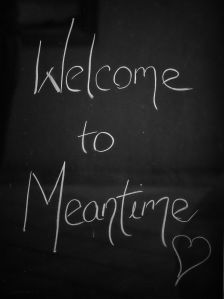
Meantime is so Yesterday. Make it Nicetime today!

Do nice

The verb do suggests doing; taking action. Do nice things for others – and for Self also. Sometimes it’s easy to do nice things for others, sometimes not so easy. Still, as with everything, it is the efforts we make that are the key: remember, nice makes nice.

Anyway, we’re all familiar with the brilliant (genius really) Random Acts of Kindness concept and movement. It’s a truly revolutionary idea that’s rightly spread far and wide and has become an integral aspcet of everyday life for many many people. Really any act of kindness, random or otherwise, is another way to describe doing nice.

And, once again, we shouldn’t forget about ourselves. Doing nice things for ourselves lifts our spirits, changes moods, enriches our lives overall. Don’t forget that doing nice things for others is just one more way we can do something nice for ourselves.

Consume nice. What am I putting into my body? What am I looking at, listening to, reading, buying – what am I consuming? How much of this consumption can I label as nice? How much of it is of benefit to myself or to any or all other beings, or to Earth herself?

And, the flip side of that question: Of all that I consume, how much is doing harm, again to myself, other beings, the planet itself?

Heaps, if you’re anything like me. I am engaged in constant struggle to change my habits of consumption. As I make these efforts, fight these battles with old old habits (I think I talked about this in a recent post?), I remind myself to be kind to myself when I fail to make forward steps – and just as or more often when I take a step (or two, or…)backwards.

Share nice. This one’s easy: reread all of the above. Well, okay, maybe there’s a little more to it than that. Actually, isn’t there an old aphorism that we’re all supposed to have heard in kindergarten? ‘Share nicely‘? I guess back then it was about sharing toys and other playthings with the other kids.

Now we are all grown ups, it means, well much the same really. If you have been blessed with material prosperity, be free with the way you share that good fortune.  Be free and generous with how, and with whom, you share that wealth with.

Equally, no it’s not equally at all; it’s way more important and significant. Share your time; share your skills; share your knowledge; share your experience. The best thing of all to share – the nicest thing – is your love.

Love works well, not only with those close to us, those we call loved ones. Love can be shared in all our interactions with the world, whether it’s family, friends, work colleagues, or with strangers we encounter as we go about our day-to-day lives.

Share nicely of course isn’t only about what you share; it’s also about how we share. Share with a nice attitude. We’re right back where we started, be nice. Approach all with an attitude of love, generosity, and kindness.

So, how does all this nice stuff contribute to our spiritual growth?

The Greatest Hashtag of Them All

Well, I think as we’ve just seen, nice equals love. I feel that having nice – love – as the foundation of our being, doing, consuming and sharing, helps us move forward on the path to the realisation that happiness does not come from outside of ourselves – and certainly not from material things like money, possessions, and the like.

Nice can really only start with me – with you. From within my own Self, which in truth is non-different than your own Self.

There is a beautiful – truly beautiful – expression that has become an empty, flavourless, hollow, meaningless platitude. I’d like to rehabilitate that expression right now.

I want to say with my heart and my love, to all of you:

Have a nice day

and

It’s only words. Or is it?

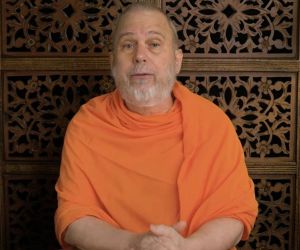
The other day, while listening to a talk by my teacher Swami Tadatmananda,  I was struck by something he said. Of course, being my teacher, there are many things that he says that have significance and that resonate with me. But these statements in particular found a home in me that day:

Words can’t get you there (ie realisation of our oneness with the Divine, God, Universal Consciousness, we may call it many things), but words can help you get rid of everything else.

Talking with my partner hermit this morning about this idea, I suddenly thought that for the vast majority of us there are only a given number of words used on a daily basis. And I think this would apply to whatever language we speak – even when you think of specialist groups like scientists, religious people, engineers, – any group.

I’m not talking here about whether me or you as an individual has a ‘wide’ vocabulary, or a ‘limited’ one; I’m just saying that there are only so many words we need to get by while living in our particular worlds.

And that thought led to a not so original idea that those words will be used to achieve all kinds of ends, including opposing goals and purposes.

In other words (no pun intended, I promise!), words may be used to attack and hurt others and ourselves; or in the relaying or writing of the news telling us (constantly and repetitively) all the bad things going on in the world; to express hate; to promote violence; in advertising for anything and everything; to threaten and dominate – have power over – other living beings or Earth herself.

Then, on the other hand, those exact same words can be used to heal others and ourselves; spread news about good things happening around us; in the prayers many of us utter every day; in the many holy scriptures and other sacred texts so many hold dear; to promote love and express love; to promote harmony and unity among peoples and with Earth and all her life; to empower ourselves and others to live well and to thrive.

So, where’s the difference? Well, I think there is a theme developing in this post: it’s going to be packed solid with obvious, even clichéd words and statements. What I’m getting at is this: Two very well worn clichés just popped into mind:

Sticks and stones might break my bones, but words will never hurt me.

And the other:

The pen (or any other means of communication) is mightier than the sword.

Behold the Mighty Pen

It seems to me that these two statements appear to be at odds with each other; kind of opposite ideas aren’t they? Well, clichés may be ‘hackneyed oft-repeated aphorisms’ (I read that definition somewhere ages ago), but I rather think that a great many clichés are merely truths passed down the ages that have been remembered and treasured precisely because they are true and have proven helpful.

Words can hurt; we have all experienced that truth for ourselves. Of course, for ‘enlightened ‘ people words might roll over them like, (forgive another cliché or two) like water off a duck’s back, or those words will go in one ear and out the other. But, I think most of us have a way to go before enlightenment, certianly it’ll be a rather high number of lifetimes before I’m even close.

Which means that before that day of enlightenment comes, words will continue to hurt. Or heal. All of us can think of many examples of words that can be used in so many ways, but let’s just take one example:

Power or powerful. In how many ways can we use that word? What does it mean if I say: ‘He’s a powerful politician’.?

Does it mean this politician is a dictator who forces people to do what he wants? Does he ban anyone who disagrees with him? Is he a believer in the myth that the people are all there to serve him? Does he raise taxes so he can live luxuriously? Does he make policies that keep people poor or hungry?

Or does it mean that this politician is a strong, good, and compassionate leader? Does he know how to empower people to move themselves and society forward? Is he sensitive to the needs of all the people he serves? Does he listen to the people and follow through on what they tell him? Does he do his best to ensure that nobody goes poor and hungry?

You probably get the point I think? Exactly the same words; two diametrically opposed meanings. Of course, we could all cite countless examples of this duality: same words, different meanings. And you know something? We all do it.

So, what’s the solution? How can we find words that don’t hurt? How are we to learn that our ‘pen’ (read voice, keyboard, paintbrush, camera, or any medium we use to ‘speak with’) is mightier? Well, until that aforementioned day of enlightenment is upon us, all we can do is practise; after all, practise makes perfect (sorry).

Okay then, how shall we practise? I can only tell you what I am trying to do myself. Focus on truth in all your actions, words, thoughts. Turn away, as your default response, from all that you know to be untrue. Develop your powers of discernment so you will know what is true and what isn’t.

And this requires that you remind yourself constantly that you already do know the difference. Your heart will tell you, so listen to it as well!

Does all this work. Yes. Maybe. Sometimes. But what I can say for sure is that practising this way of reconditioning your thoughts, words, and deeds so that they are all on the same page, (there I go again with the clichés again)  advances you ever so steadily on that road that leads to enlightenment, when we will know exactly what, when, and how to say what we need to say whenever we try to express ourselves in any given situation.