You’re Already There.

There are many blessings that come with the living of the hermit life. And I am especially blessed as I am not a ‘hermit alone’ – I share my life, the Hermitage, and my spiritual practice with another hermit. We are partner hermits.
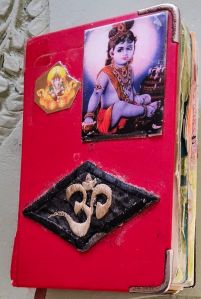
One component of that spiritual practice is our times spent together reading a few verses from the Bhagavad Gita. We pursue our own personal studies, but sometimes one or the other of us will share an especially resonant verse, or an insight or thoughts.

This morning my partner hermit told me, in a casual almost by the way manner, that she’d just read a verse that spoke about not disturbing others, and not letting ourselves be disturbed by others.

At first, I had no memory at all of this verse; I just couldn’t place it. Which might sound a little worrisome, given I’ve been studying this text for seven or eight years.

So, it wasn’t till she gave me chapter and verse and I looked it up for myself, that it finally clicked into place. Of course I knew this verse, but it had slipped from conscious memory.

And that surprised me: this verse seems to me to be speaking to a key concept in the teaching of the text as a whole, as well as to my personal aspirations. Surely, I would think, it should be, what’s the expression? Top of mind?

He [sic] who disturbs no one, and who is never perturbed by anyone, who is unattached to happiness, impatience, fear, and anxiety is dear to Me.

               Bhagavad Gita 12:15

This verse is full of meaning for me. It’s like a one-stop how to lesson in avoiding the personal suffering that’s brought about through attachments. Mind you, once again I can’t help wondering after years of study, and with how much this verse resonates for me, why I had such a hard time remembering even seeing it before.

I suspect the power of the ego and the mind have a lot to do with it. Ego – along with its master, the mind – love attachments to the world, to anything really. I guess they are always doing their best to keep me attached to my compulsions and aversions.

Imagine though, not being disturbed by anything – or anyone – and me actually not doing anything that disturbs anyone or anything?

Not just people and other living entities in my immediate physical environment, but out there in the wider world – in the Universe even.

It’s about vibes isn’t it? What vibrations am I putting out into the world? Are they vibrations and waves of love, peace, compassion, detachment, equinimity? Or at they vibes of discord, dislike, anger and sorrow over the stuff I can’t control?

And just think what it would be like if I weren’t so attached to the idea that my happiness depends on getting pleasure or ‘results’ from worldly things, activities based on the senses? Imagine really understanding that the only true and real and lasting happiness and satisfaction can only come come from within my Self?

This doesn’t mean at all that I can’t be happy, or can’t have fun or enjoyment. It is merely saying that, if I can accept whatever comes to me in life without clinging to the things I want, or running away from the things or situations I don’t want, then there will be less suffering.

Ego is jumping in now and wants me to note that, while I may in fact be on the path to detachment and freedom, I’m not far along enough yet to escape its clutches. Anyway, moving right along.

Impatience, fear, and anxiety are tricky presences in the attachment arena. I’m even less far along the path to letting go of these stubborn attachments. But, again, at least I’m on the path.

And what is that path? Where’s it going? Well (paradox alert), on the path in this instance is another way of saying I’ve not realised fully that I am already at the path’s destination. I just think I have a long way to go.
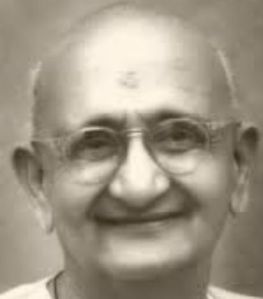
Swami Ramdas (1884-1963) Courtesy Wikipedia

I think Swami Ramdas said: ‘When you set foot upon the path, you have reached the destination.’ I think!

That’s the ‘dear to me’ bit of the verse explained. The ‘me’ in this phrase represents the aspired to full realisation that I am free, liberation or enlightenment some call it. It’s a place, or state of mind in which I move through the world with peace, calm and equilibrium, where nothing disturbs me, and I disturb no one.

That state of liberation doesn’t mean I have given up, or will have to give up, all desires for things I want, nor will I have escaped the things I have aversions to. It simply means I will no longer be driven by those desires and aversions, I will no longer be attached.

It means, too, that I will no longer be concerned in an attached way, to who says or does what to whom, when, where, why or whatever. At that stage I will be in the world, but not of it.

Of course, I am a hermit; you would think it’s easy for me being secluded from the world (well it’s not total seclusion). If only that were true.

I still have the clingings, cravings, and aversions; I’m even attached to the clingings and the aversions.

The one desire, the one I permit myself to cling to, is the desire to free from all other attachments, the attachments that cause so much suffering.

As long at I have that desire guiding my life, then I will be satisfied, when I can be, knowing that one day I will fully realise that I’m already free, unattached, liberated and happy.

There’s a song I wish I could remember the name of, or at least who sings it, but there’s a line in the lyrics that, says something like ‘I don’t want to go searching for what I already have.’ That’s me!

Me & My Senses

Today, once again, I would like to share with you some thoughts and insights on a quote I have written in the front of my Bhagavad Gita. Yes, I know, I do this quite frequently, but there really is a good reason.

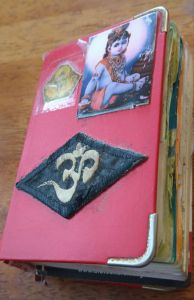
You see, for me, this particular Bhagavad Gita, this little book (and it is a little book: 10 x 7cm but still a little fat too!) is so much more than a collection of bits of paper with words printed on them inside a nice cover.

Well, it is a book, so of course it is that as well. But for me it is more a repository of wisdom. It is actually the first scripture or holy book of any kind that I have spent years studying. And over those years I have devoted who knows how much time, energy, heart and mind to it. As for how many times I’ve read it cover to cover, well I don’t keep count!

This Bhagavad Gita is truly a treasure trove that enriches me and my life every time I open it.

Anyway, enough of the praise and gratitude intro. Allow me to share the verse (in fact it’s a part of a verse) with you:

… restrain your senses and focus your entire mind on me.
               Bhagavad Gita 2:61

Let me try to explain why this verse – and this particular portion of the verse – is like a kind of motto or mission statement for my life. Well, to be honest, It’s one among a whole collection, but this one for me seems to especially significant.

It is through and only through, the senses that we are able to experience the world. In addition to the traditional five senses (sight, smell, hearing, taste, and touch) here we include the mind. This sixth sense includes all the activities of the mind.

When you think about it, the mind is really our major sense organ, in that it is in the mind that imput from our other senses comes together in such a way that allows us to perceive and experience the world around us as a coherent whole.

Then of course, the mind being a sense organ in its own right, does its share of providing us with imput in the form of thoughts and emotions. The problem arises when we let the mind have its way and we hand over control of our senses to our mind (and also we let our other senses free rein to control the mind) completely or at least in ways that  might not be in our best interests.

So, if we are to restrain our senses – all of them – what are we to do? Well, rather than getting into a long rave with a big list of what we should do, why don’t I simply talk about some of the ways in which I try to put into practice, the injunction to restrain the senses.

The Eyes of the Teacher

First, a disclaimer : I’m still in a human body. Meaning that I’ve been struggling with my senses for a long long time. And it means the struggle continues, just as it does with all of us. It’s the effort, though, that is the real key: to restrain the senses we might easily add retrain the senses including the mind.

For so much of my life I was careless about what I put into my body by way of my sense of taste. Food, I was not very controlled when it came to what, when and how I ate. I’ve been vegetarian for about 40 years and vegan for at least the last ten years. But until the last few years (and I still struggle now) that didn’t stop me from going for the tasty stuff – meaning the fatty and sugary things that can (and do) cause great harm, as they did to me.

Now, strictly vegan as I said, I never add sugar (okay one in coffee on very rare occasions), there’s no cooking with oils, and eating as little processed foods as is possible. Simple food too, simply cooked, with just a few spices. Surprisingly (to myself at least) I always have enough taste sensations to satisfy.

As to what I consume via the senses of sight and hearing, there is only so much that one can do unless one lives in a remote desert or mountain cave. Which, of course, some people do for this exact reason – to control and limit what they consume or are exposed to. Still, I don’t watch, listen to, or read news of any kind.

Like many people I watch videos on the Internet. While there is a massive amount of brilliant  content available, it is hard to sift through inappropriate suggested videos, impossible to avoid advertising, and even the news sneaks through quite often. For a while now I’ve been on the brink of deleting online video viewing platforms, but I’m not quite there yet. Soon.

Give up listening to Buddy Holly??? That’ll be the day!

As for music, I’ve gathered a large collection over the years. Lately however I’m finding that I’m not wanting to listen to much of the music I have.  Why? Well, I think as I’ve meditated more, studied, contemplated more, I’m slowly beginning to exert some discipline over my mind making me more sensitive to what my senses pick up.

It seems to me that more and more of the music and songs I’ve loved and listened to my whole life are about dark themes and subjects, about emotions made petty, and sometimes songs or tunes just feel plain and simply nasty.

I’m content with this outcome and curious to see where it leads. As with videos, TV or the news, so much of the music I listened to does’t speak of Truth, at least for me.

With a view to control visual and audio imput, I try to live in as quiet an environment as possible. As we all know, these days this is becoming more and more difficult, perhaps even for those who can retreat to the desert cave! And we have a saying in the hermitage about just this issue: Something’s gotta give! Meaning of course that the time is right for radical thinking and action to be taken in the search for silence.

Which leads me to mind – my mind anyway. Like yours, my mind is a raging torrent of often repetitive thoughts going in all directions (or none) and very often without any kind of rhyme or reason.

But, through the above efforts at discipling the other senses, I do have some control, not much, but… . Through an increasing amount of time and effort spent on meditation and engaging mindfully in all my actions as much as I can, I think I am at least giving myself (my mind that is) some control over the other senses, my thoughts, and all that mental chaos.

Now, what does it mean, ‘focus your entire mind on me’? Well, this is a question that you will find asked and answered  given in numerous books, blogs, and in many other places. But, for me, and to sum it up in the one sentence, it’s about focusing all my senses (including mind) on what is of the good, what is right, what speaks of truth, love, and is for the betterment of all beings.

I mentioned that our quote is only a part of a verse. Here’s the whole thing:

In order to attain steady wisdom {knowledge of the true nature of Self and the world} restrain your senses and focus your entire mind on me.
               Bhagavad Gita 2:61

Self Enquiry is the means to acquire Self Knowledge which leads to real wisdom

It is this wisdom, or at least the efforts we make at acquiring it, that is the way to a happier, freer life. At least that’s my take on it all.
Peace