
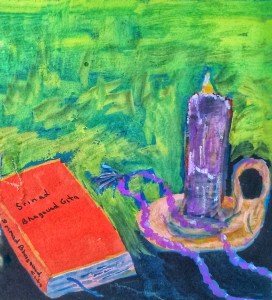
This morning as I do most mornings (trying to make it every morning) I sat for my practice starting with some prayers and reading a a few random verses from Bhagavad Gita.
Then I settled to spend some time in devotional chanting of mantra. For a change this morning, while chanting I listened to a lovely album of devotees chanting the Hare Krishna mantra:
Hare Krishna Hare Krishna
Krishna Krishna Hare Hare.
Hare Rama Hare Rama,
Rama Rama Hare Hare.
I reached for my mala (prayer beads or rosary) and as I mentally repeated these holy names in accompaniment to the recording, I held a bead between my fingers for each repetition, focusing on the chant.
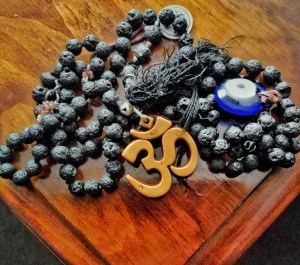
Now, chanting is much like any other human activity: that is to say, the mind is always there. Usually it manages to bring up all kinds of irrelevant fears, memories, questions, you name it. Today, however, one of those supposedly random memories actually caught my attention in a good way and took me along.
As I continued handling my prayer beads I thought about a story I read in India nearly 15 years ago now. The story concerned prayer beads as it happens. Buddhist nuns, imprisoned in Tibet, were forced to resort to making their own rosaries in secret after their meagre belongings had been seized.
Almost ten years later, after another extended stay in India, I finally was able to write about this story. In this instance it came into being as a poem I called Homage to Holiness. May I share it with you here?
Homage to Holiness
Threads harvested from threadbare clothing.
Pea-sized bits of bread, sliced from meagre rations,
secretly hoarded for sacred purpose.
Mala makers work at night
in the dark of the stinking and freezing stone cell.
Chewed bits of bread become dough again,
and, by feel, frozen fingers knead the dough
until tiny beads are created.
An even tinier twig, again by feel, pierces each bead through.
Then in solemn prayerful silence and focus,
the nun passes her harvested thread through the first bead.
She ties a knot, no easy task with freezing fingers in the frozen dark.
And so it goes; all sacred duties take their own time.
One by one; one bead of bread threaded; one knot knotted.
The nun nears collapse. But now, at last, her task is done.
As the last knot is knotted, the last bead in its place,
the nun sighs and mutters, whispers, a prayer of thanks.
One hundred and eight beads – plus one – made, and strung
Her Mala
Om Mani Padme Hum
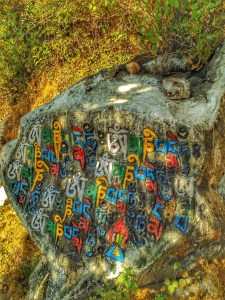
Probably the most sacred and significant of all Buddhist Mantra, Om Mani Padme Hum, means something like ‘the jewel is in the lotus’. But many would say it goes a lot further than the mere literal translation of the words; It is said to be the actual path to Enlightenment. There is a huge amount of information on the Internet about this mantra, so if you’re interested a good place to start is at this link.
Whatever the actual literal meaning, interpretation, or who chants it, I think we can all agree that the intent of this mantra is to have us focus on the divine, or on the Ultimate or Absolute reality. The same as any mantra one might choose actually. Remember last post? God is.
in any case, I think somewhere above I’ve used the word random. Well I should know better by now: no such thing as random. One of the Bhagavad Gita verses I read – in fact the final one I left marked with my bookmark – seems to me fit very nicely with that ‘random’ memory of a story read years ago, and my humble retelling of the story in a poem many years later
One who knows the Absolute and whose intelligence is fixed on the Absolute is not moved by pleasure or pain, pleasant or unpleasant happenings.
Bhagavad Gita 5:20
Did that nun imprisoned as she was in the dark and the cold feel that pain? Did she feel fear? Of course she did. The thing is, she was, as constantly as her circumstances allowed, fixed on the Absolute: the activity of making the mala, the intended use of the mala, and her prayerful attention and devotion as she worked, all enabling a complete fixing of mind, heart, and attention onto the Absolute.
The cold was still there; the hunger and fear too. But this nun was able to remain centred, you might even say calm and content, despite the dire situation.
Actually content was a word I read in relation to this nun and her sisters (she wasn’t alone in that prison cell): From what I read they were released after some time, and eventually escaped to India where they rejoined friends, family, and of course their leader the Dalai Lama
At the time the story was being recorded for posterity, the Mala Maker reported that she was happy and content and leading a full and fulfilling life. I imagine her as still being fixed on the Absolute.
Thank you for allowing me to share these moments with you
Love and peace
 Notes from the Hermit's Cave