Tripping On the Sidewalk

Walking home, returning to the sanctuary of the hermitage, I fell over. Or to be exact, I tripped.

It’s not the first time I’ve tripped in my life, and I’m sure it won’t be the last. Mind you, I’m not supposed to be making speculations about the future; after all, I may never fall over (or trip) again.

Let me share with you how I came to find myself lying on the ground, fully conscious thankfully, with only a few grazes on arms and knees, and a sore spot on the side of my head.

Walking along the sidewalk quite freely, earbuds feeding my ears and my heart my favourite mantra to Ganesha – known as the remover of obstacles and the God of wisdom. (more on the earbud issue later)

At one point I noticed, a few metres ahead, what appeared to be the back of a largish sign board leaning against the base of an electricity pole growing out of the pavement.
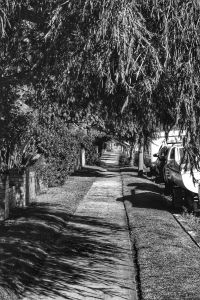
Not the actual sidewalk

Without any thought whatsoever, as I came up to that pole, I turned my head to the left to see what the sign read. Next thing I know, is I have the sense of falling. Later I remembered that at the exact moment I turned my head, my foot caught the broken and uneven edge of a slab of the pavement.

I was blessed by two passersby who stopped and helped me back to my feet, and stayed with me as I regained some semblance  of my bearings. Thank you to those two good and kind ones.

Now, I don’t like falling over (well, when you think about it, who does?), but in this case I can say through this fall, I have learned a couple of good lessons.

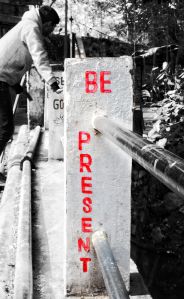
Presence – or lack thereof. Here I am, the hermit monk who is supposedly constantly practising being present, in the moment, here and now; yet I tripped over what I later discovered was a really obvious, clear obstacle on my path.

We all get distracted, you might be thinking. And, yes, it’s true. We can be paying close attention, fully focused, riveted to and in the moment, and, suddenly distraction barges in – in the form of a thought, an external noise, visual imput, and even a broken pavement. You name it, and mind will use any excuse it can to manifest a distraction.

Another lessen – intimately related to presence –  is pausing, or not! As I noticed that sign coming up, I could have chosen to pause to look at it once I reached it.

Then, rather than being a distraction, looking at that sign would have simply been another moment in the ongoing flow of the present. In other words, there’d have been no tripping.

The actual earbuds in question

Now, to the earbud issue. To be honest, my earbuds have more or less replaced my regular over the ears headphones. Because I was never comfortable going out and about with those clunky things on my head and earbuds have allowed me to listen to music pretty much whenever and wherever  I go. Even to me wearing them, they are barely noticeable. It’s possible that’s the problem right there: unnoticeable.

More than 30 years ago now, I spent every Tuesday evening for a year attending classes at a school of philosophy . To this day I still follow some of the practices I learned there. And, passed to me were so many good lessons, so much good knowledge drawn from many of the world’s spiritual and intellectual traditions. So many of these lessons have stuck with me.
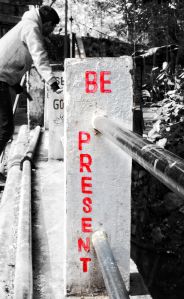
Presence, or rather the benefits and rewards of realizing  the present is all there is, was I would say, one of the cornerstones of those teachings.

One illustration about presence concerned driving, and although at the time I haddn’t learned to drive, it resonated with me. Our teacher told us that, when she was driving, she never listened to music or anything else. She told us that she simply put her full attention on the task at hand: driving.

She described how it often happened that when driving she’d reach her destination with little or no memory of the actual act of driving or any landmarks or events on the trip itself. She said it was if she was somehow unconscious, yet still able to drive ‘on autopilot’ was how she put it.

And of course it’s not a phenomenon limited to driving: how much of our routine daily activity runs on autopilot?
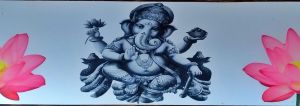
Anyway, back to the other day and me grooving to Ganesh in my ears and tripping in a moment of inattention.

I don’t recall being distracted by the mantra in my head, or moving on autopilot. But, thinking back, I was in one of the busiest sections of the little town that hosts our hermitage. I’d been to the supermarket, the parking lot of which is as busy – and crazy –  as one you would find in any big city.
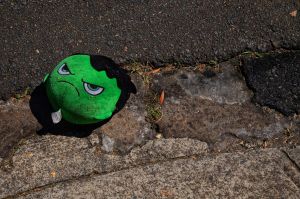
Just another sidewalk tripper

So, I realise now, I had already kind of set myself up to fall for any distraction that happened to come along. While I don’t really remember myself as being ‘unconscious’ of my surroundings or of the path itself, clearly I wasn’t completely there, not in the here and now sense if you know what I mean. Just an after thought: who remembers ‘being unconscious? Nobody I think!

Whatever I say now, I wasn’t present; I wasn’t fully in the moment, not paying attention to either what I was doing or what was going on around me.

Since my little trip, I have vowed before my hermit community to not ever walk again in a built up and busy area wearing my earbuds.

Not only do I have a sense of danger lurking when I think of the idea of wearing them in those situations, but I also feel that it’s not exactly being present, in the here and now is it?
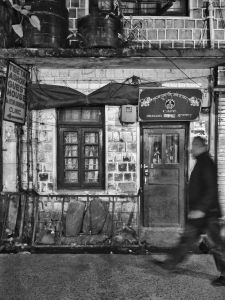
Another closed cafe on some other trip

Okay, I am very sure you are waiting with great anticipation to learn what what fateful sign, put in my way by the Universal Traffic Controller to push me into changing direction, actually said:

It was a handwritten advertisement for ‘great coffee’ to be had in a cafe across the road. A closed cafe I might add.

On Main Road –  a road that more than lives up to its name –  perhaps there are worse fates awaiting the inattentive than merely tripping on the sidewalk.

Where? & When? Here & Now


There, dear friends, right there, in the title are our next two W questions, as well as the answers to both.

The answer is brief, succinct, right to the point, yes indeed. But somehow to me it doesen’t seem very helpful, a bit vague.

Here and now. Let’s look at this tricky little phrase. On the face of it Here and Now has an obvious meaning: if we choose to think on it in the spirit of our ongoing contemplation on my prayer life, it’s very clear. Here and now is a timely reminder to me to pray right where I am, right now, wherever I might be; and whatever the time, day or night.

But it’s not really a very satisfying answer is it? Here and Now? It seems too flippant to me, too bland, even a bit of a ‘catch all’ cliche thrown around without any real insight into its meaning or importance.

Anyway, moving right along …

We are exhorted to pray without ceasing in the Christian Bible with similar exhortations found in so many other texts and scriptures from many faith traditions.

Remember my aspiration to make of my life a prayer? Well, that’s the idea: to pray without ceasing. Which translates to mean that everything I do, say, think, feel (what else?) will be prayer – or I can also say a prayer. Life is a prayer, life is lived as a prayer.

Of course the precise forms my prayer takes are – and will ever be – many and varied. We’ll be looking at some of those forms and types later in the How post of this series. But, for now, allow me to brainstorm on the topic for a bit.

Consider washing the dishes, a task we all find ourselves engaged in to some degree or other. I have a sense that my feelings towards dish washing is actually quite neutral. Don’t get me wrong: if I never had to wash a dish again you would not hear me complain.

At the same time, I have absolutely no hard feelings against washing dishes.I just get on with it, just like most everybody else.

Sticking with dish washing …

Most often dishes need washing as a consequence of preparing, cooking, and eating food, for a meal or meals. Right there is an obvious opportunity for a simple prayer of gratitude.

It might be a simple whispered thank you for the gifts of the nourishment, satisfaction, even pleasure of the meal. Anyway, just a random first thought on the subject.

There are a few other points to be made in our little dish washing thought exercise as it fits into my own prayer life.

Sometimes, while actually dish washing and cleaning up, I might chant mentally, or otherwise pray with words – set prayers. Prayers of praise or gratitude; mainly whatever pops into mind. Go with the flow is the theme here.

Now, that’s one thought. Next: I might decide to be quiet while washing up. That is not speaking and being as silent inside as I can be.

On these occasions I just focus as intently as I can on what I’m doing: washing dishes. I make it an occasion for not doing the dishes just to get them done, or to get them out of the way, or to put an end to an onerous chore.

Rather, it’s more an opportunity to simply wash the dishes, by being with the dishes and the actions required to clean them. Just a little aside: this particular form of mindful (prayerful) dish washing actually results in cleaner dishes. It’s been proven scientifically.

These two approaches to washing dishes – not to mention all the other means and forms of prayer – are not necessarily mutually exclusive, nor are they the only one: a given dish washing event might involve several prayer modes.

Which leads me to the next thought that I had more or less forgotten…

Sometimes I do indeed slip into that old ‘Just get the blank blank things done’ frustration mood. And it doesn’t just happen when faced with the dishes!

It goes without saying that I wouldn’t need an aspiration if I was already acting full time in that prayerful manner. I do practise – sometimes with more determination than others – performing all my actions mindfully (aka prayerfully), though there’s far to go for me in the praying ceaselessly department.

So, to a good question you may be asking: Is there somewhere (or multiple somewheres) that I go to to pray? Some special sacred or holy place?

Well, I know that we are always all of us standing on sacred ground – it is all the Divine. Still, there are places that help me, all of us, feel closer to that divinity, to the sacred, to God, or whatever we call it.

There are places that exude that special vibe, or have a certain  atmosphere of calm, quiet, or stillness, that are conducive to prayer.

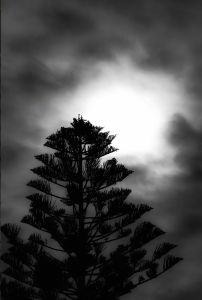
An apparently random glance skyward blessed me with this moment and this place of prayer

Talking about the idea that we are always standing and walking on sacred ground,  there are often places I come across that speak to me as places of prayer. It might be a tree, like the one pictured here; it might be a  distant view of a lake and the hills beyond.

Such places call to me to stop. Perhaps for a moment, perhaps to sit and linger and pray with words, or with silence.

In the Hermitage, there is  temple, a room we have set aside for that purpose, and no other. From the very first day I set this room aside as a temple, I have felt a stillness there, a tranquil vibe.

Among such spontaneous  little moments, there are times I simply stop and stare at a flower, or without thought put my hand on a tree. I will whisper a quiet thank you and a blessing to the Divinity I sense there.

Temples, churches, chapels, prayer rooms, mosques, and other types of sacred sites from andy and all spiritual and religious traditions, attract me as well.

These are all places people have spent time in praying, contemplating their lives and their union with the Divine. All that energy, all that love and devotion has caused an atmosphere of holiness, or sacredness to build up over what can be years, centuries, even millennia, in some places I have prayed.

But, really, when all is said and done, anywhere and anywhen can be and is a place for prayer. Here, in this booth, in the cafe at the lakeshore near the Hermitage, I make these notes in a mood of prayer, a prayer of love and devotion.

Being present, mindful, and prayerful in all I do, that’s my aspiration. Here and Now. Anywhere and anywhen; it’s all prayer.

Well, that’s my prayer anyway.

A Love Song to a Love Song

Deceptively simple is how I’d thought to describe the lyrics of a love song by John Lennon I heard again recently for the first time in years.

But, no I thought straight away, that’s not right. The message of the song is simple, and the lyrics convey that message to us just as simply.

Of course why the song is so powerful – and personally significant to me and so many others – is that, while the message may be simple, the ramifications of really hearing the lyrics, really digging the words and trying to put them into action, are far from simple or limited and have few if any boundaries of any kind.

The one word title of the song I’m talking about says it all: Love. Lennon included Love on his first solo album with the Plastic Ono Band, which was released in 1970. So not actually a solo album, but you know what I mean.

The original purpose of this post was to share with you a poem I wrote in response to reconnecting with this masterpiece.

While I will still be sharing that poem, I thought I would first let you see the lyrics of Love put together through my own listenings to the song itself. No copyright breach is intended here. I only print the lyrics for illustration purposes, and besides, if you can’t share a song called Love, by John Lennon, what can you share?

If before or after reading the lyrics you prefer to actually listen to the song being sung by John, then just head here for a great early version.

Love is real, real is love.
Love is feeling, feeling love.
Love is wanting to be loved.

Love is touch, touch is love.
Love is reaching, reaching love.
Love is asking to be loved.

Love is you,
You and me.
Love is knowing
We can be.

Love is free, free is love,
Love is living, living love.
Love is needing to be loved.

You see? Simple lyrics, simple melody, but the message! It’s all about the message. Or is it an invocation? A love mantra?

Mind you, the song is presented in such a light-hearted and gentle soft manner, that it might be easy for some to dismisss the message as being merely wishful or fluffy thinking. But, there really isn’t anything fluffy about love is there?

Now, to my response. Well one response among many I should say. I offer this poetic effort in humility and gratitude – indeed, in and with love.

‘Cos as John wrote in another great anthem:

All you need is love

Peace from Paul the Hermit

JOHN WROTE A LOVE SONG

John was a singer and a writer of songs.
John was a friend of mine – yet never known personally.
Yet known by me all my life.
A fab friend for everyone.

John wrote songs, songs he sang,
lyrics given life by voices
very few heard.
It was hysterical.

He wrote a love song, a song I heard and loved.
In fact, a whole lot of love songs he wrote.
One verse, in that one song, caught my ear, snatched at my heart.

This is the verse,
    the stanza I love:
       Love is you
       You and me
       Love is knowing
       We can be.

No sickly, sweet sentiment this.
Not like some plastic bobble-head
lurking in some grubby rear window.
No, as the song he wrote says:
Love is real.

Love not for the sake of getting it right all the time;
Love not for the sake of always looking like the good guy;
Love not for the sake of a distant and cold devotion;
But love,
Love for you alone.

What? It’s the Next Question

I’m rewriting this post after initially making it another two for one thing. One of those two questions had been: ‘What is prayer?’. As in what form can and does prayer take, my prayer that is.

Then I realised that all the thoughts, all the contemplations and reflections I came up with in answer, belonged more correctly in the How question which will be coming in due course.

Which means, that in this post we will be looking at just the one question, which also is only about my own personal prayer life.

What do I pray for?

As it happens, I have already spent a little time on this question in the Why do I pray? post back in November. I think it would be a good start to begin this post with a quote from that one:

  ‘So,’ you might ask, ‘you pray without any ulterior motive at all? You don’t pray to get things? You don’t pray for healing for others or yourself? You don’t pray for peace and happiness for the world or for yourself? None of these things?’
  These are good, valid questions. And the short answer is yes, of course I do. I do pray for healing for others and myself; I do pray for communal and personal peace. As for happiness, well who doesn’t pray in one way or another for a just a little happiness now and again?
  However, I do draw the line at praying for material things, like money and material objects to possess, none of those kind of things. I believe I don’t pray for such things. I think so anyway.

Now, I don’t know about you, but it seems to me that those two last little sentences are broadcasting a very clear message: Obviously there is some uncertainty in my thoughts about what I actually in fact do pray for.

Somewhere, sometime, recently I wrote to the effect of that there is nothing to pray for, and that there is nobody to do the praying. This, of course is not a notion we can really get to grips with while living in a material body in a material Universe.

It’s nore for those dwelling in some transcendental realm where everything that exists has ceased to exist, and all that remains is pure consciousness.

So, obviously while we continue our existence as embodied beings, living in a material universe, there is much to pray for and there are many of us who do pray. Speaking only for myself personally, I know I could pray more, better, and deeper. As I’ve mentioned many times, my aspiration is to make my entire life – physical, mental, spiritual, – a prayer.

Okay, that’s all very good and fine, but I still haven’t answered the question: What do I pray for?

Well, as I mention in the quoted passages above, I pray for healing and peace for other people, the world, and for myself. I pray for happiness, health, and freedom from suffering for all beings.

But it’s not that I’m directing my prayer to some being up there in some heavenly realm who sits arbitrarily dispensing favours or denying them, and who acts according to the quality and quantity of prayers sent their way.

No, it’s more about, as I talk about in Who do I pray to? the post before this one, directing my attention, thoughts, actions and everything else, to the symbols that represent for me the natural flow of the laws and order of the Universe. Why?

Seeking alignment, I think that’s the best answer. By praying I am seeking to align myself, to put myself in sync with those natural laws, with the flow of that natural order.

Referring to the quote above, the peace and healing I pray for are like affirmations of my desire for that alignment, and that the entirety of Self itself be in alignment. That Self I speak of is of course all that exists in the Universe.

It’s similar when talking about praying for material ‘things’ while remembering too, that healing and peace are also in fact ‘things’ of the material world. Perhaps the best way to put it is to say that it is not the ‘things’ themselves that I pray for. With the risk of sounding like i’m repeating myself, it is correct alignment with all material existence that I am praying for.

Actually, it is more than that now I think about it. My prayer – and my life – is actually about my seeking to properly and fully realise that (to quote the glorious Desiderata:

No doubt the universe is unfolding as it should

We suffer when we label that unfoldig or a person, a thing or event or whatever as good or bad, desirable or undesirable; when we think there is a them and there is a me or an us always separated; when we are compelled to gather possessions and yet still think we never have enough. These are the dualities of material nature.

My prayer is to realise, not just know in my mind, but realise in my heart, that there are no dualities. There is only … Ummm. Well, perhaps that’s it: There is. Only. Nothing else. Only. Is.

May all beings come to know their Isness.

Who? Just One of Many Questions

In November last year I published a post on this blog that sought to answer the question, Why do I pray?
In that post I said that this question is one of the big ‘Who am I’, Self-Enquiry questions.

I also claimed in that post that it was (is) a core aspiration of mine that I make prayer a ‘whole of life activity’. To quote me from that post:

You see, I want to pray, and make my whole life a prayer. A prayer of praise and devotion; a prayer of gratitude and loving; and a prayer of service to all beings .

Anyway, moving along to today’s post.

That question, why do I pray, is one I ask myself quite often. It’s not a one time enquiry you can tick off and move on from. The contemplation of why pray is an ongoing and evolving thing.

A couple of days ago, as I once again reflected on this particular question, it occured to me that perhaps it wasn’t the only one I needed to be asking myself if I am to think about my prayer life in any depth. Actually, the same could be said for pretty much anything one is trying to find answers to.

Indeed, many writers – particularly story tellers and journalists – will be aware of the series of questions often used to get to the truth of something:

Who? What? When? Where? Why? and How?

Commonly refered to as the ‘The Five W Questions’ (although there is that H in the mix leading to some calling them the WH Questions), these questions asked correctly and thoughtfully, will help to ensure a comprehensive and complete answer to any enquiry.

The next thought popping in suggested that it might be a great idea to apply the W Questions (including the H) to me and my prayer life.

At first I thought it seemed like a neat challenge, a kind of intellectual exercise that would be interesting. Then, though, after thinking about it some more, I realised that contrary to being just some mental challenge, asking myself these questions in relation to my prayer life, might actually be essential.

Especially if I am to some day reach fulfillment of my aspiration to make of my whole life a prayer. It’s the only way, I reasoned, that I would be able to get complete picture of the state of my prayer life.

Of course I have to wonder if it is indeed possible to ever get a ‘complete picture’ of a phenomenon such as an individual’s prayer life. Still, let’s just plunge in, see where it goes, what happens, how it works.

Who

There are actually two ‘who’ questions that I’d like to try to answer, both essential to our enquiry:

Who is it that’s praying? And Who do I pray to?

The answer to the first question is obvious: it’s me doing the praying. But, which me exactly? Not the me who is the true Self, the Absolute Reality. The reason why will become clear as we go along.

No, the me doing the praying is what we might call the body mind complex, the me that lives in the material world as a material being. The impulse to pray, what to pray, who to pray to and all the rest arises in the mind.

Mind you, I along with so many others I’m sure, like to say that I pray with and from my heart, my spiritual heart. But then I do also know that emotions originate as thoughts in the mind. Of course that does not lessen the significance of such emotions and the prayers, love, or devotion that follows.

Now, who do I pray to? I know it’s going to sound a bit odd, flippant and even silly, but as I think about it, I realise that I do in fact pray to everyone and to everything.

Which is to say, my prayers are directed to that invisible ‘something’ that pervades and permeates – and actually is  – everything that exists. You could say that I pray to existence itself. There is nothing or nobody else.

Of course it’s not exactly an easy thing to get a handle on praying to ‘everything and everybody’. I mean, where does one direct their attention? Who or what does one address or speak to? The answer is a lot more straightforward than you might think at first.

Because my prayers are to that amorphous ‘everything and everybody’ it’s quite easy to select one or more resonating and meaningful somethings or somebodys as the objects of my prayer.

There are many spiritual or religious traditions in the world, all with their preferred names and forms of the Divine (or Existence as I named it earlier). Each of these manifestations of the Divine has its own characteristics, their own place in the Universe. They each play their own roles in the cosmic order.

As such there are more or less an infinite number of choices for me to have as foci for my prayer life. I will try to share with you a few of my personal pantheon.

Om: The Essence of Brahman, Absolute Reality

The Existence I’ve mentioned a couple of times is named by some Brahman, the Ultimate Reality, the everything and everybody that I was talking about.

So, I might sometimes pray to Brahman. Mainly it’s an aspirational prayer as I seek to realise fully my already existent oneness with the Ultimate Reality.

Then there is Ishvara, which is probably closer to what most would recognise as God – a personal supreme being, Or, in some traditions Ishvara simply refers to the one or more deities that an individual chooses as objects of her or his devotion.

Centre of Attention on the Hermitage temple alter

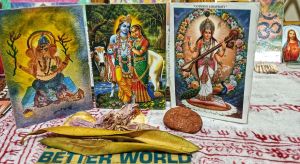
Also included in my personal pantheon, are the Divine Mother, Kirishna, Ganesha, Lord Jesus, The Buddha, Sarasvati, as well as other teachers and saints from many traditions who pop in and out of my prayers, seemingly at random.

My prayers are of praise and/or gratitude to the teacher, deity or saint who seems to me at that moment to be most linked to my current circumstances and thoughts.

All of this I call prayer. To God. Or Brahman or Ishvara. Or very often, simply My Lord,

Divine Mother