Received Wisdom: A Good Thing?

Namaste to all of you. In keeping with my ongoing (and ever frustrating) resolve to live fully in the present, I won’t comment on my long absence from the pages of this blog. Suffice it to say the hermit has been in his cave and acting as monk-like as he has been able. And as well, it’s good to be back!
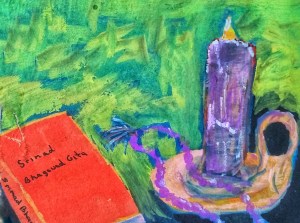
One thing I have been doing during this, let’s call it, blog sabbatical, is continuing my study of the Bhagavad Gita. Not long ago I rediscovered a couple of verses in my notebook along with some notes I’d made that got me thinking about a kind of trap that gets us all at some time or another, and some of us all the time.

First, let me quote the verses for you so you get a picture before we proceed too far.

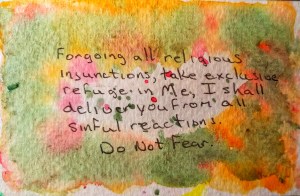
Forgoing all religious injunctions, take exclusive refuge in me. I shall deliver you from all sinful reactions. Do not fear. (Bhagavad Gita 18:66)

Just a quick side note: in this verse I think ‘sinful reactions’ refers to the risk of accumulating bad karma. You get it I’m sure.

Now that second verse:

When your mind is fixed and unmoved and not confused by scriptural injunctions you shall attain yogic samadhi. (Bhagavad Gita 2:53)

I don’t think it likely that any scriptural text would be telling us to bypass or ignore the very content of that text. Still, that’s exactly what both these verses seem to be saying.

In any case, here is where we can leave the verses themselves and look at what they are actually saying. The underlying message here I think is really a hint at how to live our lives, how to approach all we hear, see, learn and do. Which kind of sums up what you’d think a good scripture should be doing doesn’t it?

Anyway, it seems to me the essential message here is, don’t believe everything you read. Or hear or see or learn. Don’t slavishly follow any so-called rules laid down by others. Fix your mid on God, or we can say, fix your attention, model your actions and focus your thoughts, on Truth.
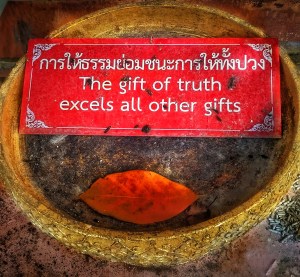
Ask questions, think for yourself, and then you will reach truth. Don’t rely on (don’t automatically dismiss either) ‘received ‘wisdom’, whatever the source.
Of course none of this sanctions us to do whatever we like without regard to the consequences of our actions. After all, we all know the difference between right and wrong.

If we focus on doing right (focusing on what is true) and staying away from what is wrong (what is untrue) we won’t necessarily always succeed in actually doing right. But the river of your life will be flowing in the right direction.

When Misreading is no Mistake

We’ve all  had this experience I think. I’ll be reading something, and right away I’ll come to a conclusion, become either sure of something or the complete opposite; I can be confused, force myself to ask more questions. I can even have brilliant insights or realizations.

No? Well, maybe it’s really just me then. But, wait there’s more: this is a two part experience. When that second part happens we will come to realise that what we think we read is nothing at all like what the words on the paper (or screen) actually said in a factual sense.

Yes, you’ve probably guessed by now that there’s a story coming. In fact this exact thing happened to me this morning, all the way to the brilliant insight or realisation bit.

In fact it was a brilliant realisation, the only problem was that it was based on only on what I thought I read, not what was actually being said.

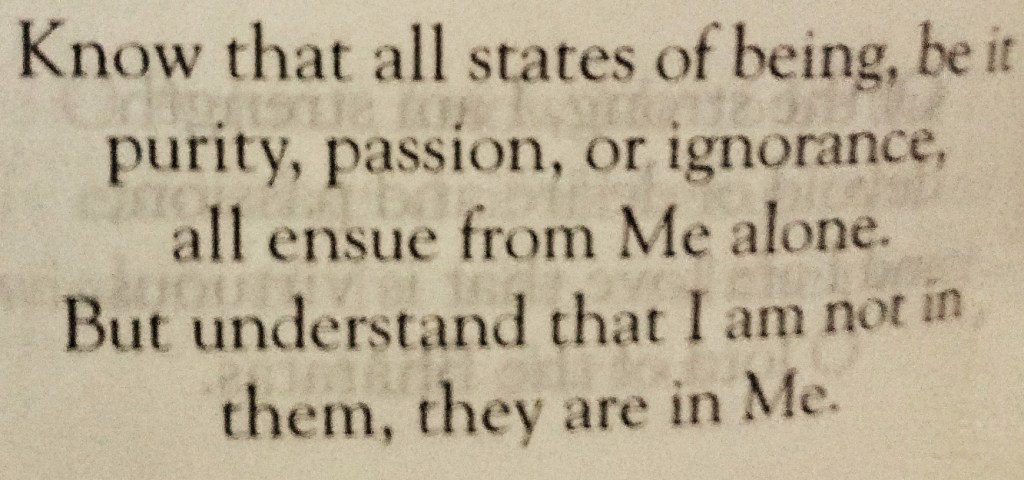
Anyway, I was reading the verse quoted below, from my Bhagavad Gita and a sudden flash of insight hit me.

Despite these five lines saying a particular thing in a clear and precise manner, I somehow misread the first three lines to say:

All beings ensue from Me.

Bhagavad Gita Ch 7:12

Somehow my mind skipped the ‘states of’ bit and made a leap that actually lead to a great realisation: Of course, I thought; God is not in us (as in living beings), it’s we who are in God.

Which to me means that we are all part and parcel of God. I’m not saying, I’m God; I’m not saying you are either. What I am saying is that all creation as one, unified whole, is in God. And if that one unified whole does indeed ensue from God, then it follows that all of creation is God.

As individualized, embodied entities, we (along with all life everywhere) are simply manifestations in the material form of that divine energy, that life, that truth; that which we often call God.

Now, this is an instance of a flash of insight leading to a truth, when the receiver of the insight (that’s me) is engaged with what you might call some other factual reality, that is, the actual words on the page.

At first I thought, that’s weird: how did I misread all those words related to states of being? I mean they are pretty clear right? But then I thought, no, maybe not so weird. In fact, it makes sense.

How can my material mind and intellect possibly be expected to always keep its millions of thoughts, ideas, impulses and the rest, in perfect order each thought or whatever following completely logically from the one before and to the one after? It’s never going to happen is it? Not for any of us (Well maybe I’m overstating my case here, but you know what I mean).

And if mind does indeed operate on what seems on the face of it to be a random basis, then it’s perfectly reasonable to suppose that one might be prompted to some momentous insight by, well by anything really. Even if it’s a conclusion jumped to after the misreading of a text.

In this case though, that jumping to conclusions, even though based a misreading, has turned out to be a genuine realisation that I feel on an intuitive level; my instincts tell me it’s Truth.

Jai Gurudev
All that I am today is by your grace.

Homage to Holiness: A Story to Share with You

This morning as I do most mornings (trying to make it every morning) I sat for my practice starting with some prayers and reading a a few random verses from Bhagavad Gita.

Then I settled to spend some time in devotional chanting of mantra. For a change this morning, while chanting I listened to a lovely album of devotees chanting the Hare Krishna mantra:

Hare Krishna Hare Krishna
Krishna Krishna Hare Hare.
Hare Rama Hare Rama,
Rama Rama Hare Hare.

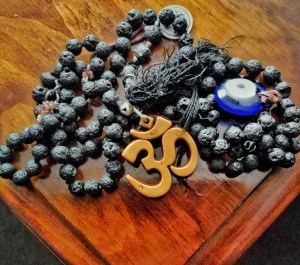
I reached for my mala (prayer beads or rosary) and as I mentally repeated these holy names in accompaniment to the recording, I held a bead between my fingers for each repetition, focusing on the chant.

Now, chanting is much like any other human activity: that is to say, the mind is always there. Usually it manages to bring up all kinds of irrelevant fears, memories, questions, you name it. Today, however, one of those supposedly random memories actually caught my attention in a good way and took me along.

As I continued handling my prayer beads I thought about a story I read in India nearly 15 years ago now. The story concerned prayer beads as it happens. Buddhist nuns, imprisoned in Tibet, were forced  to resort to making their own rosaries in secret after their meagre belongings had been seized.

Almost ten years later, after another extended stay in India, I finally was able to write about this story. In this instance it came into being as a poem I called Homage to Holiness. May I share it with you here?

Homage to Holiness

Threads harvested from threadbare clothing.
Pea-sized bits of bread, sliced from meagre rations,
secretly hoarded for sacred purpose.

Mala makers work at night
in the dark of the stinking and freezing stone cell.
Chewed bits of bread become dough again,

and, by feel, frozen fingers knead the dough
until tiny beads are created.
An even tinier twig, again by feel, pierces each bead through.

Then in solemn prayerful silence and focus,
the nun passes her harvested thread through the first bead.
She ties a knot, no easy task with freezing fingers in the frozen dark.

And so it goes; all sacred duties take their own time.
One by one; one bead of bread threaded; one knot knotted.
The nun nears collapse. But now, at last, her task is done.

As the last knot is knotted, the last bead in its place,
the nun sighs and mutters, whispers, a prayer of thanks.
One hundred and eight beads – plus one – made, and strung
Her Mala
Om Mani Padme Hum

Probably the most sacred and significant of all Buddhist Mantra, Om Mani Padme Hum, means something like ‘the jewel is in the lotus’. But many would say it goes a lot further than the mere literal translation of the words; It is said to be the actual path to Enlightenment. There is a huge amount of information on the Internet about this mantra, so if you’re interested a good place to start is at this link.

Whatever the actual literal meaning, interpretation, or who chants it,  I think we can all agree that the intent of this mantra is to have us focus on the divine, or on the Ultimate or Absolute reality. The same as any mantra one might choose actually. Remember last post? God is.

in any case, I think somewhere above I’ve used the word random. Well I should know better by now: no such thing as random. One of the Bhagavad Gita verses I read – in fact the final one I left marked with my bookmark – seems to me fit very nicely with that ‘random’ memory of a story read years ago, and my humble retelling of the story in a poem many years later

One who knows the Absolute and whose intelligence is fixed on the Absolute is not moved by pleasure or pain, pleasant or unpleasant happenings.

Bhagavad Gita 5:20

Did that nun imprisoned as she was in the dark and the cold feel that pain? Did she feel fear? Of course she did. The thing is, she was, as constantly as her circumstances allowed, fixed on the Absolute: the activity of making the mala, the intended use of the mala, and her prayerful attention and devotion as she worked, all enabling a complete fixing of mind, heart, and attention onto the Absolute.

The cold was still there; the hunger and fear too. But this nun was able to remain centred, you might even say calm and content, despite the dire situation.

Actually content was a word I read in relation to this nun and her sisters (she wasn’t alone in that prison cell): From what I read they were released after some time, and eventually escaped to India where they rejoined friends, family, and of course their leader the Dalai Lama

At the time the story was being recorded for posterity, the Mala Maker reported that she was happy and content and leading a full and fulfilling life. I imagine her as still being fixed on the Absolute.

Thank you for allowing me to share these moments with you
Love and peace

Tell Me: What is God? Dominus Est

Welcome dear reader

Have I shared with you my Bhagavad Gita? Well, I know I’ve mentioned a few times that it’s one of, if not the primary resource for study and guidance for me.

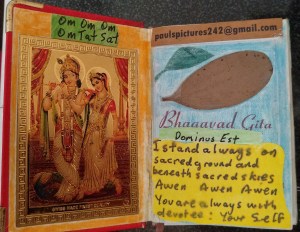
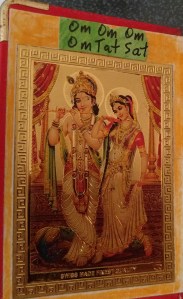
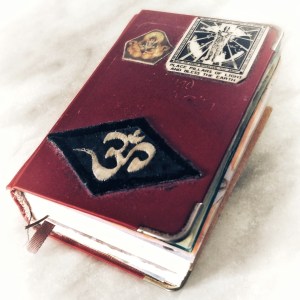
As you’ve probably guessed, this is a quick photo of the inside of the front cover. And, again as you’ve noticed, I like to stick things in my books, especially this little one. (Actually now I mention it, this is the only book in the traditional format as in made of paper, I own). It’s an old practice and for me adds multiple dimensions and depths to what is already a treasure.

Sometime I’d like to go through and describe to you all that I have added, but for today, do you see the little green section with the words Dominus Est printed?

In the religious tradition I was raised in, these two words have a specific meaning and use. However, it’s only recently that I’ve come to think of this little Latin phrase (well technically it’s a sentence, but …) in the sense of the literal meaning of the words themselves: God is.

That’s it. Or the Lord is, or the Master is. If we change the Dominus, we can use this tiny sentence to define our conception of the divine, the holy, in any way that seems right: Truth is, Beauty is, Art is. For me, God is, sits right. As do the others in this list. Same same.

So, God Is. What else could possibly be said that would add to this already very emphatic and simple statement? Nothing at all. It’s stand-alone, complete in itself.

Like asking who or what is God, we can answer: ‘I am this’ or ‘I am not that’. Or we can realise what for me is becoming the only answer:
I am.

Why? Well, if we were to add anything at all to these two words, such as God is Truth, or God is Love, or God Resides in …, or God is called … , then we are in fact stating only a little of the truth. Sure, God is truth and love, and goes by many names and is found in many forms, but once we say what something is, we are actually making more of a statement about what it is not.

In the beginning there was the word, and the word was with God, and the word was God.

Mind you, it’s perfectly natural, and for many of us helpful, even necessary, to ascribe to God a name and or form. We are ourselves material beings, living in a material universe; it’s logical that we would choose (or need) to see God in a word, a physical object, or attribute some other kind of materiality to our notions of the divine.

I must say that I am one of those who find it difficult to envisage an invisible, non-physical, and impersonal ‘God’. Of course, our little statement, God is, does indeed say just this doesn’t it? Isness is pretty non-corporeal, certainly not in the least physical. And isn’t even a ‘spirit’ or ‘entity’ of any kind; Isness just is. The moment we label something (including ourselves) we miss that isness, that essence.

You see my picture of Krishna and Radha? This form, or forms, is one of the several that I feel right in having as a kind of focus, or centre of my devotion to and love for the divine; for love, for truth, and for it all.

You might be saying, this guy does believe in a personal God. He just told us. The truth is I don’t believe or not believe that Krishna (or any of the myriad names and forms we’ve invented) is God. God simply is. And my heart tells me that this is enough.

There are a pair of theological ideas known as Cataphatic Theology, and Apophatic Theology. Cataphatic describes or approaches the divine by stating what God is, while Apothatic (you guessed it) describes God by speaking only of what God is not.

My guess is that pretty much everybody, from whatever tradition, would approach the divine (and not only the divine) in one or other of these ways. But for me it was such a relief to realise that there was no need to go there at all. I could stop with the definitions and the descriptions, the what is and what is not. I have the freedom to not have to believe or not beleive. None of it matters. Dominus Est. God is.

Am I there yet? Have I let go of dualities? Hardly. Maybe the odd glimpse, but it’s rare. And it always will be for as long as I live in a physical body. But to paraphrase something Swami Ramdas said:

I’ve set my feet upon the path, so I am already at the goal.

Peace and love from me to you

Living the Life

Welcome to another musing from the hermits’ cave. It’s been a while hasn’t it?

Mind you, I’ve been busy: settling into the new hermitage here in the desert. Actually, it’s been cloudy since we arrived, and raining sometimes. It’s as if the Subtropics have followed us here, except that it’s been freezing.

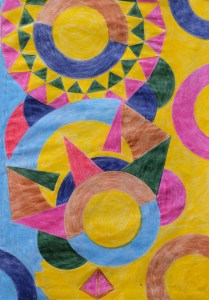
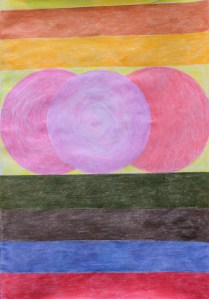
And I’ve been busy colouring in as well. Not as in filling in a picture book designed for colouring, but in making my own patterns and shapes with the one aspiration of making colour happen.

Japanese calligraphy masters will tell you that God is in the ink, or in my case in the pigment of the colour pencils I use. I draw designs, sometimes complex, sometimes simple, then fill the spaces with colour. Sometimes just one or two, sometimes multiple colours.

Why? Well, the simple answer is because I like doing it. I like to see colour covering the page, seeing it slowly fill that empty space. I’m not good at ‘drawing’ and painting in the traditional sense, but one thing I can do is make colour. So I do.

And it’s a sacred act: God is in the ink remember? It’s the making of beauty. And that is a holy act. There’s that aphorism isn’t there? It’s better to light a candle than curse the darkness?

Or, I could say that it’s better to make colour and patterns than it is to be swamped by the darkness.

There’s a Bhagavad Gita verse I like that I came across again the other day:

If one’s thoughts are fully absorbed in the Absolute all his [sic] spiritual offerings also become a part of that same Absolute

Bhagavad Gita 4:24

In other words, all our actions – and we never cease from activity while we dwell in a material body – are not only prayers or offerings to that Absolute (or you can say to God, to beauty, to art, to love, to the universe, to life. Or you don’t have to name it at all. None of the names and forms are relevant) but in fact become that Absolute.

I am a hermit pilgrim, living a contemplative life devoted to the Absolute we just talked about. I have little to offer, but I offer all that I am. And with my photographs, and with my ‘colouring in’, I try to create a little bit of the sacred, a lit bit of colour and beauty to keep us all away from the darkness.

Peace and love

When a Day Off Isn’t a Day Off

Namaste and welcome

You know by now that I study the Bhagavad Gita. I’ve been at it a few years now, and it gives me a great deal of joy and comfort, not to mention the help it is to me as I struggle to understand Self and life, the Universe and everything (to borrow a well-worn phrase).

Yes, I love this book which is the story of a warrior king and his charioteer getting ready for battle. Arjuna, the warrior, is us. Or rather he is our ego, our lower self, the us that lives as a material entity in the material world.

The charioteer is actually Krishna, and he represents our Higher Self, the Self that is what some people call God, or the Divine, spirit, universal consciousness. In other words, my Higher self is having a conversation with my lower self as I battle or struggle with living in the material world.

Anyway, it’s enough to say that I am very fond of this book, the lessons it holds, the guidance I sometimes glean from it. And I try to spend time with it as often as I can. Daily mostly, but not always. I have to admit that sometimes I just want to give it a break, leave the words alone, just be with Self for a bit.

Actually, there is a verse that I wrote down long ago that does in fact sanction the student (that’s me) to take a break.

Forgoing all religious injunctions, take exclusive refuge in me. I shall deliver you from all sinful reactions. Do not fear

Bhagavad Gita Ch 18:66

This is Krishna speaking, giving instructions to Arjuna. Essentially it’s the higher Self telling our little selves to ignore outside rules, regulations and all that, and rely instead on what comes from within the Self; in other words, what our hearts tell us.

Now, he’s not saying ignore laws of the world, that’s not what this story is about. He’s telling Arjuna, look, don’t take notice so much of what the religious leaders tell you, or what instructions you read in holy books.

Then, after more or less consistent study over years, I came across yet another verse quite recently that confirms this one, but that hadn’t ever spoken to me before:

When your mind is fixed and unmoved and not confused by scriptural injunctions you shall attain yogic samadhi

Bhagavad Gita Ch 2:53

This verse actually says: don’t confuse yourself with stuff you read in the scriptures; instead keep your mind fixed and unmoved by the outside world. And if you do that, you will achieve that level of peace, self-realisation, and happiness, that you’re after.

So, do we have here a book of scripture that is in fact telling me not to take any notice of what it says in that book? That doesn’t sound very likely does it? No, I think what both these verses are getting at is this: The first and primary thing to do if you want to achieve happiness, peace, self-realisation, is focus inwards, on the Self.

Or God, or spirit, the Universe. We all call it by different names. But the point being made is that we aren’t going to find all the answers only in a book, or in the instructions from ‘religious’ leaders; overdoing the books or the slavish following of teachers only causes us (sorry I mean me) confusion.

Higher Self here (in the guise of Krishna, who is in the guise of a charioteer) is advising us to look to our Selves, not to the words of others to reach union with that Self. At least, that’s how I’ve chosen to interpret it.

What’s interesting here is that these are two of the very few verses for which I haven’t looked at commentaries or interpretations by other people. What I’ve done in other words, is take the advice given in these verses and looked inwards.

I don’t mean to suggest that I use these verses as ‘have a day off’ cards; most likely the contrary is true. On days when I don’t look at the Bhagavad Gita, I like to think I spend more time ‘just sitting’, perhaps chanting mantra, and contemplating.

Of course it doesn’t always work out like that naturally. But, at least on those occasions there is the heart and mind space available for a more direct communication or connection with Self. With that part of me that is one with all.

Peace and love

Put Me in My Place. Please

Reverence the place and learn from what you see


Coming across this note last night, I was stumped. I coudln’t think where it had come from, where I’d seen it; nothing at all came to mind. And an online search just now failed to turn up anything either. I mean I must have read it somewhere. Or is it possible it came from me?

Of course it’s all the same: there is only one source. At any rate, it’s an injunction one can relate to anywhere, any place. It’s surely about presence?

And about learning from all that is to be seen (heard, felt, intuited, known) in whatever place one is in now. I mean, the place I’m in now. I am here and it is now.

I’m reminded of the faith affirmation (is it a prayer?) that seems to have been written for this particular hermit pilgrim:

As a a hermit, I am a pilgrim dependent on a pure faith that I am exactly where God wold have me be now.

Sometimes I think that too much thinking about and angst over places other than the one I’m actually in right now, is a sure and certain way to resist and reject any reverencing of the place I’m in, not to mention what’s to be learned or gifted from the experience of being here.

And of course that angst, worry, wishful thinking, or whatever, comes with its own issues of distraction, and of a taking away of one’s Self from the present, the notion that here and now is the only time and place that exists.

A poem of mine I came across the other day while looking for something else says it all quite nicely. This poem is called Transcendental Injunctions, and it’s a rap on presence, about being here, and being now.

The central action describes how my senses can take me away from that here and now: I describe my habit of smelling my Bhagavad Gita (yes, as in putting my nose into the pages of the little book and inhaling the aroma of those pages) and how that takes me back to the shores of the River Ganges; another place, another time.

Anyway, allow me to share the final verse, which speaks of one such occasion:

Then, there is a voice:
I hear it with the ear of my heart:
There is no place to go.
What you seek is within.
There’s nothing to find:
God’s kingdom is within.

I suppose there is nothing left to say. I am here, and it is now

Peace to you from me

Karma Yoga & Contemplative Living: Creating Good Vibrations

Greetings friends

Not so long ago I read The Glass Bead Game by Herman Hesse. And I have to say it’s what I like to call a ‘real book’: written beautifully with an interesting and deeply engrossing story, full of detail, symbolism, thought-provoking ideas, and at the end of the day just plain and simply a delight to spend time with.

I won’t go into what the book is about here, but for the sake of this post, I will just tell you that it is about a mythical European province populated by an elite group of scholars of all sorts who have as their main cultural, social, and even political focus, the game of the book’s title.

Anyway, what I want to talk about here today is something said by the book’s main character, who in the course of the story becomes the master of the game and therefore a hugely influential figure.

This character is having a conversation with a friend. And he’s talking about the way this elite group conducts itself in the world. How it helps shape the country and history. He says to his friend:

We do not intend to flee from the vita activa (the active life) to the vita contemplativa (the contemplative life), nor vice versa, but to keep moving forward while alternating between the two, being at home in both, partaking of both.

Now, what struck me about this quote is that only a couple of days before I’d read a verse in the Bhagavad Gita that I felt said almost exactly the same thing. Krishna says to the warrior Arjuna:

Contemplative life and Karma Yoga are one and the same and takes one to the same destination. One who perceives this sees things as they are.

Bhagavad Gita Ch 5 Verse 5

Karma Yoga is usually defined as taking action without desiring reward for oneself or being attached to the fruits of the action. It is very much the taking of selfless action that is for the benefit or others. However, because as living beings in the world, we are always taking action and actually can’t not be acting, Karma Yoga is also described as being simply the yoga of action.
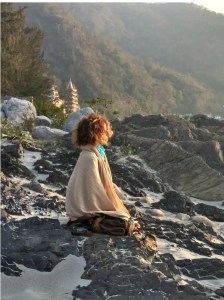
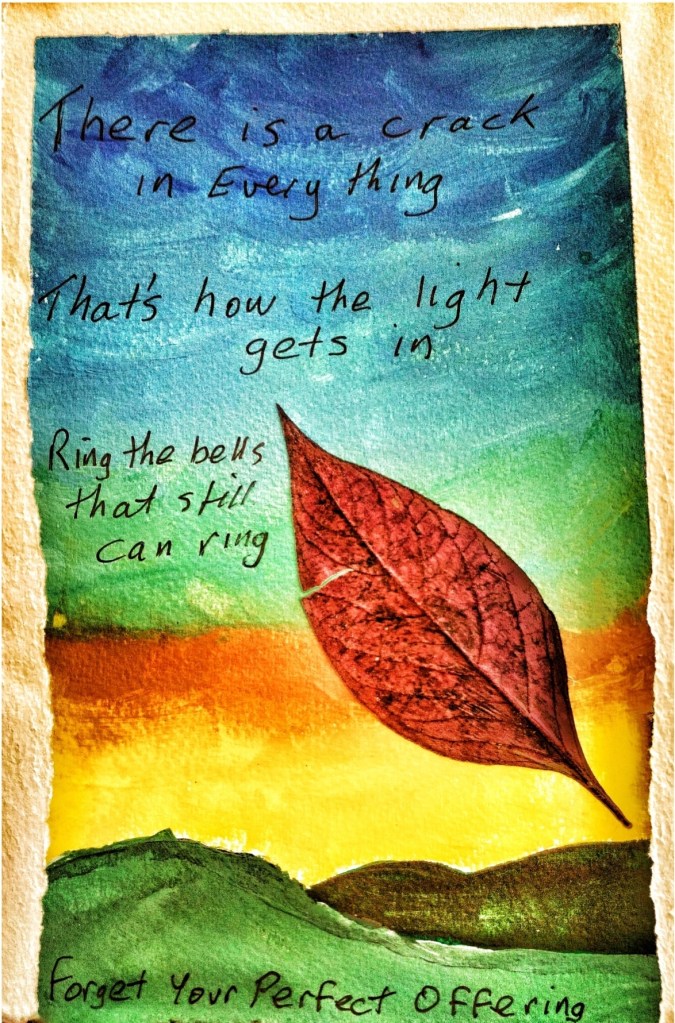
The Contemplative Life is most often ascribed to monks and nuns, and others living a life of deep thought, study, meditation and prayer. But any of us can lead a contemplative life because such a life is about being mindful, it’s about considering the consequences of our actions.

Such a life is lived slowly and thoughtfully and would be called ‘spiritual’ by some people. We could also call it an examined life. It is about cultivating an inner life, a life of mindfulness in all aspects of our lives.

And living in a contemplative manner helps create more peaceful communities; people living in this way project a calm that can have profound impacts on others. Such people help to set up what some us like to think of as good vibrations

Of course it’s one thing to talk about the Contemplative Life versus the active life in a novel and in an ancient book of scripture. It’s a whole other thing to be trying to figure out what sort of life we should be living in the world here and now, with the urgency of climate change, wars, despotic leaders, increasing poverty and the rest. Or is it?

Is it better for us to take action by protesting, joining activist groups, writing letters? Or is better that we live apart in some way, spending time contemplating, meditating, ‘praying’?

To me it seems there’s a real struggle going on right now between these two points of view. There are those who will tell us that it is too late for ‘thoughts and prayers’, and then there are those who say, we can’t achieve world peace (in its many facets), until we have attained inner peace on an individual level, and that the only way to reach that state is to meditate, live a contemplative life, and slow down.

Obviously, and you already knew I was going to say this, the two are not mutually exclusive; both approaches are required and serve their own purposes. There is no dilemma; there is no conflict. And above all, neither approach is superior to the other.

Many of us are suited to an active life; some of us less so. Some of us are suited to silence and to quiet reflection and study, some of us aren’t. And oftentimes if we try to act contrary to our true natures, then we have great difficulty in achieving anything. And we don’t help anyone when that happens.

Karma Yoga or the Contemplative life. An active life or a life of silence and contemplation. Only you are able to know which is for you. Of course there’s always a crossover to some degree or other. Being fully active and engaged in the world, doesn’t stop one from spending time in a contemplation, and perusing one’s life mindfully.
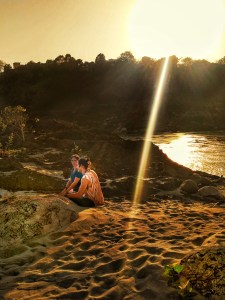
Equally, leading a totally or partially contemplative life doesn’t mean you aren’t taking action in the world. Obviously you are. For me, the contemplative life is a way to find some personal peace, to create those good vibrations I mentioned, and it allows me to connect with others of like mind, who are working for the highest good. Those living in the invisible community I think I’ve mentioned some other time.

Balance. The key is to find the balance that expresses you and your nature best. So, take some action right now and begin contemplating!

An Idea From a Not So Random Corner of the Universe

Namaste and Greetings friends

Remember in my last post I mentioned that I like to ‘Let the noble thoughts come to me from all corners of the universe’? Well I’ve been exploring, investigating, studying, in one of those corners for a few years now.

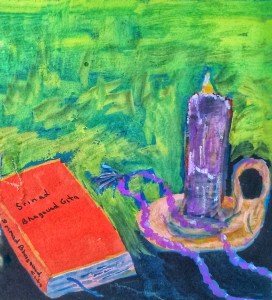
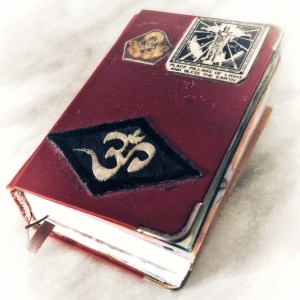
In 2016, in India, I gifted myself a small copy of the Bhagavad Gita. It’s a little red book, my Gita; no commentaries, just a plain, simple, and easy to understand translation of the 5000-year-old text known as the ‘Song of God’

Of course there are many sources of divine wisdom. No. That’s not right. Start again. Everything is a source of divine wisdom, of the word of God, universal knowledge, Truth, the Dharma. We can call it what we like.

But every living thing – human and non-human – every experience we have, and the entirety of the material and non-matieral creation, is divine wisdom in action.
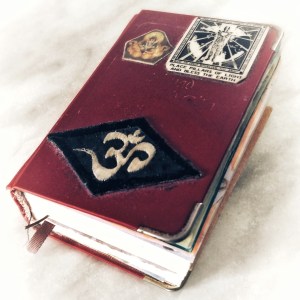
Speaking for myself, I don’t always remember or realise (as in believe, trust, know) this never-ending, inexhaustible supply of wisdom. So I have to make use of some physical forms that help me narrow my focus, to centre my attention. It happens that the Bhagavad Gita is for me, one of those physical forms.
So today I want to talk about a verse from the Gita that really leapt out at me when I opened the book at random yesterday.
That verse comes from a chapter titled Self Knowledge and Enlightenment. It’s where Krishna – representing our Higher Self, Divine Wisdom; the real us, the real me – is telling Arjuna – the ego self, or little self, the us that thinks ‘this is me’, ‘puny, small, little me, just a sack of bones’ – all the various attributes and qualities of the Higher Self, the real us.

In other words, our Higher Self is helping our lower self to realise what we really are, trying to get us to see that there is a lot more to us than meets the (physical) eye.

Anyway, to the verse:

Of the strong, I am strength devoid of desire and passion, and I am love that is virtuous.

Bhagavad Gita Ch 7 verse 11

My sense is that the entire Bhagavad Gita is designed to help rid us of our attachments to the dualities of the world. Of course material life is obviously a state of dualities: we like good things, don’t like bad things; sometimes we’re happy, sometimes full of sorrow; we might at one time have many material possessions, then at another have nothing. You know where I’m going here; after all you dwell in the same world as I do!

Naturally none of us want bad things to happen, so we try to develop ways to be strong, to gather strength so we can face the bad stuff when it (inevitably) happens. And there’s nothing wrong with being strong, nothing amiss about having strength, but here Krishna (Higher Self) says that we don’t need to desire to get strength: we already are strength. Remember: Krishna is our Higher Self, so if Krishna is strength then that means we all are.

The desire and passion he talks about is really our attachment to outcomes, to expectations, to labelling things good or bad, or this or that, or wanting to feel this emotion but not that one. In other words, we are strength without any of these attachments;

So, when those inevitable ‘bad things’ happen, we already have the ability to flow with them, to cope with them, without judgements, without fear. Equally, when the inevitable ‘good things’ happen, we can rejoice, but we are strength, so there’s no need to hang onto them, wishing them to keep on happening, or being fearful of them changing.

You know there is an expression I used to loathe: It’s all good. It’s one of those non-commital, bland platitudes that really doesn’t mean anything. Well I don’t hate it quite as much as I used to but I still have trouble with it. Maybe we can take it a bit further?

Perhaps we could say instead: It all is. No good or bad; no joy or sorrow; no dualities of any kind. Sounds like heaven doesn’t it?

Well, while we’re in physical bodies here on Earth (and who can say what kind of bodies if any we’ll get to inhabit in the future), then the most that can ever happen is a glimpse – or maybe a few glimpses – of isness. Moments when we actually stop labelling, stop seeing dualities, and really and truly can know, it all is. For real.

And the love bit? Well, here we have Krishna (our Higher Self) saying he is love. He means us. He’s actually telling us that we are love. And virtuous love at that. Mind you, is there any other kind?

Peace