A Journey to the Centre of the World (sort of)

Namaste and greetings

Yesterday I came across a couple of stories – true ones – that I wrote years ago. They are what we might loosely call ‘travellers’ tales. I thought it might be nice to share them here. So here’s the first one. Enjoy

Not the Manu temple I write about, but another one close by

I’d walked up to Old Manali, and I’d kept walking through the town. Then higher still, past the temple to Manu, and the scattering of traditional houses and small fields clustered around the temple.

Three near-naked and stoned saddhus invited me into their cave – more a kind of overhanging rock shelf poking out from the foundations of the temple itself.

Naturally I declined. Politely. I wasn’t, never had been, and never shall be a stoner. Besides, here I was deep in the Himalayas walking through ancient villages and past temples to ancient gods. Seems to me that that’s enough to bring on a high all its own and like no other.

Then, a little higher up the trail. I rounded a corner to be greeted by a kind of open forest glade; a grassed and flowered field protected by a semi circle of forest sentinels, their crowns maybe thirty metres above my head.

And there, in the middle of this magic field, a large flat rocky area, like a series of ‘shelves’ layered one on the other. This maybe twenty square metre tiered platform was probably the remnants of an ancient hill (or mountain?) that got in the way of a more recent but clearly relentless glacier.

Whatever the history, here was an arena with views no theatre or movie could ever hope to reproduce. This natural amphitheatre faced several layers of peaks across the valley. But, before those peaks, and directly in front of me, just down the slope, stood the temple, then more trees, reaching down into the valley. Here the river flowed, surrounded by farmers’ fields and the brown dots of houses.

Then the forests begin again, thick at the bottom in the valley, but becoming more scattered on the higher ground. Then those many layers of higher and higher hills, mountains really, rolling off into the distance to, where on the horizon and behind it all, a row of the really high peaks covered in their permanent snows.
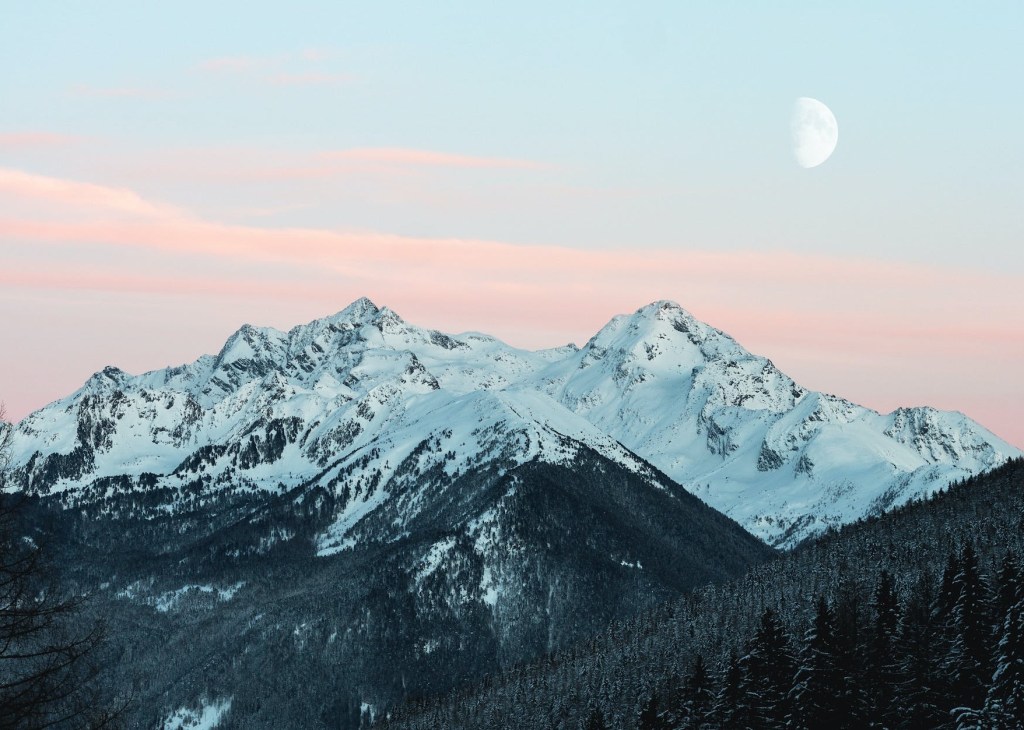
‘This is a special place, a sacred place,’ I heard myself sigh out loud. Sitting cross-legged now, I let my eyes wander over the scene taking in the blue sky, the white peaks, the multiple greens of the forests, the sliver ribbon of the river, and the rest.

At such times and in such places, one’s eyes tend to close of their own accord. And so it was for me then and there. I let myself drift. Thoughts came and went, to be replaced by more thoughts that came and went.

Then, my eyes opened. Again of their own accord. After a few seconds of that cliched ‘where am I?’ feeling one has when startled out of one state and into another, I made out the figure of a person standing facing me a few metres from where I sat.

‘I’m sorry,’ I heard her voice call to me. ‘You just looked so peaceful sitting there meditating, I just had to stop and watch you.’

She told me she’s been watching me for about fifteen minutes, which gave me a start: It’d felt l Ike I’d only just sat down and closed my eyes.

‘They say the light of the world is held about twelve kilometres up this trail. That means it’s the centre of the world.’

I had to stand to try to take in a revelation of this magnitude.

‘And apparently,’ she went on, ‘they’re going to move it soon and nobody knows where.’

Was she an angel? Was I dreaming? They, whoever they were, are about to shift the centre of the world? Even in India one doesn’t hear this kind of news everyday. Actually, I doubt you’d ever hear it on any day.
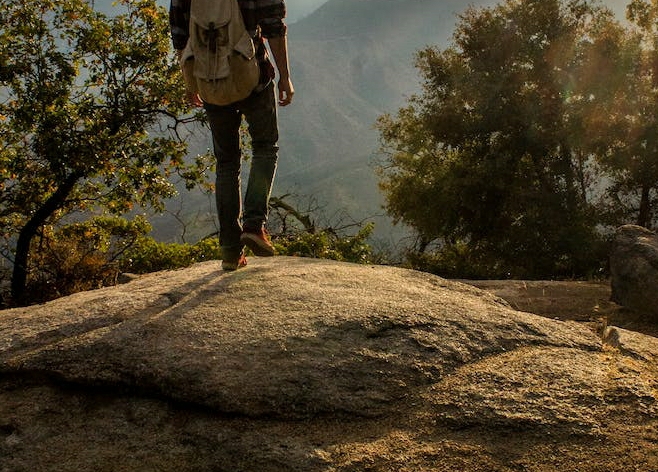
Then she was gone, headed up the trail. I didn’t follow. I remember thinking: twelve kilometres was too far for me especially as I already had a long walk downhill to my hotel back down in the new town.

Yes, mundane, practical musings, a typical response to news of such a wild and far-out nature. So, not exactly in shock, yet not quite myself, I turned back. Down. Through the village, past the temple with three crashed out saddhus out front, back into the town.

There are cafes there. They sell Chai there. I needed one.

Actually, given the momentous news I was going to have to digest, I might even have a couple extras.

This is a true story; it actually happened more or less the way it’s described here.

Of course, there is no ‘light of the world’ stored in some secret spot, somewhere on Earth.

Well, I suppose if there is a light of the world, then it’s likely to be the world itself, I mean Earth, all the beings who live on this planet. Life itself I guess you could say. Life is light; Life is love.

Peace
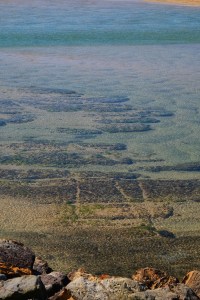
Remnants of Sea Cliffs

Here there are remnants
of sea cliffs.
Cliffs that have not towered
since ancient times.

God is My All: A Reaching Out, a Rap on time, & a (sort of) unrelated poem

Namaste and Welcome to you.

I can’t remember when I wrote my last post. And of course it isn’t relevant at all is it? I mean to say that in the contemplative life, time sometimes seems to take on some other kind of character.

Or at least I should say that one’s perception of the passage of time shifts; nothing unusal there I hear you say, and of course you’re right. Just thinking out loud I suppose.

For me, having a right perception of time is an important aspect of my Sadhana, my practice: yes, it’s true: time is seen to fly, or it is frustratingly felt to drag. But my aspiration is to see time as simply a human construction that we use to limit, structure, bind, define, and place all kinds of restrictions on our lives.

Which for me, simply means that there is only presence or Presence; only the ongoing continous moment (what we often call The Now). Easier said than done mind!

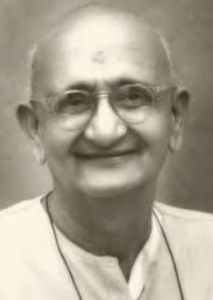
Swami Ramdas (known as Papa to his followers)

In any case, here I am, just where God would have me be. Feeling strongly to reach out to you, I remember the poem (it’s not really about time in the sense we’re discussing it so far) that emerged the other day after reading a quote from Swami Ramdas that seemed to be an answer to some thoughts I’d been having.

I’m grateul for this, all of this. And for you too, the reader of these musings offered with humility and thanks.

Peace and love from me to you.

GOD IS MY ALL

Thinking thoughts
as if battered by demons.
Memories arising of my own evil deeds, selfish and cruel.
Right away I turn to God:
God is my all;
Hare Krishna

Forego repentance,
relinquish regrets;
you are filled with God,
the supreme essence of life.
God is my all;
Hare Krishna.

Through Papa Ramdas
I hear the Universe speak:
Forgiveness is from God;
and it has been granted.
God is my all;
Hare Krishna.

Broken Hill, Australia
9 July 2022

Let Me Tell You About a Visitor I had This Morning

Greeting and Welcome to you

Quite a long time ago now I half wrote a book. I mean to say, I wrote half the thing before giving up. The book was going to be called When a Pet Dies, and was about, well exactly what the title suggests. All the practical stuff that you’d expect, as well as ways to deal with the grief over the loss of a companion animal .

I thought at the time that the reason it was only half written is that, once I got through that practical stuff and was ready to tackle the grief and loss parts, some kind of lethargy set in, or I got lazy. Or perhaps, I was thinking also, the muse for that particular project had simply left and was gone. So it remains half written.

So, why am I musing over this half done, half forgotten project from long ago? Well, let me tell you about a visit I had this morning.

I was sitting, focusing on chanting my mantra. Suddenly I felt an absolutely overwhelming sense of loss and sadness. I don’t recall thinking of anything in particular beforehand, but the sense was overpowering. Flooded with grief is what they call it I think.

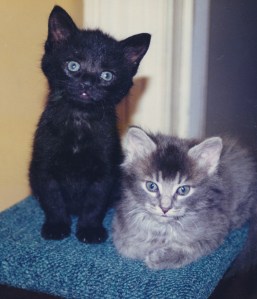
Lofi (on the right) with his sister Shanti

And then, just as powerfully, I sensed the presence of Lofi, my cat who died in my arms over ten years ago. Immense feeling of presence is what I wrote in my notebook. Now, I’m not saying he was literally there with me. I’m also not saying he wasn’t. All I can say is that it was among the most intense of similar experiences I’ve had over the years. Anyway, that’s most likely what got me thinking about my incomplete book.

Later this morning I was sitting with my partner on a benchseat overlooking the sea, the bit of the Pacific coast I’ll be leaving behind next week.

Actually, now I’ve mentioned that, you might remember from my last post how keen I am to get out there to the desert. That excitement and anticipation doesn’t mean for a second that I’m not feeling quite sad about leaving the coast.

Anyway, we were just sitting there and chatting on and off, when suddenly a thought seemed to push its way to the surface. I all of a sudden knew why I stopped where I did when writing that book. I realized in a strong and convincing way that you can’t build a structure to define what grief is or how or if it should be experienced, by whom and when.

I’m not talking about the ‘truism’ that one hears all the time that says that the ‘stages of grief’ are in a set order, until they’re not. Actually come to think about it, I’m not even sure this is true. I mean, I’m not sure it (grief) is a thing to be labelled, quantified, recorded, predicted, analysed.

I mean, who’s to ever say how any other individual, or even oneself, will feel about anything at all? Sure, there might be a ‘typical’ set of responses to any given circumstance, such as a loss, but even the proponents of such theories will tell you that none of us is typical.

Which kind of leads me back to my feeling of oneness with my Lofi earlier in the day. Obviously I’m not alone in having such feelings. How often has any one of us heard other people say, after they’ve lost a loved one:e, ‘S/he was really here. It was so real’.

Such experiences can occur anytime, even decades after the loved one has left. I’ve mentioned somewhere else that I’m reading (in little chunks) a great book by Joseph Campbell, the renowned scholar of myth. Let me share with you a quote from the section I’ve been reading today where he’s talking about how art in India seeks to portray the divine in all things:

This is the wonderful song that one hears when one reads the Bhagavad Gītā or any of the great texts of Eastern philosophy. This is the song of that immortal spirit that never was born and never die.

Of course this isn’t meant to be a consolation to myself or anyone else. After all, we are physical beings, living in a material, solid and apparently ‘real’ world. So, naturally, we experience loss, like everything else in that context.

Our bodies react (or don’t) as do our minds, creating physical sensations and emotional responses. Or not. These physical and emotional responses, or lack of them, are totally unpredictable, unexpected, and most definitely unclassifiable by anyone outside of oneself (myself)

Anyway, there are no rules. Even the grief and loss experts will tell you this. Mind you, I can and will only speak for myself, and my experience. Basically that experience has taught me that I have an intuitive resistance to ever thinking in terms of there being a ‘roadmap’ for grief.

Or a statistically valid ‘pattern’ or ‘process’, or that there are even such things as ‘stages of grief’.

My grief for my Lofi is unique, just as everyone’s is. I’m pretty sure I don’t even want to define it, label it, ‘try to get closure’, ‘come to terms with my loss’. No. None of that. It’s like I’ve said someplace else, or at some other times:

Sometimes we make way too many words for something for which there are no words.

Thank you for allowing me to share these words with you. I pray that they are not ‘too many’

peace and love

Believe It or Not

Welcome friend to another post. It’s good you are here.

Like so many other people I like documentaries on, well, all kinds of topics. I sort of go through phases and a while back I was on an historical/archaeological kick. And if it involved adventurous journeying, then so much the better.

Anyway, one I watched has stuck with me. In this show, an Indiana Jones type went in search of an ancient religious artifact. After a sombre pilgrimage across a stunning but arid landscape, a number of adventures and fascinating tours of interesting historic sites, he was forced to conclude that nobody could know for sure that this particular artifact actually existed.

This was especially the case given the fact that several hundred individual churches across a vast area claimed to possess said artifact, according to our intrepid guide. Then there was a doco I’d seen a few days prior that suggested this artifact was in fact hidden in Southern France.

Or perhaps it was destroyed in 800BC as some other ‘experts’ suggest. In any case, our fearless explorer came to the conclusion that, at the end of the day, whether the artifact still exists (or ever did exist) isn’t the point. He told us that what mattered was that people believed it existed, and that its power existed through that belief and was a force for good in people’s lives.

Actually I think even this misses the real point: I don’t think we are necessarily meant to have a belief one way or the other when it comes to the historical accuracy of myth. Myths tell us stories about truth, about our place in the Universe, and how to behave and live a good life. The facts or lack of them aren’t important.

Every culture throughout human history has had its myths: about creation, about their pasts, their gods, their futures, and how to conduct one’s life so that society can continue to function. Some will say that we in the so-called West are lacking our own myths and stories.

Well, I also believe that our myths are in many respects largely forgotten, or perhaps are only held by this group or that within our societies.

I think we all have our own myths, whether they are ones received from our society either consciously or unconsciously learned, or from our own personal life experience. Then of course there are the so called ‘modern mythmakers’: the media, politicians, and marketeers, all advertising their own ‘truths’. But that’s not what I’m talking about today.

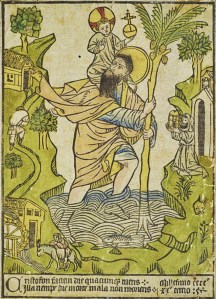
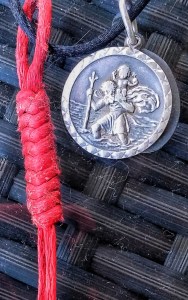
So, moving right along. Hands up if you’ve ever owned or been given a St Christopher medal? Ah, just as I thought. Huge numbers of people out there have at one time or another had a St Christopher around their neck, or hanging from their car’s rear vision mirror, or perhaps tucked securely in their bags. And really one doesn’t have to be ‘religious’ to admit to ownership of such an artifact.

He’s an interesting character this Christopher. He is a saint of the Roman Catholic Church and here we start already to get into the myths and legends around our friend Chris. It’s widely known that he was stripped of sainthood and declared to have never existed after the reforms of the late 60s in the Catholic Church. Myth number one.

He is still a saint, and all that happened was the church found itself with an overly crowded calender of saints’ days and decided that some could be cut off because they weren’t necessarily of ‘universal importance’, and besides, he may not have actually ever existed.

Poor old Christopher was thus unceremoniously dumped. No saint’s day, but he did keep his sainthood. As for the minor question of his existence, the church said that wasn’t their decision to make.

Not much is known about the possibly historical figure of Christopher. First up (myth number two) his name wasn’t Christopher: he was a seven foot five inch (may or may not be a myth) called Reprobus. He was a Canaanite who while working for the king suddenly decided to go off on a spiritual quest to find an even greater king.

Like all good heroes, Reprobus has all kinds of adventures, until one day he meets a wise old hermit who tells him that if he wants to serve the greatest king of all then he has to help people cross a treacherous river where many drowned trying to get across.

So, Reprobus started to carry people safely across the raging river. One day he lifted a small child onto his broad shoulders and carried him safely to the other side. Reprobus told the child that he’d never carried such a heavy weight before, and so they had both been in grave danger.

The child then told Reprobus that he had not only carried the weight of the world on his shoulders, but also the one who made the world. In other words our friend was informed that he was indeed serving the greatest King of all.

And that’s how good old Reprobus got the name Christopher: the name means Christ bearer. Later, Christopher is martyred for his faith and the rest, as they say, is history. Because of his splendid lifesaving deeds serving people crossing the river, our hero over time became the patron saint of travellers. And his fame spread beyond the confines of the Catholic Church and all sorts of people have looked to him for protection for themselves or loved ones when travelling.

I have a confession to make: I love and always have loved (venerated isn’t too strong a word) St Christopher.

Mind you, I’d always had some issues around the lack of evidence for his having ever existed. Not to mention the small detail of a miraculous appearance of the Christ as a child who was as heavy as the whole planet.

Anyway, while I was never quite convinced that St Christopher was a real historical figure anyway, I agree with what our friend the Indiana Jones look-a-like says: it doesn’t matter.

And for me there is still a truth at the heart of all this: Our pal St Christopher is me. He is you; he is each of us. We all have the strength to carry the soul of Self, the heart of ourselves, across the raging rivers, through the wild storms, and across the sometimes very rocky ground that make up each of our lives here on Earth.

Do I wear a St Christopher medal? I most certainly do. Belief or non-belief in his historical existence is beside the point for me. It’s the myth I resonate with, the symbolism.

My medal shows a big, strong guy wading through knee high water carrying a small child on his shoulder. Both of them are me. Both of them are you.

Peace and Love
Paul

Walk In The Waters of Life

Since I launched this blog (a whole month and a bit ago already), I’ve had an idea for a post. A short, spontaneous, chatty but informative little piece on my favourite name and form of the Divine Feminine (often referred to as the Goddess): Saraswati.

Well, as the keenly observant among you will have noticed, no such post has appeared. Procrastination in overdrive you might say. Or perhaps it was that the Goddess just wasn’t keen on me doing the post about her?

You see, I did some research, made a ton of notes, and discovered all kinds of fascinating things and I just felt I wanted to share what I’d learned. Somehow, though, the idea didn’t go any further. I’ve thought about it from time to time, but still, nothing has come. Then, a couple of days ago, I came across my notes and reread what I’d discovered.

Now, here’s a key moment: as I reread those notes, I thought (paraphrasing here), ‘I really must post this. It’s all so fascinating and would interest a lot of people and even be helpful.’ Something like that anyway. Yet, still, it is not written.

So, despite my notes seemingly begging for my attention, I guess that maybe it’s not the time. Now my notes are safely tucked into a few nice little folders within a larger folder somewhere in the depths of my harddrive.

All that struggle; all that thinking and fretting over what was supposed to be a short, spontaneous couple of hundred words on a subject I love. Still, the episode has got me thinking about intuition and how it can disguise itself – with our help – as procrastination. And vice versa.

Yes, I know, obvious question: how can we ever know the difference? When are we inventing all kinds of reasons for putting something off, and when is it really intuition trying to guide us?

Well, it’s complicated. As creatures able to reason, we are always ready to come up with arguments for and against, to think endlessly and agonize over the smallest and most trivial details while ignoring the big stuff. Really, in my case that’s all there is to it: I just think too much.

Sticking to the Saraswati blog post episode (a catchy title don’t you think? Watch out for a post headed up ‘The Saraswati Blog Post Episode‘), I don’t recall why I didn’t just get right to writing it. It might have been any number of things: a perceived lack of time; a promise to self to ‘give it some more thought’; a resistance to the actual ‘labour’ required. Who knows?

Or, was it more that, while the idea was a good one, I just wasn’t feeling it? Maybe the timing just wasn’t right? The problem is that sometimes an intuition comes in a flash of knowing – with a capital K – that you can’t possibly miss.

Then, other times, it creeps up so slowly and quietly that it gets drowned out and ignored as our monkey mind takes over with its endless arguments for and against, pros and cons, advantages and disadvantages,

The lesson I was given here was this: What is going to get done, will get done; what is not going to get done, won’t. Sounds simple really, but so often we make it more complicated with our overthinking, our coming up with excuses. We procrastinate.

Then, at other times, we just dive in the deep end, flowing with the intuition. It may be right or it may be wrong, but it’s done. Actually, I am trying to realise that there is no right or wrong about a decision made: it just is as it is. Easy to type, hard to do.

Flowing. That’s a good word actually. Saraswati, along with many other characteristics, embodies flow. As in the flow of the river of life. She’s the Goddess of all things creative as well as any activity that helps one to discover the essence of self.

So, flash or gradual realisation; right or wrong; left or right, be the river: flow with what happens or doesn’t happen. Don’t fret about the twists and turns, the ebb and flow of tides, the rocks in the stream that force us to flow around or over, or to change direction completely. In 1946 the poet Jorge Luis Borges wrote an essay about time. In that essay, among other things he says:

Time is the substance I am made of. Time is a river which sweeps me along, but I am the river (emphasis is mine)

Jean Luis Borges A New Refutation of Time 1946

Reading that quote reminded me of a song that I’ve been humming on and off for a very very long time (hint: I saw the movie when it first came out).

The river flows, it flows to the sea.
Wherever that river goes, that’s where I want to be.
Flow river flow.

Peace from me to you.

PS: Thanks to my memory for giving me these lyrics from The Ballad of Easy Rider. Or was it actually Saraswati whispering in my ear?

Truth Is

Namaste friends. Welcome.

Fake news, propaganda, misinformation, disinformation, manipulative advertising. Such a tsunami of information threatening to swamp us, all of it claiming to be ‘facts’ or ‘true’, mean we are almost continually asking, what is true? Who can tell anymore? When we look at the world we live in today it is a rare thing when we are able to tell if something or someone is real or true.

For me there is only one solution: stop looking to the world as the source of any kind of answers to anything, and particularly when it comes to trying to sort out what is true and what isn’t.

The only place you will find the answer to the question ‘what is the truth of …?’ and know for certain that it is true, is within yourself. You are the only one who can decide what is true and what isn’t, what is right and what is wrong.

It doesn’t mean you ignore all information from external sources; it only means that you appeal to that inner part of yourself, the intellect and beyond, to help you reach your own truth sifted from all that information.

It’s a well trod path in philosophical circles: the debate around absolute versus relative truth(s) has been going on for a few thousand years already, and it’s unlikely to reach any kind of resolution anytime soon.

I’m not saying that a thing might be true for you and not true for someone else. At the same time I’m not saying that there is some kind of externally arbitrated single, absolute truth that is always true regardless of whether one agrees or not.

What I am saying is that, if you come to the truth of a thing, situation, person, whatever, from within yourself and it is accompanied by that inner ‘I just know this is right’ feeling one gets sometime, then putting it simply, it is truth. Period; fullstop; that’s all there is to it. End of story.

If someone tells me there is a tiger in the centre of town, how can I really know if there actually is a tiger in the centre of town? And if three (or three hundred) people tell me there is a tiger in the centre of town? Well even then, how can I really know for sure if there is a tiger? There might be, or there might not be.

Okay then, how do I find out? Putting it like that the answer seems obvious doesn’t it? I go and look for myself.

But you know even then, do my eyes deceive me? Do I know what a tiger looks like? You see, even if my physical eyes see what I’ve been led to believe is a tiger, I still need to use my intellect, or even my intuition, to assess its real identity, to figure out the truth for myself. I mean, for my Self.

Afterword:

The tiger example is from a Chinese fable from the Taoist tradition. I’ll put my slightly elaborated version in my next post, and once it’s there you can find it here.

Food & Drink of the Gods

Namaste and Welcome friends

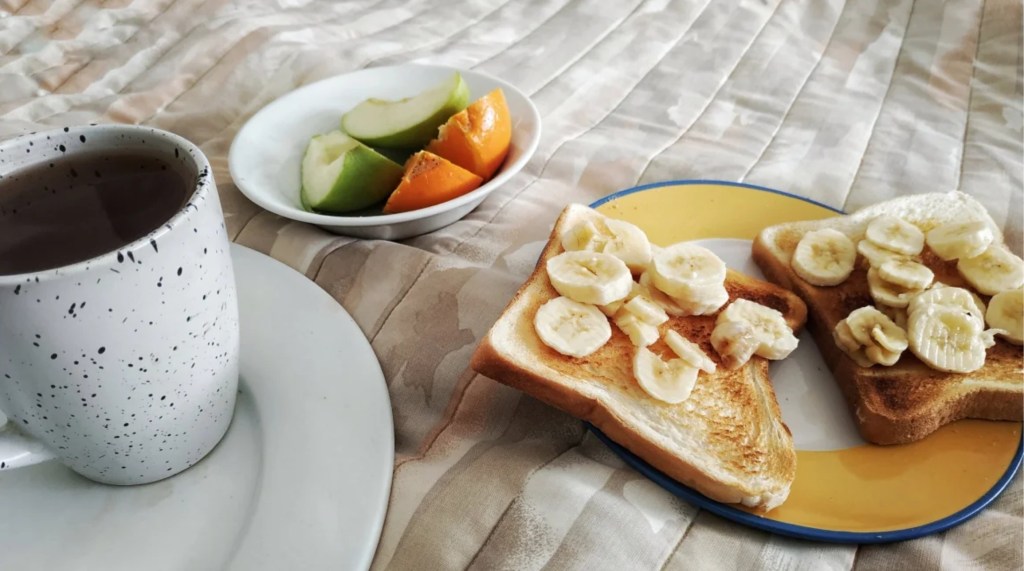
An idea that’s kept its hold on me for a while now concerns Black Tea and Dry Toast. It’s a part of my almost daily diet, and I’ve wanted to write about it. Anyway, here’s the note I first jotted down when the idea first came:

Black Tea and Dry Toast – In Reality is what we might call the food and drink of the Gods, of liberation, especially when I remember to offer it to Brahman and it becomes Prasada: simple, appetising, comforting, nourishing.
         What else?

Yes, sounds kind of weird, writing about such an apparently mundane subject. But, really, I  can say it definitely is for me the food and drink of the Gods. And as such, it moves beyond the little r reality of worldly food, of mundane considerations. It takes on the big R of Transcendental Reality.

Simple, plain food and drink. Pared down from all the extras and the padding, all the ‘additives’ we generally ply ourselves with. In a real sense this simplicity is in keeping with the uncluttered, minimal life I am called to live.

And everyone knows how comforting tea and toast is, how welcome it is pretty much any time of the day or night. Nourishing, too, for the spirit and the mind.

Actually for the body also. At least it is for me as a person who used to eat way too many biscuits, and take jam (thickly) on my toast. As I say, simple with no additives.

All of this equals in my view liberation. Freedom. Freedom at least sometimes, from harmful substances; Liberation from complicated preparations and the stresses and tedium that comes with it.

Black Tea and Dry Toast represents a snack (sometimes even a small meal) that at least for a short time can liberate us from stresses and tiredness. At other times, it gives us that freedom that comes from indulging in simple pleasures.

The food and drink of the Gods is not a complicated, invented and dressed up thing. It is plain, simple, comforting, nourishing.

And yummy.

PS Okay. That photo stuck in the middle up there isn’t quite in keeping with the topic is it? Alright, I admit it: Sometimes I really indulge myself and add banana to my toast. And yes, sometimes apples and oranges too

What’s ‘Ordinary’ Got to do With It?

Perhaps shameful is too strong a word, but that’s kind of how it feels. You see, I’ve been thinking of giving up on the book I’m reading at the moment. And you are thinking, this is a big deal? If you don’t like it, put it aside and try something else.

Yes, excellent advice, thank you. And usually that’s what I would do. In fact now I think about it there was a time when I would force myself to complete a book, even if I wasn’t enjoying it or was bored with it. But I learned a long time ago that this is a waste of time, waste of mind, waste of energy, and unfair to me.

Yet, on this occasion, I started to have some thoughts that took it a bit deeper. It’s true to say that I’m a bit bored with this book; it’s as if I’m not overly interested in the story the author is telling, and in the way she’s telling it. As well I had this feeling that the book was ‘ordinary’: meaning that it was a kind of day to day telling of a segment of a life with its mundane and routine elements included along with the ‘good bits’.

And it was that feeling of being not so interested that got me thinking. The author’s vocation, thinking, activities, and the subject of the book itself, is exactly in line with areas I am very interested in reading about, not only for entertainment but for my learning, for my own spiritual journey and way of life.

The way she’s telling it? Now, this one got to me even more. The book was put together after the author’s death and is made up of extracts from the author’s journals and from the many letters she wrote to family and friends during the period of her life the book covers.

That’s what I do isn’t it? Keep a journal? Write letters? These and the many many blog posts (which in a way are a lot like letters, and even journal entries do you think?) I’ve written over many years, and the journal I’ve been keeping for most of my life, are the core of at least the personal writing I have done over my lifetime. By rejecting this book I started to feel that I was rejecting my own, for want of a better word, genres.

Or, worse than that, I’m rejecting the invitation to share a life. And illogically I’m rejecting the life story and insights of a person whose own experience I actually value for my own quest and from whom I could learn a great deal.

And what about the feeling of boredom and that the book was too ‘ordinary’ and mundane? Well, to borrow a well-worn phrase, this really does take the cake. I mean if you were to look at much of my past writings and look at my photography blogs from times past, you would see that one of my main statements of belief was:

There are no ordinary moments, nor are there any ordinary people.

And I still believe this. Indeed, spiritual practice and study has only deepened my instincts that all there is is the moment; all there is is all the beings of the world experiencing that ongoing presence, that never-ending moment. There can be nothing in the least ordinary about that.

I’ve saved the best – or is it the worst? – for last: what the book is about. It tells the story of a three year period in the life of a person just out of university who looking for a deeper meaning to life and to finding a true course for her life, travels from her home to Japan and enters a Zen monastery to become a monk.

Her journals and letters give the reader an intimate and in-depth account of her experiences: what she learned; insights into the language, culture, and history of Japan and Zen itself; the people she met and knew, her own feelings and reactions to what was a huge shift in her life.

After three years the author left the monastery to travel slowly back to see family at home. Sadly she was killed in a bus crash along the way.

Pretty much everything that has to do with living a life. And here’s me rejecting it because it was ‘ordinary’ and some details were ‘boring’.

So, I’m going to stay with this book. It’s taught me a lot already, and I think there is more there for me. Perhaps, I can better put into practice by own so strongly held idea that there are no ordinary moments or ordinary people.

Peace and love from me to you
Homage to The Cockroach Man. With thanks and affection

Notes from the Hermit’s Cave is what this blog is called. I promised to publish musings or notes of all sorts: your regular text blog; photos or other pictures; poems; and other assorted bit and pieces.

Well, I’ve rediscovered a poem that I think would be great to share with you.

Looking through some posts saved from old blogs no longer active, I came across theaforementioned poem. It’s about a guy I met in a cafe in India back in 2006. This person kept me and a crowd of other travellers spellbound for a couple of hours one monsoon afternoon. Not to mention the many conversations focused on him that followed in the next few days and the several pages in my Journal recounting the whole experience.

Anyway, as soon as I saw this poem again, I thought I just have to post it here. That trip was a big step for me in my own healing and spiritual journey. And meeting this guy has played a part in all that.

So, please join me in making this small offering of thanks to that guy, whose actual name I never learned, and who forever will be known to several very fortunate travellers as the Cockroach Man

THE COCKROACH MAN

This is what he said.
He’d lived many years in India,
and, in that time he’d done many things.
Even, he said, for a while he’d trained with a yogi, his guru.
This is what he said.

Yogic training is not easy, he said,
In fact, he said, one aspect made him sick
for a year.
This is what he said.

His Guru put beings in his head.
Beings like parasites he said.
Yes, yogic training, it made him sick.
This is what he said.

Parasites implanted in the head? A part of yogic training?
No. I don’t think so.
Actually, inserted was the word he used.
‘inserted beings in my head.’
This is what he said.

All gone now, save one, he said.
Only one remains—it’s like a cockroach.
And it’s still in him making him sick.
This is what he said.

At night, he said, there is sometimes relief.
The cockroach leaves and floats just below the ceiling.
Well, its astral body leaves his head and floats above his bed.
This is what he said

‘You’re a healer. You understand,’
is what he says as he turns to me.
Umm, no. Actually I don’t.
But this is not what I said.

Where is he now, the Cockroach Man?
‘It’s winter soon. I’m gonna give blankets
to the villagers.’
This is what he said.

He’s known suffering, he said.
And you could tell he was tired
from fighting the cockroach.
‘I’ll feed the poor.’
This is what he said.