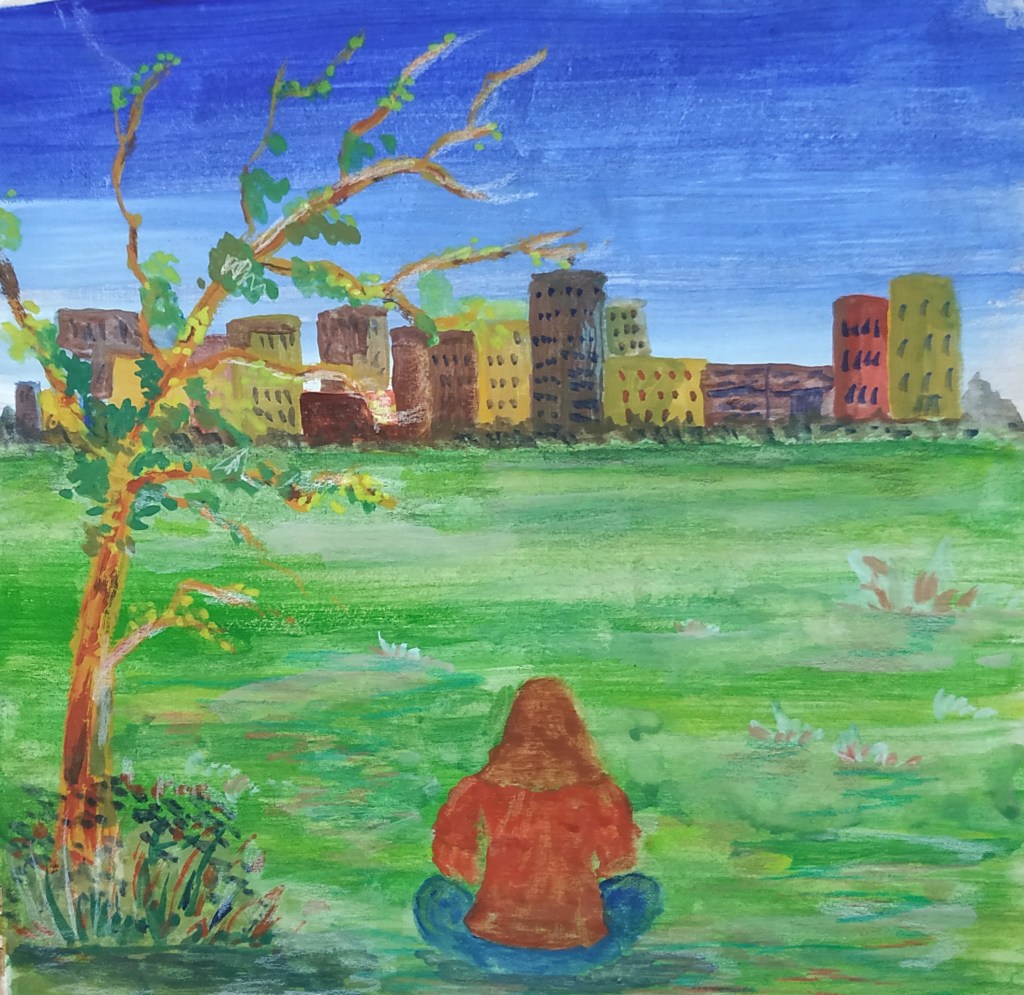
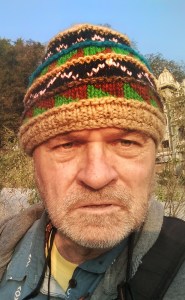
The Paradox of the Hermit Life (Courtesy of @travellinghermit3)
THE BEGINNING OF DEVOTION
Attention, paying attention. It’s the beginning of devotion. And when you see? When there is seeing? Well, seeing is praise.
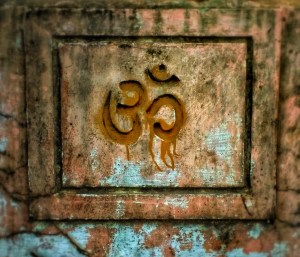
When we see, what we see, is God. Not the god, or this or that god. There aren’t lots of gods, or so it seems. And in the end, there isn’t even one god: there is only God. So it was said by the sages.
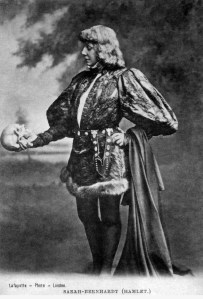
Sarah Bernhardt as Prince Hamlet (Public Domain image)
No, it’s not a quote from Shakespeare. Mind you, now I think about it, there’s a line in Hamlet, where the man himself is monologuing about the human condition and declaims a strong-felt sentiment:
What a piece of work is man! [sic]
The reality is that first quote is from someone far more mundane than the bard: me. The occasion on which I uttered this equally impassioned statement was as I sat holding my smartphone and listening to the music flowing from it through bluetooth fairy land and into the headphones I was wearing.
The truth is I was at that moment just awestruck and a bit overwhelmed with what I was hearing, and just as significantly, with how I was hearing a particular song.
Not being a materialist by any measure, my phone and headphones are nowhere the latest or top of the line models, but still, to me, what I was hearing was magnificent. It’s the only word that fits really.
Anyway, that isn’t exactly what I want to write about today. Reflecting on the experience described above, got me thinking about the actual song I was listening to. And that’s what I want to write about now.
The song in question is written and sung by Australian singer-songwriter Cyndi Boste (died 2018) and is called Cry Down on Me. Here are the lines that have struck me particularly:
I’m not afraid of your tears. Cry down on me I’ll make sure nobody hears Cry down on me.
Before we go on, a short note. Until I started research for this post I had my own idea of what ‘Cry down on me’ means. Seems I got it wrong. However, for this post I am choosing to believe that the songwriter agrees with me. If you look up the meaning and then listen carefully to the lyrics, you’ll see that perhaps I didn’t get it wrong after all.
Essentially here we have the singer/protagonist reassuring another person (friend? lover? sibling? We don’t really find out, but if I had to guess, I’d say they are lovers) that they are safe to share their tears, their sadness, anger, fears and so on. Most of us at some time or another (or always?) have been afraid to express or share our emotions, to show our tears.
So, why is our protagonist going to make sure nobody hears the other’s tears? Well, she is obviously aware that the other is at the very least embarrassed, perhaps afraid of being ridiculed, rejected, or perhaps they’re worried about appearing ‘weak’ or making themselves seem vulnerable.
And how did she come to that awareness? I think she has seen this other with the eyes of her heart, seen their need. And now she’s telling them: ‘Look don’t worry, I am listening to you with my heart and I can hear you.’
We are exposed to so much ‘noise’ from everywhere all the time. Even the tears of a loved one can be lost in the overall din that sometimes threatens to smother us all.
And of course we’re not just talking about literal tears here, and the sound the shedding of them makes: anything said, written or otherwise made known that is of substance, or real importance and meaning, is threatened with annihilation by all the trivia, gossip, advertising, round the clock news, and what I often call the general blah blah, that passes for life in the modern materialistic world.
Of course to protect ourselves from all that noise, it’s no surprise that we so often only listen with our physical ears, see with our physical eyes. Actually having said that, I know from my own experience that even that level of engagement and attention can be a struggle sometimes. And doesn’t that struggle sometimes lead us to closing down altogether?
I guess the answer lies in what Buddha call The Middle Way or Path: The bottom line is that we can choose what we listen to (or look at) and what we don’t. No need to switch off and isolate ourselves completely from the ‘outside’. Nor is it necessary to leave ourselves wide open to all that noise.
Like our protagonist in the song, we can listen with the ears of our hearts; we can see with the eyes of our hearts. It is in our hearts that love lies, where Truth lives. We can say to that other that we are listening and seeing with our hearts, while at the same time reassuring them that nobody, including us, is going to simply be hearing or seeing you only with physical ears and eyes.
The last time I listened to the song (yesterday: it’s become a big favourite) I had the thought that maybe our protagonist is reminding her Self that she’s listening. Sometimes our ‘real’ self can feel like a stranger, as if that Self is someone unknown, and living as a separate entity outside of us can’t it?
It’s at that heart level where we can truly listen, truly see, the other. And whether that other is one’s Self or another person, the truth is there really is no difference: your heart is truth, the other’s heart is truth, and it’s the same Truth.
We’ve all had this experience I think. I’ll be reading something, and right away I’ll come to a conclusion, become either sure of something or the complete opposite; I can be confused, force myself to ask more questions. I can even have brilliant insights or realizations.
No? Well, maybe it’s really just me then. But, wait there’s more: this is a two part experience. When that second part happens we will come to realise that what we think we read is nothing at all like what the words on the paper (or screen) actually said in a factual sense.
Yes, you’ve probably guessed by now that there’s a story coming. In fact this exact thing happened to me this morning, all the way to the brilliant insight or realisation bit.
In fact it was a brilliant realisation, the only problem was that it was based on only on what I thought I read, not what was actually being said.
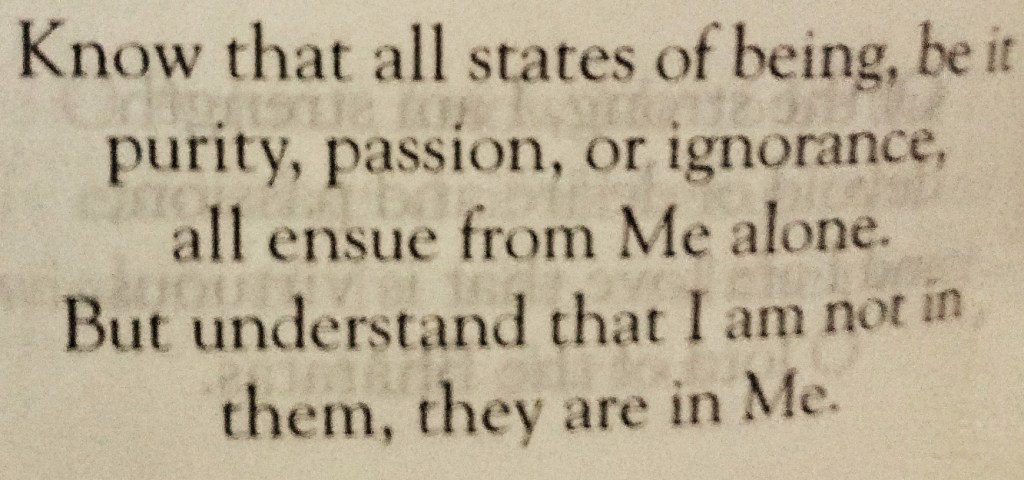
Anyway, I was reading the verse quoted below, from my Bhagavad Gita and a sudden flash of insight hit me.
Despite these five lines saying a particular thing in a clear and precise manner, I somehow misread the first three lines to say:
All beings ensue from Me.
Bhagavad Gita Ch 7:12
Somehow my mind skipped the ‘states of’ bit and made a leap that actually lead to a great realisation: Of course, I thought; God is not in us (as in living beings), it’s we who are in God.
Which to me means that we are all part and parcel of God. I’m not saying, I’m God; I’m not saying you are either. What I am saying is that all creation as one, unified whole, is in God. And if that one unified whole does indeed ensue from God, then it follows that all of creation is God.
As individualized, embodied entities, we (along with all life everywhere) are simply manifestations in the material form of that divine energy, that life, that truth; that which we often call God.
Now, this is an instance of a flash of insight leading to a truth, when the receiver of the insight (that’s me) is engaged with what you might call some other factual reality, that is, the actual words on the page.
At first I thought, that’s weird: how did I misread all those words related to states of being? I mean they are pretty clear right? But then I thought, no, maybe not so weird. In fact, it makes sense.
How can my material mind and intellect possibly be expected to always keep its millions of thoughts, ideas, impulses and the rest, in perfect order each thought or whatever following completely logically from the one before and to the one after? It’s never going to happen is it? Not for any of us (Well maybe I’m overstating my case here, but you know what I mean).
And if mind does indeed operate on what seems on the face of it to be a random basis, then it’s perfectly reasonable to suppose that one might be prompted to some momentous insight by, well by anything really. Even if it’s a conclusion jumped to after the misreading of a text.
In this case though, that jumping to conclusions, even though based a misreading, has turned out to be a genuine realisation that I feel on an intuitive level; my instincts tell me it’s Truth.
Strangely for one who lives a life that at least aspires to be outside the mainstream of our culture and society, I have a lot of rules to follow.
What I mean to say, is that, while for the most part I disdain the ‘rules and customs’, and the ‘demands and obligations’ of the dominent culture and our materialistic society, I seem to be quite capable of making up all kinds of rules for myself. I’m then more than able to put the exact same pressures on myself to obey, to comply and to conform.
One of those ‘rules’ is to try not to repeat topics of posts. Obviously there are posts that fall through the cracks of such strictness, but on the whole I like to keep coming up with new things to share with you.
But it’s been occuring to me lately that musings and contemplations don’t work that way. The mind, the heart, know no such rules as ‘no repittion’. (Actually, now I think about it, there are some things the mind likes to repeat all the time that I could do very well without thank you very much)
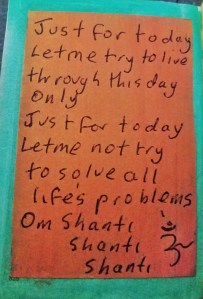
Sometime, not too long ago I think, I wrote about the beautiful George Harrison song, Just for today. I wrote about how I have a slightly paraphrased few lines from that song written in my Bhagavat Gita, and I read those lines every day:
I know I am not alone in my desire to not be constantly trying to sort out all life’s problems; I know many of us would just like a little peace, a little pause in the ongoing rush of life. Just for today, or even just for a minute.
What George is making a plea for here has resonated with me since I first heard this song so many years ago I can’t remember.
Anyway, this was supposed to lead up to the real topic of today’s post which was going to be about my decision last night to spend the next few days in a kind of retreat. Instead it’s turned into a bit of a rave about breaking self-imposed rules.
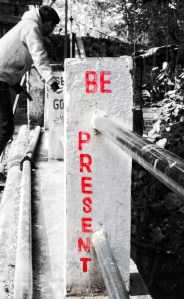
Actually though, one of the primary motivations for my decision was the very notion of presence, of being still for ‘this day only’. You know the idea: leave all life’s worries and issues, and worldly concerns out of mind, just for a bit.
In other words, in this case I don’t think I mind repeating myself, breaking my own (really rather silly if you ask me) rule. The retreat is timely, and it’s a good thing to be reminded that it really is about presence.
I’ve been getting too caught up in ‘what’s next?’ kind of questions. As well as the usual and very tedious existential angst over life, the universe, and everything past, present, and still yet to be!
So, at the risk of creating a classic oxymoron, it’s now the time to head off to find a little presence, and a little stillness.
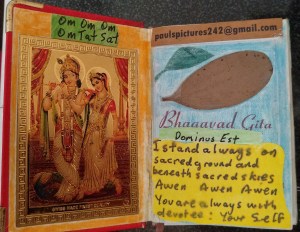
Have I shared with you my Bhagavad Gita? Well, I know I’ve mentioned a few times that it’s one of, if not the primary resource for study and guidance for me.
As you’ve probably guessed, this is a quick photo of the inside of the front cover. And, again as you’ve noticed, I like to stick things in my books, especially this little one. (Actually now I mention it, this is the only book in the traditional format as in made of paper, I own). It’s an old practice and for me adds multiple dimensions and depths to what is already a treasure.
Sometime I’d like to go through and describe to you all that I have added, but for today, do you see the little green section with the words Dominus Est printed?
In the religious tradition I was raised in, these two words have a specific meaning and use. However, it’s only recently that I’ve come to think of this little Latin phrase (well technically it’s a sentence, but …) in the sense of the literal meaning of the words themselves: God is.
That’s it. Or the Lord is, or the Master is. If we change the Dominus, we can use this tiny sentence to define our conception of the divine, the holy, in any way that seems right: Truth is, Beauty is, Art is. For me, God is, sits right. As do the others in this list. Same same.
So, God Is. What else could possibly be said that would add to this already very emphatic and simple statement? Nothing at all. It’s stand-alone, complete in itself.
Like asking who or what is God, we can answer: ‘I am this’ or ‘I am not that’. Or we can realise what for me is becoming the only answer: I am.
Why? Well, if we were to add anything at all to these two words, such as God is Truth, or God is Love, or God Resides in …, or God is called … , then we are in fact stating only a little of the truth. Sure, God is truth and love, and goes by many names and is found in many forms, but once we say what something is, we are actually making more of a statement about what it is not.
In the beginning there was the word, and the word was with God, and the word was God.
Mind you, it’s perfectly natural, and for many of us helpful, even necessary, to ascribe to God a name and or form. We are ourselves material beings, living in a material universe; it’s logical that we would choose (or need) to see God in a word, a physical object, or attribute some other kind of materiality to our notions of the divine.
I must say that I am one of those who find it difficult to envisage an invisible, non-physical, and impersonal ‘God’. Of course, our little statement, God is, does indeed say just this doesn’t it? Isness is pretty non-corporeal, certainly not in the least physical. And isn’t even a ‘spirit’ or ‘entity’ of any kind; Isness just is. The moment we label something (including ourselves) we miss that isness, that essence.
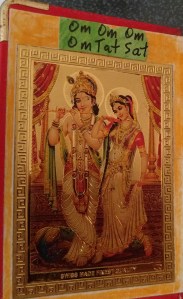
You see my picture of Krishna and Radha? This form, or forms, is one of the several that I feel right in having as a kind of focus, or centre of my devotion to and love for the divine; for love, for truth, and for it all.
You might be saying, this guy does believe in a personal God. He just told us. The truth is I don’t believe or not believe that Krishna (or any of the myriad names and forms we’ve invented) is God. God simply is. And my heart tells me that this is enough.
There are a pair of theological ideas known as Cataphatic Theology, and Apophatic Theology. Cataphatic describes or approaches the divine by stating what God is, while Apothatic (you guessed it) describes God by speaking only of what God is not.
My guess is that pretty much everybody, from whatever tradition, would approach the divine (and not only the divine) in one or other of these ways. But for me it was such a relief to realise that there was no need to go there at all. I could stop with the definitions and the descriptions, the what is and what is not. I have the freedom to not have to believe or not beleive. None of it matters. Dominus Est. God is.
Am I there yet? Have I let go of dualities? Hardly. Maybe the odd glimpse, but it’s rare. And it always will be for as long as I live in a physical body. But to paraphrase something Swami Ramdas said:
I’ve set my feet upon the path, so I am already at the goal.
I can’t remember when I wrote my last post. And of course it isn’t relevant at all is it? I mean to say that in the contemplative life, time sometimes seems to take on some other kind of character.
Or at least I should say that one’s perception of the passage of time shifts; nothing unusal there I hear you say, and of course you’re right. Just thinking out loud I suppose.
For me, having a right perception of time is an important aspect of my Sadhana, my practice: yes, it’s true: time is seen to fly, or it is frustratingly felt to drag. But my aspiration is to see time as simply a human construction that we use to limit, structure, bind, define, and place all kinds of restrictions on our lives.
Which for me, simply means that there is only presence or Presence; only the ongoing continous moment (what we often call The Now). Easier said than done mind!
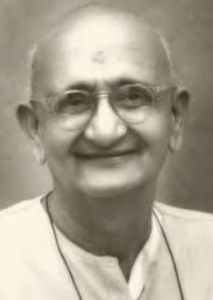
Swami Ramdas (known as Papa to his followers)
In any case, here I am, just where God would have me be. Feeling strongly to reach out to you, I remember the poem (it’s not really about time in the sense we’re discussing it so far) that emerged the other day after reading a quote from Swami Ramdas that seemed to be an answer to some thoughts I’d been having.
I’m grateul for this, all of this. And for you too, the reader of these musings offered with humility and thanks.
Peace and love from me to you.
GOD IS MY ALL
Thinking thoughts as if battered by demons. Memories arising of my own evil deeds, selfish and cruel. Right away I turn to God: God is my all; Hare Krishna
Forego repentance, relinquish regrets; you are filled with God, the supreme essence of life. God is my all; Hare Krishna.
Through Papa Ramdas I hear the Universe speak: Forgiveness is from God; and it has been granted. God is my all; Hare Krishna.
I’m actually scheduling this one to publish sometime in the future. The reason is that, as I reread it now, I see I’ve used ideas, and even some sentences here that appear in a couple of recent posts. The thing is, I think this is a post worth reading, so I’m kind of sneaking it in via a touch of time travel. In any case, please enjoy, and by the way, thank you for sticking with me for this long (however long this is).
It was a revolutionary idea for its time, the early 19th Century. Come to think of it, it still is. A reform minded Christian minister, William Ellery Channing proposed that the proper goal for each of us human beings is perfection.
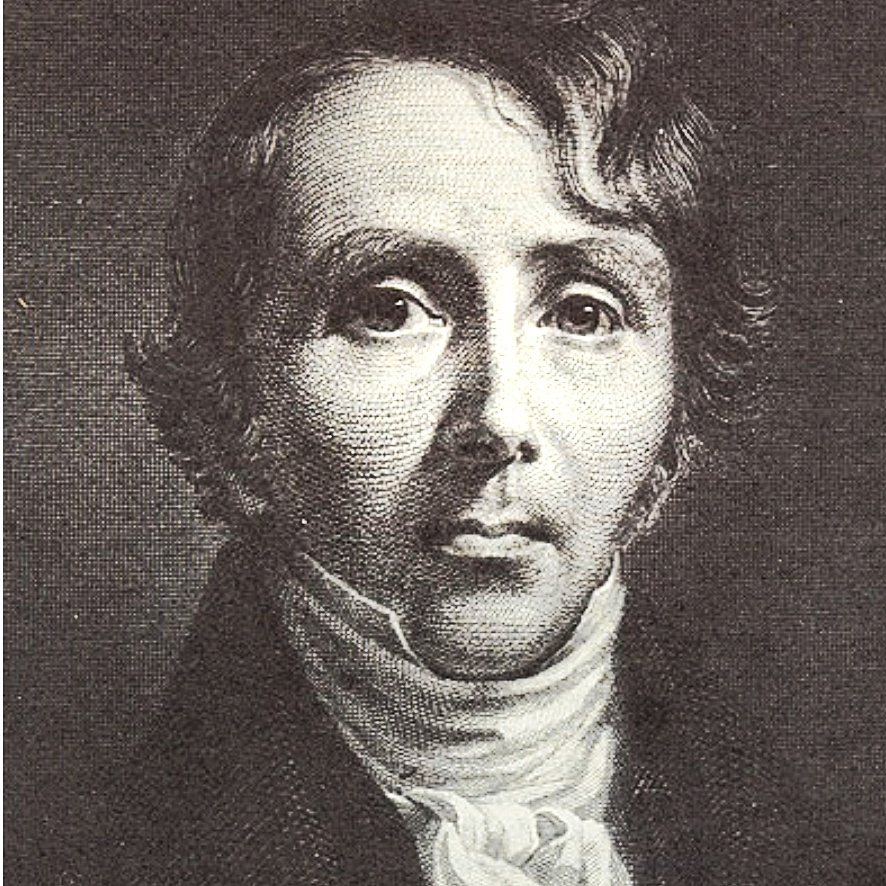
William Ellery Channing (Public Domain)
Or rather, the goal should be a realisation of the perfection that is already our true natural state, our true selves, which we’ve forgotten as we have got on with the rarely easy business of living in a material world. You see? I did say it was a revolutionary idea.
After all, he wasn’t talking about the obsessive perfectionism that often curses so many of us anxious types. Or the myths propogated by mass media of what it means to be ‘perfect’. No, he was proposing a complete and thorough shift in the prevailing thinking about the nature of humans, and in reality, of all life.
Anyway, he posed the question:
Do you ask in what this perfection consists?
He then proceeded to answer his own rhetorical question:
I answer: in knowledge, in love, and in activity
When I came across this little vignette in an unrelated book I’ve recently finished reading, I was a little bit mind-blown. Channing’s formula is more or less identical to that presented over millennia in a number of the world’s religious or spiritual traditions.
For example in the tradition I am studying these last years, Sanātana Dharma, this little formula constitutes pretty much the foundation for any kind of spiritual growth. It could be said that in a real sense it is the very basis of all Yoga:
Jnana Yoga (knowledge, study, includes meditation, contemplative practices and so on), Bhakti Yoga (Divine Love. In the sense that love is always divine) and Karma Yoga (often called the Yoga of action. It basically includes everything we do in the physical world. The Karma bit is about our actions becoming selfless).
In other words, just sitting there on their own these three Yogas offer a pretty succinct answer to the question many of us ask ourselves constantly: How can I live a good life?
We pursue knowledge for many reasons: it may be a reluctant pursuit as we sit through the interminable years of high school; or later as we head to university or college to train for a career that we hope will support us. The thirst for knowledge might arise when we come upon a topic or an area of interest and fascination that we just have to learn more about.
Just as with the infinity of knowledge, love comes in equally infinite guises. Unlike knowledge, however, I don’t think there are ‘reasons’ we can give for love. Love is love; it is its own reward (and it’s own torture), it just is what it is. Divine is as good a word as any. Any love, all love, is love for all and for everything.
And then there is the kind of knowledge we pursue as we try to answer what I like to call the Who am I? questions. Things such as: What’s the meaning of life? Where am I from? Where am I going? Is this all there is? Oh, and of course the real biggie: Who am I?
Now, at the risk of having to take the prize for the most obvious statement ever made, let me make the point that all living things have to take action all the time if they are to remain alive. So obvious that I’m even having to take several different actions in order to tell you this. So, you might well ask, what’s the big deal? What’s Channing and all the others through the ages getting at? What activity?
Well, I think Channing was getting at the notion that every action we take needs to be informed by knowledge and love. But, what knowledge? Well, clearly we are caught in a tsunami of information much of which goes to making ‘fake’ knowledge, propaganda, deceptive advertising, biased education, and the rest.
In other words how often do we see knowledge not used correctly? And, how often is humanity’s use of knowledge – our actions – informed by love? Now we can begin to realise how revolutionary this idea is, and always has been.
I think that’s why the Sanātana Dharma teachings and world view embody the concept Bhakti, or divine love. As I noted, all love is divine. These teachings tell us that all action is to be undertaken with love, without attachment to rewards or outcomes, and dedicated to the welfare of all life.
Channing had the same idea: for him all life is pure and perfect already. And of course it follows I think that all actions we take have the potential to be informed by a wisdom gained from proper use of knowledge, and to be informed by love, whether it’s for self, for other people, other animals, Earth herself.
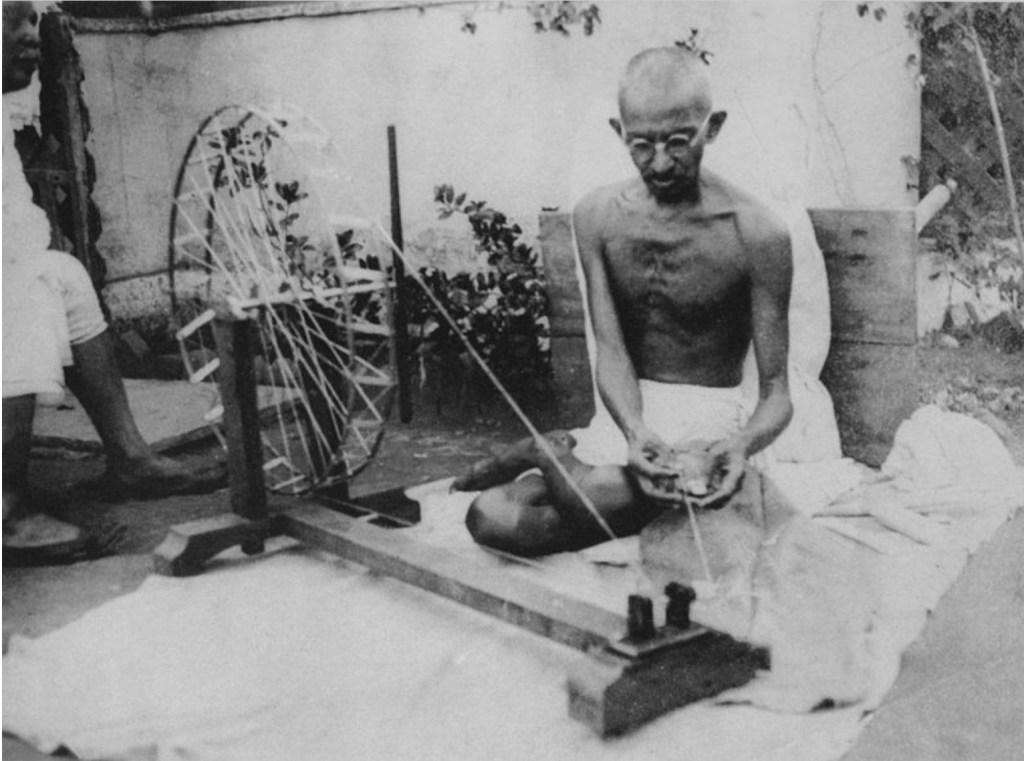
So, pretty revolutionary stuff eh? I guess a lot of us have heard that famous quote from Gandhi:
Be the change you wish to see in the world.
Well, here’s the freaky bit. Just now as I looked up the quote to make sure I got it right, I discovered that he never actually said those words. Not in that form anyway. Here’s what he actually did say. It’s a long quote but I think it’s an interesting note to finish on. I think for me it clarifies many of the questions this little discussion has raised in my own mind, as it will for you I hope.
Gandhiji at his spinning wheel (thank you Wikimedia Commons)
Knowledge; Love; Activity
We but mirror the world. All the tendencies present in the outer world are to be found in the world of our body. If we could change ourselves, the tendencies in the world would also change. As a man [sic] changes his own nature, so does the attitude of the world change towards him. This is the divine mystery supreme. A wonderful thing it is and the source of our happiness. We need not wait to see what others do.
Quite a long time ago now I half wrote a book. I mean to say, I wrote half the thing before giving up. The book was going to be called When a Pet Dies, and was about, well exactly what the title suggests. All the practical stuff that you’d expect, as well as ways to deal with the grief over the loss of a companion animal .
I thought at the time that the reason it was only half written is that, once I got through that practical stuff and was ready to tackle the grief and loss parts, some kind of lethargy set in, or I got lazy. Or perhaps, I was thinking also, the muse for that particular project had simply left and was gone. So it remains half written.
So, why am I musing over this half done, half forgotten project from long ago? Well, let me tell you about a visit I had this morning.
I was sitting, focusing on chanting my mantra. Suddenly I felt an absolutely overwhelming sense of loss and sadness. I don’t recall thinking of anything in particular beforehand, but the sense was overpowering. Flooded with grief is what they call it I think.
Lofi (on the right) with his sister Shanti
And then, just as powerfully, I sensed the presence of Lofi, my cat who died in my arms over ten years ago. Immense feeling of presence is what I wrote in my notebook. Now, I’m not saying he was literally there with me. I’m also not saying he wasn’t. All I can say is that it was among the most intense of similar experiences I’ve had over the years. Anyway, that’s most likely what got me thinking about my incomplete book.
Later this morning I was sitting with my partner on a benchseat overlooking the sea, the bit of the Pacific coast I’ll be leaving behind next week.
Actually, now I’ve mentioned that, you might remember from my last post how keen I am to get out there to the desert. That excitement and anticipation doesn’t mean for a second that I’m not feeling quite sad about leaving the coast.
Anyway, we were just sitting there and chatting on and off, when suddenly a thought seemed to push its way to the surface. I all of a sudden knew why I stopped where I did when writing that book. I realized in a strong and convincing way that you can’t build a structure to define what grief is or how or if it should be experienced, by whom and when.
I’m not talking about the ‘truism’ that one hears all the time that says that the ‘stages of grief’ are in a set order, until they’re not. Actually come to think about it, I’m not even sure this is true. I mean, I’m not sure it (grief) is a thing to be labelled, quantified, recorded, predicted, analysed.
I mean, who’s to ever say how any other individual, or even oneself, will feel about anything at all? Sure, there might be a ‘typical’ set of responses to any given circumstance, such as a loss, but even the proponents of such theories will tell you that none of us is typical.
Which kind of leads me back to my feeling of oneness with my Lofi earlier in the day. Obviously I’m not alone in having such feelings. How often has any one of us heard other people say, after they’ve lost a loved one:e, ‘S/he was really here. It was so real’.
Such experiences can occur anytime, even decades after the loved one has left. I’ve mentioned somewhere else that I’m reading (in little chunks) a great book by Joseph Campbell, the renowned scholar of myth. Let me share with you a quote from the section I’ve been reading today where he’s talking about how art in India seeks to portray the divine in all things:
This is the wonderful song that one hears when one reads the Bhagavad Gītā or any of the great texts of Eastern philosophy. This is the song of that immortal spirit that never was born and never die.
Of course this isn’t meant to be a consolation to myself or anyone else. After all, we are physical beings, living in a material, solid and apparently ‘real’ world. So, naturally, we experience loss, like everything else in that context.
Our bodies react (or don’t) as do our minds, creating physical sensations and emotional responses. Or not. These physical and emotional responses, or lack of them, are totally unpredictable, unexpected, and most definitely unclassifiable by anyone outside of oneself (myself)
Anyway, there are no rules. Even the grief and loss experts will tell you this. Mind you, I can and will only speak for myself, and my experience. Basically that experience has taught me that I have an intuitive resistance to ever thinking in terms of there being a ‘roadmap’ for grief.
Or a statistically valid ‘pattern’ or ‘process’, or that there are even such things as ‘stages of grief’.
My grief for my Lofi is unique, just as everyone’s is. I’m pretty sure I don’t even want to define it, label it, ‘try to get closure’, ‘come to terms with my loss’. No. None of that. It’s like I’ve said someplace else, or at some other times:
Sometimes we make way too many words for something for which there are no words.
Thank you for allowing me to share these words with you. I pray that they are not ‘too many’
One week today and I will be there. In other words, this time next week at this time I will have arrived in the desert city of Broken Hill. Almost in the heart of the continent and right in the middle of the Outback. In fact they call that whole area The Big Red after the colour of its tens of thousands of square kilometres of desert sands.
Back to Country
It’s about 1500 kilometres from the Pacific Coast where I am right now. I’d like to write about the ‘call’ to the desert, which I am finally answering, but maybe I’ll get to that in another post.
Right now I only want to say how excited I am to be going. A bit anxious too (I’ve been there before, but still …), and plain and simple looking forward to getting there.
Acturally, to be perfectly clear about it: I can’twait to be there. But, you see, herein lies the problem: I am so keen to get there that I’m feeling as if I am no longer here. I am not present; I am not living in the moment and in the place I’m in (which I love by the way, the place I mean).
I don’t mean to say that I am some sort of Buddha who is usually fully present in each moment; or who is serene and calm when he knows change is coming. Any reader of this blog will tell you that presence isn’t necessarily my greatest strength.
But, I must say that lately I have improved (slightly) my living in the moment, being here and now, way of living. It’s just that I’ve been longing for this particular change (and all that I anticipate will come with it) so much that I just can’t help myself.
Did I mention already that this is a problem for me? Well, yes, I did, and it is. I prefer very much to be where I am and when I am and fully in the flow of the ongoing present.
Of course there is nothing wrong with wanting something to happen. The problem arises when one is so anxious for whatever it is to happen, that what’s happening here and now ceases to be where one is at—in other words: the trouble is that I stop being in the present.
Buddha taught what are called The Four NobleTruths. (which pretty much form the core of Buddhist teachings) The second of these Truths says that attachment is the cause of suffering. Suffering here means anxiety, worry, regret, fear; all those kinds of things. Whenever we say something like, ‘I can’t wait to…’, then it is a sure sign we are attached to that want or desire.
If I’m in it, will I win it?
By the way, the First Noble Truth is: Life is suffering. Suffering, The Buddha taught, is simply the price of being alive. We get hungry, we are conscious of pain (in all its guises), we grieve; we grow old; we get sick; and we die.
But, right now, I want to talk more about Noble Truths three and four. Number three says that suffering can be overcome. Nice clean, clear, and not to mention, succinct little statement. Of course, it’s easy for him to say isn’t it? He is Buddha after all.
Perfectly reasonable reaction from us suffering humans. But there is hope and we will find that in Noble Truth number four which gives us the how to overcome suffering. There are quite a few ways to put this Truth into words, but the one I like best says:
The way to overcome suffering is to sit.
What? Sit? Yes, sit. Be still; stop moving. Of course if we relate this Truth to my little dilemma for wanting to so badly to be somewhere else that I’m not able to be where I am now, we can expand this Truth to something like this:
Focus your full attention on what you are doing now, and where you are now as well. As much as you can, be open to change, but be less attached to the nature or timing of that change. After all, you can make all the plans you like, but who knows what’s really going to happen—you won’t know that till it actually happens.
So, that’s what I am trying to do. Instead of saying stuff like ‘I wish I could go sooner’, or ‘it’s only x days till I go’ (yes I know, that’s what I said way up there at the top of the post), I am going to ask myself, ‘What am I doing now?’, and I plan to look around me, and engage more with the reality of this moment. And try hard to realise the ongoingness of that everlasting moment.
Hey, that’s a great mantra isn’t it? Chanting it whenever I start getting out of the here and now mode, might just put me back there again. I mean here—and now. You know what I mean!