
Karma Yoga & Contemplative Living: Creating Good Vibrations

Greetings friends

Not so long ago I read The Glass Bead Game by Herman Hesse. And I have to say it’s what I like to call a ‘real book’: written beautifully with an interesting and deeply engrossing story, full of detail, symbolism, thought-provoking ideas, and at the end of the day just plain and simply a delight to spend time with.

I won’t go into what the book is about here, but for the sake of this post, I will just tell you that it is about a mythical European province populated by an elite group of scholars of all sorts who have as their main cultural, social, and even political focus, the game of the book’s title.

Anyway, what I want to talk about here today is something said by the book’s main character, who in the course of the story becomes the master of the game and therefore a hugely influential figure.

This character is having a conversation with a friend. And he’s talking about the way this elite group conducts itself in the world. How it helps shape the country and history. He says to his friend:

We do not intend to flee from the vita activa (the active life) to the vita contemplativa (the contemplative life), nor vice versa, but to keep moving forward while alternating between the two, being at home in both, partaking of both.

Now, what struck me about this quote is that only a couple of days before I’d read a verse in the Bhagavad Gita that I felt said almost exactly the same thing. Krishna says to the warrior Arjuna:

Contemplative life and Karma Yoga are one and the same and takes one to the same destination. One who perceives this sees things as they are.

Bhagavad Gita Ch 5 Verse 5

Karma Yoga is usually defined as taking action without desiring reward for oneself or being attached to the fruits of the action. It is very much the taking of selfless action that is for the benefit or others. However, because as living beings in the world, we are always taking action and actually can’t not be acting, Karma Yoga is also described as being simply the yoga of action.

The Contemplative Life is most often ascribed to monks and nuns, and others living a life of deep thought, study, meditation and prayer. But any of us can lead a contemplative life because such a life is about being mindful, it’s about considering the consequences of our actions.

Such a life is lived slowly and thoughtfully and would be called ‘spiritual’ by some people. We could also call it an examined life. It is about cultivating an inner life, a life of mindfulness in all aspects of our lives.

And living in a contemplative manner helps create more peaceful communities; people living in this way project a calm that can have profound impacts on others. Such people help to set up what some us like to think of as good vibrations

Of course it’s one thing to talk about the Contemplative Life versus the active life in a novel and in an ancient book of scripture. It’s a whole other thing to be trying to figure out what sort of life we should be living in the world here and now, with the urgency of climate change, wars, despotic leaders, increasing poverty and the rest. Or is it?

Is it better for us to take action by protesting, joining activist groups, writing letters? Or is better that we live apart in some way, spending time contemplating, meditating, ‘praying’?
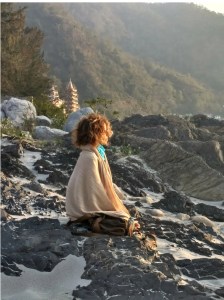
To me it seems there’s a real struggle going on right now between these two points of view. There are those who will tell us that it is too late for ‘thoughts and prayers’, and then there are those who say, we can’t achieve world peace (in its many facets), until we have attained inner peace on an individual level, and that the only way to reach that state is to meditate, live a contemplative life, and slow down.

Obviously, and you already knew I was going to say this, the two are not mutually exclusive; both approaches are required and serve their own purposes. There is no dilemma; there is no conflict. And above all, neither approach is superior to the other.

Many of us are suited to an active life; some of us less so. Some of us are suited to silence and to quiet reflection and study, some of us aren’t. And oftentimes if we try to act contrary to our true natures, then we have great difficulty in achieving anything. And we don’t help anyone when that happens.

Karma Yoga or the Contemplative life. An active life or a life of silence and contemplation. Only you are able to know which is for you. Of course there’s always a crossover to some degree or other. Being fully active and engaged in the world, doesn’t stop one from spending time in a contemplation, and perusing one’s life mindfully.

Equally, leading a totally or partially contemplative life doesn’t mean you aren’t taking action in the world. Obviously you are. For me, the contemplative life is a way to find some personal peace, to create those good vibrations I mentioned, and it allows me to connect with others of like mind, who are working for the highest good. Those living in the invisible community I think I’ve mentioned some other time.

Balance. The key is to find the balance that expresses you and your nature best. So, take some action right now and begin contemplating!

With These Words … Part 4

Welcome back to my little mini-series With These Words … , my reflections on how well my way of living measures up to the vows taken by many spiritual seekers, either in a community setting, or as a spiritually oriented hermit, or an individual ‘monk in the world‘ (and monk here has no gender specific meaning. A monk is a monk). Do these concepts work as a kind of philosophy of life for me?

Funny I used the expression measure up just now: You see, we’re at Part 4 which is Accountability. So, measuring up is the very thing we will be talking about right now! Oh, one thing: If you missed any of those earlier Parts to this series, you’ll find links in the PS at the bottom.

Accountability

It goes without saying that we are always accountable for the consequences of our actions, decisions, behaviours, and way of being in the world. Of course there is a deep mystical concept that it is only our material nature that carries out actions in the physical world and that the doer is actually the source of that material nature: God, Self, Brahman. Or you could say the Universe. As in I am a child of the Universe kind of thing.

But, you know, putting all that aside, we are actually living a physical life, and the truth is we are accountable for anything we do in this material world. And that means literally everything: thought, word, deed; the whole deal.

So, the question is not whether or not we are accountable: we just are. The real question is whether I myself acknowledge that accountability and act accordingly to change behaviours or whatever might be necessary.

To be honest, I truly feel that we all very often fail, sometimes even refuse, to even see the consequences of our actions, and therefore fail to make those necessary corrections or changes. Certainly you can put me high up on that list.

So, the big question: Do I feel ‘obligated to explain, justify and take responsibility for [our] actions and to answer to someone [for the consequences of those actions]? (Thanks Dictionary.com for the help here) That someone is very often yourself, or a partner, family member, work colleague, friend. You get it.

Personally, I would say definitely yes, sort of, sometimes. The problem comes up on those occasions when I fail to see, as I noted above. Now, again being very truthful about myself, I would say that most of the time I am aware of my actions, even when I’m not able to control them. But, still being truthful, I am often guilty of picking on the wrong stuff I do and end up blaming myself for innocent actions, and blissfully ignoring the other kind.

I am very big on taking responsibility once I’m aware of a not so good consequence or behaviour, or whatever. Of course like everyone else I do at times defend the indefensible. I’m particularly good with that sort of thing: it often takes me a long time to wake up. Not as long as it once did, but still.

In my attempts to live an authentic hermit life, I think naturally and, through my spiritual practice, meditation, study, and contemplation, not to mention self enquiry and heart level honesty, steadily making progress.

Like I said, being accountable is not the question. It’s about realising that I’m accountable and that I am thus responsible for taking whatever remedial action necessary. And it goes without saying I am also accountable for the consequences of those actions too.

Phew. That’s quite enough of this particular little episode of self enquiry. Okay. Just one more thought:

Remember my last post (I Think, Therefore I suffer. Sometimes) ? About how I was able to divert the ‘poor me’ thought train, to let the ‘I’m really and truly blessed’ express to roll on through? Well it occurred to me that this is a terrific example of accountability. Remember thoughts count as actions too.

I had the negative thoughts, which lead to the consequence of an onslaught of maudlin self-pity. and even in that sad state I realized that there could only be bad stuff come from that self-pity if left to fester – and it might not just be me who gets entangled: self-pity makes vibes, an atmosphere, and that affects everyone.

No, that was not going to happen, so other thoughts kicked in. In other words, I made changes: my thoughts of ‘woe is me’ transformed into ones of gratitude and acknowledgement of my true position.

Essentially I saw the consequences of my actions (or thoughts), realized at some level I was accountable to myself and others for those consequences (actual and potential), and I took action. As I said, this all was going on inside and happened in a flash really. Still, I am still witnessing the consequences of that little incident of being accountable for my actions and acting accordingly.

Enough I think I said? I realise that I have gone on and on and not given thought to the consequences to you, the suffering reader stuck with said verbosity. So, as a responsible hermit who has taken a vow to be a bit more silent at least sometimes, I will stop this post without further ado.

PS Just in case you’ve missed the previous posts in this series:
Part 1 The Introduction and overview
Part 2 Simplicity
Part 3 Purity