Allow Me to Introduce My Mask

Greetings friends

At the moment I’m reading a book (Myths of Light: Eastern Metaphors of the Eternal) by Joseph Campbell, the brilliant, more than brilliant scholar, writer, teacher, and philosopher of all things having to do with myth.

Actually, to be honest, it’s truly riveting reading, but still, it’s a hard book to get my head around, but I’m taking it in little chunks, and the effort is, you can believe me, well worth it.

Campbell makes so many fascinating observations and his insights are genius. One section that gave me much to think about was where he talked about Carl Jung‘s idea of masks:

… he [Jung] points out that each one of us is invited by his [sic] society to play a certain role, a certain social function …
… We all have to put on a mask of some sort in order to function in the society. And even those who choose not to function in the society, to revolt from the society, put on masks too. They wear certain insignia that indicate, “I am in revolt.”

Yes, I know, it’s an idea we’re all pretty much familiar with: we all put on masks: work masks, school masks, relationship masks, masks to impress, masks to hide behind, all kinds of masks. But here’s what got me thinking: If you saw my last post, you’ll remember just near the end I said something like, ‘I am a hermit and a pilgrim’.

Now, normally, I tend to think I don’t wear masks. But, surely such a statement declares that I have simply put on one more mask? And, given the usual perceptions of hermits and even pilgrims, am I telling anyone who will listen (especially myself) that ‘I am in revolt’?

And that got me thinking more, about that ‘especially myself’ thing. I don’t think there’s anything wrong with wearing masks; after all as our quote says we wear them in order to function, to have a role or roles in our society.

But we also wear masks for ourselves, so we can give ourselves an identity, a role, a function. So a mask, you might say, is just how we get on in the world, and in our own minds; we take them off, and put them on according to the situation and needs of the moment.

Which says of course that we all are, I am, many things at different times and stages of our lives, our days, our careers, and so on. At this stage of my life I have put on the hermit/pilgrim mask I’ve carried around on the inside all my life. I am asking myself again, does this make me a rebel?

Well, before I donned the hermit/pilgrim mask properly, yes I wore the mask of the rebel, of the angry and outraged advocate of complete and total social change. And perhaps from some people’s point of view, I might still be a rebel: rebelling against the expectations, demands, and easy temptations of my society.

Anyway, I seem to have taken the very long route to the main point of my thoughts on all this rebel insignia stuff. The reality is, I’m not rebelling against anything. Except for those times (all too frequent) when I let anger and outrage slip through. After all, I am still human and have my weaknesses. ‘Tipping points’ as a wise person has called those moments when ‘it all gets too much’.

I see my role, the role of the mask I wear, as a creative one, one of building up, not tearing down.  This particular mask is still in the development stages, but isn’t that how everything works

There’s an aphorism I like very much:

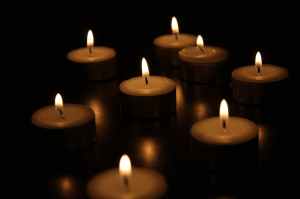
It is better to light a candle than curse the darkness.
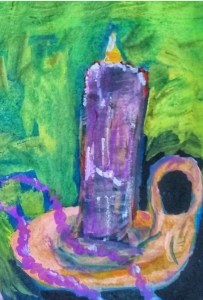
(back in March I wrote a post describing a real-life event that illustrates this wonderful expression, both literally and metaphorically. If you missed it, do check it out).

Now, as of this moment in my life and in my progress on whatever path I’m on, I can truly say that I spend time – a lot of time – cursing the darkness. I mean, how could I not? That probably makes me still a bit of a rebel.

Yet, at the same time, I think I’m learning to understand the pointlessness of only cursing the darkness. Maybe it’s not a case of all one way or the other. Okay, I’m human, so I curse the darkness? There is a great deal of darkness to curse isn’t there?

Perhaps I can allow that cursing to lead me to action? And, well it has. At least that’s what I’m working on, aspiring to. Living as simply, quietly, and in as much solitude, as I am able; buying fewer things; letting compassion inform my eating, clothing, and travel choices (actually all my choices); having as little to do with what I call ‘the mainstream’ as possible; acting as far as I’m able in accordance with my true nature.  All these measures are aspects of the hermit/pilgrim role.
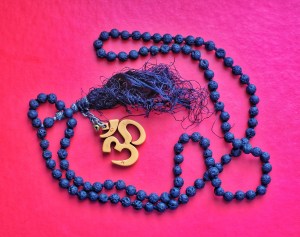
But I’ve missed the greatest, most important and vital aspect that goes with the responsibility of wearing the hermit/pilgrim mask: Prayer. Quiet prayer and contemplation. Sometimes just sitting (I know, it’s a favourite thing to do for me), letting the quiet come. Letting the light come.

You know, in some post, somewhere on this blog I’ve mentioned that often repeated statement:

It’s too late for thoughts and prayers

Well, more and more I am getting to grips with the notion that, far from being too late, this is precisely the exact moment when thoughts and prayers are needed most.

I hope that my little efforts can at least contribute in some small measure to the efforts of all the other people out there in the world who, while they may not be hermits or pilgrims, and while their natures might lead them to any number of differing activities in the world, nonetheless share with me the aspiration to light a few candles.

An Idea From a Not So Random Corner of the Universe

Namaste and Greetings friends

Remember in my last post I mentioned that I like to ‘Let the noble thoughts come to me from all corners of the universe’? Well I’ve been exploring, investigating, studying, in one of those corners for a few years now.

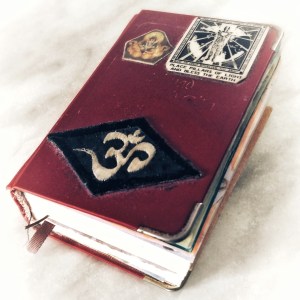
In 2016, in India, I gifted myself a small copy of the Bhagavad Gita. It’s a little red book, my Gita; no commentaries, just a plain, simple, and easy to understand translation of the 5000-year-old text known as the ‘Song of God’

Of course there are many sources of divine wisdom. No. That’s not right. Start again. Everything is a source of divine wisdom, of the word of God, universal knowledge, Truth, the Dharma. We can call it what we like.

But every living thing – human and non-human – every experience we have, and the entirety of the material and non-matieral creation, is divine wisdom in action.

Speaking for myself, I don’t always remember or realise (as in believe, trust, know) this never-ending, inexhaustible supply of wisdom. So I have to make use of some physical forms that help me narrow my focus, to centre my attention. It happens that the Bhagavad Gita is for me, one of those physical forms.

So today I want to talk about a verse from the Gita that really leapt out at me when I opened the book at random yesterday.
That verse comes from a chapter titled Self Knowledge and Enlightenment. It’s where Krishna – representing our Higher Self, Divine Wisdom; the real us, the real me – is telling Arjuna – the ego self, or little self, the us that thinks ‘this is me’, ‘puny, small, little me, just a sack of bones’ – all the various attributes and qualities of the Higher Self, the real us.

In other words, our Higher Self is helping our lower self to realise what we really are, trying to get us to see that there is a lot more to us than meets the (physical) eye.

Anyway, to the verse:

Of the strong, I am strength devoid of desire and passion, and I am love that is virtuous.

Bhagavad Gita Ch 7 verse 11

My sense is that the entire Bhagavad Gita is designed to help rid us of our attachments to the dualities of the world. Of course material life is obviously a state of dualities: we like good things, don’t like bad things; sometimes we’re happy, sometimes full of sorrow; we might at one time have many material possessions, then at another have nothing. You know where I’m going here; after all you dwell in the same world as I do!

Naturally none of us want bad things to happen, so we try to develop ways to be strong, to gather strength so we can face the bad stuff when it (inevitably) happens. And there’s nothing wrong with being strong, nothing amiss about having strength, but here Krishna (Higher Self) says that we don’t need to desire to get strength: we already are strength. Remember: Krishna is our Higher Self, so if Krishna is strength then that means we all are.

The desire and passion he talks about is really our attachment to outcomes, to expectations, to labelling things good or bad, or this or that, or wanting to feel this emotion but not that one. In other words, we are strength without any of these attachments;

So, when those inevitable ‘bad things’ happen, we already have the ability to flow with them, to cope with them, without judgements, without fear. Equally, when the inevitable ‘good things’ happen, we can rejoice, but we are strength, so there’s no need to hang onto them, wishing them to keep on happening, or being fearful of them changing.

You know there is an expression I used to loathe: It’s all good. It’s one of those non-commital, bland platitudes that really doesn’t mean anything. Well I don’t hate it quite as much as I used to but I still have trouble with it. Maybe we can take it a bit further?

Perhaps we could say instead: It all is. No good or bad; no joy or sorrow; no dualities of any kind. Sounds like heaven doesn’t it?

Well, while we’re in physical bodies here on Earth (and who can say what kind of bodies if any we’ll get to inhabit in the future), then the most that can ever happen is a glimpse – or maybe a few glimpses – of isness. Moments when we actually stop labelling, stop seeing dualities, and really and truly can know, it all is. For real.

And the love bit? Well, here we have Krishna (our Higher Self) saying he is love. He means us. He’s actually telling us that we are love. And virtuous love at that. Mind you, is there any other kind?

Peace

What’s ‘Ordinary’ Got to do With It?

Perhaps shameful is too strong a word, but that’s kind of how it feels. You see, I’ve been thinking of giving up on the book I’m reading at the moment. And you are thinking, this is a big deal? If you don’t like it, put it aside and try something else.

Yes, excellent advice, thank you. And usually that’s what I would do. In fact now I think about it there was a time when I would force myself to complete a book, even if I wasn’t enjoying it or was bored with it. But I learned a long time ago that this is a waste of time, waste of mind, waste of energy, and unfair to me.

Yet, on this occasion, I started to have some thoughts that took it a bit deeper. It’s true to say that I’m a bit bored with this book; it’s as if I’m not overly interested in the story the author is telling, and in the way she’s telling it. As well I had this feeling that the book was ‘ordinary’: meaning that it was a kind of day to day telling of a segment of a life with its mundane and routine elements included along with the ‘good bits’.

And it was that feeling of being not so interested that got me thinking. The author’s vocation, thinking, activities, and the subject of the book itself, is exactly in line with areas I am very interested in reading about, not only for entertainment but for my learning, for my own spiritual journey and way of life.

The way she’s telling it? Now, this one got to me even more. The book was put together after the author’s death and is made up of extracts from the author’s journals and from the many letters she wrote to family and friends during the period of her life the book covers.

That’s what I do isn’t it? Keep a journal? Write letters? These and the many many blog posts (which in a way are a lot like letters, and even journal entries do you think?) I’ve written over many years, and the journal I’ve been keeping for most of my life, are the core of at least the personal writing I have done over my lifetime. By rejecting this book I started to feel that I was rejecting my own, for want of a better word, genres.

Or, worse than that, I’m rejecting the invitation to share a life. And illogically I’m rejecting the life story and insights of a person whose own experience I actually value for my own quest and from whom I could learn a great deal.

And what about the feeling of boredom and that the book was too ‘ordinary’ and mundane? Well, to borrow a well-worn phrase, this really does take the cake. I mean if you were to look at much of my past writings and look at my photography blogs from times past, you would see that one of my main statements of belief was:

There are no ordinary moments, nor are there any ordinary people.

And I still believe this. Indeed, spiritual practice and study has only deepened my instincts that all there is is the moment; all there is is all the beings of the world experiencing that ongoing presence, that never-ending moment. There can be nothing in the least ordinary about that.

I’ve saved the best – or is it the worst? – for last: what the book is about. It tells the story of a three year period in the life of a person just out of university who looking for a deeper meaning to life and to finding a true course for her life, travels from her home to Japan and enters a Zen monastery to become a monk.

Her journals and letters give the reader an intimate and in-depth account of her experiences: what she learned; insights into the language, culture, and history of Japan and Zen itself; the people she met and knew, her own feelings and reactions to what was a huge shift in her life.

After three years the author left the monastery to travel slowly back to see family at home. Sadly she was killed in a bus crash along the way.

Pretty much everything that has to do with living a life. And here’s me rejecting it because it was ‘ordinary’ and some details were ‘boring’.

So, I’m going to stay with this book. It’s taught me a lot already, and I think there is more there for me. Perhaps, I can better put into practice by own so strongly held idea that there are no ordinary moments or ordinary people.

Peace and love from me to you

May All Beings be Happy & Free

Lokah Samastah Sukhino

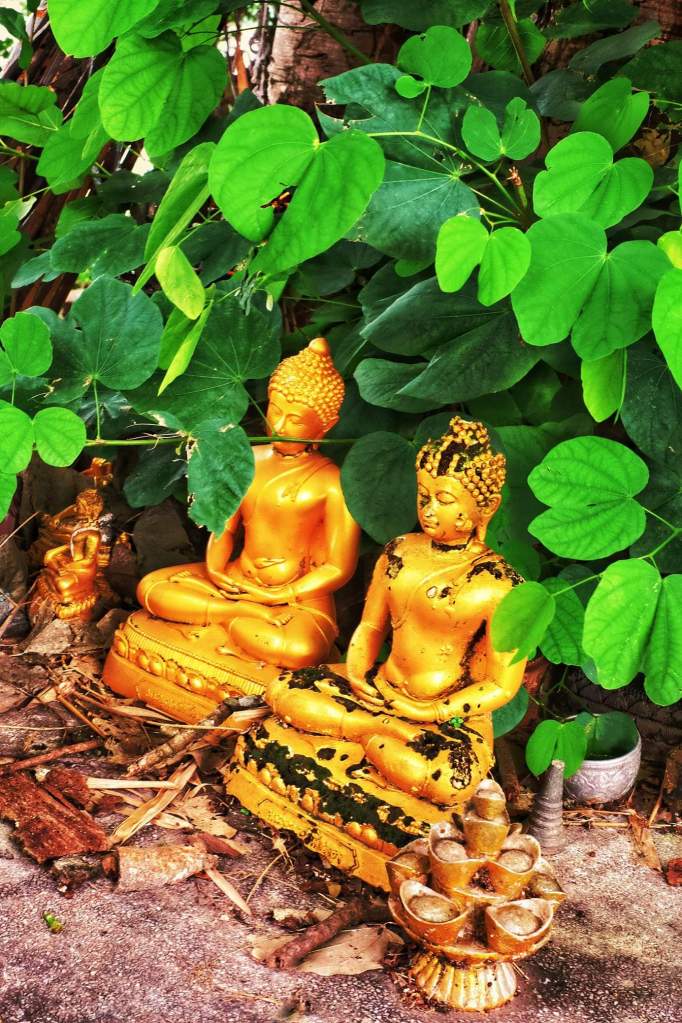
There is a little shrine at the foot of a huge and ancient tree, outside a Buddhist temple above the banks of the Mekong River in a little town called Chiang Khong in the far north of Thailand. As I looked at this obviously highly revered sacred site, through the viewfinder of my camera, I knew what I would call the photo:

Lokah Samastah Sukhino

Now, I already knew that this translates to: May all beings everywhere be happy and free. A friend of my son’s used to use this ancient Sanskrit mantra a lot and I’d long since discovered its meaning. Or so I thought.

Anyway, later as I readied this (what turned out to be quite a lovely image in my ever so humble opinion) I thought I would look up the mantra again. Just to make sure I had the right spelling and so on.

It was then I had a surprise. May all beings everywhere be happy and free is only the first part of this beautifully expressive mantra. I quickly discovered that this mantra is not simply some vague wish or prayer for universal peace and happiness; it is also a call to action. Here’s the complete translation as I found it:

May all beings everywhere be happy and free, and may the thoughts, words, and actions of my own life contribute in some way to that happiness and to that freedom for all.

But, wait. There’s more.

As I read more deeply into the meaning of all the words in the mantra, I discovered that it’s more than a call to action or a simple invocation. I learned that the mantra as I knew it was missing a final word: Bhavantu. So with this word missing, a vital element of the mantra was lost: the use of the suffix antu at the very end in the original Sanskrit turns the whole thing into a solemn promise. Antu means it must be so.

This all got me thinking: How? I mean, how do we transform our ‘thoughts, words, and actions’ so that they will contribute to the happiness of all beings? And how can we actually make it a promise?

Then it suddenly occurred to me: the action required was summarised very nicely by the Buddha in what he called The Eightfold Path. We are meant to start living according to the principles in that teaching.

Now, The Eightfold Path is, on the face of it, a fairly straightforward set of life principles that, when understood and integrated into one’s life and being, will lead to the cessation of suffering.

Now, this sounds all very well and good, but I’ve been wondering if there was a way I could sum it up in just a few words.

Something succinct, and to the point.

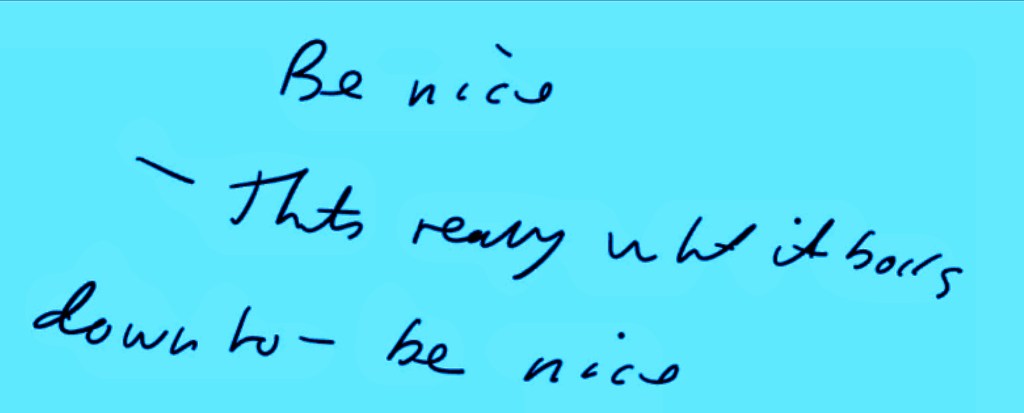
Then I found myself (again suddenly, right out of the blue) scribbling a note on my phone:

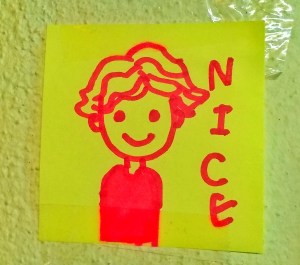
Be nice.

That’s really what it boils down to

Kindness in all our intereractions with all the forms that life has taken: other humans; other animals; plants; Earth herself; the rivers; the oceans; the forests. You name it. All forms that life has taken.

So, how do we be nice?

When I say it like that, it almost sounds silly; I mean, how hard can it be? Be nice? Easy.

Well, I guess I can say for myself that it’s true, sort of, sometimes. Yes it is often extremely easy for me to be nice. And, then, other times I have to try to be nice. And then there are those times when try as I might, nice just doesn’t happen.

Which means, I guess, that it might not be quite that simple after all.

There are so many wonderful explanations of the Buddha’s teachings, including The Eightfold Path, on the Internet. On the face of it, that might seem confusing. However Buddha himself advised that each person should question the teachings and come to their own conclusions. In other words, he said, don’t take my word for it, check it out for yourself.

The Eightfold Path. I might know that lovely list by name (Right Understanding, Right Thought, Right Speech, and so on), and I’ve read a little about them, but maybe it’s time to dig a bit deeper.

I’m going to make a start with Right Understanding simply because it’s the first on the list, and has always seemed to be a pretty important starting point.

So, next post (or perhaps a later one) that’s what I’m going to do. Just sit and see what comes out of my heart and onto the page (or screen). Please join me then and we’ll see what happens.
Peace and love from me to you

What I learned from a Glass of Chai

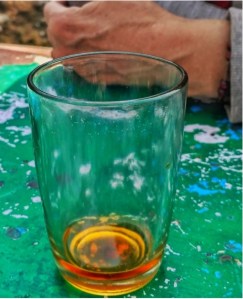
One of my favourite things to do India back in the days when I still spent hours in cafes was to drink tea. Or Chai as it’s called there, very often served in a glass. 

Most of the time the glass is filled to a level that leaves a small space at the top of the glass cool enough to allow the drinker to pick up the (usually) super-heated glass.  A great idea really because Chai is best imbibed at close to boiling point!

However, occasionally, a glass will arrive full to the brim with scalding hot but sweet and tempting Chai. With no cooler glass at the rim, how is the desperate Chai addict going to get to that sweet and satisfying liquid?

Well, obviously, the only way is to take the rim of that glass as gingerly as possible between one’s toughest and most calloused two fingers and just lift that glass and finally taste the flavorsome nectar contained within.

Of course there is another possible response: our Chai drinker may fear the painful consequences of taking hold of the hot glass, so will either leave the glass to cool or will reject the Chai completely.  Neither of these outcomes would ever satisfy a true Chai aficionado.

Now, how does the cliché go? This is a lot like life isn’t it? Well yes it is.  How often have we been confronted with an obstacle that’s preventing us from achieving something we want, or that is keeping us away from finding peace or love or some other condition we want in our lives?

Those problems, those obstacles, they are simply the hot glass blocking our way to the good things we want. Perhaps this is a good time to go ahead bravely, grab that hot glass and declare that for you there really are no problems that are (ready for another cliché?) too hot to handle.