Making a Dream a Reality (kind of)

A few weeks ago I was wandering around in the CBD of Sydney, in Martin Place to be precise. It’s a popular square with loads of tourists,  shoppers, coffee drinkers, and lunching folks.

It’s also a drawcard for both buskers and for street photographers. For me, it’s mainly a short cut from one street to anoher, though I must say, I’ve very often stopped to make a photo or two of the grand architecture, fountain, and the great light that seems to permeate the place.

Anyway, on this occasion as I walked about slowly, I heard a busker. Not a singer, more a spoken word poet type performer. I guess if I were to categorise him, I’d have to say he was a Rapper.

And to put it mildly, his poetry was a amazing; I had to stop and watch and listen for a while. I realised quickly that what he was doing was focusing on a particular passerby and would then make some (mostly humourous) ryhmes about that person. Things like:

Here comes a dude with groovy green shoes.
Not having a pair like them is givin’ me the blues.

or:

Now I see a fella with a phone stuck on his ear.
Come on buddy, why not let us all hear?

Now, I confess that these are my own made-up examples. I wish I’d noted some of the real ones, but I was too busy listening!

It’s easy to tell right away that I’m not what you would call a “natural rhymer”, if there is even such a thing.

But what turns this into a true synchronicity for me is that for a few years now I’ve had a recurring dream in which I’m simply walking along making up superb rhymes as I go. It’s one of those dreams you’re never sure are ‘real’ or simply a dream.

In any case, when I saw and heard this guy that day, it got me remembering the dream and how I’d often thought I would really love to actually be able to do that exact same thing.

Not about people though. I used to photograph people in the street; all kinds of people.  I still consider photography among the most important of my contemplative and creative practices, just these days I don’t photograph people.

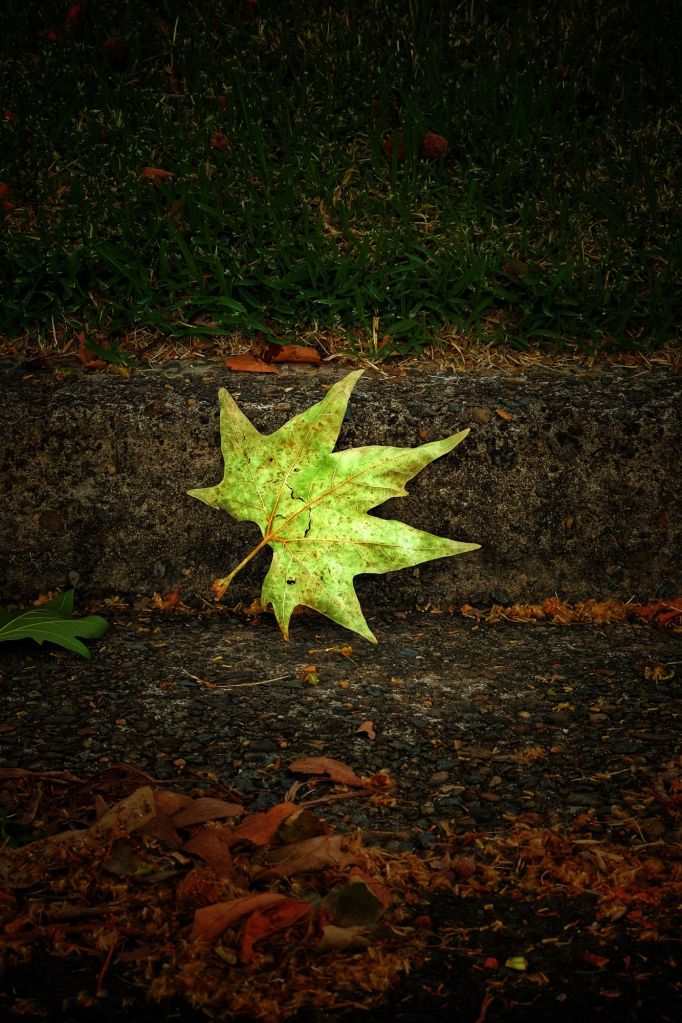
So, in a round about way, I’ve made a little “poem” that refers to what I do photograph, inspired by this encounter as well as particular photo I came across just yesterday but made months ago now.

Please enjoy

Strollin’ down the street
I lift my camera to my eye,
no longer interested in the people walking by.
Nowadays I tend to notice their many and varied traces left behind,
or perhaps (and even better) a golden leaf in the gutter I might find.

Thank you for reading this small attempt. Now here’s the photo I mentioned that inspired this attempt at a kind of spontaneous rhyme.

Blowin’ in the Wind

Walk In The Waters of Life

Since I launched this blog (a whole month and a bit ago already), I’ve had an idea for a post. A short, spontaneous, chatty but informative little piece on my favourite name and form of the Divine Feminine (often referred to as the Goddess): Saraswati.

Well, as the keenly observant among you will have noticed, no such post has appeared. Procrastination in overdrive you might say. Or perhaps it was that the Goddess just wasn’t keen on me doing the post about her?

You see, I did some research, made a ton of notes, and discovered all kinds of fascinating things and I just felt I wanted to share what I’d learned. Somehow, though, the idea didn’t go any further. I’ve thought about it from time to time, but still, nothing has come. Then, a couple of days ago, I came across my notes and reread what I’d discovered.

Now, here’s a key moment: as I reread those notes, I thought (paraphrasing here), ‘I really must post this. It’s all so fascinating and would interest a lot of people and even be helpful.’ Something like that anyway. Yet, still, it is not written.

So, despite my notes seemingly begging for my attention, I guess that maybe it’s not the time. Now my notes are safely tucked into a few nice little folders within a larger folder somewhere in the depths of my harddrive.

All that struggle; all that thinking and fretting over what was supposed to be a short, spontaneous couple of hundred words on a subject I love. Still, the episode has got me thinking about intuition and how it can disguise itself – with our help – as procrastination. And vice versa.

Yes, I know, obvious question: how can we ever know the difference? When are we inventing all kinds of reasons for putting something off, and when is it really intuition trying to guide us?

Well, it’s complicated. As creatures able to reason, we are always ready to come up with arguments for and against, to think endlessly and agonize over the smallest and most trivial details while ignoring the big stuff. Really, in my case that’s all there is to it: I just think too much.

Sticking to the Saraswati blog post episode (a catchy title don’t you think? Watch out for a post headed up ‘The Saraswati Blog Post Episode‘), I don’t recall why I didn’t just get right to writing it. It might have been any number of things: a perceived lack of time; a promise to self to ‘give it some more thought’; a resistance to the actual ‘labour’ required. Who knows?

Or, was it more that, while the idea was a good one, I just wasn’t feeling it? Maybe the timing just wasn’t right? The problem is that sometimes an intuition comes in a flash of knowing – with a capital K – that you can’t possibly miss.

Then, other times, it creeps up so slowly and quietly that it gets drowned out and ignored as our monkey mind takes over with its endless arguments for and against, pros and cons, advantages and disadvantages,

The lesson I was given here was this: What is going to get done, will get done; what is not going to get done, won’t. Sounds simple really, but so often we make it more complicated with our overthinking, our coming up with excuses. We procrastinate.

Then, at other times, we just dive in the deep end, flowing with the intuition. It may be right or it may be wrong, but it’s done. Actually, I am trying to realise that there is no right or wrong about a decision made: it just is as it is. Easy to type, hard to do.

Flowing. That’s a good word actually. Saraswati, along with many other characteristics, embodies flow. As in the flow of the river of life. She’s the Goddess of all things creative as well as any activity that helps one to discover the essence of self.

So, flash or gradual realisation; right or wrong; left or right, be the river: flow with what happens or doesn’t happen. Don’t fret about the twists and turns, the ebb and flow of tides, the rocks in the stream that force us to flow around or over, or to change direction completely. In 1946 the poet Jorge Luis Borges wrote an essay about time. In that essay, among other things he says:

Time is the substance I am made of. Time is a river which sweeps me along, but I am the river (emphasis is mine)

Jean Luis Borges A New Refutation of Time 1946

Reading that quote reminded me of a song that I’ve been humming on and off for a very very long time (hint: I saw the movie when it first came out).

The river flows, it flows to the sea.
Wherever that river goes, that’s where I want to be.
Flow river flow.

Peace from me to you.

PS: Thanks to my memory for giving me these lyrics from The Ballad of Easy Rider. Or was it actually Saraswati whispering in my ear?

Buddhism’s Three Refuges: They’re for Everyone

Greetings and Welcome

To become a Buddhist, , there are a number of things a person must commit to. One of these consists of a kind of three in one resolution that’s welcomed by any aspirant. In fact, some say that in order to be a Buddhist, one has to repeat The Triratna or The Three Jewels. Three refuges is the other name used.

I take refuge in the Buddha
I take refuge in the Dharma
I take refuge in the Sangha

The exact words used may vary, but The Three Jewels is common throughout the Buddhist world. And of course there will be many meanings ascribed to ‘take refuge’, but the one I like is the one that any of us might use in, say, a heavy downfall of rain. What do we usually do in when the rain starts falling? We look for shelter, we take refuge.

I don’t mean to suggest that becoming a Buddhist automatically means that one is seeking a safe dry cosy place out of the storm. Though, now I’ve said that, it does make sense. I know myself that (though I am not a Buddhist) sometimes the only way forward, the only means to seek the truth, and to find peace, is to take refuge somewhere or in someone or something.

Not being a Buddhist as I said, I’m not qualified to speak about Buddhism in any real detail. What I have in mind is I would like to borrow the Three Refuges and reflect on how we could all use what me might call a ‘secular’ interpretation as a way of putting into words our own commitment to finding a refuge, a safe haven as we tackle what is for all of us born into a physical body, a life of trials, tribulations, ups and downs, storms and lulls, happy times and sad times, and all the rest of the package that’s called living a life.

Let’s take a look at each of the Three Jewels (also known as the Three Treasures which I like a lot), and think about how we can apply it to our own life, to our own seeking of refuge.

I take refuge in the Buddha.

For a Buddhist, the Buddha is the Guru, the teacher, the one who holds the Truth and shows the way. Many people would say right now, well that counts me out. I don’t follow a religion. I don’t have a teacher or guru. I’m just another regular person trying to make my way through life.

While it may be true that you don’t have a teacher or priest or guru, or anyone else in the role of guide, there is one person who is always there with and for you, one person who is always thinking about you, who is making decisions for you on which way to go, what to do and all the rest: you.


Yes, you. Your Self. When it comes down to it, who knows you better than you do? Take refuge in you, in the Self. Need to make a hard choice? Look within. Feeling tired, or ill or fed up? Look within you for the answers to what can be done. Follow your intuition. You, plus intuition, plus you taking refuge in you, equals teacher, guide. You are your own guru.

I take refuge in the Dharma.

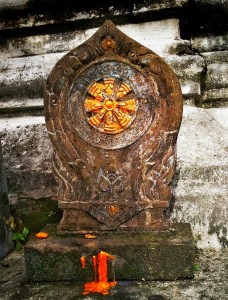
Once again there’s a myriad of ways to define dharma. And once again, I have a favourite: Dharma (often represented by a wheel) according to the religious tradition we know as Hinduism is cosmic or universal law that underpins right behaviour. It is the eternal and inherent nature of reality. In other words it is Truth.

We can all say, regardless of our beliefs say, I take refuge in the truth and in what is right. It’s a commitment to always acting in the best interests of everyone – including ourselves (maybe even especially ourselves). It is taking shelter or refuge in what is right. Living such a life in our messed up world is never going to be easy, so it is best to think in terms of doing the best one can. But having it as your ongoing guide will ease the path.

I take refuge in the Sangha.

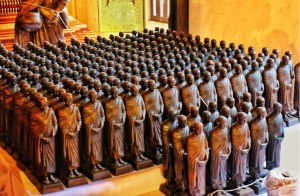
A Sangha is an association or a community. Often used to describe monastic communities of monks or nuns, it may also include lay people. If we step outside of the religious framework, then a Sangha is a community that shares common bonds, beliefs, commitments, interests, and so on. Family, tribe, workmates, recreational and sports clubs. You name it: all sorts of groups might be sanghas or communities.

Of course, and perhaps very obviously, not all groups will be communities, And equally we may not think we are a part of any community; we may think of ourselves as being quite outside any group. However there are no rules that say a community has to have a set number of members. Besides, being in community is a condition and has nothing to do with group size or composition.

So, if you find yourself in a community of one – or two or however many – take refuge there. Make a commitment there. As with any other real community, this one begins with you and your truth.

The Buddha, the Dharma, and the Sangha. The Teacher, the Truth, and the Community. Making commitments to the Three Refuges can create a solid foundation as we continue our journey through the world and our lives. The refuges – the safe havens we can call them – we have sought and found will support us through good and bad times.

Actually, I just thought: if we are genuinely able to take true refuge in these three treasures then we will conditioning our Selves to be more present, more in the here and now of who we are, what we’re doing, and what’s happening to us.

Peace to you from me

Awen: Bring On the Creative Spirit

Hello friends

My last post spoke a little about my study of the Bhagavad Gita, and it prompted me to share a little more with you about the actual book itself. Well, not the book as such; more like some of the words I’ve written on the title page:

I stand always on sacred ground and beneath sacred skies.
Awen          Awen          Awen
You are always with [a] devotee: Your Self


Every time I open that little book I see and read those three lines. They are all sacred to me with great personal meaning. Four distinct ideas, from four sources. In a sense reading them is a kind of preparation for my actual reading of the Gita.

While all those words are special to me, today what seemed to call out to be heard, was Awen.  Or I should say, the three repetitions of the word.

Awen has been special to me ever since a friend told me about it many years ago. It’s a Welsh word, basically defined as poetic – or creative – inspiration. It is sometimes personified as the Muses that inspires artists generally.

Wikipedia says, Awen comes from Indo-European root uel, meaning ‘to blow’. Awel the Welsh word for breeze shares this root. Awen is also ‘flowing spirit’, as in the flow of energy that is the essence of life. Reading this made me think of Bob Dylan:

The answer my friend
is blowing in the wind

Bob Dylan Blowing in the Wind

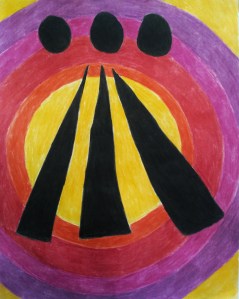
The symbol for Awen is beautiful. Three rays of light that emanate from three points of light. There are many interpretations for the three rays and the three points, but the ones I like have them symbolizing Earth, Sea, and Air; body, mind, and spirit; love, wisdom, and truth.

I like the idea that the three points are the actual foundation of Awen itself: the understanding of truth, the love of truth, and the maintaining of truth.

Enough with the explanations and definitions. The repetition of Awen three times is a kind of chant or prayer. As such, it’s an invocation of Awen, the divine creative energy – or the muse.

So there you have it: a little more about my special little book. Don’t worry, I’ll try not to make a habit of this. I guess it’s what happens when something is in your consciousness, and you just never know when Awen will reach out and bless you.

Thank you

Peace