When Misreading is no Mistake

We’ve all  had this experience I think. I’ll be reading something, and right away I’ll come to a conclusion, become either sure of something or the complete opposite; I can be confused, force myself to ask more questions. I can even have brilliant insights or realizations.

No? Well, maybe it’s really just me then. But, wait there’s more: this is a two part experience. When that second part happens we will come to realise that what we think we read is nothing at all like what the words on the paper (or screen) actually said in a factual sense.

Yes, you’ve probably guessed by now that there’s a story coming. In fact this exact thing happened to me this morning, all the way to the brilliant insight or realisation bit.

In fact it was a brilliant realisation, the only problem was that it was based on only on what I thought I read, not what was actually being said.

Anyway, I was reading the verse quoted below, from my Bhagavad Gita and a sudden flash of insight hit me.
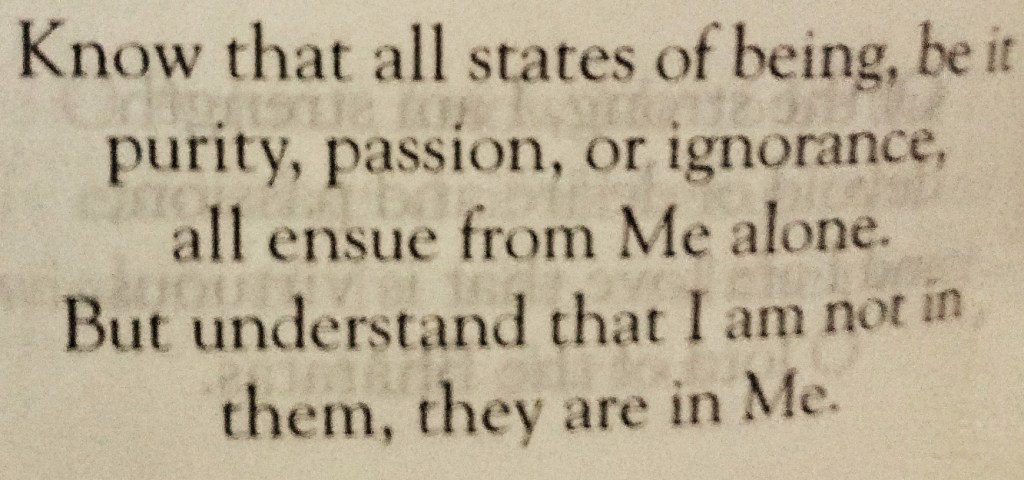
Despite these five lines saying a particular thing in a clear and precise manner, I somehow misread the first three lines to say:

All beings ensue from Me.

Bhagavad Gita Ch 7:12

Somehow my mind skipped the ‘states of’ bit and made a leap that actually lead to a great realisation: Of course, I thought; God is not in us (as in living beings), it’s we who are in God.
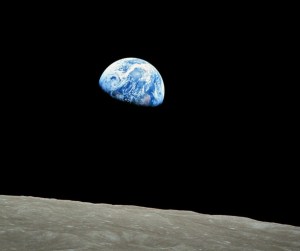
Which to me means that we are all part and parcel of God. I’m not saying, I’m God; I’m not saying you are either. What I am saying is that all creation as one, unified whole, is in God. And if that one unified whole does indeed ensue from God, then it follows that all of creation is God.

As individualized, embodied entities, we (along with all life everywhere) are simply manifestations in the material form of that divine energy, that life, that truth; that which we often call God.

Now, this is an instance of a flash of insight leading to a truth, when the receiver of the insight (that’s me) is engaged with what you might call some other factual reality, that is, the actual words on the page.
At first I thought, that’s weird: how did I misread all those words related to states of being? I mean they are pretty clear right? But then I thought, no, maybe not so weird. In fact, it makes sense.

How can my material mind and intellect possibly be expected to always keep its millions of thoughts, ideas, impulses and the rest, in perfect order each thought or whatever following completely logically from the one before and to the one after? It’s never going to happen is it? Not for any of us (Well maybe I’m overstating my case here, but you know what I mean).
And if mind does indeed operate on what seems on the face of it to be a random basis, then it’s perfectly reasonable to suppose that one might be prompted to some momentous insight by, well by anything really. Even if it’s a conclusion jumped to after the misreading of a text.

In this case though, that jumping to conclusions, even though based a misreading, has turned out to be a genuine realisation that I feel on an intuitive level; my instincts tell me it’s Truth.

Jai Gurudev
All that I am today is by your grace.

Let the Music Play

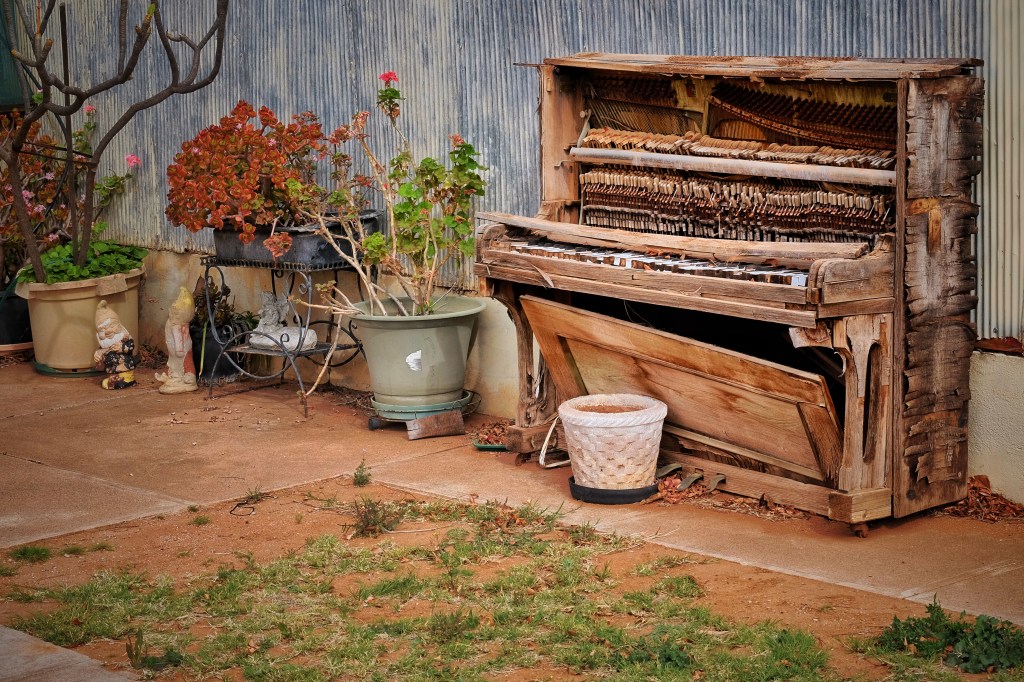
When thinking about a name for this photo I was really tempted to somehow reference the song American Pie by Don McLean. The phrase from the lyrics ‘the day the music died’, kept coming to mind – even as I made the photo of the scene.

By the way, ‘the day the music died’ refers to the plane crash in 1959 in which the up and coming Buddy Holly, and the more well known Ritchie Valens and The Big Bopper were killed.

And there was that brilliant MASH scene coming to mind. In the scene there is concert pianist who has lost the use of his right hand in battle. One of the doctors attempts to encourage him to not allow the music to die, to find other ways than actually playing piano to share the music.

Both connections seemed obvious: a very old dead piano decaying, returning to old forms of itself. But then it struck me: it was the instrument that had died and was changing forms. All material things change, die, becoming something else.

The music on the other hand, hasn’t died. It not only survived that plane crash and the transition of those three singers, it has thrived. Their music lives on. Music can’t die. Why?

Because music is life. Vibrations, harmony, and sound itself, are the foundations, the roots of ‘life the universe and everything’ (to borrow an old expression). As such, music is not a tangible, physical thing and it needs an instrument to make it manifest in the world; music merely passes through the instrument and emerges into being.

I liked that MASH episode. The doctor (stuffy Major Winchester) says to his patient, the wounded pianist, that as a skilled surgeon he has hands that ‘can make a scalpel sing’. But really, what he’s wanted all his life to is to experience music the way the pianist has.

He says he can play the notes, but he doesn’t have the gift that would allow the music (as in Chopin, Brahms and the rest) to flow through him. He tells his patient, who is depressed and unwilling or unable to consider that the music may not have died:

The gift does not live in your hands. The true gift is in your head, and in your heart, and in your soul.

Major Charles Winchester

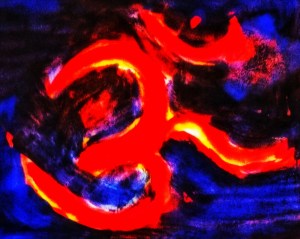
Hearing that line again reminded me of Om. There are a number of religious traditions that consider OM (sometimes spelt as AUM) to be the primordial sound, the very source of creation. The word itself, when written is considered sacred.

Then there is the verse from the Christian Bible that makes the exact same assertion:

In the beginning was the word and the word was with God and the word was God.

John 1:1-3

Well, music needs an instrument – whether in the form of a voice, body, mind, or in an object made of wood, strings, brass, or something else – in order to manifest into the material world and to be experienced by us.

Just think: the piano in my photo in the front garden of a house in a mining town has most likely allowed many generations to experience music. Accompanied them in celebrations and greivings; helped so many through good times and bad times; witnessed people laugh, cry, and even dance;

Of course, Major Winchester’s gifts as a surgeon are that he is a instrument for the vibration, the music of the universe, to make itself manifest in another way.

And what he is essentially saying to our wounded pianist is: ‘Look you can shut it off forever (his words) or you can continue making your gifts – your Self – available as an instrument that allows that music to come into the world for everyone to share’.

Well dear friends, I have pledged to carry on using my gifts and be available in just that way that allows the music to come through me in whatever form and shape it takes.

By gifts I mean those things that have been granted to every living being: the ability to create harmony; the ability to make and spread good vibrations; and the capacity to appreciate and celebrate beauty.

And when you think of it there is no way to put a limit on the number of ways that the music that is Life might be channelled through each and every one of us

A good place to pick up some good vibes, get into harmony with yourself and appreciate beauty all at the same time

In my own ways I try to make harmony in and around myself as much as I’m able. I am always attempting to cultivate behaviours and attitudes that help to create and spread good vibes. And I constantly seek to appreciate beauty, even when the world seems to be only ugliness.

Of course, as I say I am only the instrument. The music -the beauty, good vibes, and harmony – exist with or without me. But music in whatever shape and form it takes needs an instrument if it is to come into our material world and be there for all of us to share.

So, this is my prayer: that at least every once in a while, every now and then, I can actually be that instrument .

PS Just a little postscript. When passing that particular garden (the piano garden I call it now) I was drawn to this:

Eagle-eyed Garden Guardian

Just as I photographed this lovely creature, I heard my partner’s voice:

‘Did you see the piano?’

Now being in what you’ve heard me call the Zen Zone I was fully focused on and absorbed in, our winged friend. Coming back from wherever I’d been, I did in fact notice the piano.

You see, you just never never know where the music is going to come from. I might not have seen the piano with my own eagle eye but lucky for me music had a ready and willing instrument standing by to remind me of which way to look.

God is My All: A Reaching Out, a Rap on time, & a (sort of) unrelated poem

Namaste and Welcome to you.

I can’t remember when I wrote my last post. And of course it isn’t relevant at all is it? I mean to say that in the contemplative life, time sometimes seems to take on some other kind of character.

Or at least I should say that one’s perception of the passage of time shifts; nothing unusal there I hear you say, and of course you’re right. Just thinking out loud I suppose.

For me, having a right perception of time is an important aspect of my Sadhana, my practice: yes, it’s true: time is seen to fly, or it is frustratingly felt to drag. But my aspiration is to see time as simply a human construction that we use to limit, structure, bind, define, and place all kinds of restrictions on our lives.

Which for me, simply means that there is only presence or Presence; only the ongoing continous moment (what we often call The Now). Easier said than done mind!

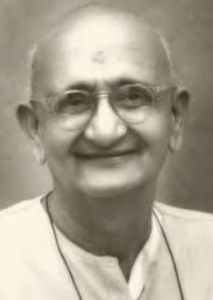
Swami Ramdas (known as Papa to his followers)

In any case, here I am, just where God would have me be. Feeling strongly to reach out to you, I remember the poem (it’s not really about time in the sense we’re discussing it so far) that emerged the other day after reading a quote from Swami Ramdas that seemed to be an answer to some thoughts I’d been having.

I’m grateul for this, all of this. And for you too, the reader of these musings offered with humility and thanks.

Peace and love from me to you.

GOD IS MY ALL

Thinking thoughts
as if battered by demons.
Memories arising of my own evil deeds, selfish and cruel.
Right away I turn to God:
God is my all;
Hare Krishna

Forego repentance,
relinquish regrets;
you are filled with God,
the supreme essence of life.
God is my all;
Hare Krishna.

Through Papa Ramdas
I hear the Universe speak:
Forgiveness is from God;
and it has been granted.
God is my all;
Hare Krishna.

Broken Hill, Australia
9 July 2022

You Say You Want a Revolution, Well You Know …

Welcome friends to another post

I’m actually scheduling this one to publish sometime in the future. The reason is that, as I reread it now, I see I’ve used ideas, and even some sentences here that appear in a couple of recent posts. The thing is, I think this is a post worth reading, so I’m kind of sneaking it in via a touch of time travel. In any case, please enjoy, and by the way, thank you for sticking with me for this long (however long this is).

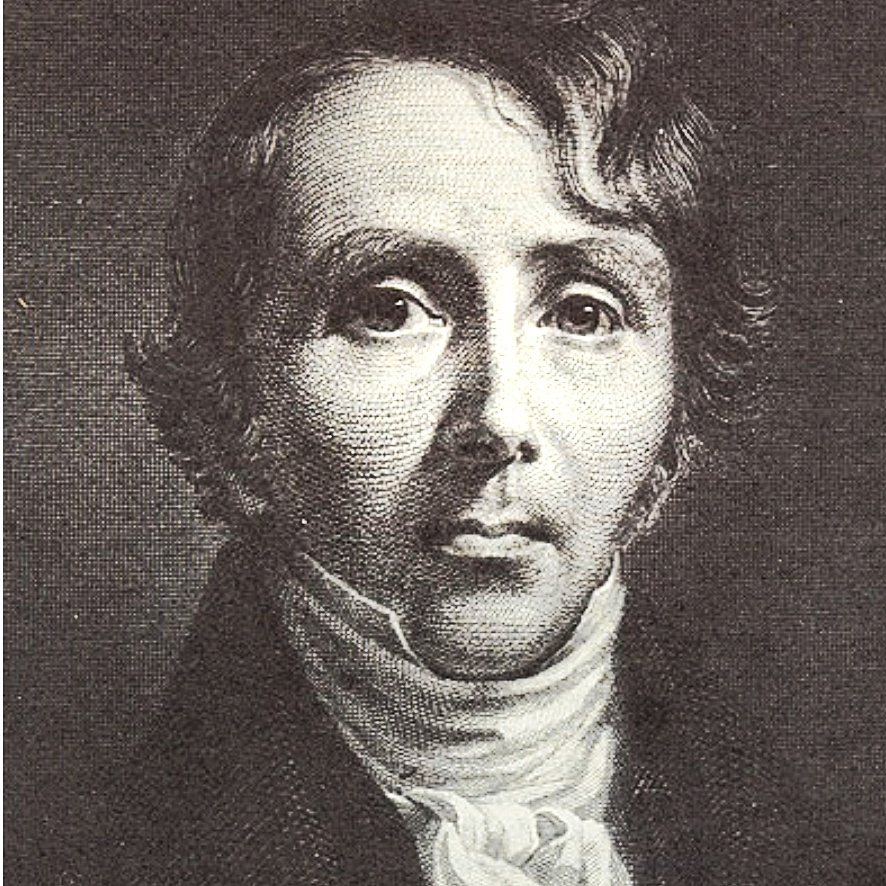
It was a revolutionary idea for its time, the early 19th Century. Come to think of it, it still is. A reform minded Christian minister, William Ellery Channing proposed that the proper goal for each of us human beings is perfection.

William Ellery Channing (Public Domain)

Or rather, the goal should be a  realisation of the perfection that is already our true natural state, our true selves, which we’ve forgotten as we have got on with the rarely easy business of living in a material world. You see? I did say it was a revolutionary idea.

After all, he wasn’t talking about the obsessive perfectionism that often curses so many of us anxious types. Or the myths propogated by mass media of what it means to be ‘perfect’. No, he was proposing a complete and thorough shift in the prevailing thinking about the nature of humans, and in reality, of all life.

Anyway, he posed the question:

Do you ask in what this perfection consists?

He then proceeded to answer his own rhetorical question:

I answer: in knowledge, in love, and in activity

When I came across this little vignette in an unrelated book I’ve recently finished reading, I was a little bit mind-blown. Channing’s formula is more or less identical to that presented over millennia in a number of the world’s religious or spiritual traditions.

For example in the tradition I am studying these last years, Sanātana Dharma, this little formula constitutes pretty much the foundation for any kind of spiritual growth. It could be said that in a real sense it is the very basis of all Yoga:

Jnana Yoga (knowledge, study, includes meditation, contemplative practices and so on), Bhakti Yoga (Divine Love. In the sense that love is always divine) and Karma Yoga (often called the Yoga of action. It basically includes everything we do in the physical world. The Karma bit is about our actions becoming selfless).

In other words, just sitting there on their own these three Yogas offer a pretty succinct answer to the question many of us ask ourselves constantly: How can I live a good life?

We pursue knowledge for many reasons: it may be a reluctant pursuit as we sit through the interminable years of high school; or later as we head to university or college to train for a career that we hope will support us. The thirst for knowledge might arise when we come upon a topic or an area of interest and fascination that we just have to learn more about.

Just as with the infinity of knowledge, love comes in equally infinite guises. Unlike knowledge, however, I don’t think there are ‘reasons’ we can give for love. Love is love; it is its own reward (and it’s own torture), it just is what it is. Divine is as good a word as any. Any love, all love, is love for all and for everything.

And then there is the kind of knowledge we pursue as we try to answer what I like to call the Who am I? questions. Things such as: What’s the meaning of life? Where am I from? Where am I going? Is this all there is? Oh, and of course the real biggie: Who am I?

Now, at the risk of having to take the prize for the most obvious statement ever made, let me make the point that all living things have to take action all the time if they are to remain alive. So obvious that I’m even having to take several different actions in order to tell you this. So, you might well ask, what’s the big deal? What’s Channing and all the others through the ages getting at? What activity?

Well, I think Channing was getting at the notion that every action we take needs to be informed by knowledge and love. But, what knowledge? Well, clearly we are caught in a tsunami of information much of which goes to making ‘fake’ knowledge, propaganda, deceptive advertising, biased education, and the rest.

In other words how often do we see knowledge not used correctly? And, how often is humanity’s use of knowledge – our actions – informed by love? Now we can begin to realise how revolutionary this idea is, and always has been.

I think that’s why the Sanātana Dharma teachings and world view embody the concept Bhakti, or divine love. As I noted, all love is divine. These teachings tell us that all action is to be undertaken with love, without attachment to rewards or outcomes, and dedicated to the welfare of all life.

Channing had the same idea: for him all life is pure and perfect already. And of course it follows I think that all actions we take have the potential to be informed by a wisdom gained from proper use of knowledge, and to be informed by love, whether it’s for self, for other people, other animals, Earth herself.

So, pretty revolutionary stuff eh? I guess a lot of us have heard that famous quote from Gandhi:

Be the change you wish to see in the world.

Well, here’s the freaky bit. Just now as I looked up the quote to make sure I got it right, I discovered that he never actually said those words. Not in that form anyway. Here’s what he actually did say. It’s a long quote but I think it’s an interesting note to finish on. I think for me it clarifies many of the questions this little discussion has raised in my own mind, as it will for you I hope.

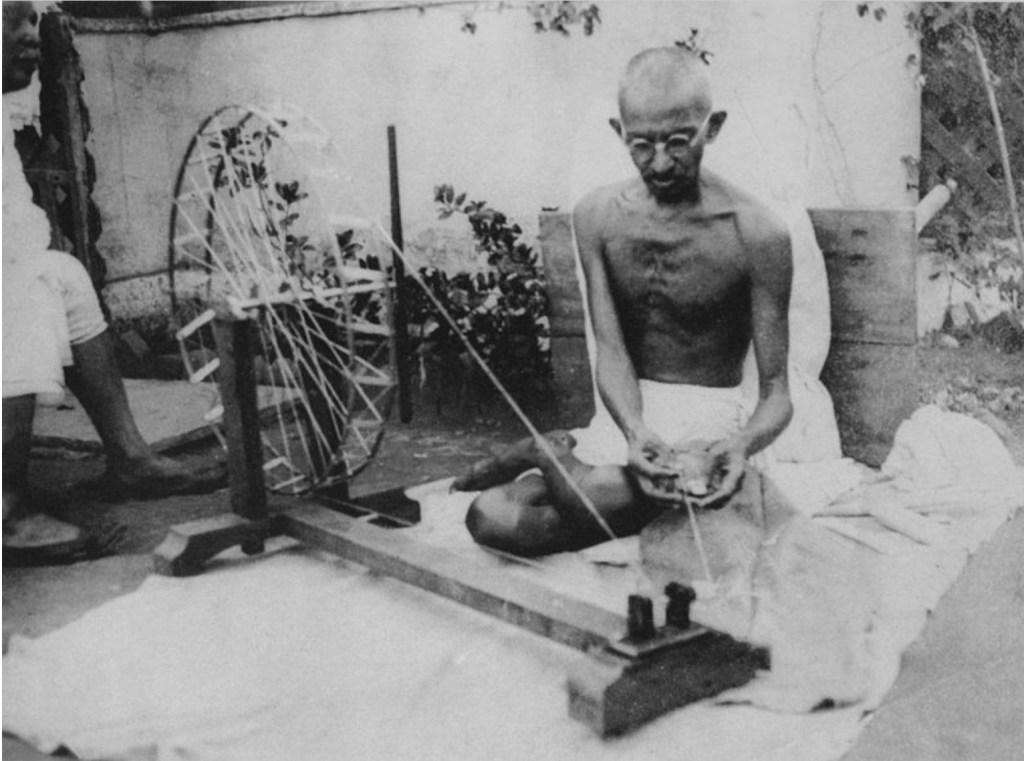
Gandhiji at his spinning wheel (thank you Wikimedia Commons)

Knowledge; Love; Activity

We but mirror the world. All the tendencies present in the outer world are to be found in the world of our body. If we could change ourselves, the tendencies in the world would also change. As a man [sic] changes his own nature, so does the attitude of the world change towards him. This is the divine mystery supreme. A wonderful thing it is and the source of our happiness. We need not wait to see what others do.

Mohandas Gandhi

Peace from me to you

Quiet and Free (A Haiku of Sorts)

Much speech leads to exhaustion;
guard your inner being.
And keep it free.
A bit of blue sky coming.

When a Day Off Isn’t a Day Off

Namaste and welcome

You know by now that I study the Bhagavad Gita. I’ve been at it a few years now, and it gives me a great deal of joy and comfort, not to mention the help it is to me as I struggle to understand Self and life, the Universe and everything (to borrow a well-worn phrase).

Yes, I love this book which is the story of a warrior king and his charioteer getting ready for battle. Arjuna, the warrior, is us. Or rather he is our ego, our lower self, the us that lives as a material entity in the material world.

The charioteer is actually Krishna, and he represents our Higher Self, the Self that is what some people call God, or the Divine, spirit, universal consciousness. In other words, my Higher self is having a conversation with my lower self as I battle or struggle with living in the material world.

Anyway, it’s enough to say that I am very fond of this book, the lessons it holds, the guidance I sometimes glean from it. And I try to spend time with it as often as I can. Daily mostly, but not always. I have to admit that sometimes I just want to give it a break, leave the words alone, just be with Self for a bit.

Actually, there is a verse that I wrote down long ago that does in fact sanction the student (that’s me) to take a break.

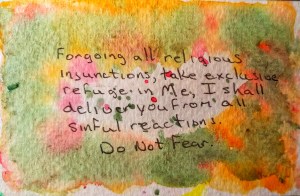
Forgoing all religious injunctions, take exclusive refuge in me. I shall deliver you from all sinful reactions. Do not fear

Bhagavad Gita Ch 18:66

This is Krishna speaking, giving instructions to Arjuna. Essentially it’s the higher Self telling our little selves to ignore outside rules, regulations and all that, and rely instead on what comes from within the Self; in other words, what our hearts tell us.

Now, he’s not saying ignore laws of the world, that’s not what this story is about. He’s telling Arjuna, look, don’t take notice so much of what the religious leaders tell you, or what instructions you read in holy books.

Then, after more or less consistent study over years, I came across yet another verse quite recently that confirms this one, but that hadn’t ever spoken to me before:

When your mind is fixed and unmoved and not confused by scriptural injunctions you shall attain yogic samadhi

Bhagavad Gita Ch 2:53

This verse actually says: don’t confuse yourself with stuff you read in the scriptures; instead keep your mind fixed and unmoved by the outside world. And if you do that, you will achieve that level of peace, self-realisation, and happiness, that you’re after.

So, do we have here a book of scripture that is in fact telling me not to take any notice of what it says in that book? That doesn’t sound very likely does it? No, I think what both these verses are getting at is this: The first and primary thing to do if you want to achieve happiness, peace, self-realisation, is focus inwards, on the Self.

Or God, or spirit, the Universe. We all call it by different names. But the point being made is that we aren’t going to find all the answers only in a book, or in the instructions from ‘religious’ leaders; overdoing the books or the slavish following of teachers only causes us (sorry I mean me) confusion.

Higher Self here (in the guise of Krishna, who is in the guise of a charioteer) is advising us to look to our Selves, not to the words of others to reach union with that Self. At least, that’s how I’ve chosen to interpret it.

What’s interesting here is that these are two of the very few verses for which I haven’t looked at commentaries or interpretations by other people. What I’ve done in other words, is take the advice given in these verses and looked inwards.

I don’t mean to suggest that I use these verses as ‘have a day off’ cards; most likely the contrary is true. On days when I don’t look at the Bhagavad Gita, I like to think I spend more time ‘just sitting’, perhaps chanting mantra, and contemplating.

Of course it doesn’t always work out like that naturally. But, at least on those occasions there is the heart and mind space available for a more direct communication or connection with Self. With that part of me that is one with all.

Peace and love

Allow Me to Introduce My Mask

Greetings friends

At the moment I’m reading a book (Myths of Light: Eastern Metaphors of the Eternal) by Joseph Campbell, the brilliant, more than brilliant scholar, writer, teacher, and philosopher of all things having to do with myth.

Actually, to be honest, it’s truly riveting reading, but still, it’s a hard book to get my head around, but I’m taking it in little chunks, and the effort is, you can believe me, well worth it.

Campbell makes so many fascinating observations and his insights are genius. One section that gave me much to think about was where he talked about Carl Jung‘s idea of masks:

… he [Jung] points out that each one of us is invited by his [sic] society to play a certain role, a certain social function …
… We all have to put on a mask of some sort in order to function in the society. And even those who choose not to function in the society, to revolt from the society, put on masks too. They wear certain insignia that indicate, “I am in revolt.”

Yes, I know, it’s an idea we’re all pretty much familiar with: we all put on masks: work masks, school masks, relationship masks, masks to impress, masks to hide behind, all kinds of masks. But here’s what got me thinking: If you saw my last post, you’ll remember just near the end I said something like, ‘I am a hermit and a pilgrim’.

Now, normally, I tend to think I don’t wear masks. But, surely such a statement declares that I have simply put on one more mask? And, given the usual perceptions of hermits and even pilgrims, am I telling anyone who will listen (especially myself) that ‘I am in revolt’?

And that got me thinking more, about that ‘especially myself’ thing. I don’t think there’s anything wrong with wearing masks; after all as our quote says we wear them in order to function, to have a role or roles in our society.

But we also wear masks for ourselves, so we can give ourselves an identity, a role, a function. So a mask, you might say, is just how we get on in the world, and in our own minds; we take them off, and put them on according to the situation and needs of the moment.

Which says of course that we all are, I am, many things at different times and stages of our lives, our days, our careers, and so on. At this stage of my life I have put on the hermit/pilgrim mask I’ve carried around on the inside all my life. I am asking myself again, does this make me a rebel?

Well, before I donned the hermit/pilgrim mask properly, yes I wore the mask of the rebel, of the angry and outraged advocate of complete and total social change. And perhaps from some people’s point of view, I might still be a rebel: rebelling against the expectations, demands, and easy temptations of my society.

Anyway, I seem to have taken the very long route to the main point of my thoughts on all this rebel insignia stuff. The reality is, I’m not rebelling against anything. Except for those times (all too frequent) when I let anger and outrage slip through. After all, I am still human and have my weaknesses. ‘Tipping points’ as a wise person has called those moments when ‘it all gets too much’.

I see my role, the role of the mask I wear, as a creative one, one of building up, not tearing down.  This particular mask is still in the development stages, but isn’t that how everything works

There’s an aphorism I like very much:

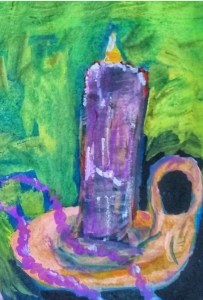
It is better to light a candle than curse the darkness.

(back in March I wrote a post describing a real-life event that illustrates this wonderful expression, both literally and metaphorically. If you missed it, do check it out).

Now, as of this moment in my life and in my progress on whatever path I’m on, I can truly say that I spend time – a lot of time – cursing the darkness. I mean, how could I not? That probably makes me still a bit of a rebel.

Yet, at the same time, I think I’m learning to understand the pointlessness of only cursing the darkness. Maybe it’s not a case of all one way or the other. Okay, I’m human, so I curse the darkness? There is a great deal of darkness to curse isn’t there?

Perhaps I can allow that cursing to lead me to action? And, well it has. At least that’s what I’m working on, aspiring to. Living as simply, quietly, and in as much solitude, as I am able; buying fewer things; letting compassion inform my eating, clothing, and travel choices (actually all my choices); having as little to do with what I call ‘the mainstream’ as possible; acting as far as I’m able in accordance with my true nature.  All these measures are aspects of the hermit/pilgrim role.

But I’ve missed the greatest, most important and vital aspect that goes with the responsibility of wearing the hermit/pilgrim mask: Prayer. Quiet prayer and contemplation. Sometimes just sitting (I know, it’s a favourite thing to do for me), letting the quiet come. Letting the light come.

You know, in some post, somewhere on this blog I’ve mentioned that often repeated statement:

It’s too late for thoughts and prayers

Well, more and more I am getting to grips with the notion that, far from being too late, this is precisely the exact moment when thoughts and prayers are needed most.

I hope that my little efforts can at least contribute in some small measure to the efforts of all the other people out there in the world who, while they may not be hermits or pilgrims, and while their natures might lead them to any number of differing activities in the world, nonetheless share with me the aspiration to light a few candles.

You Can’t Chase Happiness: You Can Only Be Happy

Sitting down just now at the keyboard (actually to be honest it was 30 minutes ago) I thought I had an idea for a blog post. But, sure enough, the moment I opened a new document, fingers poised on the keys, it went. As in vanished from my mind, disappeared. And what remnant that was left seemed to be taunting me with ‘Why on Earth did you ever think this was a good idea?’

So, what do you think this hermit pilgrim, living the serene monkish life who goes on and on about presence did? Relaxed my poised fingers, closed my eyes, and whispered my mantra as I waited for inspiration to revisit?

Hardly. What I actually did was begin having unhappy thoughts, frustration boiling up: I had really been looking forward to writing that post, and now it’s gone. And all that’s left is this annoying frustration and growing desperation to do something.

Nevertheless, I did in the end manage to calm myself at least a little. I just stopped. Took my hands off the keyboard and just sat. Just sitting is a go to strategy for me as you know.

Thoughts emerged, wandered around my mind, crashed together, one pushing another out of the way.

‘Just typical,’ one of those thoughts ran. ‘I try to do something to make me happy and nothing happens except I make myself miserable’. Next thought: don’t I have a quote somewhere about this? Sure enough, there it was, at the other end of a search of my quote files (I’ve got lots!).

You do not become happy by pursuing happiness.  You become happy by living a life that means something.

Then a quick online search revealed literally dozens of articles, books, similar quotes, podcasts, on and on, telling me the exact same thing. I didn’t know where to start, so I just closed the searches after scanning a few headlines, then sat thinking for a bit on my own, at the keyboard yes, but not poised. More like, well just thinking.

I read somewhere a long time ago that some say the word happiness comes from the verb to happen. Or put another way, happiness is living life so that we are in touch with what’s happening, when it’s happening.

Have you ever noticed that the happiest, most content people are often those who simply get on with whatever life puts before them? Whether it looks to be good or bad?

It seems to me that the pursuit of happiness has become so much more than a lofty turn of phrase; its become an almost obligatory activity to fill ones life with. All this despite those many dozens of articles etc advising against it. (Just as an aside: This says to me that we are swamped by so much information that we hardly have time, energy, or mental space to turn most of that information into knowledge we can use)

So. How do we get past this obligation? How do we get back in touch with what’s happening right now? How do we just get happy from what happens? And, then, how do we get to live a life that means something?

Let me say that I can’t give you the answers: what is meaningful to me might not be for you and vice versa.  But the process is the same for us all.  And it is this:  ask the questions (the ones above).

It’s that simple.  It is enough to ask the questions.  We don’t have to worry about the answers.  The answers will come when the time’s right; its just that sometimes we don’t always notice their arrival.  They sort of sneak up on us!

Whatever answers we come up with, we need to remember that living life fully means living each moment, each thing that happens, as it happens.  It means not being too concerned about what will happen next week or in five minutes time.

This doesn’t mean we don’t make plans or think about the consequences of our actions.  In fact just the opposite is true:  it is by living fully in the moment that we best prepare for the future precisely because the moment is not something that comes and is gone: it’s a flowing thing. The moment is continuous always. No past present future (well except when you have to write stuff, then there’s grammar) Only now.

So, thinking about all this I decided: don’t worry. If no idea for a blog post works, then that’s just what’s happening. Be happy, be content with that, and just move with the ever-flowing moment.

And I’m going to try to remember that everything I do, no matter how mundane it seems, has its own meaning.  There’s no rush to get onto some mythical ‘next thing’. Meanwhile, blog post ideas come when they’re ready, not because I’m chasing them.

peace

Mind Your Own Business and Save the World

Namaste friends

Welcome to another post. Just a little note before we get into it: This one picks up where the last one left off. Kind of. No need to read that one first, unless you want to.

And that’s the whole thing in one sentence, or at least in part of a sentence: unless you want to: none of it is any of my business. What do I mean when I say ‘none of it’? Just that. None of it. Or we can say it in another way: the only thing that is your business is you.

But, all of us are bound to ask, how can I simply mind my own business in a world torn by endless war? How can I ignore the environment I live in and that it’s dying before my eyes? How can I turn away from the evils of racism, injustice, greed, and cruelty?

Well, the simple answer is we can’t and we shouldn’t. Of course, in order to reconcile this apparent contradiction, it would be helpful to clarify exactly what we mean by minding our own business.

In essence my business (or yours or anyone’s) is anything that has to do with me: what I do; how I behave; what I think, feel, and believe; my behaviour and attitudes towards others; and—and this is the key—how I interact with and respond to the world as I experience it as I go about living my life.

So, it isn’t completely accurate to say that the wars, racism, injustice, and the killing of the environment (and everything else) is none of my business; my business is limited to my interaction with and response to all of it. And that has to be determined by a range of factors like my nature, my abilities, my circumstances, and so on.

Above all, and as Susan Sontag, American writer, philosopher, and political activist, said in a speech in 2004:

To be a moral human being is to pay, be obliged to pay, certain kinds of attention.

While the theme of that speech had to do with the writer’s responsibility to truth, I think her assertion applies here and may provide a solution to the seeming contradiction between minding our own business while at the same time stating that our business can, should, and does indeed include what goes on outside of ourselves (actually as we shall see, in reality there is no outside or inside)

How we utilise our own personal resources is in the end for each of us to decide. In the sense of our engagement with the world, the most precious of these resources are arguably time and attention.

Each of us possesses these things in our own unique quantities, just as we all have our own unique qualities, so each of us has the opportunity to decide how we use our time, and what we pay attention to.

It is so very easy to be overwhelmed by the constant torrent of information detailing the horrors threatening to consume and destroy our poor Earth and the life she supports. It is so very tempting to throw up our hands in defeat, and shrug our shoulders as we turn away exclaiming ‘It’s none of my business’.

While none of us would blame anyone for retreating in this way, a great many of us realise that for us this is not an option. Well, as the Buddha taught, there is a middle way. A way that allows us to avoid this kind of ‘none of my business’ denial, at the same time as protecting us from being overwhelmed and beaten down by the scale of it all.

The first step involves surrender. Surrender to the idea that there is no ‘me’; there is no ‘you’. There is no ‘them’, no ‘us’. There is only ‘I’. Surrender to the notion that not only is all life ‘connected’ or linked, but to the thought that all life—human, other animals, plant, mineral — everything —  is one. There is no separation.

Easy eh? Hardly. But this is where the paying attention thing comes in. Rather than being swamped by the never-ending tsunami,  choose where to put your attention. Ask yourself, where am I able to place my attention? How can I—how am I able to—use my time so that I avoid drowning yet still contribute to the well-being of the whole of which I am a part?

Obviously, as I hinted at above, the answers will be different for each and every one of us. For some, the kind of attention they pay will involve being on the literal front lines, working in the political field, or with activist groups working for social justice.

Then there will be those whose nature compels them to  choose to put their attention on a life of prayer, meditation, and contemplation.

For these people this requires the quiet and solitude of monastery, ashram, or cave (whether it be in forest, mountain, or suburban home). And along the huge spectrum in between, there is a a unique spot for every one of us.

Each of us is a part of the whole. Everything we do affects the whole. Remember that saying that goes something like: A butterfly flutters it’s wings in the forest and the sun rises? Okay, maybe I’m pushing it a bit, but you know what I mean.


Never underestimate what (you perceive of as the little) you’re able to do; no one can say what impact it will have. All that is required of you is that you mind your own business.

The Ananda Mart is Closed Today

Hello and welcome dear reader

Almost four years ago now, we spent a couple of months in Bali. For a big portion of that time we based ourselves in a town called Ubud, on a street called Gautama. Yes, indeed, most auspicious.

Anyway, one day I was walking down the street, going somewhere, and for a change without my camera. I passed a small shop that somehow looked unusual. and I stopped to make a photo with my phone.

That’s it: The Ananda Mart is closed today, I remember thinking. In the few weeks we’d been there, I don’t think I’d ever seen it closed before. On most days the man who runs the shop could be found sitting on the front steps. And mostly he’d have his dog for company.

In the early days of our time on Gautama Street, we’d buy bottles of water at the Ananda Mart. Each time I would smile, say hello, and enquire after the shopkeeper’s health. And while he always responded, it was never with what you’d call a friendly smile or a cheery wave. Probably grumpy grunt would be a more accurate way to describe his replies.

You know you’re on Gautama Street when you see the man himself at the corner

And each time I passed the shop, I would say hello. Again on a lucky day I’d get a grunt, but mostly he would say nothing and ignore me. Just as he ignored everyone who passed him and his dog. Eventually after a particularly rude response to me trying to purchase water, I, as they say, took my custom elsewhere.

Often in such situations I have been known to become irritable, angry even, and end up being just as rude (or ruder) than the other person. For some reason, this time I didn’t react that way. Instead I was interested in figuring out why the shopkeeper acted in this way and seemed to be in a world of his own which, from what I could see, he shared only with his dog.

Of course, being the overthinking speculator champion of the galaxy, I made many guesses: he is the owner of the Ananda Mart and is totally over people; being I thought in his 60s, maybe he’s just hanging out till he can retire. Given that the Ananda Mart is only one component of what looks to be a multi-armed business this could be a good guess. He’s one of the family elders, doing his part.

Above the door beneath the name it reads ‘cheap and friendly’. And it’s interesting to check the meaning of Ananda. In Hinduism, Buddhism, and Jainism it refers to extreme happiness, one of the highest states of being. In Sanatana Dharma philosophy for example, God is sat-chit-ananda or existence, consciousness, bliss.

Now, before I ramble on too long, I will just say that really and truly ‘the real story’ is absolutely none of my business. I suppose what I’m getting at is, rather than dismiss him as a grumpy man in a shop, My reaction to our, shall we call it, our relationship was one of compassion and curiosity. Let’s just say my sense was that the Ananda Mart shopkeeper is perhaps not a happy man.

You see what I mean? I tell you that it’s none of my business, then I tell you how I kept sticking my mind in where it doesn’t belong. Makes me human I guess!

Paramhansa Yogananda, one of the first teachers to bring Yogic philosophy to the so-called West, and the author of Autobiography of a Yogi, says in that book that Ananda is different from the temporary happiness that comes from sense pleasures such as eating and other ‘material pursuits’. He said , too, that Ananda is not the kind of joy that we’d call monotonous and that always stays the same.

Yogananda wrote in Finding the Joy in Life, that Ananda refers to a joy that ‘changes and dances itself in many ways to enthral your mind and keep your attention occupied forever’.

It’s anybody’s guess really isn’t it? Whether our seemingly unhappy and not so friendly shopkeeper, has that kind of joy in his life. And perhaps his aloofness and ‘grumpiness’ is merely an expression of his weariness of the temporary joys of the material word with its emphasis on pleasures of the senses.

Anyway, as I say, it’s none of my business.

Peace to you from the Hermit