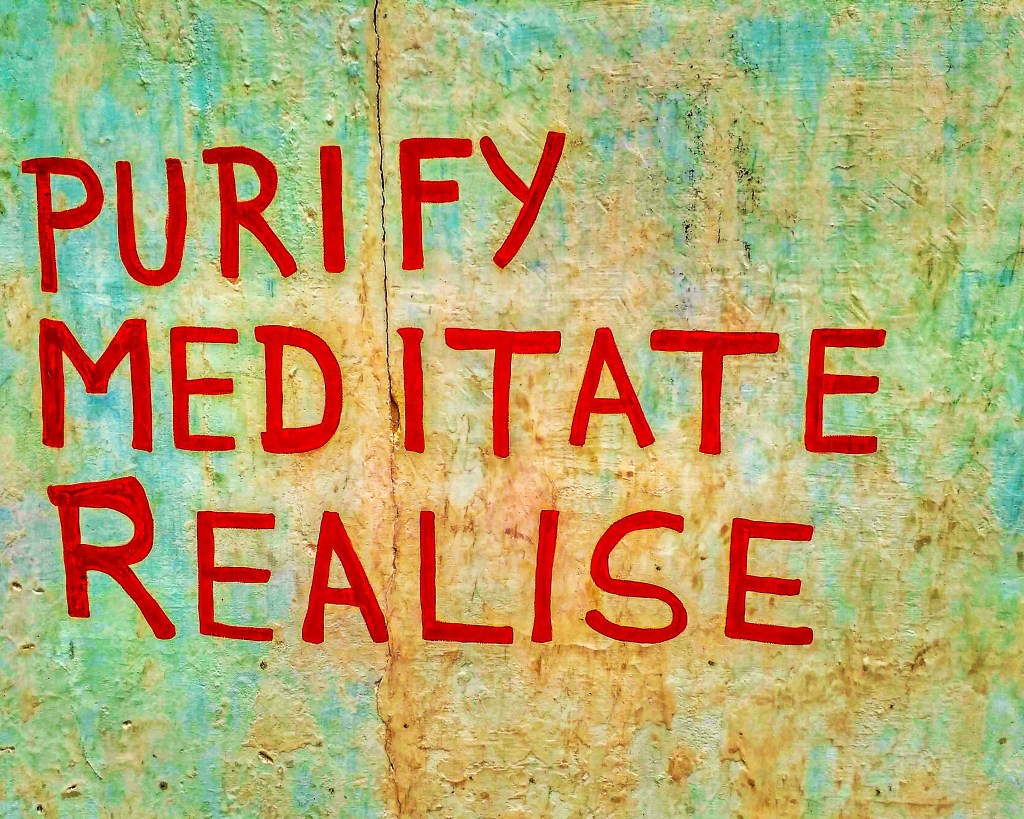
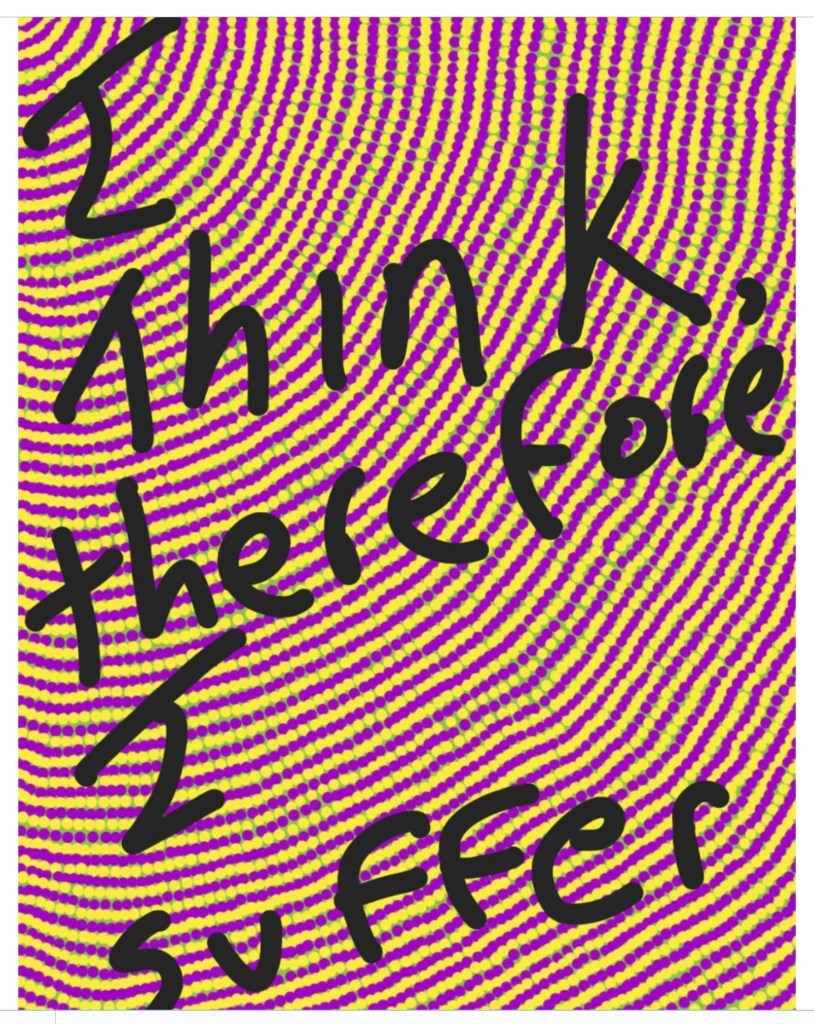
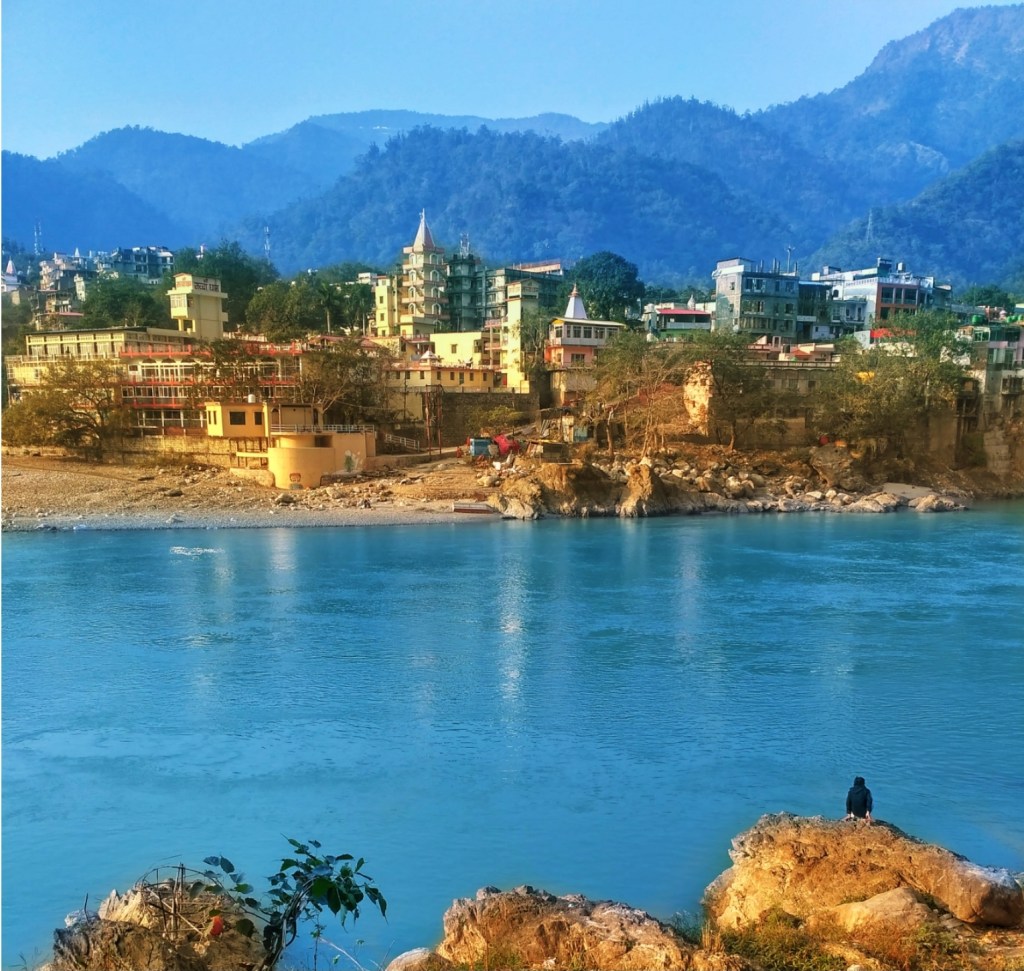
You Can’t Chase Happiness: You Can Only Be Happy

Sitting down just now at the keyboard (actually to be honest it was 30 minutes ago) I thought I had an idea for a blog post. But, sure enough, the moment I opened a new document, fingers poised on the keys, it went. As in vanished from my mind, disappeared. And what remnant that was left seemed to be taunting me with ‘Why on Earth did you ever think this was a good idea?’

So, what do you think this hermit pilgrim, living the serene monkish life who goes on and on about presence did? Relaxed my poised fingers, closed my eyes, and whispered my mantra as I waited for inspiration to revisit?

Hardly. What I actually did was begin having unhappy thoughts, frustration boiling up: I had really been looking forward to writing that post, and now it’s gone. And all that’s left is this annoying frustration and growing desperation to do something.
Nevertheless, I did in the end manage to calm myself at least a little. I just stopped. Took my hands off the keyboard and just sat. Just sitting is a go to strategy for me as you know.

Thoughts emerged, wandered around my mind, crashed together, one pushing another out of the way.

‘Just typical,’ one of those thoughts ran. ‘I try to do something to make me happy and nothing happens except I make myself miserable’. Next thought: don’t I have a quote somewhere about this? Sure enough, there it was, at the other end of a search of my quote files (I’ve got lots!).

You do not become happy by pursuing happiness.  You become happy by living a life that means something.

Then a quick online search revealed literally dozens of articles, books, similar quotes, podcasts, on and on, telling me the exact same thing. I didn’t know where to start, so I just closed the searches after scanning a few headlines, then sat thinking for a bit on my own, at the keyboard yes, but not poised. More like, well just thinking.
I read somewhere a long time ago that some say the word happiness comes from the verb to happen. Or put another way, happiness is living life so that we are in touch with what’s happening, when it’s happening.

Have you ever noticed that the happiest, most content people are often those who simply get on with whatever life puts before them? Whether it looks to be good or bad?

It seems to me that the pursuit of happiness has become so much more than a lofty turn of phrase; its become an almost obligatory activity to fill ones life with. All this despite those many dozens of articles etc advising against it. (Just as an aside: This says to me that we are swamped by so much information that we hardly have time, energy, or mental space to turn most of that information into knowledge we can use)

So. How do we get past this obligation? How do we get back in touch with what’s happening right now? How do we just get happy from what happens? And, then, how do we get to live a life that means something?

Let me say that I can’t give you the answers: what is meaningful to me might not be for you and vice versa.  But the process is the same for us all.  And it is this:  ask the questions (the ones above).

It’s that simple.  It is enough to ask the questions.  We don’t have to worry about the answers.  The answers will come when the time’s right; its just that sometimes we don’t always notice their arrival.  They sort of sneak up on us!

Whatever answers we come up with, we need to remember that living life fully means living each moment, each thing that happens, as it happens.  It means not being too concerned about what will happen next week or in five minutes time.
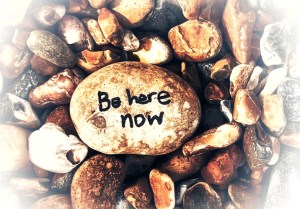
This doesn’t mean we don’t make plans or think about the consequences of our actions.  In fact just the opposite is true:  it is by living fully in the moment that we best prepare for the future precisely because the moment is not something that comes and is gone: it’s a flowing thing. The moment is continuous always. No past present future (well except when you have to write stuff, then there’s grammar) Only now.

So, thinking about all this I decided: don’t worry. If no idea for a blog post works, then that’s just what’s happening. Be happy, be content with that, and just move with the ever-flowing moment.

And I’m going to try to remember that everything I do, no matter how mundane it seems, has its own meaning.  There’s no rush to get onto some mythical ‘next thing’. Meanwhile, blog post ideas come when they’re ready, not because I’m chasing them.

peace
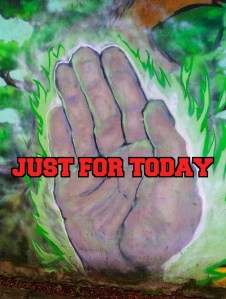
Just For Today

There is a song by George Harrison that I like very much. Actually there are many songs of his that mean a great deal to me. He’s been a kind of mentor or teacher for me since the early 70s. But, having said that, there is something about Just for Today that really does resonate deeply within me. It’s not even one of his ‘biggies’, and was released in 1987 on the album Cloud Nine

In fact, if you read the lyrics of the song. Or even better, listen to George actually doing the song himself, you’ll most likely agree that this is more than a song. This is a refrain, a plea, even a prayer. No ordinary pop song anyway.

If just (for) today
I could try to live through this day only
Not deal with all life’s problems
Just for today

Then, the other verse (there are only two):

If just for tonight
I could feel not sad and lonely
Not be my own life’s problems
Just for one night

How many times have I made these same pleas? I don’t think I’d be able to count them. Of course I’d guess we all have at some time or other (or even quite often, all the time, every day, ahhhhh!!!!!!) wished or prayed for the problems (whatever they may be) to just go away, even for just a day. No, not even a whole day. How about just for a few minutes?

So, I’m not alone then. Still, it’s no consolation is it, to know that we all go through the same wishful thinking to be rid of the same or similar problems? I think, though, in this song George has given us a clue to what we can do to bring ourselves a little more into the present when it comes to the angst we weigh ourselves down with over ‘all life’s problems’.

And actually, he’s suggesting not that we focus fully on the present moment, the micro if you like, which can be tricky at the best of times. He’s given us a bit of a an easier task: Just look at this day only. Perhaps we can better look at a whole day than this ‘moment’ or ‘second’. A day is sort of a macro moment, a bit easier to get hold of.

But, that last little question, about always me being my own life’s problem, that’s what I really try to get to grips with. I am my own life’s problem. The problem is not the family I was born into. It’s not the less than idyllic childhood I endured. It’s not even the bullies I seem to have attracted to myself over many years in far-off school days.

The problem is not even the anxiety that I seem to have been born with, or that’s evolved over time. Nature vs nurture?

And I can’t even say that the problem is the kinds of choices I’ve made about life, work, thinking, and all the rest, over the years.

No. None of this. The problem is me. And, let’s get really trippy here: the problem isn’t even me. It’s the physical manifestation that thinks it’s me and which exists in relationship to the physical world.

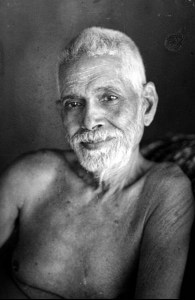
So, who is the real me? Who am I? Ah, well, these are the really big questions. Asking these questions is called Self Enquiry. And I think it’s helping me.

Whenever one of those life’s problems, or anxieties pops up I try to remember to ask: ‘To whom is this feeling/thought/memory occuring?’ That answer is (obviously) to me. And then I ask, ‘Who is this me? Who am I?’ Then, for the minutest of tiny moments, it all stops. Sometimes.

You see, I’m not really able to answer that Who am I question. The best I can come up with is a never-ending list of who I’m not, or what I’m not. It’s called Neti Neti: not this, not that. So, if I keep returning to who am I every time one of those ‘I’m not …’ comes up, what happens?

Well, in theory, nothing.  The idea is that asking Who am I stops the mind. It can’t answer. If a mind can’t answer, there can be no thought. And if there is no thought, then mind ceases to exist. (I’m not talking of brain here, but mind. It seems to me that the mind has no existence as a distinct entity of its own. It is more what we could say a ‘place’ that comes into being when thought happens. No thought, no mind.)

This cessation of thought is only a momentary thing. Thoughts soon come barging back (it also seems to me that while mind might not actually exist, it has a way of making its presence known in no uncertain terms). One thing I try to remember that causes me no end of extra thinking, is the fact that if we are not having a thought, then we can’t ever know it. You can’t have a conscious thought that says ‘hey, I’m not thinking now’

I see this Self Enquiry as a way (in a long term, lifetime kind of way) to rid myself of my incessant thinking and the confused (confusing too) and useless thoughts that arise all the time. For me it is, in a sense, a way to become mindless.

In that moment, when thought ceases, there is no pain. There are no questions, and there is no anxiety. There is no dread; no hope even. Basically you can say there is nothing for that tiny moment.

And that’s me, the real me. In that little moment (who can measure the length of a moment?), there is presence, as in I (the real I) am present, right here, right now.

Actually there is no time, as we measure it in the world, in that little moment (or whatever we choose to call it). Perhaps it’s more accurate to call it a state of being.

And it’s a state I’d like to be in more often. Not, as I say, that I’d know I was in it. Only by what you might call the spin-off effects of more calm, more clarity, less anxiety, all that sort of thing. In a way I would call that a state of grace.

All I can say is that it is exactly where and when and how I want to be.

Just for today.

I’ll Try Not to Pass Them By

So, anyway, here I am. Just sitting. It’s what I do, when I can, when I’m able. Well, to be completely accurate, here I am sitting and typing. Writing yes.

But every day, I sit. I try to sit. On a comfortable chair or bed. Here is where I commune with the Divine. It’s where I say my prayers, empty my mind, try to be silent, sometimes read holy books.

Whatever I do when I am just sitting, the sitting bit isn’t always easy; it requires effort and patience. Just being still can be hard; everyone knows that. But it’s part of the practice, part of the sadhana, the way to liberation. All that.

Of course I’m not the only one you might find just sitting. Why, just today on my way home from buying fruit I saw some other people sitting. One had his eyes fixed, completely transfixed on his phone’s flickering screen; head bowed, the world around him shut out.

The other sat, head bent forward, arms crossed; I couldn’t see her eyes. Perhaps she was sleeping, perhaps feigning sleep, perhaps trying for sleep. Whatever, resting it looked like.

These two were a lot like me I thought: just sitting, being quiet, resting even. Mind you, they were younger than me. Though of course what’s age got to do with it? I carried shopping bags; they sat beside a very full shopping trolley.

But, wait, my bags held fresh fruits to top up our supply. Their trolley overflowed with, what shall we call them? All their worldly goods? Personal effects? All they own?

And another difference? I’m going home with my bags. They have no home to house those effects; no soft bed to rest upon or commune at leisure with the divine.

Whereas I sit under a roof, in a room, on a soft bed, they sit in a bus shelter. Sure, there’s a roof but it offers scant protection from the approaching storm, and none at all from the incessant wind that will soon be full of rain blowing.

It’s no use asking why am I in a comfortable house, and they are in a bus shelter, just as I was and they were, the last time I saw them. There’s nothing for me to say that will mean anything to them, to anyone else, or even to myself.

I suppose I or you or someone else might remind me (remind all of us) that the world can be hard, is hard: bad things happen to all of us. Of course that’s true. I actually truly believe that the world by its very being in existence is hard. What did The Buddha say? Life is suffering?

But, as they say, that just doesn’t cut it, does it? All just words don’t you think? It’s what I think today anyhow. Oh yes, I’ve been praying since I passed them by (and I did pass them by with no words, no smile or greeting, my face turned away. I am ashamed).

I thought of them as angels there to remind me of my own advantages and privilege. Even those very thoughts themselves prove my own failing to understand, to actually get it.

But, yes: all just words. Meaning very little. I suppose after all that perhaps all I can do is pray.

For all of us.

Peace

Not as if I don’t bloody live here is it?
Yeah. I know, I know. Its a bloody bus stop.
But, geez, a fella’s gotta live
somewhere. Don’t he?

An Aspiration. A Prayer

Hello friends and welcome

The last couple of posts have had me thinking about what I actually do to contribute to the world, to life, to making changes that could bring peace, a safe environment, and a better life for all.

I have to say my commitment to my life as a hermit, as a pilgrim aspiring to live a life apart from ‘the world’ all the while dedicating myself to what we might call Self or God Realisation, has been strengthened.

I have once again come to the conclusion that living a life focused on spiritual development, on art, on prayer, and on contemplation, is the most valuable way I personally can contribute to change, to love, to the good of all. My true nature, my inclinations, my faith, my life experience, all these equip me for this life that has chosen me.

And at the same time, these same factors have left me ill-equipped for life ‘in the world’

In those last two posts, I talked about how so few of us think we have anything to offer a world teetering on the edge. But of course, as I pointed out, the opposite is true. I think I made the point that there is some unique role for each and every one of us in the continued unfolding, upliftment, protection and prospering of all life in this world.

Having said all that, I have to say that for me it’s not always easy to actually realise this in my heart. Intellectually it’s an easy concept to explain (well sort of anyway), but on that deeper heart level, well it’s tricky. Guilt rears its ugly head: ‘It’s all falling apart; I have to do more; But what can I do? It’s useless. I’m useless’.

As I mentioned in one of those posts I think, people have turned away from the horror, injustice, cruelty, and murderous greed and lust for power, for as long as these things have existed – which is obviously for as long as our species has been around. At certain times in history this move away from ‘the world’ has accelerated and intensified. And we are living in one of those periods now.

In the last century so many people have taken up the contemplative life, and many have chosen to make that life one of complete or partial solitude in order that they may be free from distraction in their prayer, study, and contemplative life.

But, many will say, ‘You are in denial. Now is the time you are needed out there. The world and all of life is in danger. You can’t escape and hide in a cave’.(read here stop watching the news, ignore politics, stop spending, become a literal or metaphorical hermit, go traveling, shirk your responsibility to the rest of the world).

Again guilt trips us up and we just keep on trying to find ways to at least rid ourselves of the guilt over our perception that we can do nothing.

But many such people, and that includes me, rather than being in denial, rather than shirking responsibility, have looked at the material world with its horrors, and said, ‘This isn’t right’, and have started to look at other ways to live and, seeing that continuing to struggle against the weight of the world on the world’s terms is pointless, seek to find other ways they can contribute to change. Ways that don’t perpetuate the playing of the game.

And rather than escaping these people (including me, I say with humility) face the world head on, dedicating their lives to the world through creativity, through prayer and meditation, and through the expression of freedom in their choice of lifestyle. They are, as Mahatma Gandhi is supposed to have said, being the change they want to see in the world.

While Gandhiji didn’t actually say those words, (Actually there’s a post coming in a couple of weeks in which I share the full text this quote is apparently derived from. Stay tuned for the link here), he certainly lived his life being the change he wanted to see.

But sadly, this ‘quote’ has come to be seen as a kind of feel good cliché, something the privileged are accused of mouthing while not actually even thinking about changing their lives. Just one more platitude you might say.

But for many, like me in my own way, it is much more: it is a call to action, a respectful and heartfelt request that I embark upon the quest for a more authentic way of living that has love, compassion, service, and truth at the centre of all I do.

This is my aspiration. This is my prayer.

Peace from me to you

Mind Your Own Business and Save the World

Namaste friends

Welcome to another post. Just a little note before we get into it: This one picks up where the last one left off. Kind of. No need to read that one first, unless you want to.

And that’s the whole thing in one sentence, or at least in part of a sentence: unless you want to: none of it is any of my business. What do I mean when I say ‘none of it’? Just that. None of it. Or we can say it in another way: the only thing that is your business is you.

But, all of us are bound to ask, how can I simply mind my own business in a world torn by endless war? How can I ignore the environment I live in and that it’s dying before my eyes? How can I turn away from the evils of racism, injustice, greed, and cruelty?

Well, the simple answer is we can’t and we shouldn’t. Of course, in order to reconcile this apparent contradiction, it would be helpful to clarify exactly what we mean by minding our own business.

In essence my business (or yours or anyone’s) is anything that has to do with me: what I do; how I behave; what I think, feel, and believe; my behaviour and attitudes towards others; and—and this is the key—how I interact with and respond to the world as I experience it as I go about living my life.

So, it isn’t completely accurate to say that the wars, racism, injustice, and the killing of the environment (and everything else) is none of my business; my business is limited to my interaction with and response to all of it. And that has to be determined by a range of factors like my nature, my abilities, my circumstances, and so on.

Above all, and as Susan Sontag, American writer, philosopher, and political activist, said in a speech in 2004:

To be a moral human being is to pay, be obliged to pay, certain kinds of attention.

While the theme of that speech had to do with the writer’s responsibility to truth, I think her assertion applies here and may provide a solution to the seeming contradiction between minding our own business while at the same time stating that our business can, should, and does indeed include what goes on outside of ourselves (actually as we shall see, in reality there is no outside or inside)

How we utilise our own personal resources is in the end for each of us to decide. In the sense of our engagement with the world, the most precious of these resources are arguably time and attention.

Each of us possesses these things in our own unique quantities, just as we all have our own unique qualities, so each of us has the opportunity to decide how we use our time, and what we pay attention to.

It is so very easy to be overwhelmed by the constant torrent of information detailing the horrors threatening to consume and destroy our poor Earth and the life she supports. It is so very tempting to throw up our hands in defeat, and shrug our shoulders as we turn away exclaiming ‘It’s none of my business’.

While none of us would blame anyone for retreating in this way, a great many of us realise that for us this is not an option. Well, as the Buddha taught, there is a middle way. A way that allows us to avoid this kind of ‘none of my business’ denial, at the same time as protecting us from being overwhelmed and beaten down by the scale of it all.

The first step involves surrender. Surrender to the idea that there is no ‘me’; there is no ‘you’. There is no ‘them’, no ‘us’. There is only ‘I’. Surrender to the notion that not only is all life ‘connected’ or linked, but to the thought that all life—human, other animals, plant, mineral — everything —  is one. There is no separation.

Easy eh? Hardly. But this is where the paying attention thing comes in. Rather than being swamped by the never-ending tsunami,  choose where to put your attention. Ask yourself, where am I able to place my attention? How can I—how am I able to—use my time so that I avoid drowning yet still contribute to the well-being of the whole of which I am a part?

Obviously, as I hinted at above, the answers will be different for each and every one of us. For some, the kind of attention they pay will involve being on the literal front lines, working in the political field, or with activist groups working for social justice.

Then there will be those whose nature compels them to  choose to put their attention on a life of prayer, meditation, and contemplation.

For these people this requires the quiet and solitude of monastery, ashram, or cave (whether it be in forest, mountain, or suburban home). And along the huge spectrum in between, there is a a unique spot for every one of us.

Each of us is a part of the whole. Everything we do affects the whole. Remember that saying that goes something like: A butterfly flutters it’s wings in the forest and the sun rises? Okay, maybe I’m pushing it a bit, but you know what I mean.

Never underestimate what (you perceive of as the little) you’re able to do; no one can say what impact it will have. All that is required of you is that you mind your own business.

The Ananda Mart is Closed Today

Hello and welcome dear reader

Almost four years ago now, we spent a couple of months in Bali. For a big portion of that time we based ourselves in a town called Ubud, on a street called Gautama. Yes, indeed, most auspicious.

Anyway, one day I was walking down the street, going somewhere, and for a change without my camera. I passed a small shop that somehow looked unusual. and I stopped to make a photo with my phone.

That’s it: The Ananda Mart is closed today, I remember thinking. In the few weeks we’d been there, I don’t think I’d ever seen it closed before. On most days the man who runs the shop could be found sitting on the front steps. And mostly he’d have his dog for company.

In the early days of our time on Gautama Street, we’d buy bottles of water at the Ananda Mart. Each time I would smile, say hello, and enquire after the shopkeeper’s health. And while he always responded, it was never with what you’d call a friendly smile or a cheery wave. Probably grumpy grunt would be a more accurate way to describe his replies.

You know you’re on Gautama Street when you see the man himself at the corner

And each time I passed the shop, I would say hello. Again on a lucky day I’d get a grunt, but mostly he would say nothing and ignore me. Just as he ignored everyone who passed him and his dog. Eventually after a particularly rude response to me trying to purchase water, I, as they say, took my custom elsewhere.

Often in such situations I have been known to become irritable, angry even, and end up being just as rude (or ruder) than the other person. For some reason, this time I didn’t react that way. Instead I was interested in figuring out why the shopkeeper acted in this way and seemed to be in a world of his own which, from what I could see, he shared only with his dog.

Of course, being the overthinking speculator champion of the galaxy, I made many guesses: he is the owner of the Ananda Mart and is totally over people; being I thought in his 60s, maybe he’s just hanging out till he can retire. Given that the Ananda Mart is only one component of what looks to be a multi-armed business this could be a good guess. He’s one of the family elders, doing his part.

Above the door beneath the name it reads ‘cheap and friendly’. And it’s interesting to check the meaning of Ananda. In Hinduism, Buddhism, and Jainism it refers to extreme happiness, one of the highest states of being. In Sanatana Dharma philosophy for example, God is sat-chit-ananda or existence, consciousness, bliss.

Now, before I ramble on too long, I will just say that really and truly ‘the real story’ is absolutely none of my business. I suppose what I’m getting at is, rather than dismiss him as a grumpy man in a shop, My reaction to our, shall we call it, our relationship was one of compassion and curiosity. Let’s just say my sense was that the Ananda Mart shopkeeper is perhaps not a happy man.

You see what I mean? I tell you that it’s none of my business, then I tell you how I kept sticking my mind in where it doesn’t belong. Makes me human I guess!

Paramhansa Yogananda, one of the first teachers to bring Yogic philosophy to the so-called West, and the author of Autobiography of a Yogi, says in that book that Ananda is different from the temporary happiness that comes from sense pleasures such as eating and other ‘material pursuits’. He said , too, that Ananda is not the kind of joy that we’d call monotonous and that always stays the same.

Yogananda wrote in Finding the Joy in Life, that Ananda refers to a joy that ‘changes and dances itself in many ways to enthral your mind and keep your attention occupied forever’.

It’s anybody’s guess really isn’t it? Whether our seemingly unhappy and not so friendly shopkeeper, has that kind of joy in his life. And perhaps his aloofness and ‘grumpiness’ is merely an expression of his weariness of the temporary joys of the material word with its emphasis on pleasures of the senses.

Anyway, as I say, it’s none of my business.

Peace to you from the Hermit

Methinks There’s a Whole Lot of Overthinking Going On

So much anxiety taking me over. Overwhelming all possibility of rational thought. I guess that doesn’t have to be such a bad thing in itself, but along with that often redundant supposedly rational thought, has gone equilibrium, peace of mind, calmness, and silence.

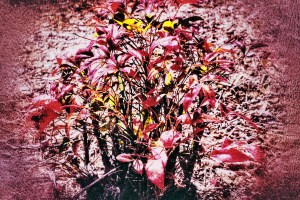
No silence. But a little breakthrough: I’ve told myself (my Self?) I won’t wallow. In this way I am opposing, resisting, the anxiety with discipline, with bravery, and, well, more discipline. So I turned in another direction: I worked on a couple of photographs.

Fantasies both for sure. But that’s Art responding as Art ought isn’t it? Fantasy. Anyway, it works better than anxiety, which of course is also fantasy isn’t it?

So, anyway, I’m resisting. I refuse to give in and allow the anxiety to take over and dictate my behaviour, tell me how to and what to speak, and exhaust me.

Yes, it is exhausting. I always say that resistance is never ever futile, but it sure is tiring. And there are other ways: Just chant. That’s the thing I tell myself a lot, just keep focus on the mantra, and all will be well.

Mind you at the moment I am having an atrocious period of trouble with my devotional practice. Forgetting the Divine seems to be the norm these last days – even as I sit preparing for daily practice.

It’s kind of a catch 22 thing I think sometimes: If I can chant more then I can help myself achieve a little more equilibrium, relieve the anxieties a little. But because I overthink those anxieties and all the intricacies of every thought, I forget to chant.

So, it does indeed look like discipline and self-control are the keys here. There’s a phrase, a kind of motto I like: One thing, God alone. Call it right living, or peace, or calm, or mindfulness, the Divine; it’s all the same thing. That’s where my focus has to be above all else.

Actually, not wanting to risk overthinking here, but when you do think about it, focusing my life on what is good and right; what is calm and peaceful; what it true, well, that’s the whole of it isn’t it? I mean that takes care of all the mundane stuff almost in an automatic way.

It seems that in just about every one of my posts I end up talking about presence. In this case, I think presence might have to at least sometimes be worked on. I mean to say that the discipline and self-control I was talking about, needs to centre around being present.

In other words, as my anxious mind wanders off on its fiendish ways, I am to just pay attention, turn away a little, put the focus back on the good, on God, and remember.

I really do feel (actually let’s be honest, let’s say it how it is), I think that I am always simply overthinking. Or thinking way too much, too often, anyway.

And along with my mind, my typing fingers can run away with themselves if I let them. So, I’ll just say see you next time!

Put Me in My Place. Please

Reverence the place and learn from what you see


Coming across this note last night, I was stumped. I coudln’t think where it had come from, where I’d seen it; nothing at all came to mind. And an online search just now failed to turn up anything either. I mean I must have read it somewhere. Or is it possible it came from me?

Of course it’s all the same: there is only one source. At any rate, it’s an injunction one can relate to anywhere, any place. It’s surely about presence?

And about learning from all that is to be seen (heard, felt, intuited, known) in whatever place one is in now. I mean, the place I’m in now. I am here and it is now.

I’m reminded of the faith affirmation (is it a prayer?) that seems to have been written for this particular hermit pilgrim:

As a a hermit, I am a pilgrim dependent on a pure faith that I am exactly where God wold have me be now.

Sometimes I think that too much thinking about and angst over places other than the one I’m actually in right now, is a sure and certain way to resist and reject any reverencing of the place I’m in, not to mention what’s to be learned or gifted from the experience of being here.

And of course that angst, worry, wishful thinking, or whatever, comes with its own issues of distraction, and of a taking away of one’s Self from the present, the notion that here and now is the only time and place that exists.

A poem of mine I came across the other day while looking for something else says it all quite nicely. This poem is called Transcendental Injunctions, and it’s a rap on presence, about being here, and being now.

The central action describes how my senses can take me away from that here and now: I describe my habit of smelling my Bhagavad Gita (yes, as in putting my nose into the pages of the little book and inhaling the aroma of those pages) and how that takes me back to the shores of the River Ganges; another place, another time.

Anyway, allow me to share the final verse, which speaks of one such occasion:

Then, there is a voice:
I hear it with the ear of my heart:
There is no place to go.
What you seek is within.
There’s nothing to find:
God’s kingdom is within.

I suppose there is nothing left to say. I am here, and it is now

Peace to you from me

A Little Blogging Balance is Called For

Hello and welcome

In yesterday’s post I made mention of how Notes from the Hermit’s Cave is a month and ‘a bit’ old now. I thought when I typed that, ah yes, so it is; I don’t think I’d given a lot of thought to details like that.

So, first things first: Thank you for being there at the other end of all this, and for joining me on this new venture. Adventure really.

Anyway, as you could tell if you read that post, I just kept on typing with hopefully something reasonable coming out at the end!

Later when I told a wise one I know about that realisation, this person said to me:

‘Are you sure you’re getting enough new imput to keep coming up with new ideas for more writing?’

Good question. Wasn’t yesterday’s post about precisely the issue of an idea that wouldn’t (or maybe couldn’t) evolve into a post? But, wait, not having any ideas isn’t a problem is it? Or is it? So, what’s ‘enough new imput’?

So now I had two pieces of information that had me thinking: the running out of ideas is a possibility; having ideas that won’t or don’t work is a certainty. Together these bits of information came together to form a little bit of knowledge.

That’s how it’s supposed to work: we gather information, then we turn that information into knowledge. The trouble happens when we are overloaded with too much information and can’t sort out any of it to form anything like coherent knowledge.

Anyway, here am I getting distracted! What I was about to say was that the knowledge which came from those three pieces of information, was:

There’s a potential for ideas to run dry, but the other problem is that just because there are ideas apparently available now, doesn’t mean they are any good, or can be used, want to be used, or for a myriad of other reasons, I can’t connect with them. Either way, I am definitely going to need some new, perhaps different imput

What to do? Now, this is where the formation of wisdom comes into the picture: first there were seemingly random bits of information, which then came together to form a little parcel, nugget, insight (what do you call a piece of knowledge?). Some knowledge.

As we all know, simply gathering information, even if we somehow are able to turn that information into knowledge, is no guarantee that wisdom will follow.

However in this particular instance, wisdom did emerge. After some thinking, and some not thinking, I thought, I know: I’ll have a couple of days off. No posts. No blog (except to answer people who reach out to me obviously) stuff at all.

Ah wisdom. So simple really when you look at it isn’t it? I’ll just have a couple of days without thinking about, or looking at Notes from the Hermit’s Cave. So, what will I do instead? Well it’s not as if my time isn’t rather (very rewardingly) full with the other practices incumbent upon me as a hermit and a pilgrim. And a monk.

Still, I thought, I could use a bit more time just sitting still. You know: being quiet, eyes closed, not doing anything. Then, I’ve been a bit light on listening to music this last little while. And not listening to enough music is enough to cause trouble with anybody’s creative self isn’t it?

So, decision made. More time sitting and being. In silence so the inner mind is open to receive new ideas, to process existing ones, and to well, just be quiet. And some more music. Doesn’t matter what it is {well to a point it doesn’t): ideas come from and because of music.

Perhaps by this point, it has occured to you as it has to me, that there is an irony at work here. Here I am writing a blog post on the very first day of a couple of days off from writing blog posts. Okay, I get it. Time off starts … now!
No-post weekend starts … now!

Alright, I can’t make any promises; The creative spirit arises when it does; my heart opens when it does. Besides, as that same wise one said to me by way of an injunction on how to approach everything and anything:

No overthinking

PS I was just thinking, there’s a book I’ve been meaning to get to for weeks now, so … Never mind

Walk In The Waters of Life

Since I launched this blog (a whole month and a bit ago already), I’ve had an idea for a post. A short, spontaneous, chatty but informative little piece on my favourite name and form of the Divine Feminine (often referred to as the Goddess): Saraswati.

Well, as the keenly observant among you will have noticed, no such post has appeared. Procrastination in overdrive you might say. Or perhaps it was that the Goddess just wasn’t keen on me doing the post about her?

You see, I did some research, made a ton of notes, and discovered all kinds of fascinating things and I just felt I wanted to share what I’d learned. Somehow, though, the idea didn’t go any further. I’ve thought about it from time to time, but still, nothing has come. Then, a couple of days ago, I came across my notes and reread what I’d discovered.

Now, here’s a key moment: as I reread those notes, I thought (paraphrasing here), ‘I really must post this. It’s all so fascinating and would interest a lot of people and even be helpful.’ Something like that anyway. Yet, still, it is not written.

So, despite my notes seemingly begging for my attention, I guess that maybe it’s not the time. Now my notes are safely tucked into a few nice little folders within a larger folder somewhere in the depths of my harddrive.

All that struggle; all that thinking and fretting over what was supposed to be a short, spontaneous couple of hundred words on a subject I love. Still, the episode has got me thinking about intuition and how it can disguise itself – with our help – as procrastination. And vice versa.

Yes, I know, obvious question: how can we ever know the difference? When are we inventing all kinds of reasons for putting something off, and when is it really intuition trying to guide us?

Well, it’s complicated. As creatures able to reason, we are always ready to come up with arguments for and against, to think endlessly and agonize over the smallest and most trivial details while ignoring the big stuff. Really, in my case that’s all there is to it: I just think too much.

Sticking to the Saraswati blog post episode (a catchy title don’t you think? Watch out for a post headed up ‘The Saraswati Blog Post Episode‘), I don’t recall why I didn’t just get right to writing it. It might have been any number of things: a perceived lack of time; a promise to self to ‘give it some more thought’; a resistance to the actual ‘labour’ required. Who knows?

Or, was it more that, while the idea was a good one, I just wasn’t feeling it? Maybe the timing just wasn’t right? The problem is that sometimes an intuition comes in a flash of knowing – with a capital K – that you can’t possibly miss.

Then, other times, it creeps up so slowly and quietly that it gets drowned out and ignored as our monkey mind takes over with its endless arguments for and against, pros and cons, advantages and disadvantages,

The lesson I was given here was this: What is going to get done, will get done; what is not going to get done, won’t. Sounds simple really, but so often we make it more complicated with our overthinking, our coming up with excuses. We procrastinate.

Then, at other times, we just dive in the deep end, flowing with the intuition. It may be right or it may be wrong, but it’s done. Actually, I am trying to realise that there is no right or wrong about a decision made: it just is as it is. Easy to type, hard to do.

Flowing. That’s a good word actually. Saraswati, along with many other characteristics, embodies flow. As in the flow of the river of life. She’s the Goddess of all things creative as well as any activity that helps one to discover the essence of self.

So, flash or gradual realisation; right or wrong; left or right, be the river: flow with what happens or doesn’t happen. Don’t fret about the twists and turns, the ebb and flow of tides, the rocks in the stream that force us to flow around or over, or to change direction completely. In 1946 the poet Jorge Luis Borges wrote an essay about time. In that essay, among other things he says:

Time is the substance I am made of. Time is a river which sweeps me along, but I am the river (emphasis is mine)

Jean Luis Borges A New Refutation of Time 1946

Reading that quote reminded me of a song that I’ve been humming on and off for a very very long time (hint: I saw the movie when it first came out).

The river flows, it flows to the sea.
Wherever that river goes, that’s where I want to be.
Flow river flow.

Peace from me to you.
PS: Thanks to my memory for giving me these lyrics from The Ballad of Easy Rider. Or was it actually Saraswati whispering in my ear?