Creatures of the Air,
the Winged ones.
Same like you and me:
Bound to material nature.


Creatures of the Air,
the Winged ones.
Same like you and me:
Bound to material nature.
Welcome to another musing from the hermits’ cave. It’s been a while hasn’t it?
Mind you, I’ve been busy: settling into the new hermitage here in the desert. Actually, it’s been cloudy since we arrived, and raining sometimes. It’s as if the Subtropics have followed us here, except that it’s been freezing.

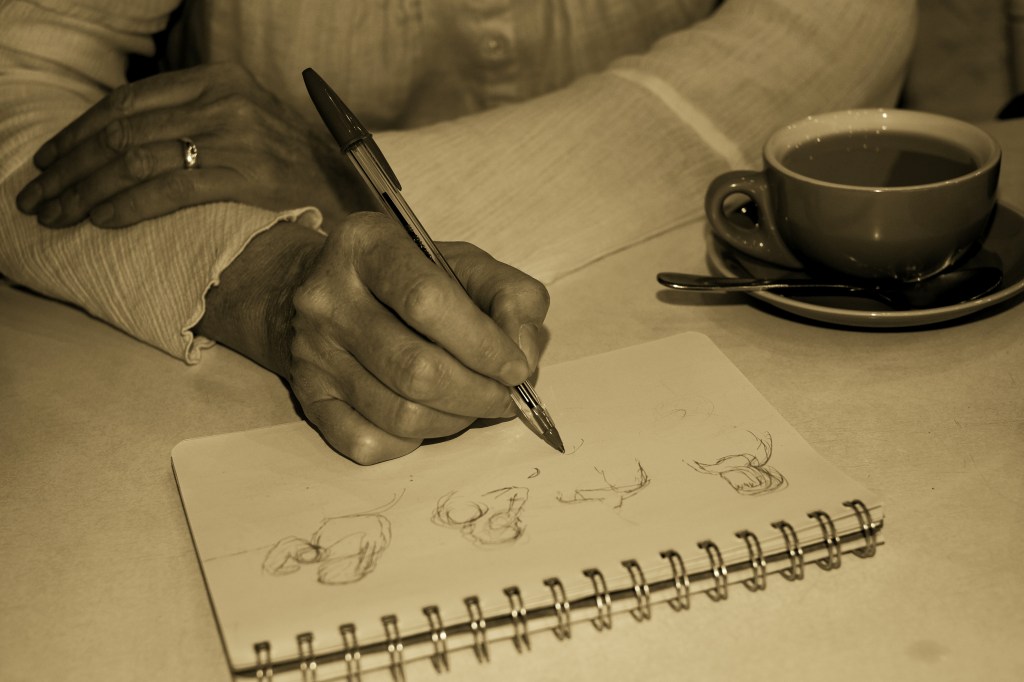
And I’ve been busy colouring in as well. Not as in filling in a picture book designed for colouring, but in making my own patterns and shapes with the one aspiration of making colour happen.
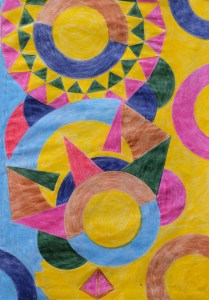
Japanese calligraphy masters will tell you that God is in the ink, or in my case in the pigment of the colour pencils I use. I draw designs, sometimes complex, sometimes simple, then fill the spaces with colour. Sometimes just one or two, sometimes multiple colours.
Why? Well, the simple answer is because I like doing it. I like to see colour covering the page, seeing it slowly fill that empty space. I’m not good at ‘drawing’ and painting in the traditional sense, but one thing I can do is make colour. So I do.
And it’s a sacred act: God is in the ink remember? It’s the making of beauty. And that is a holy act. There’s that aphorism isn’t there? It’s better to light a candle than curse the darkness?
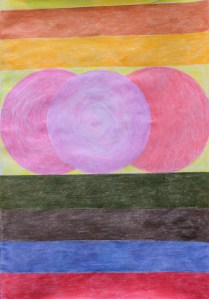
Or, I could say that it’s better to make colour and patterns than it is to be swamped by the darkness.
There’s a Bhagavad Gita verse I like that I came across again the other day:
If one’s thoughts are fully absorbed in the Absolute all his [sic] spiritual offerings also become a part of that same Absolute
Bhagavad Gita 4:24
In other words, all our actions – and we never cease from activity while we dwell in a material body – are not only prayers or offerings to that Absolute (or you can say to God, to beauty, to art, to love, to the universe, to life. Or you don’t have to name it at all. None of the names and forms are relevant) but in fact become that Absolute.
I am a hermit pilgrim, living a contemplative life devoted to the Absolute we just talked about. I have little to offer, but I offer all that I am. And with my photographs, and with my ‘colouring in’, I try to create a little bit of the sacred, a lit bit of colour and beauty to keep us all away from the darkness.
Peace and love
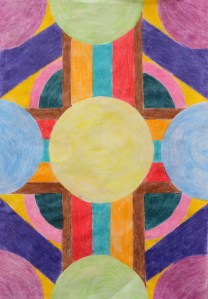
One week today and I will be there. In other words, this time next week at this time I will have arrived in the desert city of Broken Hill. Almost in the heart of the continent and right in the middle of the Outback. In fact they call that whole area The Big Red after the colour of its tens of thousands of square kilometres of desert sands.

It’s about 1500 kilometres from the Pacific Coast where I am right now. I’d like to write about the ‘call’ to the desert, which I am finally answering, but maybe I’ll get to that in another post.
Right now I only want to say how excited I am to be going. A bit anxious too (I’ve been there before, but still …), and plain and simple looking forward to getting there.
Acturally, to be perfectly clear about it: I can’t wait to be there. But, you see, herein lies the problem: I am so keen to get there that I’m feeling as if I am no longer here. I am not present; I am not living in the moment and in the place I’m in (which I love by the way, the place I mean).

I don’t mean to say that I am some sort of Buddha who is usually fully present in each moment; or who is serene and calm when he knows change is coming. Any reader of this blog will tell you that presence isn’t necessarily my greatest strength.
But, I must say that lately I have improved (slightly) my living in the moment, being here and now, way of living. It’s just that I’ve been longing for this particular change (and all that I anticipate will come with it) so much that I just can’t help myself.
Did I mention already that this is a problem for me? Well, yes, I did, and it is. I prefer very much to be where I am and when I am and fully in the flow of the ongoing present.
Of course there is nothing wrong with wanting something to happen. The problem arises when one is so anxious for whatever it is to happen, that what’s happening here and now ceases to be where one is at—in other words: the trouble is that I stop being in the present.
Buddha taught what are called The Four Noble Truths. (which pretty much form the core of Buddhist teachings) The second of these Truths says that attachment is the cause of suffering. Suffering here means anxiety, worry, regret, fear; all those kinds of things. Whenever we say something like, ‘I can’t wait to…’, then it is a sure sign we are attached to that want or desire.
By the way, the First Noble Truth is: Life is suffering. Suffering, The Buddha taught, is simply the price of being alive. We get hungry, we are conscious of pain (in all its guises), we grieve; we grow old; we get sick; and we die.
But, right now, I want to talk more about Noble Truths three and four. Number three says that suffering can be overcome. Nice clean, clear, and not to mention, succinct little statement. Of course, it’s easy for him to say isn’t it? He is Buddha after all.
Perfectly reasonable reaction from us suffering humans. But there is hope and we will find that in Noble Truth number four which gives us the how to overcome suffering. There are quite a few ways to put this Truth into words, but the one I like best says:
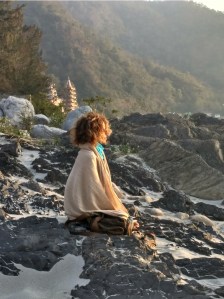
The way to overcome suffering is to sit.
What? Sit? Yes, sit. Be still; stop moving. Of course if we relate this Truth to my little dilemma for wanting to so badly to be somewhere else that I’m not able to be where I am now, we can expand this Truth to something like this:
Focus your full attention on what you are doing now, and where you are now as well. As much as you can, be open to change, but be less attached to the nature or timing of that change. After all, you can make all the plans you like, but who knows what’s really going to happen—you won’t know that till it actually happens.
So, that’s what I am trying to do. Instead of saying stuff like ‘I wish I could go sooner’, or ‘it’s only x days till I go’ (yes I know, that’s what I said way up there at the top of the post), I am going to ask myself, ‘What am I doing now?’, and I plan to look around me, and engage more with the reality of this moment. And try hard to realise the ongoingness of that everlasting moment.
As Ram Dass said,
Be Here Now.
Hey, that’s a great mantra isn’t it? Chanting it whenever I start getting out of the here and now mode, might just put me back there again. I mean here—and now. You know what I mean!
Love and blessings from me to you
Paul
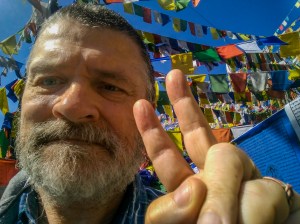
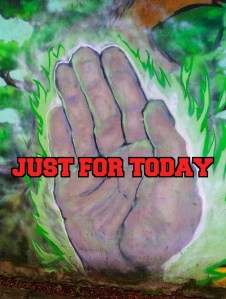
There is a song by George Harrison that I like very much. Actually there are many songs of his that mean a great deal to me. He’s been a kind of mentor or teacher for me since the early 70s. But, having said that, there is something about Just for Today that really does resonate deeply within me. It’s not even one of his ‘biggies’, and was released in 1987 on the album Cloud Nine
In fact, if you read the lyrics of the song. Or even better, listen to George actually doing the song himself, you’ll most likely agree that this is more than a song. This is a refrain, a plea, even a prayer. No ordinary pop song anyway.
If just (for) today
I could try to live through this day only
Not deal with all life’s problems
Just for today
Then, the other verse (there are only two):
If just for tonight
I could feel not sad and lonely
Not be my own life’s problems
Just for one night
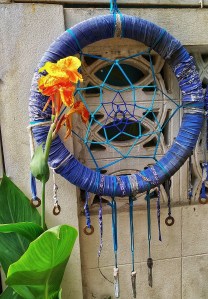
How many times have I made these same pleas? I don’t think I’d be able to count them. Of course I’d guess we all have at some time or other (or even quite often, all the time, every day, ahhhhh!!!!!!) wished or prayed for the problems (whatever they may be) to just go away, even for just a day. No, not even a whole day. How about just for a few minutes?
So, I’m not alone then. Still, it’s no consolation is it, to know that we all go through the same wishful thinking to be rid of the same or similar problems? I think, though, in this song George has given us a clue to what we can do to bring ourselves a little more into the present when it comes to the angst we weigh ourselves down with over ‘all life’s problems’.
And actually, he’s suggesting not that we focus fully on the present moment, the micro if you like, which can be tricky at the best of times. He’s given us a bit of a an easier task: Just look at this day only. Perhaps we can better look at a whole day than this ‘moment’ or ‘second’. A day is sort of a macro moment, a bit easier to get hold of.
But, that last little question, about always me being my own life’s problem, that’s what I really try to get to grips with. I am my own life’s problem. The problem is not the family I was born into. It’s not the less than idyllic childhood I endured. It’s not even the bullies I seem to have attracted to myself over many years in far-off school days.
The problem is not even the anxiety that I seem to have been born with, or that’s evolved over time. Nature vs nurture?
And I can’t even say that the problem is the kinds of choices I’ve made about life, work, thinking, and all the rest, over the years.
No. None of this. The problem is me. And, let’s get really trippy here: the problem isn’t even me. It’s the physical manifestation that thinks it’s me and which exists in relationship to the physical world.
So, who is the real me? Who am I? Ah, well, these are the really big questions. Asking these questions is called Self Enquiry. And I think it’s helping me.
Whenever one of those life’s problems, or anxieties pops up I try to remember to ask: ‘To whom is this feeling/thought/memory occuring?’ That answer is (obviously) to me. And then I ask, ‘Who is this me? Who am I?’ Then, for the minutest of tiny moments, it all stops. Sometimes.

You see, I’m not really able to answer that Who am I question. The best I can come up with is a never-ending list of who I’m not, or what I’m not. It’s called Neti Neti: not this, not that. So, if I keep returning to who am I every time one of those ‘I’m not …’ comes up, what happens?
Well, in theory, nothing. The idea is that asking Who am I stops the mind. It can’t answer. If a mind can’t answer, there can be no thought. And if there is no thought, then mind ceases to exist. (I’m not talking of brain here, but mind. It seems to me that the mind has no existence as a distinct entity of its own. It is more what we could say a ‘place’ that comes into being when thought happens. No thought, no mind.)
This cessation of thought is only a momentary thing. Thoughts soon come barging back (it also seems to me that while mind might not actually exist, it has a way of making its presence known in no uncertain terms). One thing I try to remember that causes me no end of extra thinking, is the fact that if we are not having a thought, then we can’t ever know it. You can’t have a conscious thought that says ‘hey, I’m not thinking now’
I see this Self Enquiry as a way (in a long term, lifetime kind of way) to rid myself of my incessant thinking and the confused (confusing too) and useless thoughts that arise all the time. For me it is, in a sense, a way to become mindless.
In that moment, when thought ceases, there is no pain. There are no questions, and there is no anxiety. There is no dread; no hope even. Basically you can say there is nothing for that tiny moment.
And that’s me, the real me. In that little moment (who can measure the length of a moment?), there is presence, as in I (the real I) am present, right here, right now.
Actually there is no time, as we measure it in the world, in that little moment (or whatever we choose to call it). Perhaps it’s more accurate to call it a state of being.
And it’s a state I’d like to be in more often. Not, as I say, that I’d know I was in it. Only by what you might call the spin-off effects of more calm, more clarity, less anxiety, all that sort of thing. In a way I would call that a state of grace.
All I can say is that it is exactly where and when and how I want to be.
Just for today.

Reverence the place and learn from what you see
Coming across this note last night, I was stumped. I coudln’t think where it had come from, where I’d seen it; nothing at all came to mind. And an online search just now failed to turn up anything either. I mean I must have read it somewhere. Or is it possible it came from me?
Of course it’s all the same: there is only one source. At any rate, it’s an injunction one can relate to anywhere, any place. It’s surely about presence?
And about learning from all that is to be seen (heard, felt, intuited, known) in whatever place one is in now. I mean, the place I’m in now. I am here and it is now.
I’m reminded of the faith affirmation (is it a prayer?) that seems to have been written for this particular hermit pilgrim:
As a a hermit, I am a pilgrim dependent on a pure faith that I am exactly where God wold have me be now.
Sometimes I think that too much thinking about and angst over places other than the one I’m actually in right now, is a sure and certain way to resist and reject any reverencing of the place I’m in, not to mention what’s to be learned or gifted from the experience of being here.

And of course that angst, worry, wishful thinking, or whatever, comes with its own issues of distraction, and of a taking away of one’s Self from the present, the notion that here and now is the only time and place that exists.
A poem of mine I came across the other day while looking for something else says it all quite nicely. This poem is called Transcendental Injunctions, and it’s a rap on presence, about being here, and being now.
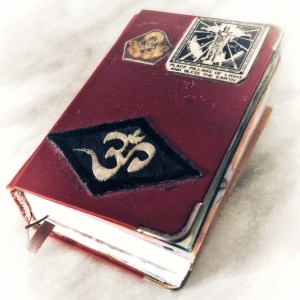
The central action describes how my senses can take me away from that here and now: I describe my habit of smelling my Bhagavad Gita (yes, as in putting my nose into the pages of the little book and inhaling the aroma of those pages) and how that takes me back to the shores of the River Ganges; another place, another time.
Anyway, allow me to share the final verse, which speaks of one such occasion:
Then, there is a voice:
I hear it with the ear of my heart:
There is no place to go.
What you seek is within.
There’s nothing to find:
God’s kingdom is within.
I suppose there is nothing left to say. I am here, and it is now
Peace to you from me
This morning I was just sitting, or at least trying to just sit. You know, being quiet, relaxing the mind. All that kind of thing. And of course, an idea sprung into that not so cooperative mind, so I grabbed my notebook. Just as I went to put this latest brainwave on paper I noticed a very extraordinary note I must have made I don’t know when:
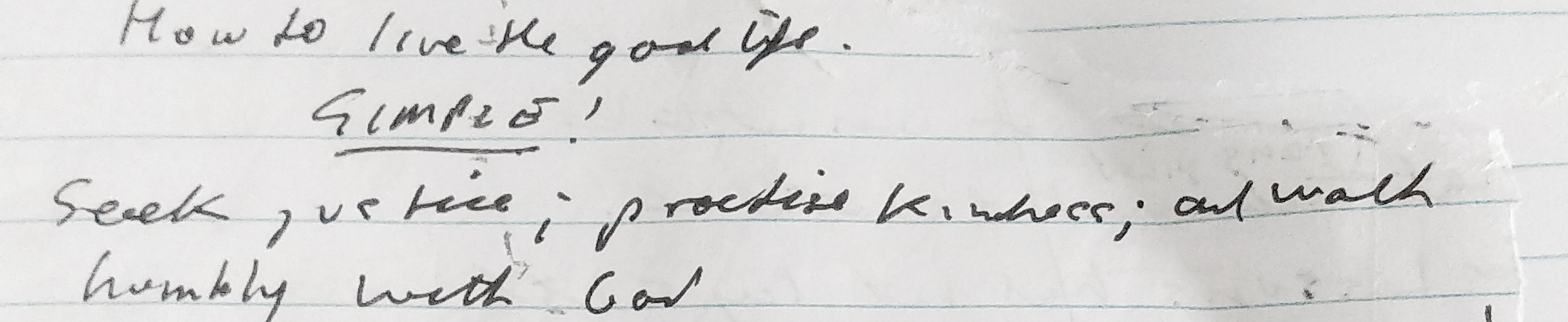
I’ve just looked it up: It’s a slight paraphrase of a verse from the Old Testament, from the prophet Micah. Where I read it, I can’t say (the note is at least several weeks old). But to quote another little note from some unknown source, I always like to:
Let the noble thoughts come to me from all corners of the universe.
unknown

I’m just like everyone else, always wanting the easy solutions and you can tell that can’t you? ‘How to live the good life? Simple!’. I mean really; hardly humble in my approach in that note was I? Well, let’s talk about what Micah says, not my own lack of humility.
Seek justice; practise kindness; and walk humbly with [your] God.
There are numerous versions online of this verse (Micah, 6:8), so I will leave it to you to check those out for yourself. I’ve added the word your because all those versions do say ‘your God’. But even in this paraphrase it’s easy to see there is nothing at all simple about any of these injunctions.
I discovered that this verse is often invoked in times of grave injustice, or crisis. I think it goes without saying that we would be hard pressed to think of a time that was not a time of grave injustice or crisis. Certainly, we are living in one of those times of injustice and crisis.

There’s no need to or purpose served by getting into how ‘grave’ injustice is now compared to some other time; there’s no need or point to weighing up the relative severity of one crisis versus another. Injustice is injustice; a crisis is a crisis.
In other words, the present is always the time to heed the injunctions of this verse.
So, what do we do if we are to seek justice? Running the risk of sounding flippant, I would say that there are as many answers to this question as there are people to answer it. Now, you would think this would make the task impossible; too many cooks and all that. But actually it’s perfect. Why? Because it means that whoever you are, whatever your situation, you can actively seek justice.
Or, I am sorry: I should say I, me. Not you. I can actively seek justice. But, you say, you are a hermit; you live in a cave (not literally but I know what you mean); you hardly ever even talk to people in ‘real life’. Yes, all true. And I would say that the action I take is by no means at the level I know I want it to be. I’m doing nowhere enough.
Does that mean I’m leaving the cave? Going out into the world, onto the streets to join other brave souls seeking justice? Believe me, I ask myself such questions constantly. But to speak truth to you now, I will say that I know absolutely, in my heart, that my role is something different.

If anything, I need to go deeper into the cave; I need to go deeper into the inner world of my own Self. I know that in this way I will join with so many others in what I’ve come to call the Invisible Community of people all over the world living lives of contemplation and prayer. Or, speaking for me personally, trying to live a life of contemplation and prayer.
By so doing I am at least in a tiny way supporting those millions of others out there on the streets, in the aid groups, running campaigns, writing letters, helping the victims of injustice, in all kinds of miraculous, brave, and innovative ways.
So that’s my commitment to you. To deepen my prayer; to intensify my contemplation; to more fully realise my union with all living beings; and to really join with the invisible community in its efforts.
And, you ask, this blog? What’s it about then? Well, notes, musings, thoughts and reflections all aimed at reminding me of my responsibilities. And hopefully along the way, solidifying my union with you and the rest of creation, just a bit.
Peace and love
PS I haven’t forgotten ‘practise kindness’ or ‘walk humbly with your God’. Maybe another time.

Greetings friends
In my last post I mentioned I would share a poem with you in this one. And here it is!
Just Passing Through … or Seeking Noble Truths, is, like the previous post, concerned with passing through, how as I go through life, I am always in some sort of passing through place. Before we get to the poem, just let me fill you in on a bit of the back story.
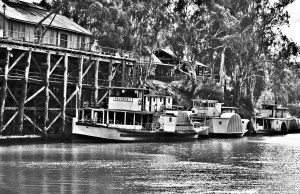
First, I wrote the poem as I walked home to our hermitage at the time in a town called Moama on the Murray River in Australia. Now, the Murray is the biggest river in the country and the then little town of Moama sits across the river from its bigger city sized sibling: Echuca, the biggest inland port in Australia.

Anyway, I’d just crossed the river bridge and the words just started coming to me. Not exactly as you read it here, but close. I am very lucky that I had only a few minutes walk left to get home, otherwise the whole lot could have been lost to memory.
The longer back back story? Well, as the poem suggests, I’d spent a lot of time hitchhiking, in Australia and a few other places too. It’s true what it says in the first lines: I’d done a lot of trudging through a rather large number of towns unknown to me then, and only some of which are better known to me now in much later years.

Okay, that’s enough back story to last a while, so let’s just present the star of the show. I share this, as I do all my efforts, with heart.
Many have been the nights
I’ve trudged (and less often, strode)
past illuminated windows framing.
families sharing sit down meals.
Or huddled worshipfully before
flickering and silent (to my passing by ears)
picture boxes in corners of cosy family rooms.
I am just one more invisible (to most), anonymous
drifter. Just passing through
the empty nighttime streets of one more
anonymous town.
Longing to enter the illumined frame.
Longing to share one of those sit down meals.
Longing to worship at the alter of the flickering picture box.
Longing is loss.
The edge of town roadside summons
this lonesome bodhisattva begging rides.
It’s just one more quiet and cold
semi desert night. A high moon in a clear sky
casts ghostly shadows through Eucalypts:
my only company as the waiting game begins.
Waiting to see headlights coming and going my way.
Waiting to be rescued from this lonely edge of town roadside.
Waiting for another ride, to another anonymous town.
Waiting is wasteful
Better to be here, now, on this
edge of town roadside. A place as good
as any. Illumined by the moon,
the ghostly gums create the frame
in which this bodhisattva rests.
And worships.
Thank you for allowing me to share these words with you. The road, as many of you will know, can be a teacher, a guru. I don’t hitch-hike anymore, but the road is still teaching me. And I am grateful.

Sloth. Its a good word isn’t it? One of those words you don’t have to look up to know what it means. But if you do look it up, you’ll find it has a couple of meanings. One is: laziness, indolence and a reluctance to make an effort.

Is sloth a bad thing? Certainly it gets a bad rap; I mean: lazy? Indolent? Not willing to make an effort? Hardly words of praise. On the other hand we value words like busy, productive, efficient, hard working, and the rest. In our culture, these are definitely words of praise.
Go out and play; Read a book; Go to school; Study hard; Get a good job (whatever that means); How much do you make a year? When are up for promotion? Demands and questions like these are constants in all our lives, and they force us into defining ourselves by what we do whether we are a little kid at school, a teenager trying to sort life out, an adult trying to make our way in the world the best we can.
Yes, it’s true I think: it always seems to be a about defining ourselves by what we do, rather than who we are, or what we stand for. Always we have to be doing something. Ever heard that little identity joke, I’m a human being, not a human doing? I wonder how many of us would feel lost if we shifted from that need to be a doer to another definition of our identity, one less reliant on what we do or on what we’ve done in the past, or will do in the future.
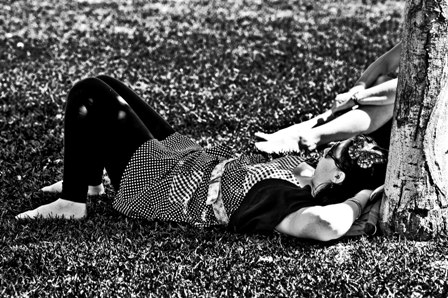
Well, I hear you saying, this is all fine and dandy, but my boss won’t pay me unless I show up, there are meals to cook for the kids, I’m running late for an appointment, the lawn needs mowing and after that I have to write a report for my night class.
All very true, valid, and all of them things that do need to be done. We all have a life don’t we? But perhaps sometimes, even just now and again, and perhaps just for a few minutes at a time, you can stop. Just stop. Thats all. Stop and just do nothing, or rather stop and simply be.
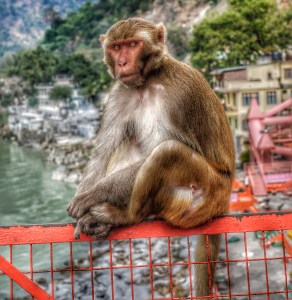
Have I mentioned a favourite little two word sentence I really really like? Just sit. Don’t read, don’t think, don’t try to stop thinking, don’t ‘meditate’. All that’s required is to do nothing. Do No Thing. Actually, I think I’ve found a new favourite.
On, remember I said there are a couple of definitions of sloth? Well the other one tells us that a sloth is a slow moving nocturnal mammal noted for hanging upside down from tree branches. It lives entirely in the trees and is capable of only very slow movement on the ground.
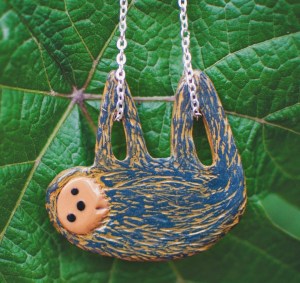
So, I guess you should be very careful when you tell someone else I’m a sloth. Mind you, putting aside the hanging upside down bit, and the nocturnal requirement, it’s probably not such a bad way of being to emulate, do you think?
Have a lazy (slothful) day.
In my last post, I reflected upon a lovely Buddhist mantra, an invocation for peace and happiness for all beings (Lokah Samastah Sukhino). We discovered along the way, that it is no ordinary mantra: it actually amounts to a solemn promise to contribute to the peace and happiness of others (and Self obviously).
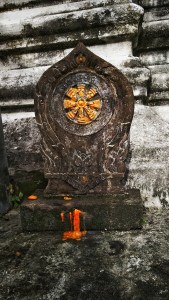
Then we thought about how to actually go about acting on this promise: Be kind. That’s what I came to. That’s all that is required. But, as you will recall, being kind sounds easy but quite often isn’t. The Buddha himself came to our rescue with The Eightfold Path,
At the end of that last post, I declared I would devote this next one to looking at Right Understanding, the first of the principles in The Eightfold Path. I said I would just sit at the keyboard and see what emerges as I thought about what is Right Understanding.
Before we get started, let me make the point that The Eightfold Path is not a kind of ‘to do’ list where you tick off one item and move onto the next. The Path is more about integrating the principles into our lives, letting them overlap when they do and moving forward in one area, while (possibly) moving backwards in another as our lives unfold with all the usual twists and turns.
The Eightfold Path is a life-long (some would say lives-long) process; don’t think in terms of goals to be achieved.
Does this mean we will need to explore all eight principles on the Path? Well, we’ll have to see how this evolves over time. Although as I say it’s not a to-do list, I think it more than possible to at least think about the principles or steps on the Path one at a time.
The second thing to say by way of introduction is this: As I mentioned in my previous post, there are virtually unlimited places on the internet where one can source The Buddha’s Teachings, including many commentaries on The Eightfold Path.
I’ve made no use of any of these sources. I have sought only to put down some of my own ideas and learnings, as well as just letting my heart have its say.
If in that process I’ve made any errors of any kind, forgive me. I merely follow The Buddha’s own instruction: Don’t take my word for it; Ask questions; Do your own analysis; Think for yourself.
Now that’s all out of the way, let’s just describe briefly the Four Noble Truths. This is necessary because the injunction to follow The Eightfold Path, comes in the Fourth of those Noble Truths.
Putting them as succinctly as I can, The Four Noble Truths are as follows: The first truth tells us that life is suffering, the second that the cause of suffering is desire (or we can also say attachment), the third that there is a cure for suffering and the fourth tells us what that cure is.
That’s where The Eightfold Path comes in: it’s what you might call The Buddha’s prescription for the alleviation of suffering. At this point I would like to suggest that if you are not familiar with the Four Noble Truths, please take some time to check out the topic for yourself.
The Eightfold Path does, as I mentioned last time, in fact sound very easy when put it in list form like this:
Remember, though, as I said, it’s not a to-do list we can work through one item at a time. Or perhaps we can put it another way: It is possible to work on one item at a time, but it’s not about getting that one completed before one can move on to the next item on the list.

The first step on this Noble Path we have embarked upon is Right Understanding. Actually it’s not only the first, it is the ongoing one; and it is the final step also on this particular Path of Liberation. And it seems to me that I’m right in this: my life has been one continual search for undetstanding.
Not many people know this, but I spent some time working as a journalist. One of the fundamental principles (aside from telling the truth of course) that I followed was the, Who? What? When? Where? Why? and How? set of questions.
Now, I wouldn’t say that it was necessary to ask every one of these questions in every situation. But, as a general rule, they served as a useful guideline to getting as much information on all relevant aspects of an event, a person, or whatever the subject of a story was. And I have to say that I find myself quite often using this list or some varient of it when I’m trying to understand or figure out something.
Why those questions? Where do they lead? What am I trying to do by asking them? How do they help me? (See what I mean? I can’t help myself) If we sum it up, then we would say that asking the WWWWWandH questions have the potential to lead us closer to understanding.
Let’s say you are unhappy with the work you do on a daily basis. You don’t understand why; After all, it pays okay; the hours aren’t too onerous, the work itself is fairly easy as work goes. What’s the problem then? You just don’t understand. You know there’s something not quite right, but you just can’t put your finger on it.

Who is doing that job? I am, you say. But, really, who are you? Is it you doing the job or just a part of you that you kind of section off from the real you for the working day?

What are you doing that makes you unhappy? Is it being in that workplace? Is it the work itself? It might be ‘okay as far as work goes’, but is it really okay?
When are you at that job? I guess this question is about how many hours, what percentage of your life you spend doing that job. And, even more to the point of the when question: When are you really there? How much of your work day are you actually off somewhere else? (refer to the where question)

Where are you? Are you where you want to be? And, kind of getting back to the Who question, who is it that’s there? Is it the real you? Or is it that sectioned off bit of yourself you access during work hours while the real you is off somewhere else?
Why are you doing that job/work? Well most likely your answer will be something like: I have rent to pay, food to buy, bills to pay, family to support. Well, those answers have to do with what you do with the money you earn from doing that job. The question lingers: Why are doing that job? I mean, the real you; why?

How can you be happier at your work? By now you’ve got the hang of this. If you have answered all the W questions then you will already be getting some clues about the answer to the H question.
Asking variations of this set of W and H questions can help us in many aspects of life where we seek understanding. They don’t have to be put as formal questions, and they don’t have to all be asked in every situation. Also they don’t have to be thought based queries either, if you know what I mean.
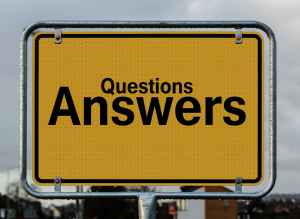
The answers may well come by simply asking the question, and ‘sleeping on it’. By that I mean you don’t have to tirelessly mull over a question. Meditate on it, think about it, of course, but then forget it consciously and let the answer come to you. And, of course you can always literally sleep on it.
There’s a small art gallery in a desert mining down almost in the heart of Australia. On their window they used to have a quote by Claude Monet:

I know we aren’t talking about art here (or maybe we are?), but I think this quote applies to many of us as we try to understand our lives and our place in the world. Especially when it comes to what makes us happy. All of us spend a lot of time, not so much pretending as in going through the motions. That’s because sometimes it’s just too hard to try and understand.
But, keep at it. Ask the questions but don’t worry about the answers: they will emerge when they’re ready. True understanding is close to love, as Monet says.
Peace to you from me
 Notes from the Hermit's Cave