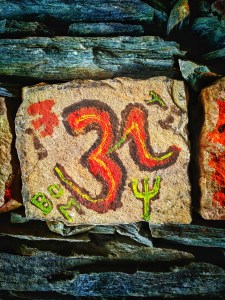
ANSWERING THE CALL LEADS TO MORE QUESTIONS

Greetings and Welcome after what feels like a gap of forever since my last post.

Two weeks today since I moved into a rented house way out here Outback in the mining town of Broken Hill, on the traditional lands of the Wilyakali people whose ongoing presence on this country I acknowledge and give thanks for.

And now, it is the location of my hermitage, my safe haven and refuge. But, no, therein lies the conundrum: I love it here; I know I’ve come to the right place to which I’ve been called. But after two weeks, I’m still not feeling grounded; I’m not really here yet.

Culture shock, fatigue, new environment, excitement; call it what you will; something has me not yet settled and in place. Yesterday a small poem came to me that I think expresses exactly the problem.

And now I’m sharing it with you as a way of explaining why the gap, why the block.

Peace and love from me to you.


The call to the desert
has been answered.
And now, I am here.
No, to tell the truth, I’m not actually. Here I mean.
So, where am I?

Not there, back there
where I came from.
Not even sure if ‘there’ really exists,
if you know what I mean.

Mind you, when I said ‘here now”
I meant it’s been a short now:
Now that I’m here. Just.
A short stretch – so far.

Here; there; now; so far;
it’s all too much.
And you know what?
It’s all in my head.
In my mind I mean.
                                             

A wise teacher once taught:
First thought, best thought.
But for here and now?
As in being here now?
No thought, more like,
is best thought.

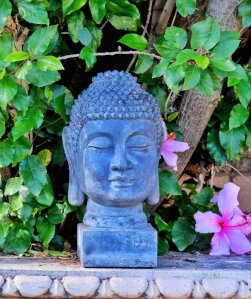
Lord Buddha graces the hermitage front garden

The Desert Called, and I Answered

Eventually.

Greetings friends. I welcome you from my new hermitage in desert country.

You know, it’s an old idea, a cliché even, to say that we, all of us, are on a pilgrimage called life, a Hero’s Journey as it’s called by the Mythologists. And, on any such journey there is what those same scholars call a Call to Adventure.

They are the times when we are challenged by life to commit to an action that will stretch us somehow, take us out of our comfort zone, change our life; to make a move; take a risk; embark on a journey either internally or out in the physical world.

So, when I tell you I got a call to come out here to the desert, and that I answered it, why the necessity to add ‘eventually’? What happened to delay that journey? Well, that’s what our Mythologist friends call The Refusal of the Call.

They’re the times when, once we’ve heard the call, and when we’ve felt its rightness, we still say no. Not now. And we come up with all kinds of perfectly reasonable explanations for our refusal.

In my case, I said, hey, it’s fine here; I’m near the beach; I really have no reason to move; there are plenty of ‘other places’ to check out first. The excuses went on and on.

All along though, there was this place, this country, calling. Of course ‘the desert’ isn’t always or for everybody the literal sand covered land, that gets very hot, and is generally thought of as barren and even hostile. It can also be a metaphor for any place – or no place in particular – that is a place of retreat, a quiet place, a place for living apart from the mainstream of human life.

For some people inclined to a life of contemplation and solitude, this place might be a small hut in a forest or a wood, or a camp on a remote beach on an even more remote island. Then there are others who are called to an actual cave high in the mountains, or on the banks of some sacred river somewhere.

And, equally, the desert, the place of retreat, quiet, solitude, and living apart, may well be an apartment or house in a suburb, or even in the centre, of a big city.

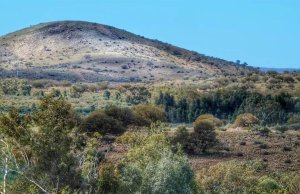
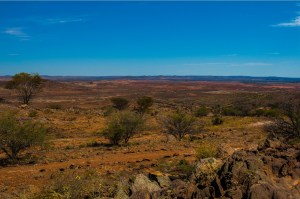
Then there’s me: called to this desert town of Broken Hill, almost but not quite in the centre of the continent of Australia. It is deep in the arid zone: it’s very far out back here in the Outback, 1500 kilometres inland from the east coast to be precise.

Yes, well this is all well and good, but shouldn’t I be answering my own question: why eventually? Well, we’ve covered the excuses, but really isn’t that just plain old procrastination? Yes indeed. If we get back to our Mythologist friends once more, we learn there is a stage in this Hero’s Journey that follows on from the Refusal: The Supernatural Act.

These are the times when things happen that seem to come at us out of the blue, from no rational, logical, or explainable source. Something that we might find hard to beleive at first because it’s way out there; supernatural like it says.

But that supernatural bit doesn’t have to take a spooky form, it might be that the ‘supernatural act’ is an internal insight or realisation triggered by a perfectly natural occurance. That’s what happened for me. What was this non-spooky, natural event that prompted such internal insights and realisations in me and got me moving?

Rain. Yes, rain. It rained almost every day for over six months. I am very very blessed that I wasn’t affected by flooding as so many in nearby area were, and I am thankful for that. But it’s safe to say that rain, mud, no sun, and limited or no access to the outside for days or weeks at a time, soured my romance with the coastal lifestyle.

You could say that through the sound of rain on the roof, I could still hear the call of the desert. In fact it got so loud that, eventually, I could no longer ignore it.

So, eventually, I answered the call, and here I am. Here is a small miner’s cottage and my new hermitage, my new safe haven by the side of the road. The cottage is situated in a mining town that sprung up in the 1880s. So this cottage has been home to miners and their families for generations, including the current owners.

In a sense it’s quite likely that I am the first occupant who hasn’t been or isn’t a miner. Though you might say that my excavations, rather than being in the dark underworld beneath the surface of Mother Earth, are taking place in the equally dark, hidden interior places of Self. A mining of another sort you might say.

Before flying out here, I was thinking about what was actually calling me to the desert (putting aside the rain for a moment). After all, I lived in a small cabin in a park like setting literally five minutes walk to a pristine Pacific Coast beach; I had trees and forest like spaces all round, as well as a small river two minutes walk. And that’s not even thinking about the abundance of wildlife.

And it occured to me that it is the stillness of the desert that was calling to me. This town of Broken Hill is a mid size town (actually a small city with about 15000 people), with the usual shops, cars, people, and the rest.

Yet there is a stillness. No longer can I hear the constant sound of seawaves crashing. No longer can I sense the never stopping coming in and going out of sea tides. And out here, it seems like even the people are moving quite a bit slower too. I’ve yet to see a single person rushing about. And they seem to smile a lot as well.

The street I live on is extremely quiet, and even on the so-called ‘busy streets’ there isn’t the mad acceleration and braking we’d see everywhere on the coast. Of course there is the odd driver who thinks every car is a racecar, but where don’t you get that?

But, actually it’s more than this. There is, beyond the actual literal quietness, a silence that seems to exist as an entity or state of being in its own right.

A stillness that is a solid thing, just as on the coast there was (is I suppose) a constant frenetic atmosphere that seemed to overlay everything. People rushing – on foot or in cars – even when there seems to be no reason for hurry (though of course you can never tell can you?). And not so many smiles either.

Contemplative people, those seeking solitude, and peace and quiet in which to pray, to live slowily, and to explore the divine, have been drawn or called to deserts (in all its forms) for thousands of years or longer. And I am fortunate enough to have finally (eventually) heeded the call myself.

Here, away from the incessant acceleration and braking (I do like this expresion), and in that stillness that envelops this land, perhaps I can dig a little deeper, uncover a bit of quiet, and discover a piece of solitude.

Out here, in the Outback, life can be harsh for all living beings, often dangerous in its aridity and isolation. It’s a long way from major cities, food and supply chains are extended to extreme limits, and the human hold on the land is precarious at best.

Yet, the paradox exists: out here far from the fertile coasts, the soft sandy beaches, the major urban centres where the mainstream of (human) life goes on, there is a quiet, a peace, a stillness that seems to pervade the very air one breathes.

A wise person wrote something short and sweet that sums all this up for me:

There is a stillness in the wildness.

I Live On a Big Round Ball

Namaste friends

Recently I came across some notes I’d made about a book I read ages ago, at least a year I think. Anyway, the name of the book: The Art of Mindful Walking. Sorry, but no prizes for guessing what it’s about.

Reading my notes I see that I had been particularly taken with what the author had to say about ‘our place in the Universe’. He reflects on our – humanity’s that is – perception of our size in the big scheme of things.

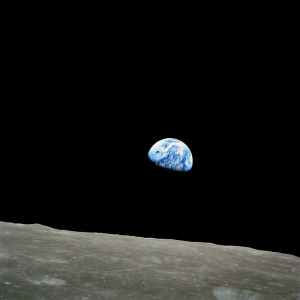
The author recounts how we once went for a walk with American astronaut Dave Scott, who’d been to the moon on one of the Apollo missions. Scott described to him what it felt like looking back at Earth from the surface of the moon:

It hangs in the black sky like a glass bauble, a blue and white Christmas decoration. It’s a small, fragile world.

Ford then goes on to reflect that this image, of a small, fragile ball floating in space, has ‘become a part of the modern psyche’. Then he says:

We begin to see how vulnerable we actually are. We are the first generation truly to see this. We are also the generation that is coming closest to polluting and destroying it.

I don’t think I’d quite looked at it in this way before. And I admit, it stunned me a bit.

Just think: Of all the humans who have ever lived, those alive in the last 50 or 60 years have been the first to see our home planet in its entirety. At least we’ve had the good fortune of seeing images of Earth just as those astronauts saw it. Thanks to those images made from space, we now have had a glimpse of where we actually live and the nature of our world.

Yet, at precisely this point in our history as a species, when we have that particular knowledge, this is the time we seem to be almost wilfully destroying the very ground we walk upon, the air that keeps us living, and the water without which there is no life.

I’m not a warrior. I am a hermit and a pilgrim and I try hard to not make judgements. As such, I can only look on in wonder.

And I can pray.

Thanks to Jimmy Buffett for the title. It’s a line from one of his greatest songs, called Defying Gravity. Thanks Jimmy for all the music man.

I’ll Try Not to Pass Them By

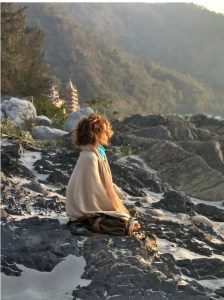
So, anyway, here I am. Just sitting. It’s what I do, when I can, when I’m able. Well, to be completely accurate, here I am sitting and typing. Writing yes.

But every day, I sit. I try to sit. On a comfortable chair or bed. Here is where I commune with the Divine. It’s where I say my prayers, empty my mind, try to be silent, sometimes read holy books.

Whatever I do when I am just sitting, the sitting bit isn’t always easy; it requires effort and patience. Just being still can be hard; everyone knows that. But it’s part of the practice, part of the sadhana, the way to liberation. All that.

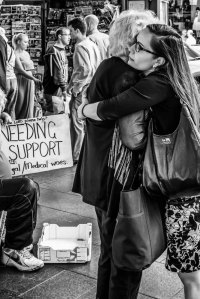
Of course I’m not the only one you might find just sitting. Why, just today on my way home from buying fruit I saw some other people sitting. One had his eyes fixed, completely transfixed on his phone’s flickering screen; head bowed, the world around him shut out.

The other sat, head bent forward, arms crossed; I couldn’t see her eyes. Perhaps she was sleeping, perhaps feigning sleep, perhaps trying for sleep. Whatever, resting it looked like.

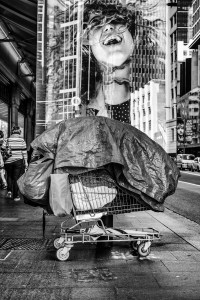
These two were a lot like me I thought: just sitting, being quiet, resting even. Mind you, they were younger than me. Though of course what’s age got to do with it? I carried shopping bags; they sat beside a very full shopping trolley.

But, wait, my bags held fresh fruits to top up our supply. Their trolley overflowed with, what shall we call them? All their worldly goods? Personal effects? All they own?

And another difference? I’m going home with my bags. They have no home to house those effects; no soft bed to rest upon or commune at leisure with the divine.

Whereas I sit under a roof, in a room, on a soft bed, they sit in a bus shelter. Sure, there’s a roof but it offers scant protection from the approaching storm, and none at all from the incessant wind that will soon be full of rain blowing.

It’s no use asking why am I in a comfortable house, and they are in a bus shelter, just as I was and they were, the last time I saw them. There’s nothing for me to say that will mean anything to them, to anyone else, or even to myself.

I suppose I or you or someone else might remind me (remind all of us) that the world can be hard, is hard: bad things happen to all of us. Of course that’s true. I actually truly believe that the world by its very being in existence is hard. What did The Buddha say? Life is suffering?

But, as they say, that just doesn’t cut it, does it? All just words don’t you think? It’s what I think today anyhow. Oh yes, I’ve been praying since I passed them by (and I did pass them by with no words, no smile or greeting, my face turned away. I am ashamed).

I thought of them as angels there to remind me of my own advantages and privilege. Even those very thoughts themselves prove my own failing to understand, to actually get it.

But, yes: all just words. Meaning very little. I suppose after all that perhaps all I can do is pray.

For all of us.

Peace

Not as if I don’t bloody live here is it?
Yeah. I know, I know. Its a bloody bus stop.
But, geez, a fella’s gotta live
somewhere. Don’t he?

An Aspiration. A Prayer

Hello friends and welcome

The last couple of posts have had me thinking about what I actually do to contribute to the world, to life, to making changes that could bring peace, a safe environment, and a better life for all.

I have to say my commitment to my life as a hermit, as a pilgrim aspiring to live a life apart from ‘the world’ all the while dedicating myself to what we might call Self or God Realisation, has been strengthened.

I have once again come to the conclusion that living a life focused on spiritual development, on art, on prayer, and on contemplation, is the most valuable way I personally can contribute to change, to love, to the good of all. My true nature, my inclinations, my faith, my life experience, all these equip me for this life that has chosen me.

And at the same time, these same factors have left me ill-equipped for life ‘in the world’

In those last two posts, I talked about how so few of us think we have anything to offer a world teetering on the edge. But of course, as I pointed out, the opposite is true. I think I made the point that there is some unique role for each and every one of us in the continued unfolding, upliftment, protection and prospering of all life in this world.

Having said all that, I have to say that for me it’s not always easy to actually realise this in my heart. Intellectually it’s an easy concept to explain (well sort of anyway), but on that deeper heart level, well it’s tricky. Guilt rears its ugly head: ‘It’s all falling apart; I have to do more; But what can I do? It’s useless. I’m useless’.

As I mentioned in one of those posts I think, people have turned away from the horror, injustice, cruelty, and murderous greed and lust for power, for as long as these things have existed – which is obviously for as long as our species has been around. At certain times in history this move away from ‘the world’ has accelerated and intensified. And we are living in one of those periods now.

In the last century so many people have taken up the contemplative life, and many have chosen to make that life one of complete or partial solitude in order that they may be free from distraction in their prayer, study, and contemplative life.

But, many will say, ‘You are in denial. Now is the time you are needed out there. The world and all of life is in danger. You can’t escape and hide in a cave’.(read here stop watching the news, ignore politics, stop spending, become a literal or metaphorical hermit, go traveling, shirk your responsibility to the rest of the world).

Again guilt trips us up and we just keep on trying to find ways to at least rid ourselves of the guilt over our perception that we can do nothing.

But many such people, and that includes me, rather than being in denial, rather than shirking responsibility, have looked at the material world with its horrors, and said, ‘This isn’t right’, and have started to look at other ways to live and, seeing that continuing to struggle against the weight of the world on the world’s terms is pointless, seek to find other ways they can contribute to change. Ways that don’t perpetuate the playing of the game.

And rather than escaping these people (including me, I say with humility) face the world head on, dedicating their lives to the world through creativity, through prayer and meditation, and through the expression of freedom in their choice of lifestyle. They are, as Mahatma Gandhi is supposed to have said, being the change they want to see in the world.

While Gandhiji didn’t actually say those words, (Actually there’s a post coming in a couple of weeks in which I share the full text this quote is apparently derived from. Stay tuned for the link here), he certainly lived his life being the change he wanted to see.

But sadly, this ‘quote’ has come to be seen as a kind of feel good cliché, something the privileged are accused of mouthing while not actually even thinking about changing their lives. Just one more platitude you might say.

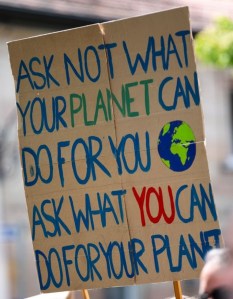
But for many, like me in my own way, it is much more: it is a call to action, a respectful and heartfelt request that I embark upon the quest for a more authentic way of living that has love, compassion, service, and truth at the centre of all I do.

This is my aspiration. This is my prayer.

Peace from me to you

Put Me in My Place. Please

Reverence the place and learn from what you see


Coming across this note last night, I was stumped. I coudln’t think where it had come from, where I’d seen it; nothing at all came to mind. And an online search just now failed to turn up anything either. I mean I must have read it somewhere. Or is it possible it came from me?

Of course it’s all the same: there is only one source. At any rate, it’s an injunction one can relate to anywhere, any place. It’s surely about presence?

And about learning from all that is to be seen (heard, felt, intuited, known) in whatever place one is in now. I mean, the place I’m in now. I am here and it is now.

I’m reminded of the faith affirmation (is it a prayer?) that seems to have been written for this particular hermit pilgrim:

As a a hermit, I am a pilgrim dependent on a pure faith that I am exactly where God wold have me be now.

Sometimes I think that too much thinking about and angst over places other than the one I’m actually in right now, is a sure and certain way to resist and reject any reverencing of the place I’m in, not to mention what’s to be learned or gifted from the experience of being here.

And of course that angst, worry, wishful thinking, or whatever, comes with its own issues of distraction, and of a taking away of one’s Self from the present, the notion that here and now is the only time and place that exists.

A poem of mine I came across the other day while looking for something else says it all quite nicely. This poem is called Transcendental Injunctions, and it’s a rap on presence, about being here, and being now.

The central action describes how my senses can take me away from that here and now: I describe my habit of smelling my Bhagavad Gita (yes, as in putting my nose into the pages of the little book and inhaling the aroma of those pages) and how that takes me back to the shores of the River Ganges; another place, another time.

Anyway, allow me to share the final verse, which speaks of one such occasion:

Then, there is a voice:
I hear it with the ear of my heart:
There is no place to go.
What you seek is within.
There’s nothing to find:
God’s kingdom is within.

I suppose there is nothing left to say. I am here, and it is now

Peace to you from me

Van Gogh: Mystic & Saint?

A few weeks ago I finished one of the most extraordinary books I have ever read. Yes, I know: we live in the days of hype and the redundant superlative. Everything is the best, biggest, greatest. Or, conversely, the worst, most tragic, saddest; it goes on and on.

In this case however I am not exaggerating. This book was amazing. It’s Learning from Henry Nouwen and Vincent Van Gogh: A portrait of a compassionate Life, by Carol A. Berry. From this book I’ve learned as much and more about Van Gogh’s motivations, his vision, his art, and yes, his very nature and soul, than in everything I’ve read, seen or heard about Vincent until now put together. And that includes from several visits to the magnificent Van Gogh museum in Amsterdam.

The book had its genesis in a course the author sat in on in the 1970s put on by Henry Nouwen for Theology students. The course aimed at helping future ministers and pastors learn to connect with their future parishioners. Basically it was about accessing the compassionate sides of their own natures so they might better help others. Nouwen used Van Gogh as a the model of a person who had lived a life built on compassion for others.

The author has mined Vincent’s letters (mostly to his brother Theo) and studied deeply his paintings and drawings, in order to understand and demonstrate what it means to live a life of compassion, and to highlight the artist’s mission in life. For me that mission is summed up very nicely in a quote from one of Van Gogh’s letters:

Art is to console those who are broken by life.

Vincent Van Gogh to his brother Theo

I had a vague sense of Vincent’s spiritual leanings (I knew he’d been a missionary living among poor miners and their families to better understand and help them), and he’d tried to become a preacher. But, before finding this book my thinking hadn’t gone much deeper than that.

But, through reading this book I discovered Vincent was really what many of us might call a mystic. The author goes further and after what i’ve learned, I tend to agree with her: she thinks Van Gogh is a saint.

A mystic in the sense that he tried to live a holy and compassionate life. He viewed all nature (of which he concluded humans are simply one equal part) as being expressions of the divine. And a saint in that he dedicated his life to making art that would inject light and colour into the darkness of people’s lives.

As I mentioned, Vincent had been a missionary for a time. But his radical way of living among the poor and sharing their lives in order to know and love them better was shocking and way too extreme for his bosses, and he had to move on.

So, he finally settled on full-on immersion in his art. His mission was to make paintings that offered comfort and consolation to those who are suffering. And that’s all of us to one degree or another isn’t it?

You can see by now that this supremely accessible (and pleasurable to read) work has had a profound impact on me. This book isn’t only for artists, nor is it a religious book; it is as I have said an inspiration and guide to living a compassionate and loving life.

I don’t want to just say ‘I can’t recommend highly enough that you read this book’; I want to say instead Please, please read this book. Then obviously act on what you have read!

I’ve always admired – loved – Vincent, now I think I know why. Or as Don McLean says in one of the most profound love songs (Vincent) in history (remember, I never exaggerate):

Now, I understand, what you tried to say to me
How you suffered for your sanity
How you tried to set them free
They would not listen, they did not know how
Perhaps they’ll listen now

Perhaps.

Love and Peace from me to you