So, anyway, here I am. Just sitting. It’s what I do, when I can, when I’m able. Well, to be completely accurate, here I am sitting and typing. Writing yes.
But every day, I sit. I try to sit. On a comfortable chair or bed. Here is where I commune with the Divine. It’s where I say my prayers, empty my mind, try to be silent, sometimes read holy books.
Whatever I do when I am just sitting, the sitting bit isn’t always easy; it requires effort and patience. Just being still can be hard; everyone knows that. But it’s part of the practice, part of the sadhana, the way to liberation. All that.
Of course I’m not the only one you might find just sitting. Why, just today on my way home from buying fruit I saw some other people sitting. One had his eyes fixed, completely transfixed on his phone’s flickering screen; head bowed, the world around him shut out.
The other sat, head bent forward, arms crossed; I couldn’t see her eyes. Perhaps she was sleeping, perhaps feigning sleep, perhaps trying for sleep. Whatever, resting it looked like.
These two were a lot like me I thought: just sitting, being quiet, resting even. Mind you, they were younger than me. Though of course what’s age got to do with it? I carried shopping bags; they sat beside a very full shopping trolley.
But, wait, my bags held fresh fruits to top up our supply. Their trolley overflowed with, what shall we call them? All their worldly goods? Personal effects? All they own?
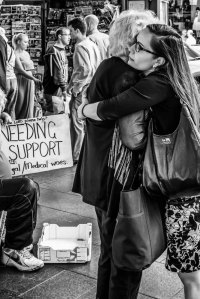
And another difference? I’m going home with my bags. They have no home to house those effects; no soft bed to rest upon or commune at leisure with the divine.
Whereas I sit under a roof, in a room, on a soft bed, they sit in a bus shelter. Sure, there’s a roof but it offers scant protection from the approaching storm, and none at all from the incessant wind that will soon be full of rain blowing.
It’s no use asking why am I in a comfortable house, and they are in a bus shelter, just as I was and they were, the last time I saw them. There’s nothing for me to say that will mean anything to them, to anyone else, or even to myself.
I suppose I or you or someone else might remind me (remind all of us) that the world can be hard, is hard: bad things happen to all of us. Of course that’s true. I actually truly believe that the world by its very being in existence is hard. What did The Buddha say? Life is suffering?
But, as they say, that just doesn’t cut it, does it? All just words don’t you think? It’s what I think today anyhow. Oh yes, I’ve been praying since I passed them by (and I did pass them by with no words, no smile or greeting, my face turned away. I am ashamed).
I thought of them as angels there to remind me of my own advantages and privilege. Even those very thoughts themselves prove my own failing to understand, to actually get it.
But, yes: all just words. Meaning very little. I suppose after all that perhaps all I can do is pray.
For all of us.
Peace
Not as if I don’t bloody live here is it? Yeah. I know, I know. Its a bloody bus stop. But, geez, a fella’s gotta live somewhere. Don’t he?
The last couple of posts have had me thinking about what I actually do to contribute to the world, to life, to making changes that could bring peace, a safe environment, and a better life for all.
I have to say my commitment to my life as a hermit, as a pilgrim aspiring to live a life apart from ‘the world’ all the while dedicating myself to what we might call Self or God Realisation, has been strengthened.
I have once again come to the conclusion that living a life focused on spiritual development, on art, on prayer, and on contemplation, is the most valuable way I personally can contribute to change, to love, to the good of all. My true nature, my inclinations, my faith, my life experience, all these equip me for this life that has chosen me.
And at the same time, these same factors have left me ill-equipped for life ‘in the world’
In those last two posts, I talked about how so few of us think we have anything to offer a world teetering on the edge. But of course, as I pointed out, the opposite is true. I think I made the point that there is some unique role for each and every one of us in the continued unfolding, upliftment, protection and prospering of all life in this world.
Having said all that, I have to say that for me it’s not always easy to actually realise this in my heart. Intellectually it’s an easy concept to explain (well sort of anyway), but on that deeper heart level, well it’s tricky. Guilt rears its ugly head: ‘It’s all falling apart; I have to do more; But what can I do? It’s useless. I’m useless’.
As I mentioned in one of those posts I think, people have turned away from the horror, injustice, cruelty, and murderous greed and lust for power, for as long as these things have existed – which is obviously for as long as our species has been around. At certain times in history this move away from ‘the world’ has accelerated and intensified. And we are living in one of those periods now.
In the last century so many people have taken up the contemplative life, and many have chosen to make that life one of complete or partial solitude in order that they may be free from distraction in their prayer, study, and contemplative life.
But, many will say, ‘You are in denial. Now is the time you are needed out there. The world and all of life is in danger. You can’t escape and hide in a cave’.(read here stop watching the news, ignore politics, stop spending, become a literal or metaphorical hermit, go traveling, shirk your responsibility to the rest of the world).
Again guilt trips us up and we just keep on trying to find ways to at least rid ourselves of the guilt over our perception that we can do nothing.
But many such people, and that includes me, rather than being in denial, rather than shirking responsibility, have looked at the material world with its horrors, and said, ‘This isn’t right’, and have started to look at other ways to live and, seeing that continuing to struggle against the weight of the world on the world’s terms is pointless, seek to find other ways they can contribute to change. Ways that don’t perpetuate the playing of the game.
And rather than escaping these people (including me, I say with humility) face the world head on, dedicating their lives to the world through creativity, through prayer and meditation, and through the expression of freedom in their choice of lifestyle. They are, as Mahatma Gandhi is supposed to have said, being the change they want to see in the world.
While Gandhiji didn’t actually say those words, (Actually there’s a post coming in a couple of weeks in which I share the full text this quote is apparently derived from. Stay tuned for the link here), he certainly lived his life being the change he wanted to see.
But sadly, this ‘quote’ has come to be seen as a kind of feel good cliché, something the privileged are accused of mouthing while not actually even thinking about changing their lives. Just one more platitude you might say.
But for many, like me in my own way, it is much more: it is a call to action, a respectful and heartfelt request that I embark upon the quest for a more authentic way of living that has love, compassion, service, and truth at the centre of all I do.
Welcome to another post. Just a little note before we get into it: This one picks up where the last one left off. Kind of. No need to read that one first, unless you want to.
And that’s the whole thing in one sentence, or at least in part of a sentence: unless you want to: none of it is any of my business. What do I mean when I say ‘none of it’? Just that. None of it. Or we can say it in another way: the only thing that is your business is you.
But, all of us are bound to ask, how can I simply mind my own business in a world torn by endless war? How can I ignore the environment I live in and that it’s dying before my eyes? How can I turn away from the evils of racism, injustice, greed, and cruelty?
Well, the simple answer is we can’t and we shouldn’t. Of course, in order to reconcile this apparent contradiction, it would be helpful to clarify exactly what we mean by minding our own business.
In essence my business (or yours or anyone’s) is anything that has to do with me: what I do; how I behave; what I think, feel, and believe; my behaviour and attitudes towards others; and—and this is the key—how I interact with and respond to the world as I experience it as I go about living my life.
So, it isn’t completely accurate to say that the wars, racism, injustice, and the killing of the environment (and everything else) is none of my business; my business is limited to my interaction with and response to all of it. And that has to be determined by a range of factors like my nature, my abilities, my circumstances, and so on.
Above all, and as Susan Sontag, American writer, philosopher, and political activist, said in a speech in 2004:
To be a moral human being is to pay, be obliged to pay, certain kinds of attention.
While the theme of that speech had to do with the writer’s responsibility to truth, I think her assertion applies here and may provide a solution to the seeming contradiction between minding our own business while at the same time stating that our business can, should, and does indeed include what goes on outside of ourselves (actually as we shall see, in reality there is no outside or inside)
How we utilise our own personal resources is in the end for each of us to decide. In the sense of our engagement with the world, the most precious of these resources are arguably time and attention.
Each of us possesses these things in our own unique quantities, just as we all have our own unique qualities, so each of us has the opportunity to decide how we use our time, and what we pay attention to.
It is so very easy to be overwhelmed by the constant torrent of information detailing the horrors threatening to consume and destroy our poor Earth and the life she supports. It is so very tempting to throw up our hands in defeat, and shrug our shoulders as we turn away exclaiming ‘It’s none of my business’.
While none of us would blame anyone for retreating in this way, a great many of us realise that for us this is not an option. Well, as the Buddha taught, there is a middle way. A way that allows us to avoid this kind of ‘none of my business’ denial, at the same time as protecting us from being overwhelmed and beaten down by the scale of it all.
The first step involves surrender. Surrender to the idea that there is no ‘me’; there is no ‘you’. There is no ‘them’, no ‘us’. There is only ‘I’. Surrender to the notion that not only is all life ‘connected’ or linked, but to the thought that all life—human, other animals, plant, mineral — everything — is one. There is no separation.
Easy eh? Hardly. But this is where the paying attention thing comes in. Rather than being swamped by the never-ending tsunami, choose where to put your attention. Ask yourself, where am I able to place my attention? How can I—how am I able to—use my time so that I avoid drowning yet still contribute to the well-being of the whole of which I am a part?
Obviously, as I hinted at above, the answers will be different for each and every one of us. For some, the kind of attention they pay will involve being on the literal front lines, working in the political field, or with activist groups working for social justice.
Then there will be those whose nature compels them to choose to put their attention on a life of prayer, meditation, and contemplation.
For these people this requires the quiet and solitude of monastery, ashram, or cave (whether it be in forest, mountain, or suburban home). And along the huge spectrum in between, there is a a unique spot for every one of us.
Each of us is a part of the whole. Everything we do affects the whole. Remember that saying that goes something like: A butterfly flutters it’s wings in the forest and the sun rises? Okay, maybe I’m pushing it a bit, but you know what I mean.
Never underestimate what (you perceive of as the little) you’re able to do; no one can say what impact it will have. All that is required of you is that you mind your own business.
Not so long ago I readThe Glass Bead Game by Herman Hesse. And I have to say it’s what I like to call a ‘real book’: written beautifully with an interesting and deeply engrossing story, full of detail, symbolism, thought-provoking ideas, and at the end of the day just plain and simply a delight to spend time with.
I won’t go into what the book is about here, but for the sake of this post, I will just tell you that it is about a mythical European province populated by an elite group of scholars of all sorts who have as their main cultural, social, and even political focus, the game of the book’s title.
Anyway, what I want to talk about here today is something said by the book’s main character, who in the course of the story becomes the master of the game and therefore a hugely influential figure.
This character is having a conversation with a friend. And he’s talking about the way this elite group conducts itself in the world. How it helps shape the country and history. He says to his friend:
We do not intend to flee from the vita activa (the active life) to the vita contemplativa (the contemplative life), nor vice versa, but to keep moving forward while alternating between the two, being at home in both, partaking of both.
Now, what struck me about this quote is that only a couple of days before I’d read a verse in the Bhagavad Gita that I felt said almost exactly the same thing. Krishna says to the warrior Arjuna:
Contemplative life and Karma Yoga are one and the same and takes one to the same destination. One who perceives this sees things as they are.
Bhagavad Gita Ch 5 Verse 5
Karma Yoga is usually defined as taking action without desiring reward for oneself or being attached to the fruits of the action. It is very much the taking of selfless action that is for the benefit or others. However, because as living beings in the world, we are always taking action and actually can’t not be acting, Karma Yoga is also described as being simply the yoga of action.
The Contemplative Life is most often ascribed to monks and nuns, and others living a life of deep thought, study, meditation and prayer. But any of us can lead a contemplative life because such a life is about being mindful, it’s about considering the consequences of our actions.
Such a life is lived slowly and thoughtfully and would be called ‘spiritual’ by some people. We could also call it an examined life. It is about cultivating an inner life, a life of mindfulness in all aspects of our lives.
And living in a contemplative manner helps create more peaceful communities; people living in this way project a calm that can have profound impacts on others. Such people help to set up what some us like to think of as good vibrations
Of course it’s one thing to talk about the Contemplative Life versus the active life in a novel and in an ancient book of scripture. It’s a whole other thing to be trying to figure out what sort of life we should be living in the world here and now, with the urgency of climate change, wars, despotic leaders, increasing poverty and the rest. Or is it?
Is it better for us to take action by protesting, joining activist groups, writing letters? Or is better that we live apart in some way, spending time contemplating, meditating, ‘praying’?
To me it seems there’s a real struggle going on right now between these two points of view. There are those who will tell us that it is too late for ‘thoughts and prayers’, and then there are those who say, we can’t achieve world peace (in its many facets), until we have attained inner peace on an individual level, and that the only way to reach that state is to meditate, live a contemplative life, and slow down.
Obviously, and you already knew I was going to say this, the two are not mutually exclusive; both approaches are required and serve their own purposes. There is no dilemma; there is no conflict. And above all, neither approach is superior to the other.
Many of us are suited to an active life; some of us less so. Some of us are suited to silence and to quiet reflection and study, some of us aren’t. And oftentimes if we try to act contrary to our true natures, then we have great difficulty in achieving anything. And we don’t help anyone when that happens.
Karma Yoga or the Contemplative life. An active life or a life of silence and contemplation. Only you are able to know which is for you. Of course there’s always a crossover to some degree or other. Being fully active and engaged in the world, doesn’t stop one from spending time in a contemplation, and perusing one’s life mindfully.
Equally, leading a totally or partially contemplative life doesn’t mean you aren’t taking action in the world. Obviously you are. For me, the contemplative life is a way to find some personal peace, to create those good vibrations I mentioned, and it allows me to connect with others of like mind, who are working for the highest good. Those living in the invisible community I think I’ve mentioned some other time.
Balance. The key is to find the balance that expresses you and your nature best. So, take some action right now and begin contemplating!
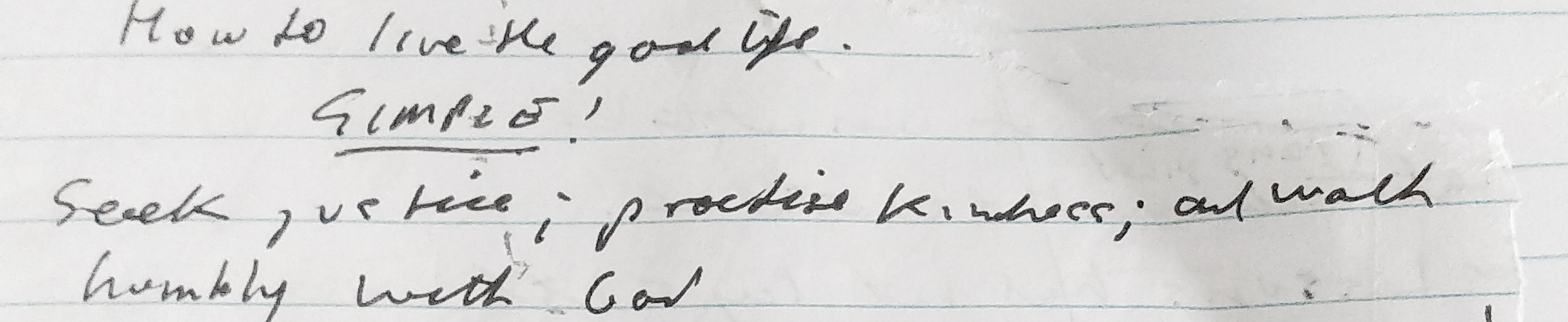
This morning I was just sitting, or at least trying to just sit. You know, being quiet, relaxing the mind. All that kind of thing. And of course, an idea sprung into that not so cooperative mind, so I grabbed my notebook. Just as I went to put this latest brainwave on paper I noticed a very extraordinary note I must have made I don’t know when:
I’ve just looked it up: It’s a slight paraphrase of a verse from the Old Testament, from the prophet Micah. Where I read it, I can’t say (the note is at least several weeks old). But to quote another little note from some unknown source, I always like to:
Let the noble thoughts come to me from all corners of the universe.
unknown
I’m just like everyone else, always wanting the easy solutions and you can tell that can’t you? ‘How to live the good life? Simple!’. I mean really; hardly humble in my approach in that note was I? Well, let’s talk about what Micah says, not my own lack of humility.
Seek justice; practise kindness; and walk humbly with [your] God.
There are numerous versions online of this verse (Micah, 6:8), so I will leave it to you to check those out for yourself. I’ve added the word your because all those versions do say ‘your God’. But even in this paraphrase it’s easy to see there is nothing at all simple about any of these injunctions.
I discovered that this verse is often invoked in times of grave injustice, or crisis. I think it goes without saying that we would be hard pressed to think of a time that was not a time of grave injustice or crisis. Certainly, we are living in one of those times of injustice and crisis.
There’s no need to or purpose served by getting into how ‘grave’ injustice is now compared to some other time; there’s no need or point to weighing up the relative severity of one crisis versus another. Injustice is injustice; a crisis is a crisis.
In other words, the present is always the time to heed the injunctions of this verse.
So, what do we do if we are to seek justice? Running the risk of sounding flippant, I would say that there are as many answers to this question as there are people to answer it. Now, you would think this would make the task impossible; too many cooks and all that. But actually it’s perfect. Why? Because it means that whoever you are, whatever your situation, you can actively seek justice.
Or, I am sorry: I should say I, me. Not you. I can actively seek justice. But, you say, you are a hermit; you live in a cave (not literally but I know what you mean); you hardly ever even talk to people in ‘real life’. Yes, all true. And I would say that the action I take is by no means at the level I know I want it to be. I’m doing nowhere enough.
Does that mean I’m leaving the cave? Going out into the world, onto the streets to join other brave souls seeking justice? Believe me, I ask myself such questions constantly. But to speak truth to you now, I will say that I know absolutely, in my heart, that my role is something different.
If anything, I need to go deeper into the cave; I need to go deeper into the inner world of my own Self. I know that in this way I will join with so many others in what I’ve come to call the Invisible Community of people all over the world living lives of contemplation and prayer. Or, speaking for me personally, trying to live a life of contemplation and prayer.
By so doing I am at least in a tiny way supporting those millions of others out there on the streets, in the aid groups, running campaigns, writing letters, helping the victims of injustice, in all kinds of miraculous, brave, and innovative ways.
So that’s my commitment to you. To deepen my prayer; to intensify my contemplation; to more fully realise my union with all living beings; and to really join with the invisible community in its efforts.
And, you ask, this blog? What’s it about then? Well, notes, musings, thoughts and reflections all aimed at reminding me of my responsibilities. And hopefully along the way, solidifying my union with you and the rest of creation, just a bit.
Peace and love
PS I haven’t forgotten ‘practise kindness’ or ‘walk humbly with your God’. Maybe another time.
I don’t remember when I began to collect quotes; my early teens I think. I just started making notes of quotes from books (even comics in those far off younger days), from conversations overheard. Then, later, little excerpts from my own journals and other writings. Even slogans I’d see on t-shirts, billboards, or wherever else.
This doesn’t mean much in these times when you can type in a search for quotes on any subject, for any occasion, by anyone from anytime in history. But, in those long ago days before computers were in our hands, and certainly way before the Internet, it wasn’t so quick and easy.
Anyway, fast forward to the not so distant past;One day I sat at the computer (it was time for computers, thank goodness) and typed up all those collected quotes stored in several boxes full of little notebooks and scraps of paper.
The result is literally hundreds of pages of tightly typed quotes. That typing (which in fact took me quite a bit longer than one day) was in fact the genesis of a book that has remains half written.
You see, as I typed I saw so many great words of wisdom that I just felt compelled to put some of them together somehow. Ive now been at that task for many years: its a very intense process and takes so much energy and, as any writer will tell you, the muse has to strike before we can begin to strike those keyboard keys! Anyway, it will be done when its done; the very notion of presence, of there only being now, is actually one of the major themes of the book.
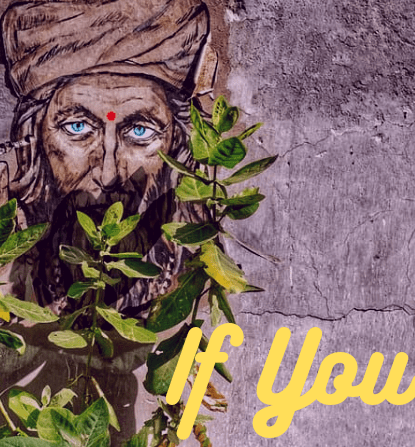
As I got to the end of that original typing marathon, I noticed that, strangely, the very last quote in that long long list reads simply, If you. Clearly a sentence begun but left hanging. Who will ever know what would or should or could have come next but never did?
Some time ago I remembered that interesting little fact and began to think about its meaning. I decided to do a quick search of the whole collection for that little conditional phrase. The search revealed that there are 139 instances of quotes beginning with If you.
So, dear readers, dear friends and fellow travellers on life’s journey, here are eight (why pick ten like everyone else would?) of those quotes, chosen at random (is there such a thing really?).
No commentary or comment from me; you, the reader, can do very nicely without my two cents worth thrown in. Well, okay, just 2c worth: I have often learned a lot from quotes such as these (not necessarily these ones specifically); sometimes a simple quote has led to a healing or an important insight.
So, I thought it would be a great idea to share some of my collection with you and perhaps there will be one or more that strikes a chord:
If You …
If you allow things to surprise you, you will get easily confused.
If you always do your best, you will be free from regrets.
If you follow the eternal law, you can understand how to love.
When you forget who you are, and dont know what to do, act the way you would if you did.
If you really dont care, you arent going to know if something is wrong. The thought would never occur to you. The act of pronouncing something wrong is a form of caring.
If you have to ask questions all the time, you never get time to just know.
If you are not interested in this, then why are you here?
If you deny even one person entrance to your life, youll never get their uniqueness from anyone else.
So, there you are. Theres much to reflect on here. Lots to focus on, to meditate on, and contemplate.
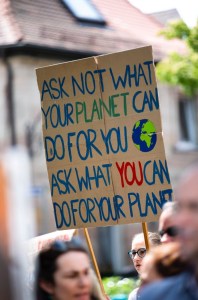
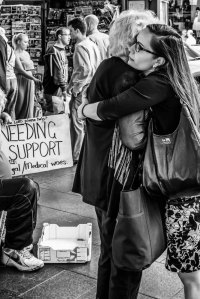
A couple of days ago when this powerful and important statement in the form of this illustration showed up on my social media, I was struck by something I don’t think I’d noticed before. Suddenly I saw: ‘might not change the world”. Might not? Which gave me the idea: it could as easily say ‘Helping one person might change the world …’.
But, you know, my thinking went even further: I realized that might and might not have nothing to do with it. The reality is that every action we take, and that includes the action of helping other living beings, actually does change the world.
Well, firstly, which of our actions help other beings, and thus change the world, we can’t always know. And obviously we can’t always (actually it’s more like very rarely) see the impacts of our actions. And even if we do, it’s likely that we’ll only directly get to see what happens in a limited and local sense. Nevertheless, all actions have a tendency to result in a domino, or cascade effect that literally never stops.
But, wait, there’s more. I kept thinking about it, and came up with a couple of ideas about why it could be a good idea to change the might not in this marvelous saying, which speaks of a negative possibility, to always will, which points to something definite.
All is one on the physical and the non-physical levels
We’ve all had those moments when we sense a connection with the rest of the world; we feel that we are part of nature, part of something bigger than just the one of us.
But, have you ever felt you were even more than just a ‘part of’ the world or nature? Have you ever had a sense that you are nature? Maybe this sounds a bit esoteric: we are one Self; we are all manifestations of the divine; we are all sparks of the one light, and so on.
And of course we can’t know for sure what goes on beyond the physical world. But, even at the most basic level of the material world, especially as we get down to the microscopic and even atomic levels, it’s hard to see any ‘separation’ between any individual and another. Atoms merge and cross over, interact, and change, energy fields collide and mingle, between all living and non-living things.
So, who’s to say that one small action on my part, one small change, won’t have a cascading effect as the ripples (that’s a good way to put it isn’t it?) from that action spread through the world and beyond?
The ‘What can One Person Do?’ Dilemma
Our Sydney Smith quote partially answers this agonising question for us as we’ve seen. Still, you might think that one person can’t do a lot when the needs are so many and so vast, and when most problems in our world seem to be so intractable. Mr Smith says that there is always something you as one person, as an individual can do, even if it’s a small thing you do.
Just think how many people everywhere are asking this same question: ‘What can one person do?’ If even a tiny percentage of those individuals answered that they could do something, then you would start to see changes taking place for sure. How could all those actions not add up to a changed world?
The Multiplyer Effect
Just now I used the words ‘add up’. Well actually it’s more like a multiplication effect isn’t it? If we say we change the world by helping just one person, then there has to be a Multiplyer at work I think.
We have all heard that aphorism that if you give food to a hungry person then you feed them for a day, but if you teach that person to produce their own food, then you feed them for a lifetime. Another truism definitely.
Still, once again, I think we can go further. Is it possible that by teaching one person to produce their own food you can help the whole world eat properly? Let me tell you a story I heard on an online video just a few days ago.
A man was traveling in a poor part of a country he loved. He’d spent the previous few years in another part of the same country building a house and growing his own vegetables and fruits.
He met a local person who was renting a small block of land, and that person asked him if he could help them build a house and teach them to grow their own food. It was a poor area, and the land was pretty much a little slice of jungle.
Anyway, this man agreed to help, and has been there for a few years now. He showed that local person how to grow various fruits and what looked to me to be a huge variety of vegetables. And they didn’t forget the flowers either. As the seasons passed, seeds were gathered and more land turned over to growing food.
Apparently from the very start they had a surplus of the fruits and vegetables they were growing, so they began offering them to neighbours, most of whom were also very poor.
Our traveling friend then showed them how to collect seeds from the food they ate (and the flowers too) and began to show these neighbours how to plant, fertilise, care for, and harvest what those seeds produced. In this way they too were able expand the amount of food they could grow.
So, already there is a growing area of this one slice of one country, that’s becoming self sufficient in fruit and vegetables. Now, that’s not the whole world obviously, but you’d have to agree, it’s a good start.
Anyway, just think: those people now have skills and surplus food and seeds to share further afield. Who can say how far such action might spread? It all sounds quite simplistic put like this, but it is the way that many grassroots movements for change have worked. And remember, nobody can reliably predict the ongoing impacts of any actions.
So, yes it is true, helping one person does indeed change the world for that one person. But whatever we do for one person, it also does definitely change the world beyond. As we’ve said, we may not see how or that it changes everything in the world and certainly not all at once.
We may think of ourselves as just one separate little individual, but we are united with all life. We may think that it’s all too much; too many problems; what can I do? The road to changing the world seems to be blocked, seems to be impassable.
Well, one teacher I admire is Swami Ramdas who founded Anandashram in India. Among the many great things he said, this one stands out for me above them all. I may have the wording a bit wrong, but basically the message is:
Once you have set your feet upon the path, then you are already at your goal
Which is another way of saying that if you help one person, then you have already changed the world.












 Notes from the Hermit's Cave