An Idea From a Not So Random Corner of the Universe

Namaste and Greetings friends

Remember in my last post I mentioned that I like to ‘Let the noble thoughts come to me from all corners of the universe’? Well I’ve been exploring, investigating, studying, in one of those corners for a few years now.

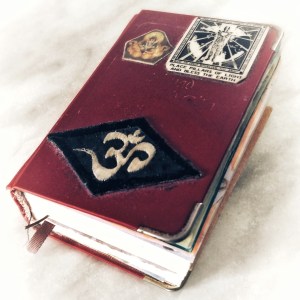
In 2016, in India, I gifted myself a small copy of the Bhagavad Gita. It’s a little red book, my Gita; no commentaries, just a plain, simple, and easy to understand translation of the 5000-year-old text known as the ‘Song of God’

Of course there are many sources of divine wisdom. No. That’s not right. Start again. Everything is a source of divine wisdom, of the word of God, universal knowledge, Truth, the Dharma. We can call it what we like.

But every living thing – human and non-human – every experience we have, and the entirety of the material and non-matieral creation, is divine wisdom in action.

Speaking for myself, I don’t always remember or realise (as in believe, trust, know) this never-ending, inexhaustible supply of wisdom. So I have to make use of some physical forms that help me narrow my focus, to centre my attention. It happens that the Bhagavad Gita is for me, one of those physical forms.

So today I want to talk about a verse from the Gita that really leapt out at me when I opened the book at random yesterday.
That verse comes from a chapter titled Self Knowledge and Enlightenment. It’s where Krishna – representing our Higher Self, Divine Wisdom; the real us, the real me – is telling Arjuna – the ego self, or little self, the us that thinks ‘this is me’, ‘puny, small, little me, just a sack of bones’ – all the various attributes and qualities of the Higher Self, the real us.

In other words, our Higher Self is helping our lower self to realise what we really are, trying to get us to see that there is a lot more to us than meets the (physical) eye.

Anyway, to the verse:

Of the strong, I am strength devoid of desire and passion, and I am love that is virtuous.

Bhagavad Gita Ch 7 verse 11

My sense is that the entire Bhagavad Gita is designed to help rid us of our attachments to the dualities of the world. Of course material life is obviously a state of dualities: we like good things, don’t like bad things; sometimes we’re happy, sometimes full of sorrow; we might at one time have many material possessions, then at another have nothing. You know where I’m going here; after all you dwell in the same world as I do!

Naturally none of us want bad things to happen, so we try to develop ways to be strong, to gather strength so we can face the bad stuff when it (inevitably) happens. And there’s nothing wrong with being strong, nothing amiss about having strength, but here Krishna (Higher Self) says that we don’t need to desire to get strength: we already are strength. Remember: Krishna is our Higher Self, so if Krishna is strength then that means we all are.

The desire and passion he talks about is really our attachment to outcomes, to expectations, to labelling things good or bad, or this or that, or wanting to feel this emotion but not that one. In other words, we are strength without any of these attachments;

So, when those inevitable ‘bad things’ happen, we already have the ability to flow with them, to cope with them, without judgements, without fear. Equally, when the inevitable ‘good things’ happen, we can rejoice, but we are strength, so there’s no need to hang onto them, wishing them to keep on happening, or being fearful of them changing.

You know there is an expression I used to loathe: It’s all good. It’s one of those non-commital, bland platitudes that really doesn’t mean anything. Well I don’t hate it quite as much as I used to but I still have trouble with it. Maybe we can take it a bit further?

Perhaps we could say instead: It all is. No good or bad; no joy or sorrow; no dualities of any kind. Sounds like heaven doesn’t it?

Well, while we’re in physical bodies here on Earth (and who can say what kind of bodies if any we’ll get to inhabit in the future), then the most that can ever happen is a glimpse – or maybe a few glimpses – of isness. Moments when we actually stop labelling, stop seeing dualities, and really and truly can know, it all is. For real.

And the love bit? Well, here we have Krishna (our Higher Self) saying he is love. He means us. He’s actually telling us that we are love. And virtuous love at that. Mind you, is there any other kind?

Peace
Seeking Justice: Commitments

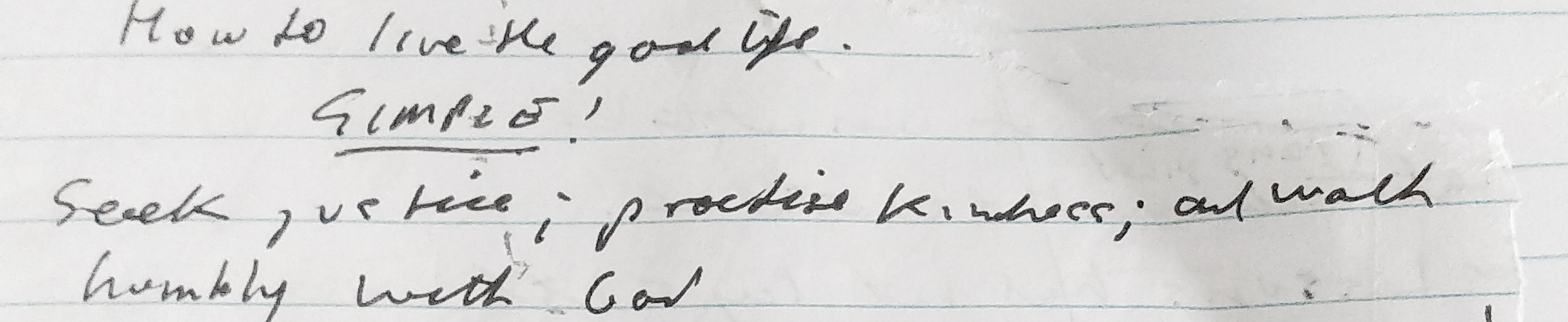
This morning I was just sitting, or at least trying to just sit. You know, being quiet, relaxing the mind. All that kind of thing. And of course, an idea sprung into that not so cooperative mind, so I grabbed my notebook. Just as I went to put this latest brainwave on paper I noticed a very extraordinary note I must have made I don’t know when:

I’ve just looked it up: It’s a slight paraphrase of a verse from the Old Testament, from the prophet Micah. Where I read it, I can’t say (the note is at least several weeks old). But to quote another little note from some unknown source, I always like to:

Let the noble thoughts come to me from all corners of the universe.

unknown

I’m just like everyone else, always wanting the easy solutions and you can tell that can’t you? ‘How to live the good life? Simple!’. I mean really; hardly humble in my approach in that note was I? Well, let’s talk about what Micah says, not my own lack of humility.

Seek justice; practise kindness; and walk humbly with [your] God.

There are numerous versions online of this verse (Micah, 6:8), so I will leave it to you to check those out for yourself. I’ve added the word your because all those versions do say ‘your God’. But even in this paraphrase it’s easy to see there is nothing at all simple about any of these injunctions.

I discovered that this verse is often invoked in times of grave injustice, or crisis. I think it goes without saying that we would be hard pressed to think of a time that was not a time of grave injustice or crisis. Certainly, we are living in one of those times of injustice and crisis.

There’s no need to or purpose served by getting into how ‘grave’ injustice is now compared to some other time; there’s no need or point to weighing up the relative severity of one crisis versus another. Injustice is injustice; a crisis is a crisis.

In other words, the present is always the time to heed the injunctions of this verse.

So, what do we do if we are to seek justice? Running the risk of sounding flippant, I would say that there are as many answers to this question as there are people to answer it. Now, you would think this would make the task impossible; too many cooks and all that. But actually it’s perfect. Why? Because it means that whoever you are, whatever your situation, you can actively seek justice.

Or, I am sorry: I should say I, me. Not you. I can actively seek justice. But, you say, you are a hermit; you live in a cave (not literally but I know what you mean); you hardly ever even talk to people in ‘real life’. Yes, all true. And I would say that the action I take is by no means at the level I know I want it to be. I’m doing nowhere enough.

Does that mean I’m leaving the cave? Going out into the world, onto the streets to join other brave souls seeking justice? Believe me, I ask myself such questions constantly. But to speak truth to you now, I will say that I know absolutely, in my heart, that my role is something different.

If anything, I need to go deeper into the cave; I need to go deeper into the inner world of my own Self. I know that in this way I will join with so many others in what I’ve come to call the Invisible Community of people all over the world living lives of contemplation and prayer. Or, speaking for me personally, trying to live a life of contemplation and prayer.

By so doing I am at least in a tiny way supporting those millions of others out there on the streets, in the aid groups, running campaigns, writing letters, helping the victims of injustice, in all kinds of miraculous, brave, and innovative ways.

So that’s my commitment to you. To deepen my prayer; to intensify my contemplation; to more fully realise my union with all living beings; and to really join with the invisible community in its efforts.

And, you ask, this blog? What’s it about then? Well, notes, musings, thoughts and reflections all aimed at reminding me of my responsibilities. And hopefully along the way, solidifying my union with you and the rest of creation, just a bit.

Peace and love
PS I haven’t forgotten ‘practise kindness’ or ‘walk humbly with your God’. Maybe another time.

Sometimes Happy, Sometimes Blue

Remember, this is just a passing through place

Many years ago now, a wise person I know used these words to remind me of a fact of life that, even now, I sometimes (to be honest, this should read very often) forget: we are – all of us – only passing through. For me, the words have extra resonance beyond what you might call that overarching reality of the temporary nature of our time in this world: I was, born and still am, a nomad.

Even though I very much see myself as being on a never-ending pilgrimage, I do often get anxious about should I move? should I do this? Should I do that? Existential and other kinds of angst are common to all of us I think. So, now and again it’s a good idea to hit the refresh button and click the reminder that I am always in a passing through place.

I often find myself singing (usually very quietly or in my mind) the chorus from Passing Through, a very special Leonard Cohen:

Passing through, passing through.
Sometimes happy, sometimes blue,
Glad that I ran into you.
Tell the people that you saw me passing through

Leonard Cohen – Passing Through

And that’s the refresh: It is literally true to say – both in terms of my internal life journey and where I might be geographically speaking at any given time – that I am only passing through.

Change is constant, that’s the message here. Being sometimes happy, sometimes blue are just facts of life Leonard’s song tells us. But putting the whole chorus together you can see it’s about presence. It’s about being in the ongoing present moment; the moment that just keeps on keeping on. It’s about living in and being conscious of that ongoingness, whether we’re happy or blue.

As I typed that last sentence, about states of happiness and blueness, I suddenly thought of a poem I wrote quite a while ago now. Just Passing Through. Or Seeking Noble Truths. It, too, is about presence, about the attachment to outcomes (like being happy, or not being blue) being the cause of our suffering. Of course this isn’t my idea: it’s one of the Buddha’s Four Noble Truths.

I think I would like to share that poem with you. But let’s do it next time shall we? Because, while there might be no time like the present, as we’ve just seen, the present is ongoing.

So, see you next time

Peace and love
What’s ‘Ordinary’ Got to do With It?

Perhaps shameful is too strong a word, but that’s kind of how it feels. You see, I’ve been thinking of giving up on the book I’m reading at the moment. And you are thinking, this is a big deal? If you don’t like it, put it aside and try something else.

Yes, excellent advice, thank you. And usually that’s what I would do. In fact now I think about it there was a time when I would force myself to complete a book, even if I wasn’t enjoying it or was bored with it. But I learned a long time ago that this is a waste of time, waste of mind, waste of energy, and unfair to me.

Yet, on this occasion, I started to have some thoughts that took it a bit deeper. It’s true to say that I’m a bit bored with this book; it’s as if I’m not overly interested in the story the author is telling, and in the way she’s telling it. As well I had this feeling that the book was ‘ordinary’: meaning that it was a kind of day to day telling of a segment of a life with its mundane and routine elements included along with the ‘good bits’.

And it was that feeling of being not so interested that got me thinking. The author’s vocation, thinking, activities, and the subject of the book itself, is exactly in line with areas I am very interested in reading about, not only for entertainment but for my learning, for my own spiritual journey and way of life.

The way she’s telling it? Now, this one got to me even more. The book was put together after the author’s death and is made up of extracts from the author’s journals and from the many letters she wrote to family and friends during the period of her life the book covers.

That’s what I do isn’t it? Keep a journal? Write letters? These and the many many blog posts (which in a way are a lot like letters, and even journal entries do you think?) I’ve written over many years, and the journal I’ve been keeping for most of my life, are the core of at least the personal writing I have done over my lifetime. By rejecting this book I started to feel that I was rejecting my own, for want of a better word, genres.

Or, worse than that, I’m rejecting the invitation to share a life. And illogically I’m rejecting the life story and insights of a person whose own experience I actually value for my own quest and from whom I could learn a great deal.

And what about the feeling of boredom and that the book was too ‘ordinary’ and mundane? Well, to borrow a well-worn phrase, this really does take the cake. I mean if you were to look at much of my past writings and look at my photography blogs from times past, you would see that one of my main statements of belief was:

There are no ordinary moments, nor are there any ordinary people.

And I still believe this. Indeed, spiritual practice and study has only deepened my instincts that all there is is the moment; all there is is all the beings of the world experiencing that ongoing presence, that never-ending moment. There can be nothing in the least ordinary about that.

I’ve saved the best – or is it the worst? – for last: what the book is about. It tells the story of a three year period in the life of a person just out of university who looking for a deeper meaning to life and to finding a true course for her life, travels from her home to Japan and enters a Zen monastery to become a monk.

Her journals and letters give the reader an intimate and in-depth account of her experiences: what she learned; insights into the language, culture, and history of Japan and Zen itself; the people she met and knew, her own feelings and reactions to what was a huge shift in her life.

After three years the author left the monastery to travel slowly back to see family at home. Sadly she was killed in a bus crash along the way.

Pretty much everything that has to do with living a life. And here’s me rejecting it because it was ‘ordinary’ and some details were ‘boring’.

So, I’m going to stay with this book. It’s taught me a lot already, and I think there is more there for me. Perhaps, I can better put into practice by own so strongly held idea that there are no ordinary moments or ordinary people.

Peace and love from me to you
Talking About Sloth

Sloth.  Its a good word isn’t it?  One of those words you don’t have to look up to know what it means.  But if you do look it up, you’ll find it has a couple of meanings.  One is: laziness, indolence and a reluctance to make an effort.

Is sloth a bad thing?  Certainly it gets a bad rap; I mean: lazy? Indolent? Not willing to make an effort? Hardly words of praise. On the other hand we value words like busy, productive, efficient, hard working, and the rest. In our culture, these are definitely words of praise.

Go out and play; Read a book; Go to school; Study hard; Get a good job (whatever that means); How much do you make a year? When are up for promotion?  Demands and questions like these are constants in all our lives, and they force us into defining ourselves by what we do whether we are a little kid at school, a teenager trying to sort life out, an adult trying to make our way in the world the best we can.

Yes, it’s true I think: it always seems to be a about defining ourselves by what we do, rather than who we are, or what we stand for.  Always we have to be doing something.  Ever heard that little identity joke, I’m a human being, not a human doing?  I wonder how many of us would feel lost if we shifted from that need to be a doer to another definition of our identity, one less reliant on what we do or on what we’ve done in the past, or will do in the future.

Well, I hear you saying, this is all fine and dandy, but my boss won’t pay me unless I show up, there are meals to cook for the kids, I’m running late for an appointment, the lawn needs mowing and after that I have to write a report for my night class.

All very true, valid, and all of them things that do need to be done. We all have a life don’t we? But perhaps sometimes, even just now and again, and perhaps just for a few minutes at a time, you can stop. Just stop. Thats all. Stop and just do nothing, or rather stop and simply be.

Have I mentioned a favourite little two word sentence I really really like? Just sit. Don’t read, don’t think, don’t try to stop thinking, don’t ‘meditate’. All that’s required is to do nothing. Do No Thing. Actually, I think I’ve found a new favourite.

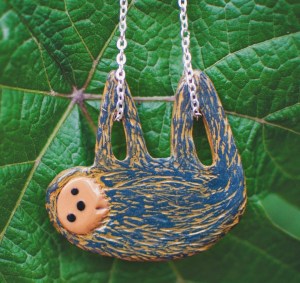
On, remember I said there are a couple of definitions of sloth?  Well the other one tells us that a sloth is a slow moving nocturnal mammal noted for hanging upside down from tree branches.  It lives entirely in the trees and is capable of only very slow movement on the ground.

So, I guess you should be very careful when you tell someone else I’m a sloth. Mind you, putting aside the hanging upside down bit, and the nocturnal requirement, it’s probably not such a bad way of being to emulate, do you think?

Have a lazy (slothful) day.

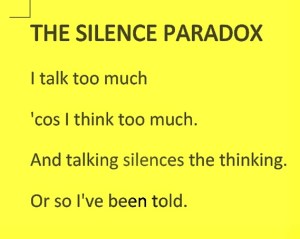
Silence. Could I have some more please?


Silence isn’t my strong suit. Or I should say, keeping quiet isn’t what I’m known for. One of the main reasons l live the life I do is because I am very sensitive to noise, but my problems start when I seem to forget that other people, and my own peace of mind, are affected by excessive noise created by me too.

And noise includes talking too much. Of course there are any number of reasons a person talks too much. Some people even believe they talk so much because it quietens the mind. No, afraid not. Been there. Not for me anyway.

Insecurity, nervousness, fear, low confidence, compulsive behaviours. The list could go on and on. When you think about it, the why isn’t always so important as the how to fix it question.

I spend a lot of time alone, in solitude, that gives other people and on rare occasions my mind, a break. I spend a lot of time listening to music to which I always listen intently. Of course that works on a number of levels, and is uplifting most of the time.

Speaking of listening to music, I usually use headphones like a lot of people. And I am blessed, absolutely and truly blessed, to have really good noise cancelling on my headphones. Anyone who uses ANC knows that it’s almost a miracle and makes the experiencing of music even better than it already is.

But I have discovered another use for the noise cancelling. I don’t always want to listen to anything: sometimes even I want some quiet, some silence. So, probably not the first person to do this, but I use ANC just by itself, just to shut out external noise.
But I’ve found it does more than this. Turning it on somehow creates another space. I actually feel like I’m enclosed in a space, or place. I hope that makes sense.

We tend to think of quiet and silence as meaning the same thing, and obviously they are similar and we use them interchangeably a lot of the time. But, sometimes they seem to be two distinct concepts. Quiet is an absence of noise. Whereas silence often seems to me to be a kind of solid state, an entity that comes into being for a short while (or longer hopefully) and encloses one in something like a cocoon or protected space.

Of course this state can be attained in different ways. For me lately I find with ANC on for itself alone, I can relax more quickly; I feel sort of ‘protected’ and safer somehow. Anyway, enough for this little tip from me. Perhaps headphone makers should change the label from Active Noise Cancelling, to Active Silence Creation

Peace and love

Look! I’m using two hands!

Namaste my friends


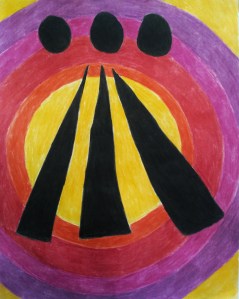
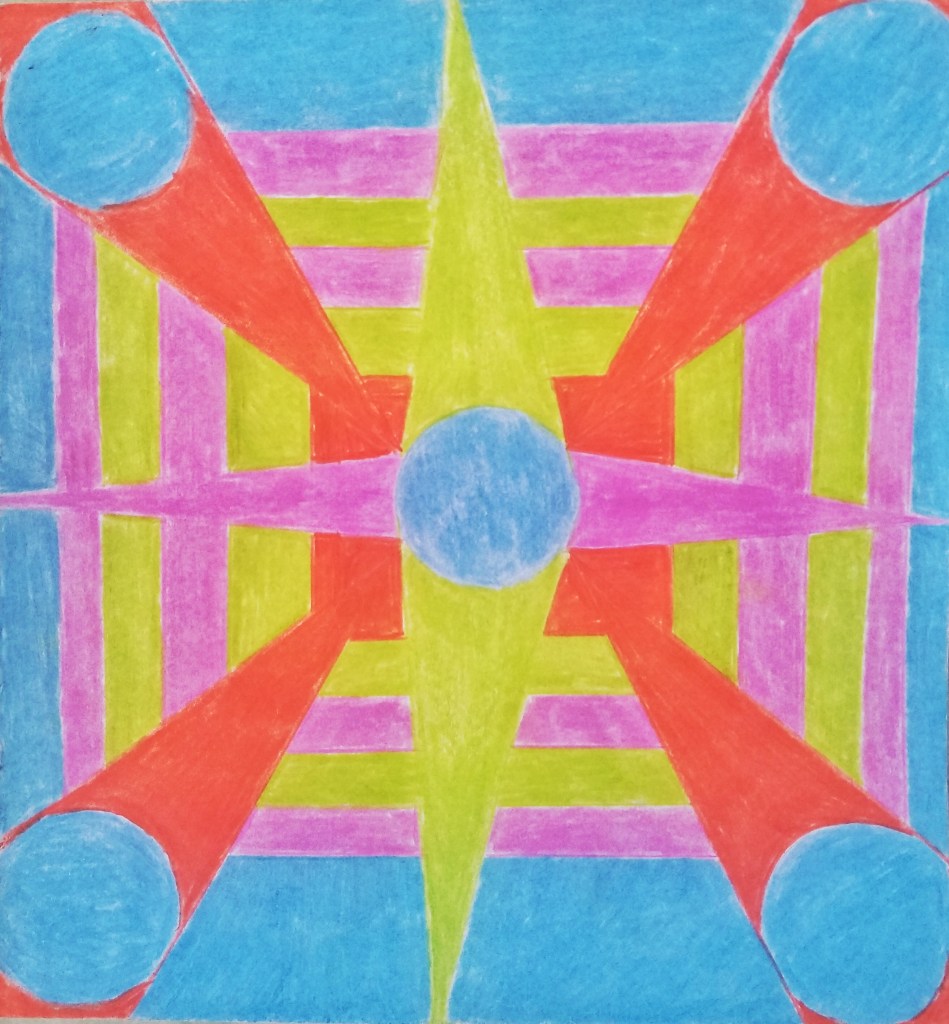
In my last post I shared with you a poem. Just another note as I said then. Today I find myself thinking about sharing a drawing with you. Or it’s a design, a ‘symbolic’ illustration. I’m not sure what to call it. Actually illustration is a good word in this case: I’m not exactly sharing it for its own sake, but to illustrate the topic for today’s post. Anyway, moving right along.

For a lot of years I have every so often had an urge to create patterns and designs, and just to colour in things. Just to see colour on the page I think. Just to be making them. They are of many and varied shapes and some are paint, some markers, and some pencil. I picked this one more or less at random so you can see the kind of thing I’m spending way too many words telling you about.

I really enjoy making these things. It can be quite a meditative process; of course mind can wander as always, but I find that if I just focus on the exact mark I’m making or a particular detail, then it pulls me in. Into the zone as you might say. In that sense it can be an intense experience.

And therein lies the problem: Sometimes, particularly with pencils I can be be so focused and intent, that I end up hurting my hand. Holding the pencil too tight, pressing too hard trying to squeeze more colour onto the page (that’s what it feels like anyway), or just old fashioned and typical impatience pulling me to push harder.

Whatever the cause, nowadays if I even begin to use a pencil (writing with a pen is okay for some reason) my hand begins to ache. It’s not terrible pain, just a nagging thing. But certainly it is what you might call a disincentive.

While I was looking through a pile of old drawings a couple of days ago, I thought, I wander if I can use my other hand instead? Now I’m not one of those people who can switch between hands with ease; if there is an opposite to ambidextrous, then that’s me. But I thought, I’m going to try anyway.

So I took a coloured pencil and paper and with my non-dominent hand (that’s an understatement if I’ve ever made one) and tried to just pretend I was colouring in some shape. No lines as such, just colouring in strokes.

Alien alert! That’s what it felt like. Completely and utterly alien. Although my hand wasn’t totally out of control, it felt like it was. Still I persisted, and you know I won’t say I got to the point of it feeling natural or fluid or comfortable, but I could tell there was potential for that to happen.

In a funny way it wasn’t even my hand that was the problem; it was more a mind or brain thing where I just felt out of joint, not connected or something. Quite disorienting actually. But I think I’m going to try again. At least I thought I can use my other hand for the big areas, leaving my usual one for the finer work when necessary.

I suppose it’s like anything new isn’t it? Or rather in this instance it was about realising I’m not able to do a thing, an activity that is meaningful to me because the way I was doing it was making it too hard, or even impossible. And actually causing damage.

Who can say why it’s only just occured to me after so many years of struggling with the issue (on and off). I guess, there’s a right time for everything, or as I often think, there is never a wrong time. Life just is.

Never too late as they say, to do it differently. I guess we’ll have to see what happens. I might end up ambidextrous, who knows? Mind you, don’t be expecting fine art or lifelike portraits with my other hand anytime soon.

May All Beings be Happy & Free

Lokah Samastah Sukhino

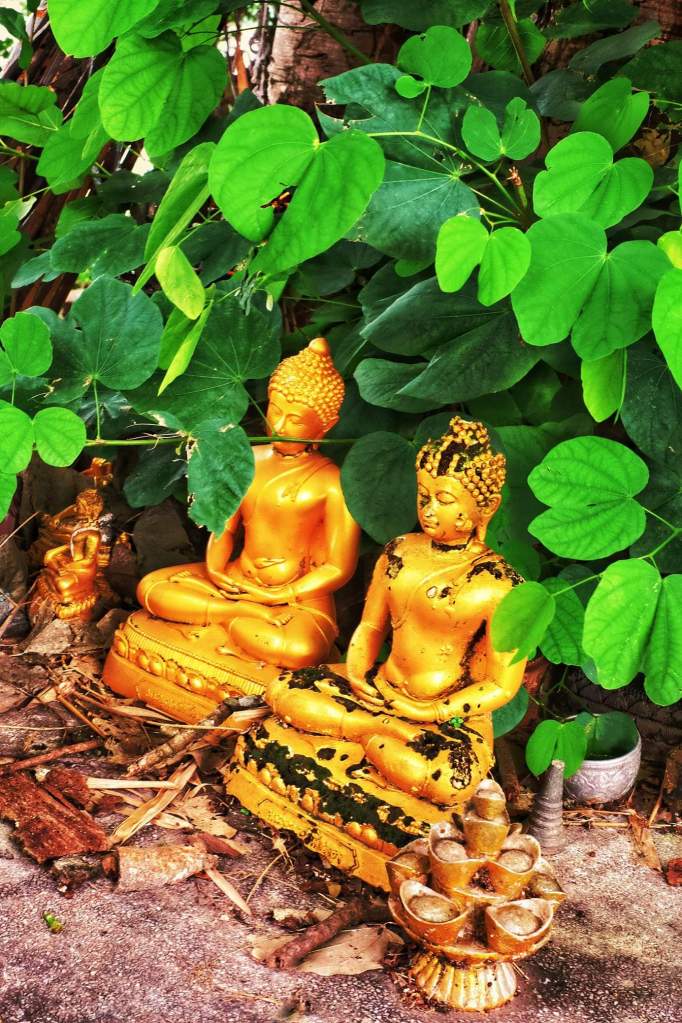
There is a little shrine at the foot of a huge and ancient tree, outside a Buddhist temple above the banks of the Mekong River in a little town called Chiang Khong in the far north of Thailand. As I looked at this obviously highly revered sacred site, through the viewfinder of my camera, I knew what I would call the photo:

Lokah Samastah Sukhino

Now, I already knew that this translates to: May all beings everywhere be happy and free. A friend of my son’s used to use this ancient Sanskrit mantra a lot and I’d long since discovered its meaning. Or so I thought.

Anyway, later as I readied this (what turned out to be quite a lovely image in my ever so humble opinion) I thought I would look up the mantra again. Just to make sure I had the right spelling and so on.

It was then I had a surprise. May all beings everywhere be happy and free is only the first part of this beautifully expressive mantra. I quickly discovered that this mantra is not simply some vague wish or prayer for universal peace and happiness; it is also a call to action. Here’s the complete translation as I found it:

May all beings everywhere be happy and free, and may the thoughts, words, and actions of my own life contribute in some way to that happiness and to that freedom for all.

But, wait. There’s more.

As I read more deeply into the meaning of all the words in the mantra, I discovered that it’s more than a call to action or a simple invocation. I learned that the mantra as I knew it was missing a final word: Bhavantu. So with this word missing, a vital element of the mantra was lost: the use of the suffix antu at the very end in the original Sanskrit turns the whole thing into a solemn promise. Antu means it must be so.

This all got me thinking: How? I mean, how do we transform our ‘thoughts, words, and actions’ so that they will contribute to the happiness of all beings? And how can we actually make it a promise?

Then it suddenly occurred to me: the action required was summarised very nicely by the Buddha in what he called The Eightfold Path. We are meant to start living according to the principles in that teaching.

Now, The Eightfold Path is, on the face of it, a fairly straightforward set of life principles that, when understood and integrated into one’s life and being, will lead to the cessation of suffering.

Now, this sounds all very well and good, but I’ve been wondering if there was a way I could sum it up in just a few words.

Something succinct, and to the point.

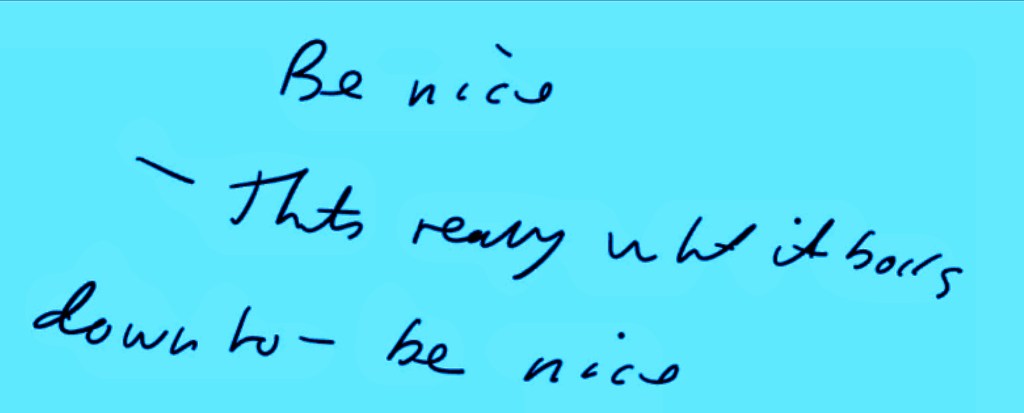
Then I found myself (again suddenly, right out of the blue) scribbling a note on my phone:

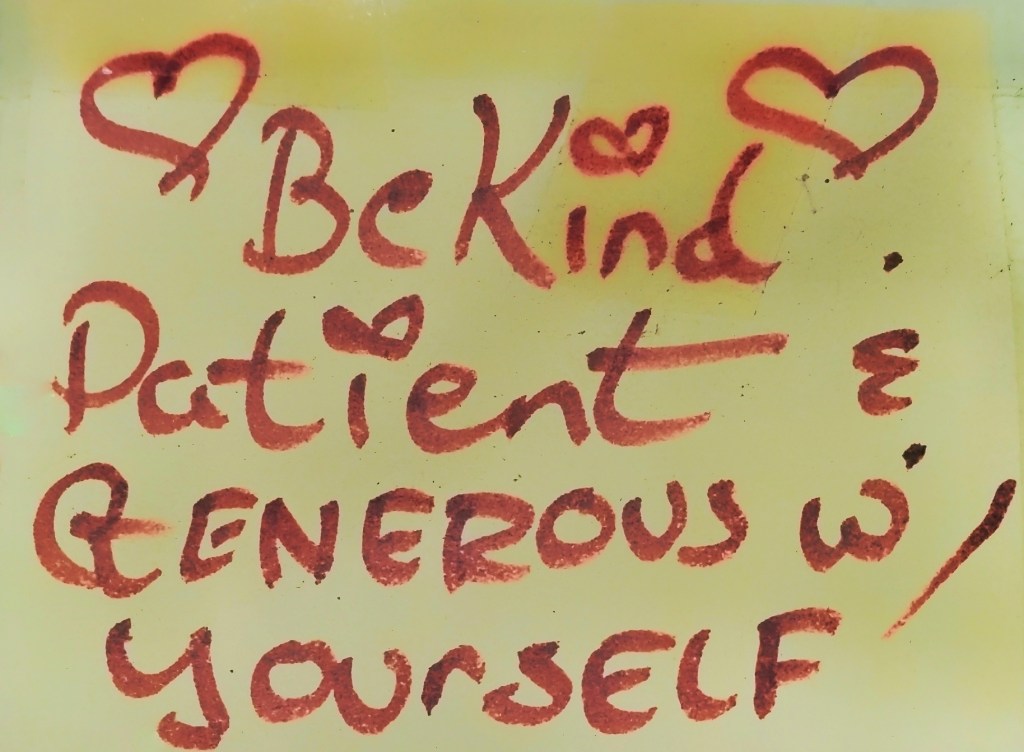
Be nice.

That’s really what it boils down to

Kindness in all our intereractions with all the forms that life has taken: other humans; other animals; plants; Earth herself; the rivers; the oceans; the forests. You name it. All forms that life has taken.

So, how do we be nice?

When I say it like that, it almost sounds silly; I mean, how hard can it be? Be nice? Easy.

Well, I guess I can say for myself that it’s true, sort of, sometimes. Yes it is often extremely easy for me to be nice. And, then, other times I have to try to be nice. And then there are those times when try as I might, nice just doesn’t happen.

Which means, I guess, that it might not be quite that simple after all.

There are so many wonderful explanations of the Buddha’s teachings, including The Eightfold Path, on the Internet. On the face of it, that might seem confusing. However Buddha himself advised that each person should question the teachings and come to their own conclusions. In other words, he said, don’t take my word for it, check it out for yourself.

The Eightfold Path. I might know that lovely list by name (Right Understanding, Right Thought, Right Speech, and so on), and I’ve read a little about them, but maybe it’s time to dig a bit deeper.

I’m going to make a start with Right Understanding simply because it’s the first on the list, and has always seemed to be a pretty important starting point.

So, next post (or perhaps a later one) that’s what I’m going to do. Just sit and see what comes out of my heart and onto the page (or screen). Please join me then and we’ll see what happens.
Peace and love from me to you

Van Gogh: Mystic & Saint?

A few weeks ago I finished one of the most extraordinary books I have ever read. Yes, I know: we live in the days of hype and the redundant superlative. Everything is the best, biggest, greatest. Or, conversely, the worst, most tragic, saddest; it goes on and on.

In this case however I am not exaggerating. This book was amazing. It’s Learning from Henry Nouwen and Vincent Van Gogh: A portrait of a compassionate Life, by Carol A. Berry. From this book I’ve learned as much and more about Van Gogh’s motivations, his vision, his art, and yes, his very nature and soul, than in everything I’ve read, seen or heard about Vincent until now put together. And that includes from several visits to the magnificent Van Gogh museum in Amsterdam.

The book had its genesis in a course the author sat in on in the 1970s put on by Henry Nouwen for Theology students. The course aimed at helping future ministers and pastors learn to connect with their future parishioners. Basically it was about accessing the compassionate sides of their own natures so they might better help others. Nouwen used Van Gogh as a the model of a person who had lived a life built on compassion for others.

The author has mined Vincent’s letters (mostly to his brother Theo) and studied deeply his paintings and drawings, in order to understand and demonstrate what it means to live a life of compassion, and to highlight the artist’s mission in life. For me that mission is summed up very nicely in a quote from one of Van Gogh’s letters:

Art is to console those who are broken by life.

Vincent Van Gogh to his brother Theo

I had a vague sense of Vincent’s spiritual leanings (I knew he’d been a missionary living among poor miners and their families to better understand and help them), and he’d tried to become a preacher. But, before finding this book my thinking hadn’t gone much deeper than that.

But, through reading this book I discovered Vincent was really what many of us might call a mystic. The author goes further and after what i’ve learned, I tend to agree with her: she thinks Van Gogh is a saint.

A mystic in the sense that he tried to live a holy and compassionate life. He viewed all nature (of which he concluded humans are simply one equal part) as being expressions of the divine. And a saint in that he dedicated his life to making art that would inject light and colour into the darkness of people’s lives.

As I mentioned, Vincent had been a missionary for a time. But his radical way of living among the poor and sharing their lives in order to know and love them better was shocking and way too extreme for his bosses, and he had to move on.

So, he finally settled on full-on immersion in his art. His mission was to make paintings that offered comfort and consolation to those who are suffering. And that’s all of us to one degree or another isn’t it?

You can see by now that this supremely accessible (and pleasurable to read) work has had a profound impact on me. This book isn’t only for artists, nor is it a religious book; it is as I have said an inspiration and guide to living a compassionate and loving life.

I don’t want to just say ‘I can’t recommend highly enough that you read this book’; I want to say instead Please, please read this book. Then obviously act on what you have read!

I’ve always admired – loved – Vincent, now I think I know why. Or as Don McLean says in one of the most profound love songs (Vincent) in history (remember, I never exaggerate):

Now, I understand, what you tried to say to me
How you suffered for your sanity
How you tried to set them free
They would not listen, they did not know how
Perhaps they’ll listen now

Perhaps.

Love and Peace from me to you

If You … Don’t Quote Me on This

I don’t remember when I began to collect quotes; my early teens I think. I just started making notes of quotes from books (even comics in those far off younger days), from conversations overheard. Then, later, little excerpts from my own journals and other writings. Even slogans I’d see on t-shirts, billboards, or wherever else.

This doesn’t mean much in these times when you can type in a search for quotes on any subject, for any occasion, by anyone from anytime in history. But, in those long ago days before computers were in our hands, and certainly way before the Internet, it wasn’t so quick and easy.

Anyway, fast forward to the not so distant past;One day I sat at the computer (it was time for computers, thank goodness) and typed up all those collected quotes stored in several boxes full of little notebooks and scraps of paper.

The result is literally hundreds of pages of tightly typed quotes. That typing (which in fact took me quite a bit longer than one day) was in fact the genesis of a book that has remains half written.

You see, as I typed I saw so many great words of wisdom that I just felt compelled to put some of them together somehow.
Ive now been at that task for many years: its a very intense process and takes so much energy and, as any writer will tell you, the muse has to strike before we can begin to strike those keyboard keys! Anyway, it will be done when its done; the very notion of presence, of there only being now, is actually one of the major themes of the book.

As I got to the end of that original typing marathon, I noticed that, strangely, the very last quote in that long long list reads simply, If you. Clearly a sentence begun but left hanging. Who will ever know what would or should or could have come next but never did?

Some time ago I remembered that interesting little fact and began to think about its meaning. I decided to do a quick search of the whole collection for that little conditional phrase. The search revealed that there are 139 instances of quotes beginning with If you.

So, dear readers, dear friends and fellow travellers on life’s journey, here are eight (why pick ten like everyone else would?) of those quotes, chosen at random (is there such a thing really?).

No commentary or comment from me; you, the reader, can do very nicely without my two cents worth thrown in. Well, okay, just 2c worth: I have often learned a lot from quotes such as these (not necessarily these ones specifically); sometimes a simple quote has led to a healing or an important insight.

So, I thought it would be a great idea to share some of my collection with you and perhaps there will be one or more that strikes a chord:

If You …

  • If you allow things to surprise you, you will get easily confused.
  • If you always do your best, you will be free from regrets.
  • If you follow the eternal law, you can understand how to love.
  • When you forget who you are, and dont know what to do, act the way you would if you did.
  • If you really dont care, you arent going to know if something is wrong. The thought would never occur to you. The act of pronouncing something wrong is a form of caring.
  • If you have to ask questions all the time, you never get time to just know.
  • If you are not interested in this, then why are you here?
  • If you deny even one person entrance to your life, youll never get their uniqueness from anyone else.

So, there you are. Theres much to reflect on here. Lots to focus on, to meditate on, and contemplate.

Love and blessings from me to you