Let Me Tell You About a Visitor I had This Morning

Greeting and Welcome to you
Quite a long time ago now I half wrote a book. I mean to say, I wrote half the thing before giving up. The book was going to be called When a Pet Dies, and was about, well exactly what the title suggests. All the practical stuff that you’d expect, as well as ways to deal with the grief over the loss of a companion animal .

I thought at the time that the reason it was only half written is that, once I got through that practical stuff and was ready to tackle the grief and loss parts, some kind of lethargy set in, or I got lazy. Or perhaps, I was thinking also, the muse for that particular project had simply left and was gone. So it remains half written.

So, why am I musing over this half done, half forgotten project from long ago? Well, let me tell you about a visit I had this morning.

I was sitting, focusing on chanting my mantra. Suddenly I felt an absolutely overwhelming sense of loss and sadness. I don’t recall thinking of anything in particular beforehand, but the sense was overpowering. Flooded with grief is what they call it I think.
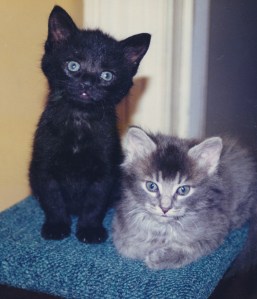
Lofi (on the right) with his sister Shanti

And then, just as powerfully, I sensed the presence of Lofi, my cat who died in my arms over ten years ago. Immense feeling of presence is what I wrote in my notebook. Now, I’m not saying he was literally there with me. I’m also not saying he wasn’t. All I can say is that it was among the most intense of similar experiences I’ve had over the years. Anyway, that’s most likely what got me thinking about my incomplete book.

Later this morning I was sitting with my partner on a benchseat overlooking the sea, the bit of the Pacific coast I’ll be leaving behind next week.

Actually, now I’ve mentioned that, you might remember from my last post how keen I am to get out there to the desert. That excitement and anticipation doesn’t mean for a second that I’m not feeling quite sad about leaving the coast.

Anyway, we were just sitting there and chatting on and off, when suddenly a thought seemed to push its way to the surface. I all of a sudden knew why I stopped where I did when writing that book. I realized in a strong and convincing way that you can’t build a structure to define what grief is or how or if it should be experienced, by whom and when.

I’m not talking about the ‘truism’ that one hears all the time that says that the ‘stages of grief’ are in a set order, until they’re not. Actually come to think about it, I’m not even sure this is true. I mean, I’m not sure it (grief) is a thing to be labelled, quantified, recorded, predicted, analysed.

I mean, who’s to ever say how any other individual, or even oneself, will feel about anything at all? Sure, there might be a ‘typical’ set of responses to any given circumstance, such as a loss, but even the proponents of such theories will tell you that none of us is typical.

Which kind of leads me back to my feeling of oneness with my Lofi earlier in the day. Obviously I’m not alone in having such feelings. How often has any one of us heard other people say, after they’ve lost a loved one:e, ‘S/he was really here. It was so real’.

Such experiences can occur anytime, even decades after the loved one has left. I’ve mentioned somewhere else that I’m reading (in little chunks) a great book by Joseph Campbell, the renowned scholar of myth. Let me share with you a quote from the section I’ve been reading today where he’s talking about how art in India seeks to portray the divine in all things:

This is the wonderful song that one hears when one reads the Bhagavad Gītā or any of the great texts of Eastern philosophy. This is the song of that immortal spirit that never was born and never die.
Of course this isn’t meant to be a consolation to myself or anyone else. After all, we are physical beings, living in a material, solid and apparently ‘real’ world. So, naturally, we experience loss, like everything else in that context.

Our bodies react (or don’t) as do our minds, creating physical sensations and emotional responses. Or not. These physical and emotional responses, or lack of them, are totally unpredictable, unexpected, and most definitely unclassifiable by anyone outside of oneself (myself)

Anyway, there are no rules. Even the grief and loss experts will tell you this. Mind you, I can and will only speak for myself, and my experience. Basically that experience has taught me that I have an intuitive resistance to ever thinking in terms of there being a ‘roadmap’ for grief.

Or a statistically valid ‘pattern’ or ‘process’, or that there are even such things as ‘stages of grief’.

My grief for my Lofi is unique, just as everyone’s is. I’m pretty sure I don’t even want to define it, label it, ‘try to get closure’, ‘come to terms with my loss’. No. None of that. It’s like I’ve said someplace else, or at some other times:

Sometimes we make way too many words for something for which there are no words.

Thank you for allowing me to share these words with you. I pray that they are not ‘too many’

peace and love

Believe It or Not

Welcome friend to another post. It’s good you are here.

Like so many other people I like documentaries on, well, all kinds of topics. I sort of go through phases and a while back I was on an historical/archaeological kick. And if it involved adventurous journeying, then so much the better.

Anyway, one I watched has stuck with me. In this show, an Indiana Jones type went in search of an ancient religious artifact. After a sombre pilgrimage across a stunning but arid landscape, a number of adventures and fascinating tours of interesting historic sites, he was forced to conclude that nobody could know for sure that this particular artifact actually existed.

This was especially the case given the fact that several hundred individual churches across a vast area claimed to possess said artifact, according to our intrepid guide. Then there was a doco I’d seen a few days prior that suggested this artifact was in fact hidden in Southern France.

Or perhaps it was destroyed in 800BC as some other ‘experts’ suggest. In any case, our fearless explorer came to the conclusion that, at the end of the day, whether the artifact still exists (or ever did exist) isn’t the point. He told us that what mattered was that people believed it existed, and that its power existed through that belief and was a force for good in people’s lives.

Actually I think even this misses the real point: I don’t think we are necessarily meant to have a belief one way or the other when it comes to the historical accuracy of myth. Myths tell us stories about truth, about our place in the Universe, and how to behave and live a good life. The facts or lack of them aren’t important.

Every culture throughout human history has had its myths: about creation, about their pasts, their gods, their futures, and how to conduct one’s life so that society can continue to function. Some will say that we in the so-called West are lacking our own myths and stories.

Well, I also believe that our myths are in many respects largely forgotten, or perhaps are only held by this group or that within our societies.

I think we all have our own myths, whether they are ones received from our society either consciously or unconsciously learned, or from our own personal life experience. Then of course there are the so called ‘modern mythmakers’: the media, politicians, and marketeers, all advertising their own ‘truths’. But that’s not what I’m talking about today.

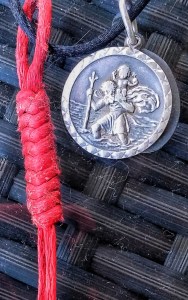
So, moving right along. Hands up if you’ve ever owned or been given a St Christopher medal? Ah, just as I thought. Huge numbers of people out there have at one time or another had a St Christopher around their neck, or hanging from their car’s rear vision mirror, or perhaps tucked securely in their bags. And really one doesn’t have to be ‘religious’ to admit to ownership of such an artifact.

He’s an interesting character this Christopher. He is a saint of the Roman Catholic Church and here we start already to get into the myths and legends around our friend Chris. It’s widely known that he was stripped of sainthood and declared to have never existed after the reforms of the late 60s in the Catholic Church. Myth number one.

He is still a saint, and all that happened was the church found itself with an overly crowded calender of saints’ days and decided that some could be cut off because they weren’t necessarily of ‘universal importance’, and besides, he may not have actually ever existed.

Poor old Christopher was thus unceremoniously dumped. No saint’s day, but he did keep his sainthood. As for the minor question of his existence, the church said that wasn’t their decision to make.

Not much is known about the possibly historical figure of Christopher. First up (myth number two) his name wasn’t Christopher: he was a seven foot five inch (may or may not be a myth) called Reprobus. He was a Canaanite who while working for the king suddenly decided to go off on a spiritual quest to find an even greater king.

Like all good heroes, Reprobus has all kinds of adventures, until one day he meets a wise old hermit who tells him that if he wants to serve the greatest king of all then he has to help people cross a treacherous river where many drowned trying to get across.

So, Reprobus started to carry people safely across the raging river. One day he lifted a small child onto his broad shoulders and carried him safely to the other side. Reprobus told the child that he’d never carried such a heavy weight before, and so they had both been in grave danger.

The child then told Reprobus that he had not only carried the weight of the world on his shoulders, but also the one who made the world. In other words our friend was informed that he was indeed serving the greatest King of all.

And that’s how good old Reprobus got the name Christopher: the name means Christ bearer. Later, Christopher is martyred for his faith and the rest, as they say, is history. Because of his splendid lifesaving deeds serving people crossing the river, our hero over time became the patron saint of travellers. And his fame spread beyond the confines of the Catholic Church and all sorts of people have looked to him for protection for themselves or loved ones when travelling.

I have a confession to make: I love and always have loved (venerated isn’t too strong a word) St Christopher.

Mind you, I’d always had some issues around the lack of evidence for his having ever existed. Not to mention the small detail of a miraculous appearance of the Christ as a child who was as heavy as the whole planet.

Anyway, while I was never quite convinced that St Christopher was a real historical figure anyway, I agree with what our friend the Indiana Jones look-a-like says: it doesn’t matter.

And for me there is still a truth at the heart of all this: Our pal St Christopher is me. He is you; he is each of us. We all have the strength to carry the soul of Self, the heart of ourselves, across the raging rivers, through the wild storms, and across the sometimes very rocky ground that make up each of our lives here on Earth.

Do I wear a St Christopher medal? I most certainly do. Belief or non-belief in his historical existence is beside the point for me. It’s the myth I resonate with, the symbolism.

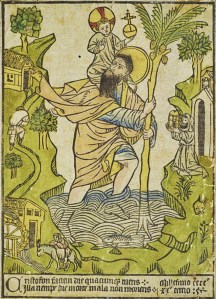
My medal shows a big, strong guy wading through knee high water carrying a small child on his shoulder. Both of them are me. Both of them are you.

Peace and Love
Paul

Is Life Too Short for Perfect Writing?

Greetings and welcome friends

Let me share a little secret with you: I have and always have had, atrocious handwriting. And it’s always been a major frustration (but a huge incentive to learn to type, which is one of the best things I’ve ever done).

Perhaps it’s because I had some sort of learning difficulty, maybe it happened because every state in Australia has a different way of teaching kids handwriting, or maybe its just that I was and am lazy. Actually, scratch this last one: I am not nor have I ever been lazy.

Anyway, it appears to be a fact of life, yet I do still get frustrated from time to time. But then there are times when I decide not to care, that it isn’t important, doesn’t matter. Being in one of those indifferent phases right now, has reminded me of an incident that should have taught me this lesson once and for all.

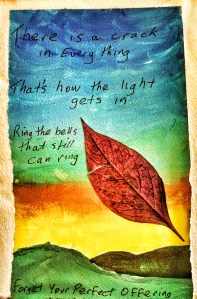
A while back I was gifted a small painting. The artist wasn’t satisfied with it as a background of a planned piece, and gave it to me thinking I might like to ‘do something with it’. I happened to think it quite a lovely painting in its own right actually, and as I was looking at it, I thought of a leaf I had collected a couple of weeks previously. A beautiful very soft and pliable purple leaf from a lovely shrub.

So, right away I just got to sticking that leaf onto the painting. As I pressed it down, a little tear appeared in the leaf. Immediately a lyric from Leonard Cohen‘s Anthem came into mind:

There is a crack, a crack in everything. Thats how the light gets in.

So, I began writing bits of the lyric onto the painting. Untidy, irregular and typically atrocious the hand writing, or printing, is. But then it struck me: that’s the point! I mean the point of Mr C’s sublime words:

Ring the bells that still can ring
Forget your perfect offering.
There is a crack, a crack in everything
Thats how the light gets in.

Here’s how I thought about what I’d written on the painting and how I’d written it: I rang a bell that I can still ring: I thought of and wrote down those beautiful lyrics to compliment the accident (is there any such thing as accident?) of tearing a leaf on a painting that ‘didn’t work’ for the artist, but that was working for me.

Therefore, the painting, the torn leaf and my handwriting was not a perfect offering in any kind of conventional sense as the world would view it. In other words there is a crack, both literal as in the tear in the leaf, and metaphorical as in the imperfections of the whole piece.

But—and here is the vital thing—this little painting, despite its initial rejection by the artist, and with its imperfections, its sloppiness, and its flaws, has provided a channel for light to get in. Into my life, into the piece itself, and now, through this sharing, into your life.

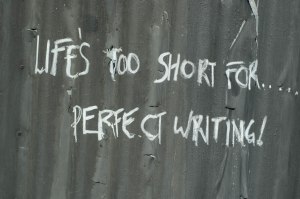
So, who cares if my handwriting is not conventionally perfect or is untidy, uneven, and even a bit tricky to read? I love the message in those lyrics; I felt that this lovely painting with its torn leaf to be the way to put that message in a concrete form. I mean, really, isn’t life too short for perfect (hand)writing?

PS I no longer collect leaves and trap them in this way. I may collect them, but after a time, I return them to their natural environment. Fallen leaves have their function in the cycles of nature too.

Just For Today

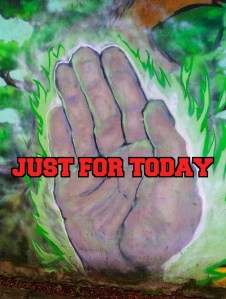
There is a song by George Harrison that I like very much. Actually there are many songs of his that mean a great deal to me. He’s been a kind of mentor or teacher for me since the early 70s. But, having said that, there is something about Just for Today that really does resonate deeply within me. It’s not even one of his ‘biggies’, and was released in 1987 on the album Cloud Nine

In fact, if you read the lyrics of the song. Or even better, listen to George actually doing the song himself, you’ll most likely agree that this is more than a song. This is a refrain, a plea, even a prayer. No ordinary pop song anyway.

If just (for) today
I could try to live through this day only
Not deal with all life’s problems
Just for today

Then, the other verse (there are only two):

If just for tonight
I could feel not sad and lonely
Not be my own life’s problems
Just for one night

How many times have I made these same pleas? I don’t think I’d be able to count them. Of course I’d guess we all have at some time or other (or even quite often, all the time, every day, ahhhhh!!!!!!) wished or prayed for the problems (whatever they may be) to just go away, even for just a day. No, not even a whole day. How about just for a few minutes?

So, I’m not alone then. Still, it’s no consolation is it, to know that we all go through the same wishful thinking to be rid of the same or similar problems? I think, though, in this song George has given us a clue to what we can do to bring ourselves a little more into the present when it comes to the angst we weigh ourselves down with over ‘all life’s problems’.

And actually, he’s suggesting not that we focus fully on the present moment, the micro if you like, which can be tricky at the best of times. He’s given us a bit of a an easier task: Just look at this day only. Perhaps we can better look at a whole day than this ‘moment’ or ‘second’. A day is sort of a macro moment, a bit easier to get hold of.

But, that last little question, about always me being my own life’s problem, that’s what I really try to get to grips with. I am my own life’s problem. The problem is not the family I was born into. It’s not the less than idyllic childhood I endured. It’s not even the bullies I seem to have attracted to myself over many years in far-off school days.

The problem is not even the anxiety that I seem to have been born with, or that’s evolved over time. Nature vs nurture?

And I can’t even say that the problem is the kinds of choices I’ve made about life, work, thinking, and all the rest, over the years.

No. None of this. The problem is me. And, let’s get really trippy here: the problem isn’t even me. It’s the physical manifestation that thinks it’s me and which exists in relationship to the physical world.

So, who is the real me? Who am I? Ah, well, these are the really big questions. Asking these questions is called Self Enquiry. And I think it’s helping me.

Whenever one of those life’s problems, or anxieties pops up I try to remember to ask: ‘To whom is this feeling/thought/memory occuring?’ That answer is (obviously) to me. And then I ask, ‘Who is this me? Who am I?’ Then, for the minutest of tiny moments, it all stops. Sometimes.

You see, I’m not really able to answer that Who am I question. The best I can come up with is a never-ending list of who I’m not, or what I’m not. It’s called Neti Neti: not this, not that. So, if I keep returning to who am I every time one of those ‘I’m not …’ comes up, what happens?

Well, in theory, nothing.  The idea is that asking Who am I stops the mind. It can’t answer. If a mind can’t answer, there can be no thought. And if there is no thought, then mind ceases to exist. (I’m not talking of brain here, but mind. It seems to me that the mind has no existence as a distinct entity of its own. It is more what we could say a ‘place’ that comes into being when thought happens. No thought, no mind.)

This cessation of thought is only a momentary thing. Thoughts soon come barging back (it also seems to me that while mind might not actually exist, it has a way of making its presence known in no uncertain terms). One thing I try to remember that causes me no end of extra thinking, is the fact that if we are not having a thought, then we can’t ever know it. You can’t have a conscious thought that says ‘hey, I’m not thinking now’

I see this Self Enquiry as a way (in a long term, lifetime kind of way) to rid myself of my incessant thinking and the confused (confusing too) and useless thoughts that arise all the time. For me it is, in a sense, a way to become mindless.

In that moment, when thought ceases, there is no pain. There are no questions, and there is no anxiety. There is no dread; no hope even. Basically you can say there is nothing for that tiny moment.

And that’s me, the real me. In that little moment (who can measure the length of a moment?), there is presence, as in I (the real I) am present, right here, right now.

Actually there is no time, as we measure it in the world, in that little moment (or whatever we choose to call it). Perhaps it’s more accurate to call it a state of being.

And it’s a state I’d like to be in more often. Not, as I say, that I’d know I was in it. Only by what you might call the spin-off effects of more calm, more clarity, less anxiety, all that sort of thing. In a way I would call that a state of grace.

All I can say is that it is exactly where and when and how I want to be.

Just for today.

The Ananda Mart is Closed Today

Hello and welcome dear reader

Almost four years ago now, we spent a couple of months in Bali. For a big portion of that time we based ourselves in a town called Ubud, on a street called Gautama. Yes, indeed, most auspicious.

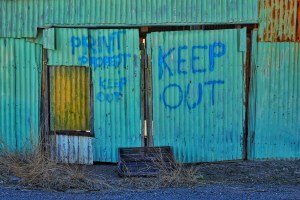
Anyway, one day I was walking down the street, going somewhere, and for a change without my camera. I passed a small shop that somehow looked unusual. and I stopped to make a photo with my phone.

That’s it: The Ananda Mart is closed today, I remember thinking. In the few weeks we’d been there, I don’t think I’d ever seen it closed before. On most days the man who runs the shop could be found sitting on the front steps. And mostly he’d have his dog for company.

In the early days of our time on Gautama Street, we’d buy bottles of water at the Ananda Mart. Each time I would smile, say hello, and enquire after the shopkeeper’s health. And while he always responded, it was never with what you’d call a friendly smile or a cheery wave. Probably grumpy grunt would be a more accurate way to describe his replies.

You know you’re on Gautama Street when you see the man himself at the corner

And each time I passed the shop, I would say hello. Again on a lucky day I’d get a grunt, but mostly he would say nothing and ignore me. Just as he ignored everyone who passed him and his dog. Eventually after a particularly rude response to me trying to purchase water, I, as they say, took my custom elsewhere.

Often in such situations I have been known to become irritable, angry even, and end up being just as rude (or ruder) than the other person. For some reason, this time I didn’t react that way. Instead I was interested in figuring out why the shopkeeper acted in this way and seemed to be in a world of his own which, from what I could see, he shared only with his dog.

Of course, being the overthinking speculator champion of the galaxy, I made many guesses: he is the owner of the Ananda Mart and is totally over people; being I thought in his 60s, maybe he’s just hanging out till he can retire. Given that the Ananda Mart is only one component of what looks to be a multi-armed business this could be a good guess. He’s one of the family elders, doing his part.

Above the door beneath the name it reads ‘cheap and friendly’. And it’s interesting to check the meaning of Ananda. In Hinduism, Buddhism, and Jainism it refers to extreme happiness, one of the highest states of being. In Sanatana Dharma philosophy for example, God is sat-chit-ananda or existence, consciousness, bliss.

Now, before I ramble on too long, I will just say that really and truly ‘the real story’ is absolutely none of my business. I suppose what I’m getting at is, rather than dismiss him as a grumpy man in a shop, My reaction to our, shall we call it, our relationship was one of compassion and curiosity. Let’s just say my sense was that the Ananda Mart shopkeeper is perhaps not a happy man.

You see what I mean? I tell you that it’s none of my business, then I tell you how I kept sticking my mind in where it doesn’t belong. Makes me human I guess!

Paramhansa Yogananda, one of the first teachers to bring Yogic philosophy to the so-called West, and the author of Autobiography of a Yogi, says in that book that Ananda is different from the temporary happiness that comes from sense pleasures such as eating and other ‘material pursuits’. He said , too, that Ananda is not the kind of joy that we’d call monotonous and that always stays the same.

Yogananda wrote in Finding the Joy in Life, that Ananda refers to a joy that ‘changes and dances itself in many ways to enthral your mind and keep your attention occupied forever’.

It’s anybody’s guess really isn’t it? Whether our seemingly unhappy and not so friendly shopkeeper, has that kind of joy in his life. And perhaps his aloofness and ‘grumpiness’ is merely an expression of his weariness of the temporary joys of the material word with its emphasis on pleasures of the senses.

Anyway, as I say, it’s none of my business.

Peace to you from the Hermit

Put Me in My Place. Please

Reverence the place and learn from what you see


Coming across this note last night, I was stumped. I coudln’t think where it had come from, where I’d seen it; nothing at all came to mind. And an online search just now failed to turn up anything either. I mean I must have read it somewhere. Or is it possible it came from me?

Of course it’s all the same: there is only one source. At any rate, it’s an injunction one can relate to anywhere, any place. It’s surely about presence?

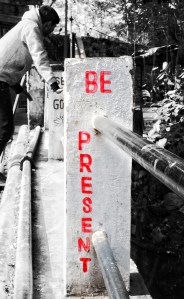
And about learning from all that is to be seen (heard, felt, intuited, known) in whatever place one is in now. I mean, the place I’m in now. I am here and it is now.

I’m reminded of the faith affirmation (is it a prayer?) that seems to have been written for this particular hermit pilgrim:

As a a hermit, I am a pilgrim dependent on a pure faith that I am exactly where God wold have me be now.

Sometimes I think that too much thinking about and angst over places other than the one I’m actually in right now, is a sure and certain way to resist and reject any reverencing of the place I’m in, not to mention what’s to be learned or gifted from the experience of being here.

And of course that angst, worry, wishful thinking, or whatever, comes with its own issues of distraction, and of a taking away of one’s Self from the present, the notion that here and now is the only time and place that exists.

A poem of mine I came across the other day while looking for something else says it all quite nicely. This poem is called Transcendental Injunctions, and it’s a rap on presence, about being here, and being now.

The central action describes how my senses can take me away from that here and now: I describe my habit of smelling my Bhagavad Gita (yes, as in putting my nose into the pages of the little book and inhaling the aroma of those pages) and how that takes me back to the shores of the River Ganges; another place, another time.

Anyway, allow me to share the final verse, which speaks of one such occasion:

Then, there is a voice:
I hear it with the ear of my heart:
There is no place to go.
What you seek is within.
There’s nothing to find:
God’s kingdom is within.

I suppose there is nothing left to say. I am here, and it is now

Peace to you from me

Mother Mary Come to Me

Namaste friends

During the early days of the pandemic, I lived in a small town out on the edge of the Outback. But after a few months, the time felt right to head for the coast. Slowly. With that in mind and headed in the right direction, I spent six weeks in another small town in that semiarid zone, staying in a motel.

I liked it there, at the Maria Motel in Moree. Described as a low-key 1960s era motel, the Maria is right across the street from the Artesian Hot Pools, which are Moree’s claim to fame. For me (for us), it was another temporary hermitage and safe haven on the side of the road in which to take shelter for a while.

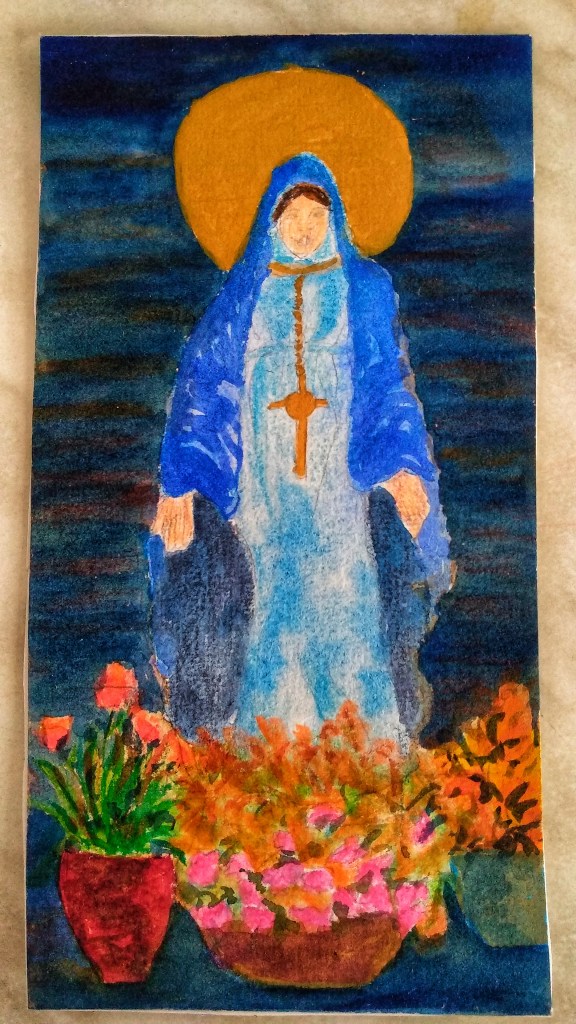
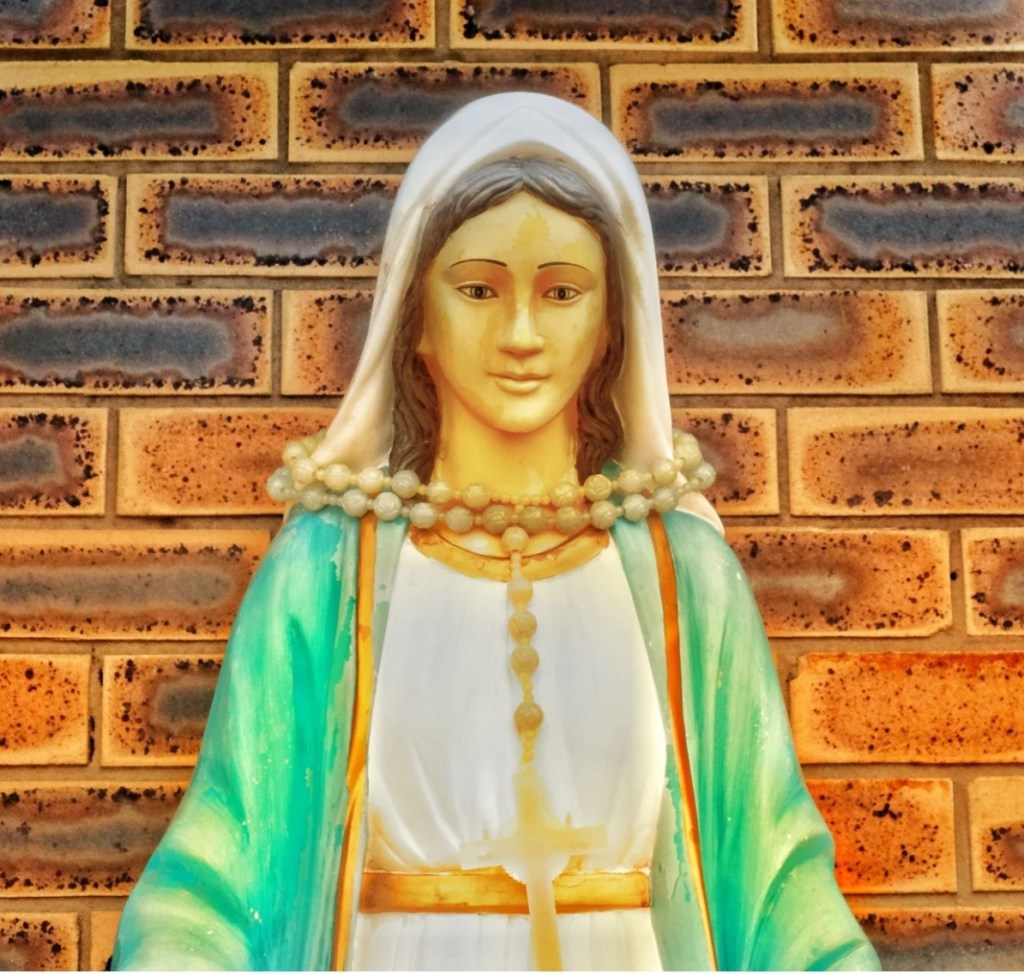
My favourite among the list of things I like about the Maria Motel is the statue of Mary out front in the courtyard. The Virgin Mary that is, Our Lady, the mother of Jesus. You know who I mean. And it isn’t only my Catholic upbringing and education that accounts for my fondness of Mary. It is more about what she symbolizes, what she stands for.

Watercolour by Pauline

For me Mary represents what I might call the feminine aspect of God. Some would call her the Earth Goddess. Mary is the mother, as in Mother Earth, Mother Nature. She is the feminine principle of the Universe. Respect and care for the mother is obviously the key to our survival.

This land from which this town was carved, has been inhabited since long before we began to mark time; since the beginning some say.

Those hot pools have been sacred for a very very long time. While nobody asked permission of the people who already lived here to build a town, at least when some of the invaders came they chose to honour the sacredness of the land they had appropriated by placing this statue representing the sacred feminine in sight of those ancient holy waters, and naming that temporary hermitage of mine, the Maria Motel.

Just Passing Through … or Seeking Noble Truths: A Poetical Sharing

Greetings friends

In my last post I mentioned I would share a poem with you in this one. And here it is!

Just Passing Through … or Seeking Noble Truths, is, like the previous post, concerned with passing through, how as I go through life, I am always in some sort of passing through place. Before we get to the poem, just let me fill you in on a bit of the back story.

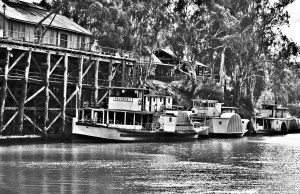
First, I wrote the poem as I walked home to our hermitage at the time in a town called Moama on the Murray River in Australia. Now, the Murray is the biggest river in the country and the then little town of Moama sits across the river from its bigger city sized sibling: Echuca, the biggest inland port in Australia.

Anyway, I’d just crossed the river bridge and the words just started coming to me. Not exactly as you read it here, but close. I am very lucky that I had only a few minutes walk left to get home, otherwise the whole lot could have been lost to memory.

The longer back back story? Well, as the poem suggests, I’d spent a lot of time hitchhiking, in Australia and a few other places too. It’s true what it says in the first lines: I’d done a lot of trudging through a rather large number of towns unknown to me then, and only some of which are better known to me now in much later years.

Okay, that’s enough back story to last a while, so let’s just present the star of the show. I share this, as I do all my efforts, with heart.

JUST PASSING THROUGH … OR SEEKING NOBLE TRUTHS


Many have been the nights 
I’ve trudged (and less often, strode) 
past illuminated windows framing. 
families sharing sit down meals. 
Or huddled worshipfully before 
flickering and silent (to my passing by ears) 
picture boxes in corners of cosy family rooms. 

I am just one more invisible (to most), anonymous 
drifter. Just passing through 
the empty nighttime streets of one more 
anonymous town. 
Longing to enter the illumined frame. 
Longing to share one of those sit down meals. 
Longing to worship at the alter of the flickering picture box. 
Longing is loss. 

The edge of town roadside summons 
this lonesome bodhisattva begging rides. 

It’s just one more quiet and cold 
semi desert night. A high moon in a clear sky 
casts ghostly shadows through Eucalypts: 
my only company as the waiting game begins. 
Waiting to see headlights coming and going my way. 
Waiting to be rescued from this lonely edge of town roadside. 
Waiting for another ride, to another anonymous town. 
Waiting is wasteful 

Better to be here, now, on this 
edge of town roadside. A place as good 
as any. Illumined by the moon, 
the ghostly gums create the frame 
in which this bodhisattva rests. 
And worships. 

Thank you for allowing me to share these words with you. The road, as many of you will know, can be a teacher, a guru. I don’t hitch-hike anymore, but the road is still teaching me. And I am grateful.

Sometimes Happy, Sometimes Blue

Remember, this is just a passing through place

Many years ago now, a wise person I know used these words to remind me of a fact of life that, even now, I sometimes (to be honest, this should read very often) forget: we are – all of us – only passing through. For me, the words have extra resonance beyond what you might call that overarching reality of the temporary nature of our time in this world: I was, born and still am, a nomad.

Even though I very much see myself as being on a never-ending pilgrimage, I do often get anxious about should I move? should I do this? Should I do that? Existential and other kinds of angst are common to all of us I think. So, now and again it’s a good idea to hit the refresh button and click the reminder that I am always in a passing through place.

I often find myself singing (usually very quietly or in my mind) the chorus from Passing Through, a very special Leonard Cohen:

Passing through, passing through.
Sometimes happy, sometimes blue,
Glad that I ran into you.
Tell the people that you saw me passing through

Leonard Cohen – Passing Through

And that’s the refresh: It is literally true to say – both in terms of my internal life journey and where I might be geographically speaking at any given time – that I am only passing through.

Change is constant, that’s the message here. Being sometimes happy, sometimes blue are just facts of life Leonard’s song tells us. But putting the whole chorus together you can see it’s about presence. It’s about being in the ongoing present moment; the moment that just keeps on keeping on. It’s about living in and being conscious of that ongoingness, whether we’re happy or blue.

As I typed that last sentence, about states of happiness and blueness, I suddenly thought of a poem I wrote quite a while ago now. Just Passing Through. Or Seeking Noble Truths. It, too, is about presence, about the attachment to outcomes (like being happy, or not being blue) being the cause of our suffering. Of course this isn’t my idea: it’s one of the Buddha’s Four Noble Truths.

I think I would like to share that poem with you. But let’s do it next time shall we? Because, while there might be no time like the present, as we’ve just seen, the present is ongoing.

So, see you next time

Peace and love

Homage to The Cockroach Man. With thanks and affection

Notes from the Hermit’s Cave is what this blog is called. I promised to publish musings or notes of all sorts: your regular text blog; photos or other pictures; poems; and other assorted bit and pieces.

Well, I’ve rediscovered a poem that I think would be great to share with you.

Looking through some posts saved from old blogs no longer active, I came across theaforementioned poem. It’s about a guy I met in a cafe in India back in 2006. This person kept me and a crowd of other travellers spellbound for a couple of hours one monsoon afternoon. Not to mention the many conversations focused on him that followed in the next few days and the several pages in my Journal recounting the whole experience.

Anyway, as soon as I saw this poem again, I thought I just have to post it here. That trip was a big step for me in my own healing and spiritual journey. And meeting this guy has played a part in all that.

So, please join me in making this small offering of thanks to that guy, whose actual name I never learned, and who forever will be known to several very fortunate travellers as the Cockroach Man

THE COCKROACH MAN

This is what he said.
He’d lived many years in India,
and, in that time he’d done many things.
Even, he said, for a while he’d trained with a yogi, his guru.
This is what he said.

Yogic training is not easy, he said,
In fact, he said, one aspect made him sick
for a year.
This is what he said.

His Guru put beings in his head.
Beings like parasites he said.
Yes, yogic training, it made him sick.
This is what he said.

Parasites implanted in the head? A part of yogic training?
No. I don’t think so.
Actually, inserted was the word he used.
‘inserted beings in my head.’
This is what he said.

All gone now, save one, he said.
Only one remains—it’s like a cockroach.
And it’s still in him making him sick.
This is what he said.

At night, he said, there is sometimes relief.
The cockroach leaves and floats just below the ceiling.
Well, its astral body leaves his head and floats above his bed.
This is what he said

‘You’re a healer. You understand,’
is what he says as he turns to me.
Umm, no. Actually I don’t.
But this is not what I said.

Where is he now, the Cockroach Man?
‘It’s winter soon. I’m gonna give blankets
to the villagers.’
This is what he said.

He’s known suffering, he said.
And you could tell he was tired
from fighting the cockroach.
‘I’ll feed the poor.’
This is what he said.