Notes from the Hermit’s Cave is what this blog is called. I promised to publish musings or notes of all sorts: your regular text blog; photos or other pictures; poems; and other assorted bit and pieces.
Well, I’ve rediscovered a poem that I think would be great to share with you.
Looking through some posts saved from old blogs no longer active, I came across theaforementioned poem. It’s about a guy I met in a cafe in India back in 2006. This person kept me and a crowd of other travellers spellbound for a couple of hours one monsoon afternoon. Not to mention the many conversations focused on him that followed in the next few days and the several pages in my Journal recounting the whole experience.
Anyway, as soon as I saw this poem again, I thought I just have to post it here. That trip was a big step for me in my own healing and spiritual journey. And meeting this guy has played a part in all that.
So, please join me in making this small offering of thanks to that guy, whose actual name I never learned, and who forever will be known to several very fortunate travellers as the Cockroach Man
THE COCKROACH MAN
This is what he said. He’d lived many years in India, and, in that time he’d done many things. Even, he said, for a while he’d trained with a yogi, his guru. This is what he said.
Yogic training is not easy, he said, In fact, he said, one aspect made him sick for a year. This is what he said.
His Guru put beings in his head. Beings like parasites he said. Yes, yogic training, it made him sick. This is what he said.
Parasites implanted in the head? A part of yogic training? No. I don’t think so. Actually, inserted was the word he used. ‘inserted beings in my head.’ This is what he said.
All gone now, save one, he said. Only one remains—it’s like a cockroach. And it’s still in him making him sick. This is what he said.
At night, he said, there is sometimes relief. The cockroach leaves and floats just below the ceiling. Well, its astral body leaves his head and floats above his bed. This is what he said
‘You’re a healer. You understand,’ is what he says as he turns to me. Umm, no. Actually I don’t. But this is not what I said.
Where is he now, the Cockroach Man? ‘It’s winter soon. I’m gonna give blankets to the villagers.’ This is what he said.
He’s known suffering, he said. And you could tell he was tired from fighting the cockroach. ‘I’ll feed the poor.’ This is what he said.
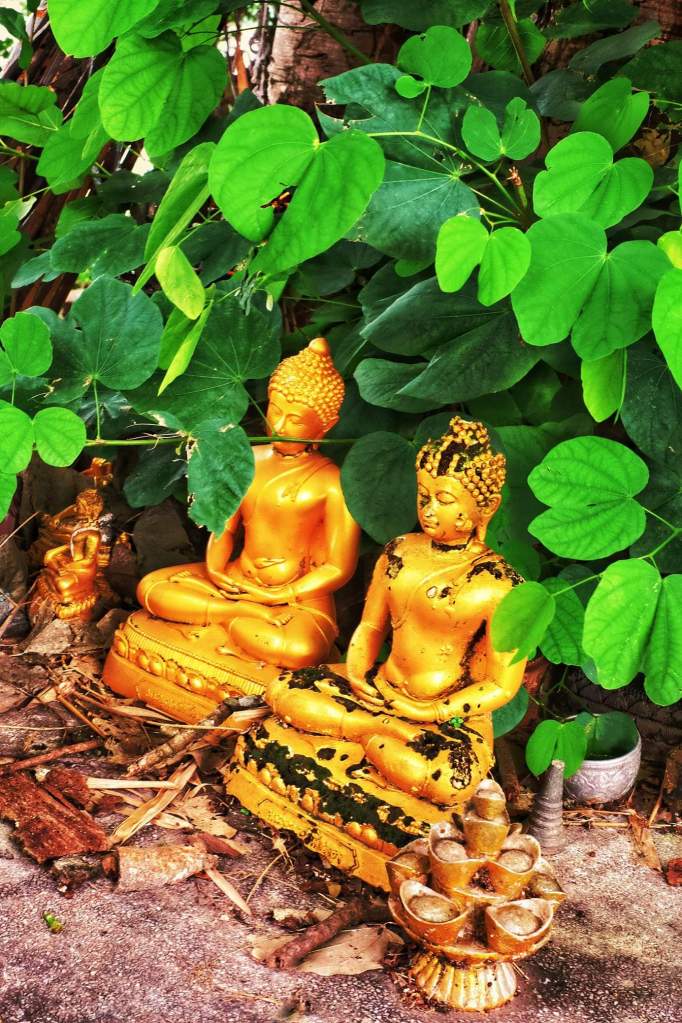
There is a little shrine at the foot of a huge and ancient tree, outside a Buddhist temple above the banks of the Mekong River in a little town called Chiang Khong in the far north of Thailand. As I looked at this obviously highly revered sacred site, through the viewfinder of my camera, I knew what I would call the photo:
Lokah Samastah Sukhino
Now, I already knew that this translates to: May all beings everywhere be happy and free. A friend of my son’s used to use this ancient Sanskrit mantra a lot and I’d long since discovered its meaning. Or so I thought.
Anyway, later as I readied this (what turned out to be quite a lovely image in my ever so humble opinion) I thought I would look up the mantra again. Just to make sure I had the right spelling and so on.
It was then I had a surprise. May all beings everywhere be happy and free is only the first part of this beautifully expressive mantra. I quickly discovered that this mantra is not simply some vague wish or prayer for universal peace and happiness; it is also a call to action. Here’s the complete translation as I found it:
May all beings everywhere be happy and free, and may the thoughts, words, and actions of my own life contribute in some way to that happiness and to that freedom for all.
But, wait. There’s more.
As I read more deeply into the meaning of all the words in the mantra, I discovered that it’s more than a call to action or a simple invocation. I learned that the mantra as I knew it was missing a final word: Bhavantu. So with this word missing, a vital element of the mantra was lost: the use of the suffix antu at the very end in the original Sanskrit turns the whole thing into a solemn promise. Antu means it must be so.
This all got me thinking: How? I mean, how do we transform our ‘thoughts, words, and actions’ so that they will contribute to the happiness of all beings? And how can we actually make it a promise?
Then it suddenly occurred to me: the action required was summarised very nicely by the Buddha in what he calledThe Eightfold Path. We are meant to start living according to the principles in that teaching.
Now, The Eightfold Path is, on the face of it, a fairly straightforward set of life principles that, when understood and integrated into one’s life and being, will lead to the cessation of suffering.
Now, this sounds all very well and good, but I’ve been wondering if there was a way I could sum it up in just a few words.
Something succinct, and to the point.
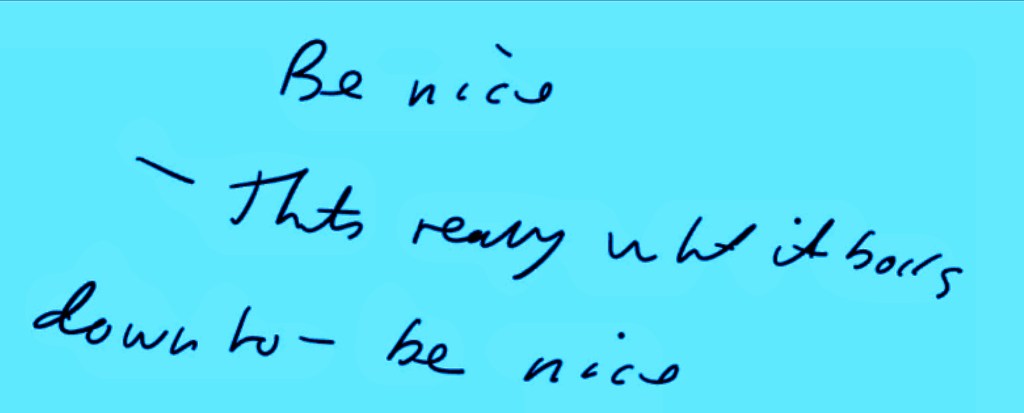
Then I found myself (again suddenly, right out of the blue) scribbling a note on my phone:
Be nice.
That’s really what it boils down to
Kindness in all our intereractions with all the forms that life has taken: other humans; other animals; plants; Earth herself; the rivers; the oceans; the forests. You name it. All forms that life has taken.
So, how do we be nice?
When I say it like that, it almost sounds silly; I mean, how hard can it be? Be nice? Easy.
Well, I guess I can say for myself that it’s true, sort of, sometimes. Yes it is often extremely easy for me to be nice. And, then, other times I have to try to be nice. And then there are those times when try as I might, nice just doesn’t happen.
Which means, I guess, that it might not be quite that simple after all.
There are so many wonderful explanations of the Buddha’s teachings, including The Eightfold Path, on the Internet. On the face of it, that might seem confusing. However Buddha himself advised that each person should question the teachings and come to their own conclusions. In other words, he said, don’t take my word for it, check it out for yourself.
The Eightfold Path. I might know that lovely list by name (Right Understanding, Right Thought, Right Speech, and so on), and I’ve read a little about them, but maybe it’s time to dig a bit deeper.
I’m going to make a start with Right Understanding simply because it’s the first on the list, and has always seemed to be a pretty important starting point.
So, next post (or perhaps a later one) that’s what I’m going to do. Just sit and see what comes out of my heart and onto the page (or screen). Please join me then and we’ll see what happens. Peace and love from me to you
A few weeks ago I finished one of the most extraordinary books I have ever read. Yes, I know: we live in the days of hype and the redundant superlative. Everything is the best, biggest, greatest. Or, conversely, the worst, most tragic, saddest; it goes on and on.
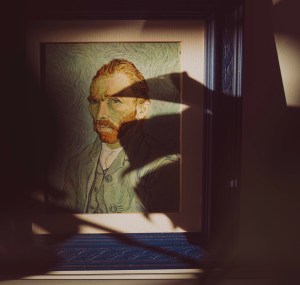
In this case however I am not exaggerating. This book was amazing. It’s Learning from Henry Nouwen and Vincent Van Gogh: A portrait of a compassionate Life, by Carol A. Berry. From this book I’ve learned as much and more about Van Gogh’s motivations, his vision, his art, and yes, his very nature and soul, than in everything I’ve read, seen or heard about Vincent until now put together. And that includes from several visits to the magnificent Van Gogh museum in Amsterdam.
The book had its genesis in a course the author sat in on in the 1970s put on by Henry Nouwen for Theology students. The course aimed at helping future ministers and pastors learn to connect with their future parishioners. Basically it was about accessing the compassionate sides of their own natures so they might better help others. Nouwen used Van Gogh as a the model of a person who had lived a life built on compassion for others.
The author has mined Vincent’s letters (mostly to his brother Theo) and studied deeply his paintings and drawings, in order to understand and demonstrate what it means to live a life of compassion, and to highlight the artist’s mission in life. For me that mission is summed up very nicely in a quote from one of Van Gogh’s letters:
Art is to console those who are broken by life.
Vincent Van Gogh to his brother Theo
I had a vague sense of Vincent’s spiritual leanings (I knew he’d been a missionary living among poor miners and their families to better understand and help them), and he’d tried to become a preacher. But, before finding this book my thinking hadn’t gone much deeper than that.
But, through reading this book I discovered Vincent was really what many of us might call a mystic. The author goes further and after what i’ve learned, I tend to agree with her: she thinks Van Gogh is a saint.
A mystic in the sense that he tried to live a holy and compassionate life. He viewed all nature (of which he concluded humans are simply one equal part) as being expressions of the divine. And a saint in that he dedicated his life to making art that would inject light and colour into the darkness of people’s lives.
As I mentioned, Vincent had been a missionary for a time. But his radical way of living among the poor and sharing their lives in order to know and love them better was shocking and way too extreme for his bosses, and he had to move on.
So, he finally settled on full-on immersion in his art. His mission was to make paintings that offered comfort and consolation to those who are suffering. And that’s all of us to one degree or another isn’t it?
You can see by now that this supremely accessible (and pleasurable to read) work has had a profound impact on me. This book isn’t only for artists, nor is it a religious book; it is as I have said an inspiration and guide to living a compassionate and loving life.
I don’t want to just say ‘I can’t recommend highly enough that you read this book’; I want to say instead Please, please read this book. Then obviously act on what you have read!
I’ve always admired – loved – Vincent, now I think I know why. Or as Don McLean says in one of the most profound love songs (Vincent) in history (remember, I never exaggerate):
Now, I understand, what you tried to say to me How you suffered for your sanity How you tried to set them free They would not listen, they did not know how Perhaps they’ll listen now
I don’t remember when I began to collect quotes; my early teens I think. I just started making notes of quotes from books (even comics in those far off younger days), from conversations overheard. Then, later, little excerpts from my own journals and other writings. Even slogans I’d see on t-shirts, billboards, or wherever else.
This doesn’t mean much in these times when you can type in a search for quotes on any subject, for any occasion, by anyone from anytime in history. But, in those long ago days before computers were in our hands, and certainly way before the Internet, it wasn’t so quick and easy.
Anyway, fast forward to the not so distant past;One day I sat at the computer (it was time for computers, thank goodness) and typed up all those collected quotes stored in several boxes full of little notebooks and scraps of paper.
The result is literally hundreds of pages of tightly typed quotes. That typing (which in fact took me quite a bit longer than one day) was in fact the genesis of a book that has remains half written.
You see, as I typed I saw so many great words of wisdom that I just felt compelled to put some of them together somehow. Ive now been at that task for many years: its a very intense process and takes so much energy and, as any writer will tell you, the muse has to strike before we can begin to strike those keyboard keys! Anyway, it will be done when its done; the very notion of presence, of there only being now, is actually one of the major themes of the book.
As I got to the end of that original typing marathon, I noticed that, strangely, the very last quote in that long long list reads simply, If you. Clearly a sentence begun but left hanging. Who will ever know what would or should or could have come next but never did?
Some time ago I remembered that interesting little fact and began to think about its meaning. I decided to do a quick search of the whole collection for that little conditional phrase. The search revealed that there are 139 instances of quotes beginning with If you.
So, dear readers, dear friends and fellow travellers on life’s journey, here are eight (why pick ten like everyone else would?) of those quotes, chosen at random (is there such a thing really?).
No commentary or comment from me; you, the reader, can do very nicely without my two cents worth thrown in. Well, okay, just 2c worth: I have often learned a lot from quotes such as these (not necessarily these ones specifically); sometimes a simple quote has led to a healing or an important insight.
So, I thought it would be a great idea to share some of my collection with you and perhaps there will be one or more that strikes a chord:
If You …
If you allow things to surprise you, you will get easily confused.
If you always do your best, you will be free from regrets.
If you follow the eternal law, you can understand how to love.
When you forget who you are, and dont know what to do, act the way you would if you did.
If you really dont care, you arent going to know if something is wrong. The thought would never occur to you. The act of pronouncing something wrong is a form of caring.
If you have to ask questions all the time, you never get time to just know.
If you are not interested in this, then why are you here?
If you deny even one person entrance to your life, youll never get their uniqueness from anyone else.
So, there you are. Theres much to reflect on here. Lots to focus on, to meditate on, and contemplate.
I wrote this little remembrance about the birth of my journaling life some time ago. I thought it might be nice to share it here on my new Notes from the Hermit’s Cave blog as keeping a journal has been such an important aid to my own ongoing healing, and has been key to my spiritual journey.
For many of us keeping a journal is a key element in our efforts to live a good life, or even to have a life: it can be a tool for healing, a means to bring some order to the chaos in our hearts and heads, and a venue for reflections on life, the Universe, and everything. For me, it’s been all of these things and more.
I guess for most people Henry David Thoreau is best known for the book he wrote about his time living alone in a small cabin on Walden Pond in Massachusetts, titled funnily enough Walden. And I suppose most people would have no idea that all, or pretty much all, his writings, lectures and so on, came from his Journal. Note the capital: he himself called it The Journal.
A few years ago I read a very cool book called The Book of Concord: Thoreau’s Life as a Writer, which is an examination of, yes you guessed it, his life as a writer. What made it extra interesting was the way the author (William Howarth) used The Journal as his way into Thoreau’s writing and life.
Let me tell you one of the many things that jumped out at me from this fascinating book: the reason Thoreau started keeping The Journal in the first place. It seems that one of his neighbours in Concord was Ralph Waldo Emerson (imagine that if you can). Anyway, one day Emerson says to Thoreau,
‘What are you doing? Do you keep a journal?’
Now, it seems that Thoreau had been running around telling everyone he was a writer and that he was examining nature and studying the life of the town. All that writerly kind of stuff. But he hadn’t been keeping a journal.
So, he answered Emerson’s challenge by beginning The Journal. And, as I said, all his writing from then on came right out of that journal. Sometimes, believe it or not, he literally ‘cut and pasted’ from The Journal; he actually tore out pages or cut up passages and stuck them together to form the final manuscripts. Now, that is called having supreme confidence in your own work.
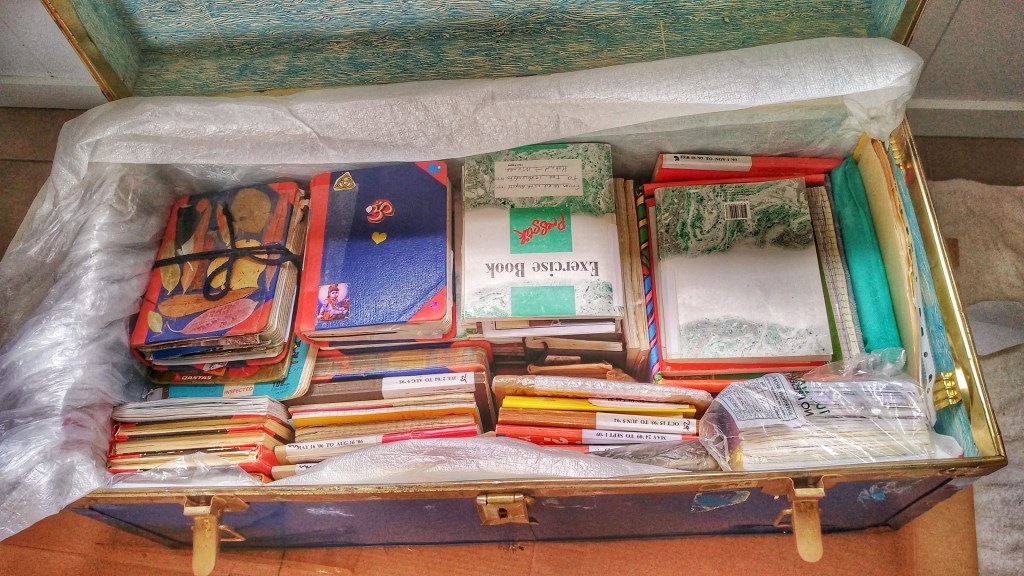
Anyway, after I read that, it got me thinking about my own journal and how I came to begin it. As I sit typing this, my journal is safely stored away in a trunk in my sister’s garage. (See the update at the end. Strange syncronicity indeed)
There are close to one hundred separate volumes, mostly school type notebooks (called exercise books in Australia), some exotic volumes from travel in India and a few odd looking specimens of varying shapes and sizes. Hard to believe really: so many words.
This is my personal journal; my art journals are another matter. Just wanted to make that distinction, though oftentimes it’s hard to tell the difference.
In late 1980, I returned to Australia after a few months in New Zealand. I wasn’t in great shape and was hanging around at my parents’ house and feeling like a ‘wet week in a thunderstorm’ (if you get my meaning). One day, my mother out of the blue said,
‘Why don’t you start keeping a diary?’
Of course you don’t know my mother, but believe me when I say that this is most definitely not the kind of thing I’d have ever expected her to suggest to her son as a way for him to deal with his very poorly mental condition.
But, just like Thoreau after his chat with Emerson, I headed to the shops without delay, bought a school exercise book, and began my diary (I often interchange the terms diary and journal). And I’m still at it, as I’ve said.
And you know what? Thinking about my journal now, I feel a sense of pride. I don’t mean arrogant, ego driven ‘pride’: my heart is glad. I have consistently for over forty years kept a record of my life which goes deep into my psyche and beyond. Well that’s what it often feels like.
Sometimes it’s been an extremely detailed account and written every day; other times there have been gaps with just scant little notes to record my doings, thoughts, feelings, and so on. But, at least it is there. I have a profound sense of achievement when I think of my journal. Maybe I need to adopt the capital like Thoreau: My Journal.
My final words must be then, thanks Mum. I know I thanked you when you were still in this world with us, but it can’t hurt to announce my thanks to the world (as much of it as reads this blog anyway) can it?
Update
The trunk containing The Journal has left my sister’s garage (thank you little sister) and is as I type this update, on a truck heading this way and will arrive late tonight or early tomorrow.
The timing is completely serendipitous: By ‘chance’ I came across the above piece of writing today as I was looking for other things, then a little while later got a call from the shipping company with the news! Pickup wasn’t scheduled for a few more days.
Of course I still regularly spend time with The Journal, perhaps more than ever, and it will be very nice indeed to have the whole thing with me once again.
Yet Another Update
Yes indeed, it certainly is, nice I mean. Here is The Journal in its full glory (one volume missing but will be here soon)
A couple of days ago when this powerful and important statement in the form of this illustration showed up on my social media, I was struck by something I don’t think I’d noticed before. Suddenly I saw: ‘might not change the world”. Might not? Which gave me the idea: it could as easily say ‘Helping one person might change the world …’.
But, you know, my thinking went even further: I realized that might and might not have nothing to do with it. The reality is that every action we take, and that includes the action of helping other living beings, actually does change the world.
Well, firstly, which of our actions help other beings, and thus change the world, we can’t always know. And obviously we can’t always (actually it’s more like very rarely) see the impacts of our actions. And even if we do, it’s likely that we’ll only directly get to see what happens in a limited and local sense. Nevertheless, all actions have a tendency to result in a domino, or cascade effect that literally never stops.
But, wait, there’s more. I kept thinking about it, and came up with a couple of ideas about why it could be a good idea to change the might not in this marvelous saying, which speaks of a negative possibility, to always will, which points to something definite.
All is one on the physical and the non-physical levels
We’ve all had those moments when we sense a connection with the rest of the world; we feel that we are part of nature, part of something bigger than just the one of us.
But, have you ever felt you were even more than just a ‘part of’ the world or nature? Have you ever had a sense that you are nature? Maybe this sounds a bit esoteric: we are one Self; we are all manifestations of the divine; we are all sparks of the one light, and so on.
And of course we can’t know for sure what goes on beyond the physical world. But, even at the most basic level of the material world, especially as we get down to the microscopic and even atomic levels, it’s hard to see any ‘separation’ between any individual and another. Atoms merge and cross over, interact, and change, energy fields collide and mingle, between all living and non-living things.
So, who’s to say that one small action on my part, one small change, won’t have a cascading effect as the ripples (that’s a good way to put it isn’t it?) from that action spread through the world and beyond?
The ‘What can One Person Do?’ Dilemma
Our Sydney Smith quote partially answers this agonising question for us as we’ve seen. Still, you might think that one person can’t do a lot when the needs are so many and so vast, and when most problems in our world seem to be so intractable. Mr Smith says that there is always something you as one person, as an individual can do, even if it’s a small thing you do.
Just think how many people everywhere are asking this same question: ‘What can one person do?’ If even a tiny percentage of those individuals answered that they could do something, then you would start to see changes taking place for sure. How could all those actions not add up to a changed world?
The Multiplyer Effect
Just now I used the words ‘add up’. Well actually it’s more like a multiplication effect isn’t it? If we say we change the world by helping just one person, then there has to be a Multiplyer at work I think.
We have all heard that aphorism that if you give food to a hungry person then you feed them for a day, but if you teach that person to produce their own food, then you feed them for a lifetime. Another truism definitely.
Still, once again, I think we can go further. Is it possible that by teaching one person to produce their own food you can help the whole world eat properly? Let me tell you a story I heard on an online video just a few days ago.
A man was traveling in a poor part of a country he loved. He’d spent the previous few years in another part of the same country building a house and growing his own vegetables and fruits.
He met a local person who was renting a small block of land, and that person asked him if he could help them build a house and teach them to grow their own food. It was a poor area, and the land was pretty much a little slice of jungle.
Anyway, this man agreed to help, and has been there for a few years now. He showed that local person how to grow various fruits and what looked to me to be a huge variety of vegetables. And they didn’t forget the flowers either. As the seasons passed, seeds were gathered and more land turned over to growing food.
Apparently from the very start they had a surplus of the fruits and vegetables they were growing, so they began offering them to neighbours, most of whom were also very poor.
Our traveling friend then showed them how to collect seeds from the food they ate (and the flowers too) and began to show these neighbours how to plant, fertilise, care for, and harvest what those seeds produced. In this way they too were able expand the amount of food they could grow.
So, already there is a growing area of this one slice of one country, that’s becoming self sufficient in fruit and vegetables. Now, that’s not the whole world obviously, but you’d have to agree, it’s a good start.
Anyway, just think: those people now have skills and surplus food and seeds to share further afield. Who can say how far such action might spread? It all sounds quite simplistic put like this, but it is the way that many grassroots movements for change have worked. And remember, nobody can reliably predict the ongoing impacts of any actions.
So, yes it is true, helping one person does indeed change the world for that one person. But whatever we do for one person, it also does definitely change the world beyond. As we’ve said, we may not see how or that it changes everything in the world and certainly not all at once.
We may think of ourselves as just one separate little individual, but we are united with all life. We may think that it’s all too much; too many problems; what can I do? The road to changing the world seems to be blocked, seems to be impassable.
Well, one teacher I admire is Swami Ramdas who founded Anandashram in India. Among the many great things he said, this one stands out for me above them all. I may have the wording a bit wrong, but basically the message is:
Once you have set your feet upon the path, then you are already at your goal
Which is another way of saying that if you help one person, then you have already changed the world.
Well my friends, here we are at Part 5 of my little mini series. As it happens, it’s also the final part.
It’s been a fascinating trip, this little journey we’ve shared. Reflecting on the set of vows usually made by nuns and monks, and how my way of living fits with these undertakings. How well do I live these vows? As a philosophy directing my life, do they work?
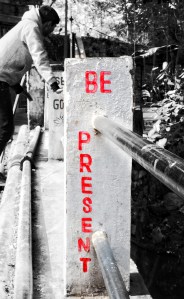
Let’s get on shall we? The final vow is Presence, which is the new interpretation on the vow of Stability taken when a person makes a life commitment to a particular place and or community. Obviously for one who moves as much as I do, presence is probably the appropriate concept to take its place
Presence
Just now I was thinking that by far the easiest of the topics we’re looking at here, is Presence. Yet at the same time it is the absolute hardest to write about – even worse to think about.
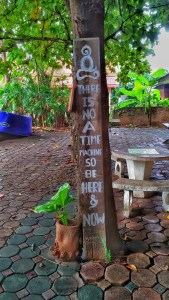
Why easy? Well, because in a very real sense there is nothing we can say about presence or the present. Of course I could spend the rest of my life reading books, studying, and even writing about it myself; how to live here and now. But all the time the obvious would be staring me in the face.
How can we be anything but present? How is it possible to be anywhere but here? And surely it’s always now? A thing called ‘the past’ doesn’t exist except in memory, and the future? Well, where is it? it doesn’t exist. Never will. I know it’s kind of common to hear things like ‘We’re living in the future’, but are we really? Of course not. So, end of story right there I guess.
Except that it’s not, is it? This is where it gets to be the hardest topic to talk about. It seems none of us – us humans anyway – can get our heads around the aforesaid obvious fact of life: we are always here, and it is always now. Why is this so?
Well, speaking only for myself, you understand, I think about it too much. I seem to have convinced myself (courtesy of my ever-busy mind) that there is a way to learn to be present; a how to guide, that I can read or invent myself that will finally allow me to put myself into the present, in the here and now.
And all Along I am sitting here, thinking and writing about how to be present or put another way, how to sit in this spot right now.Do you see where this is going? If I’m not here and it isn’t now, then where am I? And when is it?
Sorry, but I have no answers. Even asking the questions is denying the obvious: I am here, it is now. The trouble is my mind isn’t at all ever content and happy with the present, regardless of how I might feel about it.
In that case, can I say that in my way of living I am committed to presence? To be in the present? Well, speaking for me personally – whoever that me is – perhaps the better question might be: Do I fullyrealise that I can only be here and now because that’s all there is?
To that I would have to say definitely not. My mind is continually on the run between the deep past and the unreal and unknowable future and all points in between. And my mind loves repeat journeys too!
So how do I intend to come to that place of the realisation of presence? Well, before we go on, you can’t actually intend to be present. Intention is about …
Enough!!!! Enough mind stuff. Please
The truth is, there is nothing for me to DO. I am here; it is now. That’s all there is.
Except one more thing to do: I just have to wake up
Over the years I’ve tried many types of meditation. But I always come back to the same method. I call it The Third Eye technique.
Once I’ve settled quietly, perhaps having taken a few deep breaths to relax a little, I bring my awareness to the centre of my forehead, the spot between my eyes. Traditionally, this is where the Third – or spiritual – eye is located.
(Actually that particular spot is in line with the Pineal gland which is located in the centre of the brain between the hemispheres, and its function is to help regulate sleep patterns.)
And then? Well, I know I’m not alone when I say that, no matter how hard I try, it seems a lot of the time nothing happens. Well, thoughts happen. Anxieties and memories intrude their pesky (and sometimes ugly) presence. So much for emptying the mind and having transcendental experiences.
Well, in fact despite evidence to the contrary, I – along with all of you who ‘try to meditate’ – do sometimes achieve a state of no thought, of total quiet. The problem is, of course, in a state where there is no thought it’s impossible to think: ‘Hey, I’m having no thoughts.’
As for the (rare) transcendent experience referred to: on those occasions something other than a thought, memory, anxiety, comes up; something that transcends those mundane ‘normal’ things.
See the tenderness. See the tenderness. See the tenderness.
These words seemed to come right after I’d thought for the millionth time ‘nothing’s happening’ while I tried to meditate one day a while ago.
Not spoken by a voice exactly, yet heard with my internal or mental ear. Clear and distinct; the same fully formed injunction repeated three times.
But, see the tenderness? I’m not sure where these words came from. The truth is I am a gentle person by nature; I am not naturally ‘tough’ or ‘aggressive’ or anything like that. But it’s also true that I’ve been all those things over long periods of my life. Nature vs nurture you see.
Anyway, what tenderness? Where? Does it refer to the tenderness that exists in the world?
Perhaps it’s to do with what I am supposed to be reading or otherwise taking in? Books, movies, and other story sources that speak of tender things and people?
Or might it be an injunction for me to redouble my efforts to turn away from the wold? To turn away from the horrors and the nastiness of Maya or the material and essentially illusory world?
And by this turning away from the world, perhaps tenderness is to be found and seen in a turning to the interior world, in the spaces of contemplation within Self.
This injunction (repeated emphatically three times. Sorry I already said that didn’t I?) does seem to have come from some part of my Self that longs for a gentler way to be, for a more tender way to relate to others and to Self.
Ideas and questions to contemplate and to reflect upon. Meanwhile, it’s a good start to know that even if my mind tells me otherwise, when I meditate, something is happening. Sometimes.
It is an old belief, and it is a good belief, that our life is a pilgrims progress.
Vincent Van Gogh
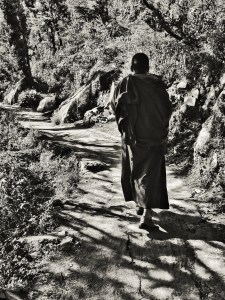
The usual definition of a pilgrim is a person who goes on a journey to a special place, a place that has significance for them, often as a spiritual exercise or quest. Sometimes the journey can be over long distances and a difficult road.
The key characteristic of a pilgrimage is that it is to be undertaken on foot, or put another way, a pilgrimage is a journey we (as the pilgrim) travel on by our own efforts, under our own steam as they say.
In this quote Vincent is talking about that other pilgrimage: the one that goes on on the inside. It’s referring to the idea that our lives can be an inner spiritual journey (or pilgrimage) from our present imperfect condition to a place or state of beatitude. Or as some might say Heaven or Nirvana. Others call it Self or God Realisation. And some other people call it Enlightenment.
You could say that Vincent is suggesting that a pilgrim is one who goes on a special quest to find the answers to life’s big questions; a pilgrim is a person who travels (either out there in the world, or inside on a journey of the heart, mind, and soul) to see, to learn, to do and to grow as a human being.
And, if all goes well, we end up in Nirvana, or a state of spiritual advancement as a kind of nice bonus at the end of the road
Spiritual for me in this context refers to the things that affect or relate to the human spirit or soul and might not be concerned simply with the physical or material aspects of life.
But here is the funny paradox about this kind of inner spiritual pilgrimage: as we learn, as we discover new ways of being and relating to people; as we find answers for ourselves and as we grow as people, we find that changes start to take place in our physical world.
From simply directing the wheres and whens of our activities in the material world, to pushing us in a direction of study, to influencing what people we meet, to the type of work we end up doing and to the actual state of our mental and physical health. It’s that inner pilgrimage that really is running the show of our lives.
So, as we travel the long road of our lives, let’s continue to learn. Let’s keep alert for those insights that come with a desire to grow and to work out what our lives and the world are all about. Above all, let’s keep on pilgriming down that road, and allowing ourselves to be open to new experience, new people, new ways of being.
Another quote from Vincent that I particularly resonate with. This time from a letter to his brother Theo and talking about the lot of the pilgrim:














 Notes from the Hermit's Cave