Let the Music Play

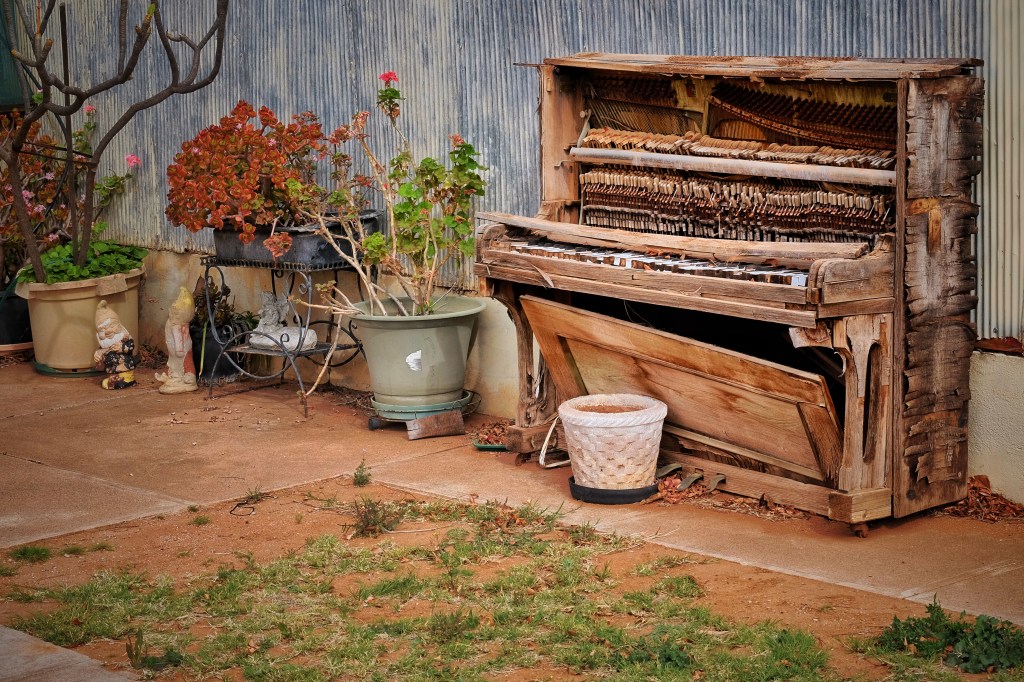
When thinking about a name for this photo I was really tempted to somehow reference the song American Pie by Don McLean. The phrase from the lyrics ‘the day the music died’, kept coming to mind – even as I made the photo of the scene.

By the way, ‘the day the music died’ refers to the plane crash in 1959 in which the up and coming Buddy Holly, and the more well known Ritchie Valens and The Big Bopper were killed.

And there was that brilliant MASH scene coming to mind. In the scene there is concert pianist who has lost the use of his right hand in battle. One of the doctors attempts to encourage him to not allow the music to die, to find other ways than actually playing piano to share the music.

Both connections seemed obvious: a very old dead piano decaying, returning to old forms of itself. But then it struck me: it was the instrument that had died and was changing forms. All material things change, die, becoming something else.

The music on the other hand, hasn’t died. It not only survived that plane crash and the transition of those three singers, it has thrived. Their music lives on. Music can’t die. Why?
Because music is life. Vibrations, harmony, and sound itself, are the foundations, the roots of ‘life the universe and everything’ (to borrow an old expression). As such, music is not a tangible, physical thing and it needs an instrument to make it manifest in the world; music merely passes through the instrument and emerges into being.

I liked that MASH episode. The doctor (stuffy Major Winchester) says to his patient, the wounded pianist, that as a skilled surgeon he has hands that ‘can make a scalpel sing’. But really, what he’s wanted all his life to is to experience music the way the pianist has.
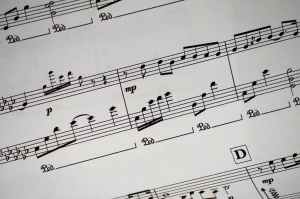
He says he can play the notes, but he doesn’t have the gift that would allow the music (as in Chopin, Brahms and the rest) to flow through him. He tells his patient, who is depressed and unwilling or unable to consider that the music may not have died:

The gift does not live in your hands. The true gift is in your head, and in your heart, and in your soul.

Major Charles Winchester
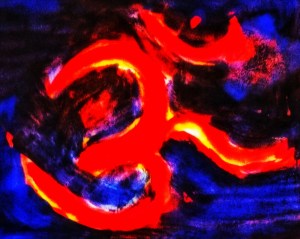
Hearing that line again reminded me of Om. There are a number of religious traditions that consider OM (sometimes spelt as AUM) to be the primordial sound, the very source of creation. The word itself, when written is considered sacred.

Then there is the verse from the Christian Bible that makes the exact same assertion:

In the beginning was the word and the word was with God and the word was God.

John 1:1-3
Well, music needs an instrument – whether in the form of a voice, body, mind, or in an object made of wood, strings, brass, or something else – in order to manifest into the material world and to be experienced by us.

Just think: the piano in my photo in the front garden of a house in a mining town has most likely allowed many generations to experience music. Accompanied them in celebrations and greivings; helped so many through good times and bad times; witnessed people laugh, cry, and even dance;

Of course, Major Winchester’s gifts as a surgeon are that he is a instrument for the vibration, the music of the universe, to make itself manifest in another way.

And what he is essentially saying to our wounded pianist is: ‘Look you can shut it off forever (his words) or you can continue making your gifts – your Self – available as an instrument that allows that music to come into the world for everyone to share’.

Well dear friends, I have pledged to carry on using my gifts and be available in just that way that allows the music to come through me in whatever form and shape it takes.

By gifts I mean those things that have been granted to every living being: the ability to create harmony; the ability to make and spread good vibrations; and the capacity to appreciate and celebrate beauty.

And when you think of it there is no way to put a limit on the number of ways that the music that is Life might be channelled through each and every one of us

A good place to pick up some good vibes, get into harmony with yourself and appreciate beauty all at the same time

In my own ways I try to make harmony in and around myself as much as I’m able. I am always attempting to cultivate behaviours and attitudes that help to create and spread good vibes. And I constantly seek to appreciate beauty, even when the world seems to be only ugliness.

Of course, as I say I am only the instrument. The music -the beauty, good vibes, and harmony – exist with or without me. But music in whatever shape and form it takes needs an instrument if it is to come into our material world and be there for all of us to share.

So, this is my prayer: that at least every once in a while, every now and then, I can actually be that instrument .

PS Just a little postscript. When passing that particular garden (the piano garden I call it now) I was drawn to this:

Eagle-eyed Garden Guardian

Just as I photographed this lovely creature, I heard my partner’s voice:

‘Did you see the piano?’

Now being in what you’ve heard me call the Zen Zone I was fully focused on and absorbed in, our winged friend. Coming back from wherever I’d been, I did in fact notice the piano.

You see, you just never never know where the music is going to come from. I might not have seen the piano with my own eagle eye but lucky for me music had a ready and willing instrument standing by to remind me of which way to look.

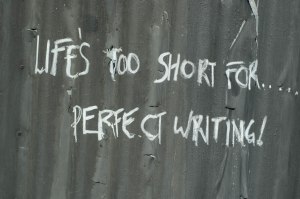
Is Life Too Short for Perfect Writing?

Greetings and welcome friends

Let me share a little secret with you: I have and always have had, atrocious handwriting. And it’s always been a major frustration (but a huge incentive to learn to type, which is one of the best things I’ve ever done).

Perhaps it’s because I had some sort of learning difficulty, maybe it happened because every state in Australia has a different way of teaching kids handwriting, or maybe its just that I was and am lazy. Actually, scratch this last one: I am not nor have I ever been lazy.

Anyway, it appears to be a fact of life, yet I do still get frustrated from time to time. But then there are times when I decide not to care, that it isn’t important, doesn’t matter. Being in one of those indifferent phases right now, has reminded me of an incident that should have taught me this lesson once and for all.

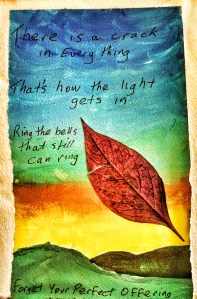
A while back I was gifted a small painting. The artist wasn’t satisfied with it as a background of a planned piece, and gave it to me thinking I might like to ‘do something with it’. I happened to think it quite a lovely painting in its own right actually, and as I was looking at it, I thought of a leaf I had collected a couple of weeks previously. A beautiful very soft and pliable purple leaf from a lovely shrub.

So, right away I just got to sticking that leaf onto the painting. As I pressed it down, a little tear appeared in the leaf. Immediately a lyric from Leonard Cohen‘s Anthem came into mind:

There is a crack, a crack in everything. Thats how the light gets in.

So, I began writing bits of the lyric onto the painting. Untidy, irregular and typically atrocious the hand writing, or printing, is. But then it struck me: that’s the point! I mean the point of Mr C’s sublime words:

Ring the bells that still can ring
Forget your perfect offering.
There is a crack, a crack in everything
Thats how the light gets in.

Here’s how I thought about what I’d written on the painting and how I’d written it: I rang a bell that I can still ring: I thought of and wrote down those beautiful lyrics to compliment the accident (is there any such thing as accident?) of tearing a leaf on a painting that ‘didn’t work’ for the artist, but that was working for me.

Therefore, the painting, the torn leaf and my handwriting was not a perfect offering in any kind of conventional sense as the world would view it. In other words there is a crack, both literal as in the tear in the leaf, and metaphorical as in the imperfections of the whole piece.

But—and here is the vital thing—this little painting, despite its initial rejection by the artist, and with its imperfections, its sloppiness, and its flaws, has provided a channel for light to get in. Into my life, into the piece itself, and now, through this sharing, into your life.

So, who cares if my handwriting is not conventionally perfect or is untidy, uneven, and even a bit tricky to read? I love the message in those lyrics; I felt that this lovely painting with its torn leaf to be the way to put that message in a concrete form. I mean, really, isn’t life too short for perfect (hand)writing?

PS I no longer collect leaves and trap them in this way. I may collect them, but after a time, I return them to their natural environment. Fallen leaves have their function in the cycles of nature too.

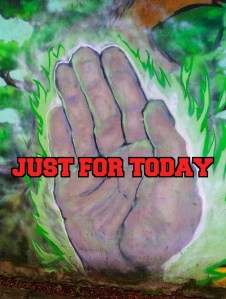
Just For Today

There is a song by George Harrison that I like very much. Actually there are many songs of his that mean a great deal to me. He’s been a kind of mentor or teacher for me since the early 70s. But, having said that, there is something about Just for Today that really does resonate deeply within me. It’s not even one of his ‘biggies’, and was released in 1987 on the album Cloud Nine

In fact, if you read the lyrics of the song. Or even better, listen to George actually doing the song himself, you’ll most likely agree that this is more than a song. This is a refrain, a plea, even a prayer. No ordinary pop song anyway.

If just (for) today
I could try to live through this day only
Not deal with all life’s problems
Just for today

Then, the other verse (there are only two):

If just for tonight
I could feel not sad and lonely
Not be my own life’s problems
Just for one night

How many times have I made these same pleas? I don’t think I’d be able to count them. Of course I’d guess we all have at some time or other (or even quite often, all the time, every day, ahhhhh!!!!!!) wished or prayed for the problems (whatever they may be) to just go away, even for just a day. No, not even a whole day. How about just for a few minutes?

So, I’m not alone then. Still, it’s no consolation is it, to know that we all go through the same wishful thinking to be rid of the same or similar problems? I think, though, in this song George has given us a clue to what we can do to bring ourselves a little more into the present when it comes to the angst we weigh ourselves down with over ‘all life’s problems’.

And actually, he’s suggesting not that we focus fully on the present moment, the micro if you like, which can be tricky at the best of times. He’s given us a bit of a an easier task: Just look at this day only. Perhaps we can better look at a whole day than this ‘moment’ or ‘second’. A day is sort of a macro moment, a bit easier to get hold of.

But, that last little question, about always me being my own life’s problem, that’s what I really try to get to grips with. I am my own life’s problem. The problem is not the family I was born into. It’s not the less than idyllic childhood I endured. It’s not even the bullies I seem to have attracted to myself over many years in far-off school days.

The problem is not even the anxiety that I seem to have been born with, or that’s evolved over time. Nature vs nurture?

And I can’t even say that the problem is the kinds of choices I’ve made about life, work, thinking, and all the rest, over the years.

No. None of this. The problem is me. And, let’s get really trippy here: the problem isn’t even me. It’s the physical manifestation that thinks it’s me and which exists in relationship to the physical world.

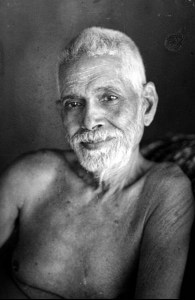
So, who is the real me? Who am I? Ah, well, these are the really big questions. Asking these questions is called Self Enquiry. And I think it’s helping me.

Whenever one of those life’s problems, or anxieties pops up I try to remember to ask: ‘To whom is this feeling/thought/memory occuring?’ That answer is (obviously) to me. And then I ask, ‘Who is this me? Who am I?’ Then, for the minutest of tiny moments, it all stops. Sometimes.

You see, I’m not really able to answer that Who am I question. The best I can come up with is a never-ending list of who I’m not, or what I’m not. It’s called Neti Neti: not this, not that. So, if I keep returning to who am I every time one of those ‘I’m not …’ comes up, what happens?

Well, in theory, nothing.  The idea is that asking Who am I stops the mind. It can’t answer. If a mind can’t answer, there can be no thought. And if there is no thought, then mind ceases to exist. (I’m not talking of brain here, but mind. It seems to me that the mind has no existence as a distinct entity of its own. It is more what we could say a ‘place’ that comes into being when thought happens. No thought, no mind.)

This cessation of thought is only a momentary thing. Thoughts soon come barging back (it also seems to me that while mind might not actually exist, it has a way of making its presence known in no uncertain terms). One thing I try to remember that causes me no end of extra thinking, is the fact that if we are not having a thought, then we can’t ever know it. You can’t have a conscious thought that says ‘hey, I’m not thinking now’

I see this Self Enquiry as a way (in a long term, lifetime kind of way) to rid myself of my incessant thinking and the confused (confusing too) and useless thoughts that arise all the time. For me it is, in a sense, a way to become mindless.

In that moment, when thought ceases, there is no pain. There are no questions, and there is no anxiety. There is no dread; no hope even. Basically you can say there is nothing for that tiny moment.

And that’s me, the real me. In that little moment (who can measure the length of a moment?), there is presence, as in I (the real I) am present, right here, right now.

Actually there is no time, as we measure it in the world, in that little moment (or whatever we choose to call it). Perhaps it’s more accurate to call it a state of being.

And it’s a state I’d like to be in more often. Not, as I say, that I’d know I was in it. Only by what you might call the spin-off effects of more calm, more clarity, less anxiety, all that sort of thing. In a way I would call that a state of grace.

All I can say is that it is exactly where and when and how I want to be.

Just for today.