Recently I came across some notes I’d made about a book I read ages ago, at least a year I think. Anyway, the name of the book: The Art of Mindful Walking. Sorry, but no prizes for guessing what it’s about.
Reading my notes I see that I had been particularly taken with what the author had to say about ‘our place in the Universe’. He reflects on our – humanity’s that is – perception of our size in the big scheme of things.
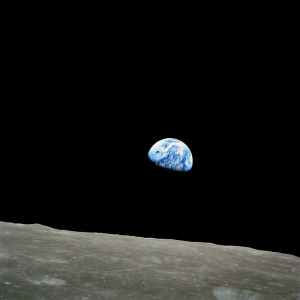
The author recounts how we once went for a walk with American astronaut Dave Scott, who’d been to the moon on one of the Apollo missions. Scott described to him what it felt like looking back at Earth from the surface of the moon:
It hangs in the black sky like a glass bauble, a blue and white Christmas decoration. It’s a small, fragile world.
Ford then goes on to reflect that this image, of a small, fragile ball floating in space, has ‘become a part of the modern psyche’. Then he says:
We begin to see how vulnerable we actually are. We are the first generation truly to see this. We are also the generation that is coming closest to polluting and destroying it.
I don’t think I’d quite looked at it in this way before. And I admit, it stunned me a bit.
Just think: Of all the humans who have ever lived, those alive in the last 50 or 60 years have been the first to see our home planet in its entirety. At least we’ve had the good fortune of seeing images of Earth just as those astronauts saw it. Thanks to those images made from space, we now have had a glimpse of where we actually live and the nature of our world.
Yet, at precisely this point in our history as a species, when we have that particular knowledge, this is the time we seem to be almost wilfully destroying the very ground we walk upon, the air that keeps us living, and the water without which there is no life.
I’m not a warrior. I am a hermit and a pilgrim and I try hard to not make judgements. As such, I can only look on in wonder.
And I can pray.
Thanks to Jimmy Buffett for the title. It’s a line from one of his greatest songs, called Defying Gravity. Thanks Jimmy for all the music man.
Let me share a little secret with you: I have and always have had, atrocious handwriting. And it’s always been a major frustration (but a huge incentive to learn to type, which is one of the best things I’ve ever done).
Perhaps it’s because I had some sort of learning difficulty, maybe it happened because every state in Australia has a different way of teaching kids handwriting, or maybe its just that I was and am lazy. Actually, scratch this last one: I am not nor have I ever been lazy.
Anyway, it appears to be a fact of life, yet I do still get frustrated from time to time. But then there are times when I decide not to care, that it isn’t important, doesn’t matter. Being in one of those indifferent phases right now, has reminded me of an incident that should have taught me this lesson once and for all.
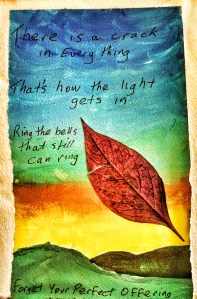
A while back I was gifted a small painting. The artist wasn’t satisfied with it as a background of a planned piece, and gave it to me thinking I might like to ‘do something with it’. I happened to think it quite a lovely painting in its own right actually, and as I was looking at it, I thought of a leaf I had collected a couple of weeks previously. A beautiful very soft and pliable purple leaf from a lovely shrub.
So, right away I just got to sticking that leaf onto the painting. As I pressed it down, a little tear appeared in the leaf. Immediately a lyric from Leonard Cohen‘s Anthem came into mind:
There is a crack, a crack in everything. Thats how the light gets in.
So, I began writing bits of the lyric onto the painting. Untidy, irregular and typically atrocious the hand writing, or printing, is. But then it struck me: that’s the point! I mean the point of Mr C’s sublime words:
Ring the bells that still can ring Forget your perfect offering. There is a crack, a crack in everything Thats how the light gets in.
Here’s how I thought about what I’d written on the painting and how I’d written it: I rang a bell that I can still ring: I thought of and wrote down those beautiful lyrics to compliment the accident (is there any such thing as accident?) of tearing a leaf on a painting that ‘didn’t work’ for the artist, but that was working for me.
Therefore, the painting, the torn leaf and my handwriting was not a perfect offering in any kind of conventional sense as the world would view it. In other words there is a crack, both literal as in the tear in the leaf, and metaphorical as in the imperfections of the whole piece.
But—and here is the vital thing—this little painting, despite its initial rejection by the artist, and with its imperfections, its sloppiness, and its flaws, has provided a channel for light to get in. Into my life, into the piece itself, and now, through this sharing, into your life.
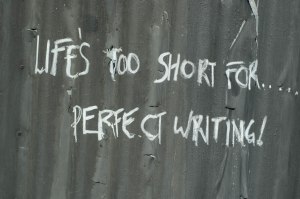
So, who cares if my handwriting is not conventionally perfect or is untidy, uneven, and even a bit tricky to read? I love the message in those lyrics; I felt that this lovely painting with its torn leaf to be the way to put that message in a concrete form. I mean, really, isn’t life too short for perfect (hand)writing?
PS I no longer collect leaves and trap them in this way. I may collect them, but after a time, I return them to their natural environment. Fallen leaves have their function in the cycles of nature too.
Welcome to another post. Just a little note before we get into it: This one picks up where the last one left off. Kind of. No need to read that one first, unless you want to.
And that’s the whole thing in one sentence, or at least in part of a sentence: unless you want to: none of it is any of my business. What do I mean when I say ‘none of it’? Just that. None of it. Or we can say it in another way: the only thing that is your business is you.
But, all of us are bound to ask, how can I simply mind my own business in a world torn by endless war? How can I ignore the environment I live in and that it’s dying before my eyes? How can I turn away from the evils of racism, injustice, greed, and cruelty?
Well, the simple answer is we can’t and we shouldn’t. Of course, in order to reconcile this apparent contradiction, it would be helpful to clarify exactly what we mean by minding our own business.
In essence my business (or yours or anyone’s) is anything that has to do with me: what I do; how I behave; what I think, feel, and believe; my behaviour and attitudes towards others; and—and this is the key—how I interact with and respond to the world as I experience it as I go about living my life.
So, it isn’t completely accurate to say that the wars, racism, injustice, and the killing of the environment (and everything else) is none of my business; my business is limited to my interaction with and response to all of it. And that has to be determined by a range of factors like my nature, my abilities, my circumstances, and so on.
Above all, and as Susan Sontag, American writer, philosopher, and political activist, said in a speech in 2004:
To be a moral human being is to pay, be obliged to pay, certain kinds of attention.
While the theme of that speech had to do with the writer’s responsibility to truth, I think her assertion applies here and may provide a solution to the seeming contradiction between minding our own business while at the same time stating that our business can, should, and does indeed include what goes on outside of ourselves (actually as we shall see, in reality there is no outside or inside)
How we utilise our own personal resources is in the end for each of us to decide. In the sense of our engagement with the world, the most precious of these resources are arguably time and attention.
Each of us possesses these things in our own unique quantities, just as we all have our own unique qualities, so each of us has the opportunity to decide how we use our time, and what we pay attention to.
It is so very easy to be overwhelmed by the constant torrent of information detailing the horrors threatening to consume and destroy our poor Earth and the life she supports. It is so very tempting to throw up our hands in defeat, and shrug our shoulders as we turn away exclaiming ‘It’s none of my business’.
While none of us would blame anyone for retreating in this way, a great many of us realise that for us this is not an option. Well, as the Buddha taught, there is a middle way. A way that allows us to avoid this kind of ‘none of my business’ denial, at the same time as protecting us from being overwhelmed and beaten down by the scale of it all.
The first step involves surrender. Surrender to the idea that there is no ‘me’; there is no ‘you’. There is no ‘them’, no ‘us’. There is only ‘I’. Surrender to the notion that not only is all life ‘connected’ or linked, but to the thought that all life—human, other animals, plant, mineral — everything — is one. There is no separation.
Easy eh? Hardly. But this is where the paying attention thing comes in. Rather than being swamped by the never-ending tsunami, choose where to put your attention. Ask yourself, where am I able to place my attention? How can I—how am I able to—use my time so that I avoid drowning yet still contribute to the well-being of the whole of which I am a part?
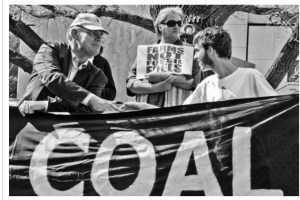
Obviously, as I hinted at above, the answers will be different for each and every one of us. For some, the kind of attention they pay will involve being on the literal front lines, working in the political field, or with activist groups working for social justice.
Then there will be those whose nature compels them to choose to put their attention on a life of prayer, meditation, and contemplation.
For these people this requires the quiet and solitude of monastery, ashram, or cave (whether it be in forest, mountain, or suburban home). And along the huge spectrum in between, there is a a unique spot for every one of us.
Each of us is a part of the whole. Everything we do affects the whole. Remember that saying that goes something like: A butterfly flutters it’s wings in the forest and the sun rises? Okay, maybe I’m pushing it a bit, but you know what I mean.
Never underestimate what (you perceive of as the little) you’re able to do; no one can say what impact it will have. All that is required of you is that you mind your own business.
During the early days of the pandemic, I lived in a small town out on the edge of the Outback. But after a few months, the time felt right to head for the coast. Slowly. With that in mind and headed in the right direction, I spent six weeks in another small town in that semiarid zone, staying in a motel.
I liked it there, at the Maria Motel in Moree. Described as a low-key 1960s era motel, the Maria is right across the street from the Artesian Hot Pools, which are Moree’s claim to fame. For me (for us), it was another temporary hermitage and safe haven on the side of the road in which to take shelter for a while.
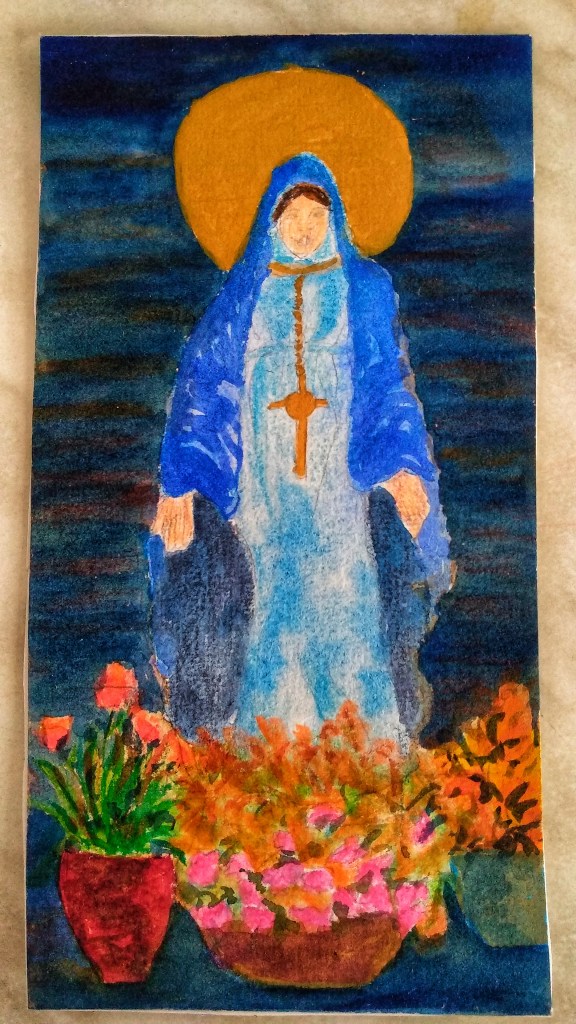
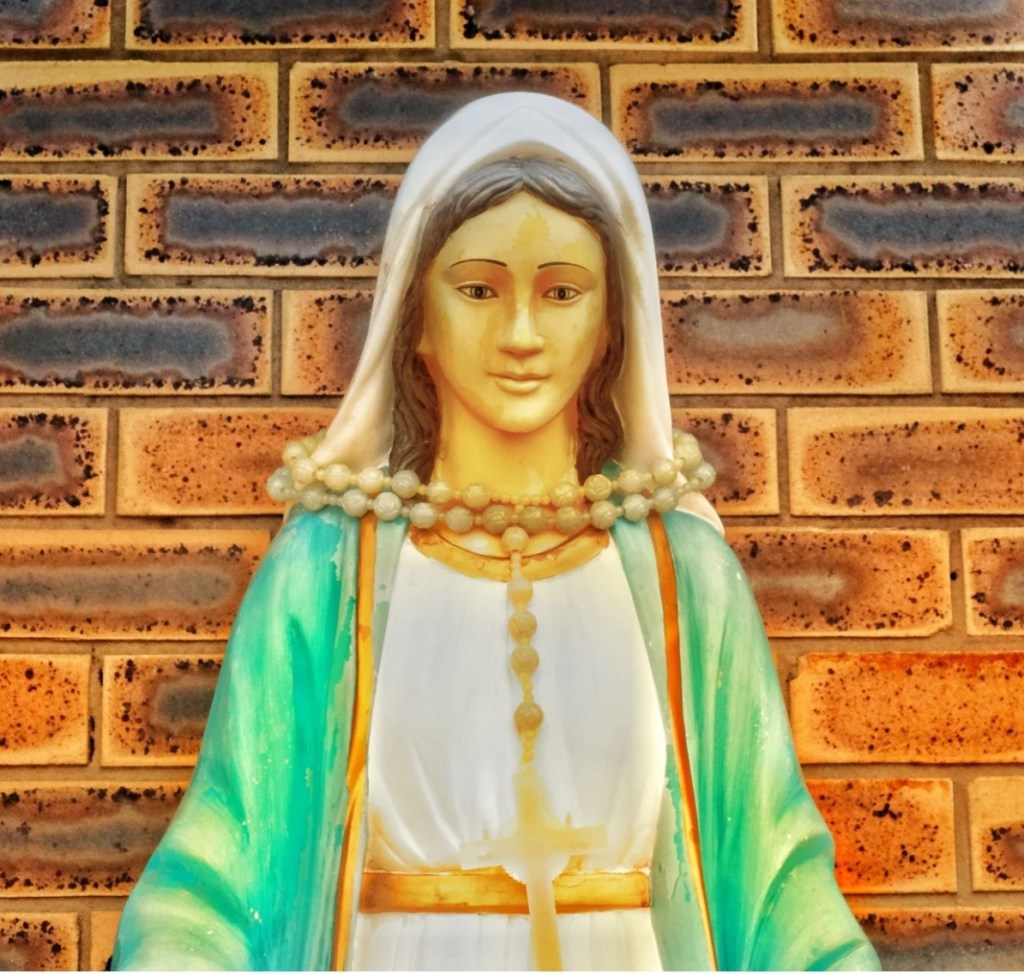
My favourite among the list of things I like about the Maria Motel is the statue of Mary out front in the courtyard. The Virgin Mary that is, Our Lady, the mother of Jesus. You know who I mean. And it isn’t only my Catholic upbringing and education that accounts for my fondness of Mary. It is more about what she symbolizes, what she stands for.
Watercolour by Pauline
For me Mary represents what I might call the feminine aspect of God. Some would call her the Earth Goddess. Mary is the mother, as in Mother Earth, Mother Nature. She is the feminine principle of the Universe. Respect and care for the mother is obviously the key to our survival.
This land from which this town was carved, has been inhabited since long before we began to mark time; since the beginning some say.
Those hot pools have been sacred for a very very long time. While nobody asked permission of the people who already lived here to build a town, at least when some of the invaders came they chose to honour the sacredness of the land they had appropriated by placing this statue representing the sacred feminine in sight of those ancient holy waters, and naming that temporary hermitage of mine, the Maria Motel.



 Notes from the Hermit's Cave