Seeking Justice: Commitments

This morning I was just sitting, or at least trying to just sit. You know, being quiet, relaxing the mind. All that kind of thing. And of course, an idea sprung into that not so cooperative mind, so I grabbed my notebook. Just as I went to put this latest brainwave on paper I noticed a very extraordinary note I must have made I don’t know when:
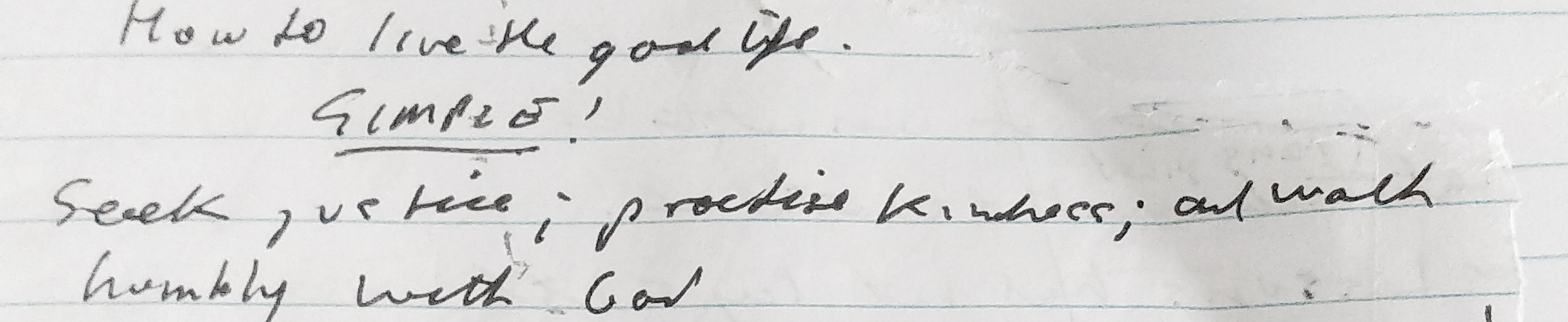
I’ve just looked it up: It’s a slight paraphrase of a verse from the Old Testament, from the prophet Micah. Where I read it, I can’t say (the note is at least several weeks old). But to quote another little note from some unknown source, I always like to:

Let the noble thoughts come to me from all corners of the universe.

unknown

I’m just like everyone else, always wanting the easy solutions and you can tell that can’t you? ‘How to live the good life? Simple!’. I mean really; hardly humble in my approach in that note was I? Well, let’s talk about what Micah says, not my own lack of humility.

Seek justice; practise kindness; and walk humbly with [your] God.

There are numerous versions online of this verse (Micah, 6:8), so I will leave it to you to check those out for yourself. I’ve added the word your because all those versions do say ‘your God’. But even in this paraphrase it’s easy to see there is nothing at all simple about any of these injunctions.

I discovered that this verse is often invoked in times of grave injustice, or crisis. I think it goes without saying that we would be hard pressed to think of a time that was not a time of grave injustice or crisis. Certainly, we are living in one of those times of injustice and crisis.
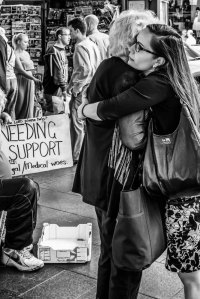
There’s no need to or purpose served by getting into how ‘grave’ injustice is now compared to some other time; there’s no need or point to weighing up the relative severity of one crisis versus another. Injustice is injustice; a crisis is a crisis.

In other words, the present is always the time to heed the injunctions of this verse.

So, what do we do if we are to seek justice? Running the risk of sounding flippant, I would say that there are as many answers to this question as there are people to answer it. Now, you would think this would make the task impossible; too many cooks and all that. But actually it’s perfect. Why? Because it means that whoever you are, whatever your situation, you can actively seek justice.

Or, I am sorry: I should say I, me. Not you. I can actively seek justice. But, you say, you are a hermit; you live in a cave (not literally but I know what you mean); you hardly ever even talk to people in ‘real life’. Yes, all true. And I would say that the action I take is by no means at the level I know I want it to be. I’m doing nowhere enough.

Does that mean I’m leaving the cave? Going out into the world, onto the streets to join other brave souls seeking justice? Believe me, I ask myself such questions constantly. But to speak truth to you now, I will say that I know absolutely, in my heart, that my role is something different.
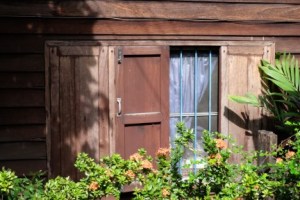
If anything, I need to go deeper into the cave; I need to go deeper into the inner world of my own Self. I know that in this way I will join with so many others in what I’ve come to call the Invisible Community of people all over the world living lives of contemplation and prayer. Or, speaking for me personally, trying to live a life of contemplation and prayer.

By so doing I am at least in a tiny way supporting those millions of others out there on the streets, in the aid groups, running campaigns, writing letters, helping the victims of injustice, in all kinds of miraculous, brave, and innovative ways.

So that’s my commitment to you. To deepen my prayer; to intensify my contemplation; to more fully realise my union with all living beings; and to really join with the invisible community in its efforts.

And, you ask, this blog? What’s it about then? Well, notes, musings, thoughts and reflections all aimed at reminding me of my responsibilities. And hopefully along the way, solidifying my union with you and the rest of creation, just a bit.

Peace and love

PS I haven’t forgotten ‘practise kindness’ or ‘walk humbly with your God’. Maybe another time.

What’s ‘Ordinary’ Got to do With It?

Perhaps shameful is too strong a word, but that’s kind of how it feels. You see, I’ve been thinking of giving up on the book I’m reading at the moment. And you are thinking, this is a big deal? If you don’t like it, put it aside and try something else.

Yes, excellent advice, thank you. And usually that’s what I would do. In fact now I think about it there was a time when I would force myself to complete a book, even if I wasn’t enjoying it or was bored with it. But I learned a long time ago that this is a waste of time, waste of mind, waste of energy, and unfair to me.

Yet, on this occasion, I started to have some thoughts that took it a bit deeper. It’s true to say that I’m a bit bored with this book; it’s as if I’m not overly interested in the story the author is telling, and in the way she’s telling it. As well I had this feeling that the book was ‘ordinary’: meaning that it was a kind of day to day telling of a segment of a life with its mundane and routine elements included along with the ‘good bits’.

And it was that feeling of being not so interested that got me thinking. The author’s vocation, thinking, activities, and the subject of the book itself, is exactly in line with areas I am very interested in reading about, not only for entertainment but for my learning, for my own spiritual journey and way of life.

The way she’s telling it? Now, this one got to me even more. The book was put together after the author’s death and is made up of extracts from the author’s journals and from the many letters she wrote to family and friends during the period of her life the book covers.

That’s what I do isn’t it? Keep a journal? Write letters? These and the many many blog posts (which in a way are a lot like letters, and even journal entries do you think?) I’ve written over many years, and the journal I’ve been keeping for most of my life, are the core of at least the personal writing I have done over my lifetime. By rejecting this book I started to feel that I was rejecting my own, for want of a better word, genres.

Or, worse than that, I’m rejecting the invitation to share a life. And illogically I’m rejecting the life story and insights of a person whose own experience I actually value for my own quest and from whom I could learn a great deal.

And what about the feeling of boredom and that the book was too ‘ordinary’ and mundane? Well, to borrow a well-worn phrase, this really does take the cake. I mean if you were to look at much of my past writings and look at my photography blogs from times past, you would see that one of my main statements of belief was:

There are no ordinary moments, nor are there any ordinary people.

And I still believe this. Indeed, spiritual practice and study has only deepened my instincts that all there is is the moment; all there is is all the beings of the world experiencing that ongoing presence, that never-ending moment. There can be nothing in the least ordinary about that.

I’ve saved the best – or is it the worst? – for last: what the book is about. It tells the story of a three year period in the life of a person just out of university who looking for a deeper meaning to life and to finding a true course for her life, travels from her home to Japan and enters a Zen monastery to become a monk.

Her journals and letters give the reader an intimate and in-depth account of her experiences: what she learned; insights into the language, culture, and history of Japan and Zen itself; the people she met and knew, her own feelings and reactions to what was a huge shift in her life.

After three years the author left the monastery to travel slowly back to see family at home. Sadly she was killed in a bus crash along the way.

Pretty much everything that has to do with living a life. And here’s me rejecting it because it was ‘ordinary’ and some details were ‘boring’.

So, I’m going to stay with this book. It’s taught me a lot already, and I think there is more there for me. Perhaps, I can better put into practice by own so strongly held idea that there are no ordinary moments or ordinary people.

Peace and love from me to you

Talking About Sloth

Sloth.  Its a good word isn’t it?  One of those words you don’t have to look up to know what it means.  But if you do look it up, you’ll find it has a couple of meanings.  One is: laziness, indolence and a reluctance to make an effort.

Is sloth a bad thing?  Certainly it gets a bad rap; I mean: lazy? Indolent? Not willing to make an effort? Hardly words of praise. On the other hand we value words like busy, productive, efficient, hard working, and the rest. In our culture, these are definitely words of praise.

Go out and play; Read a book; Go to school; Study hard; Get a good job (whatever that means); How much do you make a year? When are up for promotion?  Demands and questions like these are constants in all our lives, and they force us into defining ourselves by what we do whether we are a little kid at school, a teenager trying to sort life out, an adult trying to make our way in the world the best we can.

Yes, it’s true I think: it always seems to be a about defining ourselves by what we do, rather than who we are, or what we stand for.  Always we have to be doing something.  Ever heard that little identity joke, I’m a human being, not a human doing?  I wonder how many of us would feel lost if we shifted from that need to be a doer to another definition of our identity, one less reliant on what we do or on what we’ve done in the past, or will do in the future.

Well, I hear you saying, this is all fine and dandy, but my boss won’t pay me unless I show up, there are meals to cook for the kids, I’m running late for an appointment, the lawn needs mowing and after that I have to write a report for my night class.

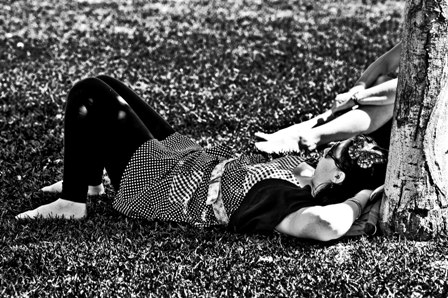
All very true, valid, and all of them things that do need to be done. We all have a life don’t we? But perhaps sometimes, even just now and again, and perhaps just for a few minutes at a time, you can stop. Just stop. Thats all. Stop and just do nothing, or rather stop and simply be.

Have I mentioned a favourite little two word sentence I really really like? Just sit. Don’t read, don’t think, don’t try to stop thinking, don’t ‘meditate’. All that’s required is to do nothing. Do No Thing. Actually, I think I’ve found a new favourite.

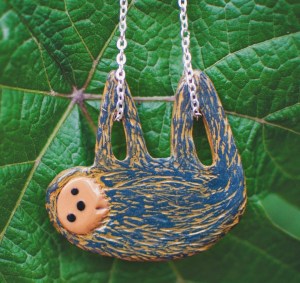
On, remember I said there are a couple of definitions of sloth?  Well the other one tells us that a sloth is a slow moving nocturnal mammal noted for hanging upside down from tree branches.  It lives entirely in the trees and is capable of only very slow movement on the ground.

So, I guess you should be very careful when you tell someone else I’m a sloth. Mind you, putting aside the hanging upside down bit, and the nocturnal requirement, it’s probably not such a bad way of being to emulate, do you think?

Have a lazy (slothful) day.

With These Words … Part 2

Namaste and Welcome to Part 2 of this little miniseries in which I hope to tell you some more about my ‘philosophy of life’. So before we get underway with Part 2, bear with me as I quote for you the last couple of paragraphs from Part 1.  (If you missed that part, you can find it here.)

After describing the vows traditionally taken by monks and nuns of various traditions (poverty, chastity, obedience, and in the case of monks and nuns committing to a specific place for life, stability).

I explained that I recently discovered how these vows have evolved for many individuals and intentional communities, and how I thought that newer interpretation summed up really nicely the way in which I aspire to live.

One renewed version [of the vows] is: Simplicity, Purity, and Accountability. In the place of Stability, there is now Presence.
While I can’t say I have taken these vows myself, it’s occurred to me that, put together, they do make a fairly precise set of principles that could be said to apply already as I attempt to live authentically as a hermit.

My idea was to look at the vows one at a time to test whether they do in fact represent the way of living I aspire to. Anyway here in Part 2 we will begin with Simplicity

Simplicity

Fingers poised. A whole lot of thinking going on. What to say about simplicity? It’s not as simple as it sounds; actually it’s quite a complicated concept. Certainly it seems that way as I begin to try and define what it means to me.

At its core it really means I live as simply as I can in a world not designed for simple living. Friends of mine have a motto: ‘Simple Living, High Thinking’, which I like a lot, and which fits with my own life.

Of course a simple life starts with looking at what one needs to live a good life which would be defined by one’s own unique needs, occupation, health, age, and all kinds of other personal factors.

For me I’ve found  that it’s not really that much. Over the years I have more and more pared down material possessions; I’ve become adaptable in terms of living in small spaces (and now actually prefer it); my diet, while extremely healthy and interesting, is very simple as I’m not always always looking for variety or new ‘taste sensations’.

I buy very few clothes; again I’m not interested in having a lot of new stuff all the time, I’m very practical and just buy what I need and I am always neat and tidy (well most of the time!), and adequately clothed.

I don’t have a car, though I have in the past. Lots of reasons for this, but essentially it’s a much simpler way to live, even if sometimes I might think it’s complicated not being able to just jump in and drive anywhere you want. A car can be a big responsibility, expensive, and a pain to take care of. Certainly for me it’s been a relief, not owning cars.

My entertainments are also simple. I don’t watch TV because it’s a terrible distraction and I’ve found it’s mostly a tool for marketing of all kinds, with very little of any real value to offer.

Of course, we all know how big a distraction the Internet can be, and I’m just like you: I get sucked into scrolling and into mindless videos and the rest. I’ve found it’s a case of self discipline: sometimes it works, sometimes it doesn’t. I try to use it as the wonderful tool it can be.

I think I mentioned somewhere else that I haven’t been to a cafe or restaurant for several years. They just don’t seem to hold any attraction anymore.

I guess this could go on and on, but basically living in simplicity is an attitude thing. And for me it’s been very much an evolutionary thing too. I try not to draw up pros and cons lists and analyse to death decisions on what to do, buy, eat, and so on. I don’t always succeed naturally!

Simplicity exists alongside the other topics we’re discussing here: they somehow work together to make a whole life. Going for the simple things sort of becomes natural to some degree. I hope that becomes clearer as we go along.

Another thing I will say about simplicity is that it’s a less impactful way of living, both personally and for the world as a whole.

Of course there are quite a few things that can’t be avoided in a world designed to make everything as multi-layered, material thing and fashion obsessed, and as profitable and ‘productive’ as possible. And simple doesn’t always mean cheap, though it has to be said that I live on quite a small income by our culture’s standards, but I would also have to say I don’t think I lack anything materially.


Actually another factor in this simplicity discussion is time. And I see now I’m using a lot of your time with this ever-lengthening post. So, before I go and get ready for Part 3, let me just say something quickly about Time and Simplicity.

For many years my health, my inclination to travel, my aversions to ‘the ways of the world’, and my tendencies to want to create, have meant I haven’t spent a lot of time in the mainstream of working life. And now I am retired.

So I believe I’ve long been given gifts of time in one way or another. But of course, just like everyone else, I can be quite good at putting the words time and pressure together. Again it’s an attitude thing that we’ll most likely talk about when we get into Presence later on. Which sounds like an oxymoron.

So, until next time

Peace and Love from me to you.

With These Words … Part 1

Namaste friends

At this early stage in the life of this blog, no doubt most visitors will really have only seen the Welcome and the About Me pages. The question I’m asking myself is what else can I tell you about myself and my life that you can’t see for yourself on those pages?

Well, I realized that I’d already, on another blog, shared some insights in a kind of miniseries of posts that speak about my philosophy of life as I call it. So, join me as I get into Part 1.

By now you probably worked out that I call myself a hermit. Perhaps I have explained what I mean by this somewhere else on this blog, but in a nutshell being a hermit to me means living a quiet life, without a lot of physical contact with other people; I visit shops and other businesses and so on, as little as I can manage. For example, I haven’t been to a cafe, restaurant, or other social gatherings for several years.

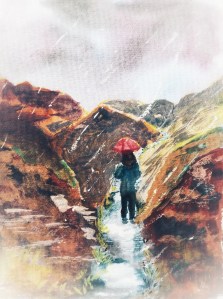
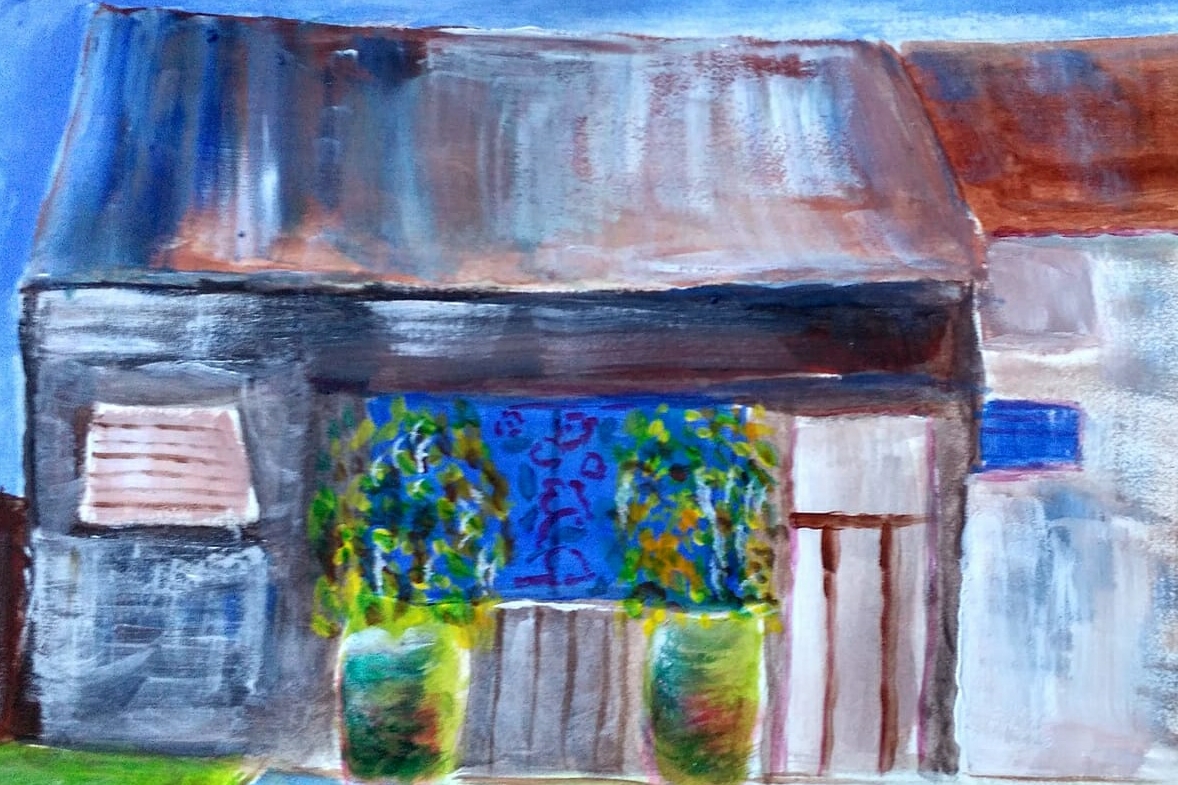
Just one of many hermitages we’ve found by the side of the road. This one way out in the desert country in Australia’s Outback
(Painting by my partner hermit Pauline)

Of course there are more esoteric or spiritual aspects to being a hermit, and I’m very much aware that it’s this spiritual quest side of things that is really the driver for the way I live. A quiet life lived apart from the world, means less distractions, more quiet, more time. All are great helps.

Obviously given the times we are living in right now, I’m far from the only one living a hermit life. At least I am blessed in that my way of living is by choice. At the same time, I’m actually quite excited to watch as the people of the world begin to slowly get back out there and into life again.

As no doubt I’m mentioned somewhere else, I was born with a nomadic nature and soul. So in a real sense it’s a pilgrimage I’ve always been on anyway. So perhaps I might be back out there on the road sometime soon

In the truest sense of the word, I aspire to live like a monk: A monk in (sort of), but not of the world you might say. However monks (and nuns) usually live in community, in a monastery or convent. It’s true to say that life with my partner has me living in community, though it’s only the two of us. Then there are the few places in cyberspace where I encounter and interact with others.

It’s well known that many monks and nuns take a number of vows when they join their communities. Traditionally these vows are: Poverty, Chastity, and Obedience. In many cases the additional vow of Stability is added, binding the monk or nun to a particular community in a particular place.

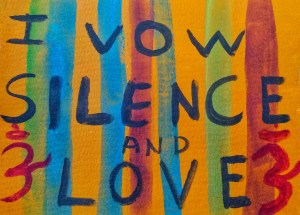
I’ve never been comfortable with those vows, so I’ve never made them. But as I have progressed in my spiritual journey, I have taken vows of various kinds. Mind you my vow to silence is having a hard time of it with me! As for the love part of this vow: well, that’s also a work in progress.

Anyway, recently I’ve been reading about communities (some religious, some secular, but always made up of people sharing the same or similar values, goals, and missions) who, also uncomfortable with those traditional vows, have reinterpreted them in a way that sits more comfortably.

That renewed version is : Simplicity, Purity, and Accountability. In the place of the vow to stability, there is now what you could say is a more precise concept: Presence.

While I can’t say I have formally taken these vows, it has occurred to me that, put together, they do make up a fairly precise set of principles that could be said to apply already as I attempt to live authentically as hermit, monk, and pilgrim!

Please join me in Part 2 (appearing soon) when I will put this theory to the test.

Peace and love from me to you