When Misreading is no Mistake

We’ve all  had this experience I think. I’ll be reading something, and right away I’ll come to a conclusion, become either sure of something or the complete opposite; I can be confused, force myself to ask more questions. I can even have brilliant insights or realizations.

No? Well, maybe it’s really just me then. But, wait there’s more: this is a two part experience. When that second part happens we will come to realise that what we think we read is nothing at all like what the words on the paper (or screen) actually said in a factual sense.

Yes, you’ve probably guessed by now that there’s a story coming. In fact this exact thing happened to me this morning, all the way to the brilliant insight or realisation bit.

In fact it was a brilliant realisation, the only problem was that it was based on only on what I thought I read, not what was actually being said.

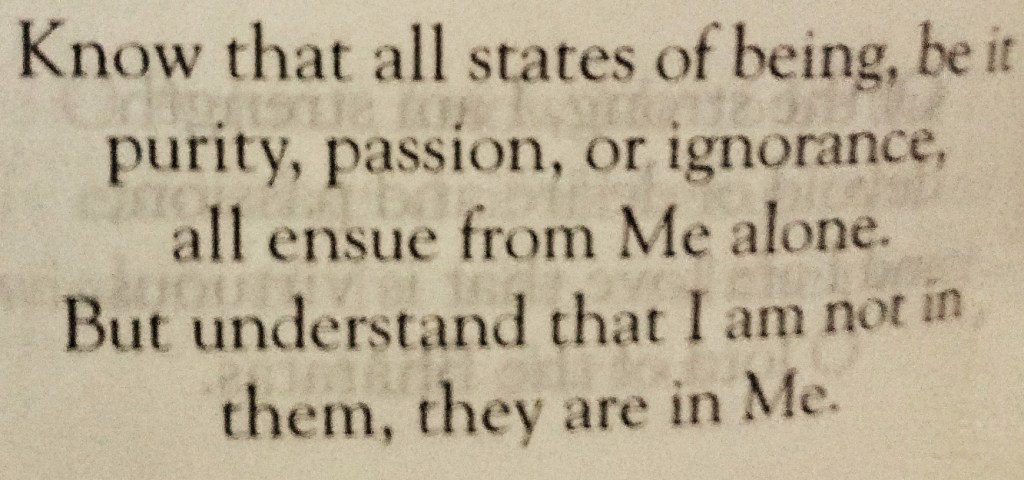
Anyway, I was reading the verse quoted below, from my Bhagavad Gita and a sudden flash of insight hit me.

Despite these five lines saying a particular thing in a clear and precise manner, I somehow misread the first three lines to say:

All beings ensue from Me.

Bhagavad Gita Ch 7:12

Somehow my mind skipped the ‘states of’ bit and made a leap that actually lead to a great realisation: Of course, I thought; God is not in us (as in living beings), it’s we who are in God.

Which to me means that we are all part and parcel of God. I’m not saying, I’m God; I’m not saying you are either. What I am saying is that all creation as one, unified whole, is in God. And if that one unified whole does indeed ensue from God, then it follows that all of creation is God.

As individualized, embodied entities, we (along with all life everywhere) are simply manifestations in the material form of that divine energy, that life, that truth; that which we often call God.

Now, this is an instance of a flash of insight leading to a truth, when the receiver of the insight (that’s me) is engaged with what you might call some other factual reality, that is, the actual words on the page.

At first I thought, that’s weird: how did I misread all those words related to states of being? I mean they are pretty clear right? But then I thought, no, maybe not so weird. In fact, it makes sense.

How can my material mind and intellect possibly be expected to always keep its millions of thoughts, ideas, impulses and the rest, in perfect order each thought or whatever following completely logically from the one before and to the one after? It’s never going to happen is it? Not for any of us (Well maybe I’m overstating my case here, but you know what I mean).

And if mind does indeed operate on what seems on the face of it to be a random basis, then it’s perfectly reasonable to suppose that one might be prompted to some momentous insight by, well by anything really. Even if it’s a conclusion jumped to after the misreading of a text.

In this case though, that jumping to conclusions, even though based a misreading, has turned out to be a genuine realisation that I feel on an intuitive level; my instincts tell me it’s Truth.

Jai Gurudev
All that I am today is by your grace.

What’s Wrong with a Little Repetition?

Strangely for one who lives a life that at least aspires to be outside the mainstream of our culture and society, I have a lot of rules to follow.

What I mean to say, is that, while for the most part I disdain the ‘rules and customs’, and the ‘demands and obligations’ of the dominent culture and our materialistic society, I seem to be quite capable of making up all kinds of rules for myself. I’m then more than able to put the exact same pressures on myself to obey, to comply and to conform.

One of those ‘rules’ is to try not to repeat topics of posts. Obviously there are posts that fall through the cracks of such strictness, but on the whole I like to keep coming up with new things to share with you.

But it’s been occuring to me lately that musings and contemplations don’t work that way. The mind, the heart, know no such rules as ‘no repittion’. (Actually, now I think about it, there are some things the mind likes to repeat all the time that I could do very well without thank you very much)

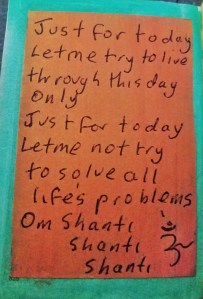
Sometime, not too long ago I think, I wrote about the beautiful George Harrison song, Just for today. I wrote about how I have a slightly paraphrased few lines from that song written in my Bhagavat Gita, and I read those lines every day:

I know I am not alone in my desire to not be constantly trying to sort out all life’s problems; I know many of us would just like a little peace, a little pause in the ongoing rush of life. Just for today, or even just for a minute.

What George is making a plea for here has resonated with me since I first heard this song so many years ago I can’t remember.

Anyway, this was supposed to lead up to the real topic of today’s post which was going to be about my decision last night to spend the next few days in a kind of retreat. Instead it’s turned into a bit of a rave about breaking self-imposed rules.

Actually though, one of the primary motivations for my decision was the very notion of presence, of being still for ‘this day only’. You know the idea: leave all life’s worries and issues, and worldly concerns out of mind, just for a bit.

In other words, in this case I don’t think I mind repeating myself, breaking my own (really rather silly if you ask me) rule. The retreat is timely, and it’s a good thing to be reminded that it really is about presence.

I’ve been getting too caught up in ‘what’s next?’ kind of questions. As well as the usual and very tedious existential angst over life, the universe, and everything past, present, and still yet to be!

So, at the risk of creating a classic oxymoron, it’s now the time to head off to find a little presence, and a little stillness.

Just for today.

Let the Music Play

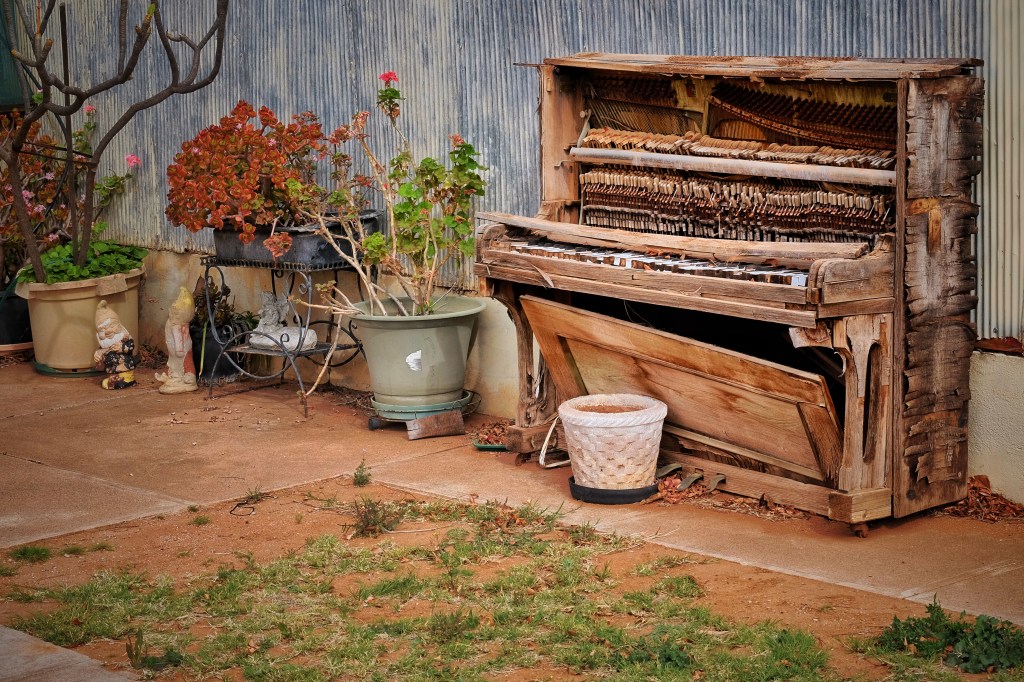
When thinking about a name for this photo I was really tempted to somehow reference the song American Pie by Don McLean. The phrase from the lyrics ‘the day the music died’, kept coming to mind – even as I made the photo of the scene.

By the way, ‘the day the music died’ refers to the plane crash in 1959 in which the up and coming Buddy Holly, and the more well known Ritchie Valens and The Big Bopper were killed.

And there was that brilliant MASH scene coming to mind. In the scene there is concert pianist who has lost the use of his right hand in battle. One of the doctors attempts to encourage him to not allow the music to die, to find other ways than actually playing piano to share the music.

Both connections seemed obvious: a very old dead piano decaying, returning to old forms of itself. But then it struck me: it was the instrument that had died and was changing forms. All material things change, die, becoming something else.

The music on the other hand, hasn’t died. It not only survived that plane crash and the transition of those three singers, it has thrived. Their music lives on. Music can’t die. Why?

Because music is life. Vibrations, harmony, and sound itself, are the foundations, the roots of ‘life the universe and everything’ (to borrow an old expression). As such, music is not a tangible, physical thing and it needs an instrument to make it manifest in the world; music merely passes through the instrument and emerges into being.

I liked that MASH episode. The doctor (stuffy Major Winchester) says to his patient, the wounded pianist, that as a skilled surgeon he has hands that ‘can make a scalpel sing’. But really, what he’s wanted all his life to is to experience music the way the pianist has.

He says he can play the notes, but he doesn’t have the gift that would allow the music (as in Chopin, Brahms and the rest) to flow through him. He tells his patient, who is depressed and unwilling or unable to consider that the music may not have died:

The gift does not live in your hands. The true gift is in your head, and in your heart, and in your soul.

Major Charles Winchester

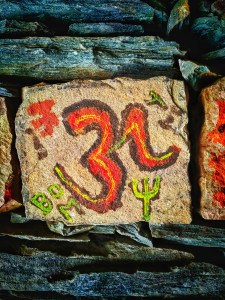
Hearing that line again reminded me of Om. There are a number of religious traditions that consider OM (sometimes spelt as AUM) to be the primordial sound, the very source of creation. The word itself, when written is considered sacred.

Then there is the verse from the Christian Bible that makes the exact same assertion:

In the beginning was the word and the word was with God and the word was God.

John 1:1-3

Well, music needs an instrument – whether in the form of a voice, body, mind, or in an object made of wood, strings, brass, or something else – in order to manifest into the material world and to be experienced by us.

Just think: the piano in my photo in the front garden of a house in a mining town has most likely allowed many generations to experience music. Accompanied them in celebrations and greivings; helped so many through good times and bad times; witnessed people laugh, cry, and even dance;

Of course, Major Winchester’s gifts as a surgeon are that he is a instrument for the vibration, the music of the universe, to make itself manifest in another way.

And what he is essentially saying to our wounded pianist is: ‘Look you can shut it off forever (his words) or you can continue making your gifts – your Self – available as an instrument that allows that music to come into the world for everyone to share’.

Well dear friends, I have pledged to carry on using my gifts and be available in just that way that allows the music to come through me in whatever form and shape it takes.

By gifts I mean those things that have been granted to every living being: the ability to create harmony; the ability to make and spread good vibrations; and the capacity to appreciate and celebrate beauty.

And when you think of it there is no way to put a limit on the number of ways that the music that is Life might be channelled through each and every one of us

A good place to pick up some good vibes, get into harmony with yourself and appreciate beauty all at the same time

In my own ways I try to make harmony in and around myself as much as I’m able. I am always attempting to cultivate behaviours and attitudes that help to create and spread good vibes. And I constantly seek to appreciate beauty, even when the world seems to be only ugliness.

Of course, as I say I am only the instrument. The music -the beauty, good vibes, and harmony – exist with or without me. But music in whatever shape and form it takes needs an instrument if it is to come into our material world and be there for all of us to share.

So, this is my prayer: that at least every once in a while, every now and then, I can actually be that instrument .

PS Just a little postscript. When passing that particular garden (the piano garden I call it now) I was drawn to this:

Eagle-eyed Garden Guardian

Just as I photographed this lovely creature, I heard my partner’s voice:

‘Did you see the piano?’

Now being in what you’ve heard me call the Zen Zone I was fully focused on and absorbed in, our winged friend. Coming back from wherever I’d been, I did in fact notice the piano.

You see, you just never never know where the music is going to come from. I might not have seen the piano with my own eagle eye but lucky for me music had a ready and willing instrument standing by to remind me of which way to look.

Lessons from Butterflies

Yesterday found me (for a couple of hours anyway) out on the suburban streets close to the hermitage. Camera in hand and trying to cultivate an attitude of Contemplation. Working for the moment my heart, my head, and my mind all came together to help my camera make a photograph.

Well, in terms of contemplative photography, the outing was a bit of a struggle: getting into the Zen Zone isn’t always easy. And come to think of it, it’s not always part of the plan is it?

I don’t mean the little plans and intentions the ego comes up with about how things are going to turn out. I’m talking here about The Plan: what the Divine has in the works for us.

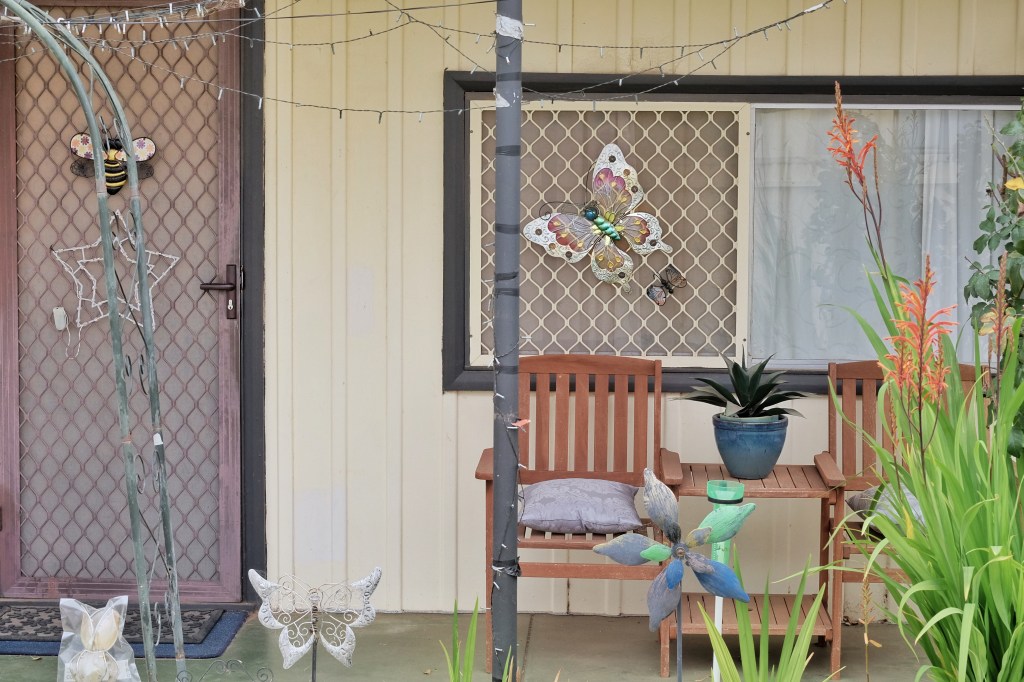
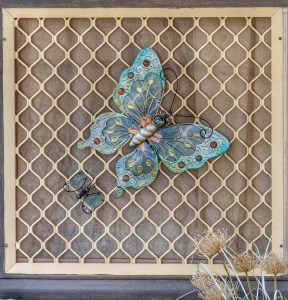
Anyway back to my walk. I kept walking, sometimes making photos. As I said, it wasn’t easy getting in the zone. Suddenly my eyes were drawn to a particular house. As I looked through the viewfinder I noticed a butterfly on the wall. On the window actually.


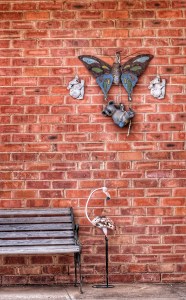
Not a living, flying, being as you can see. More of a kind of garden ornament attached to the front of the house. It struck me as I continued looking, that I’d already seen – and photographed – several ‘butterflies’ so far in that walk.

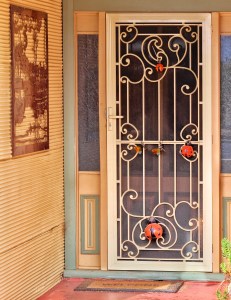
Four actually. In the space of an hour, and within a couple of streets of home. I’d seen them on walls, windows, and on doors.

Through time and in many places around the world, various cultures have looked at butterflies as symbols of transformation, for change, and renewal.

And, it seems to me, that butterflies can appear to us almost lighter than air. They kind of float on the air currents. They’re also known for their darting way of flying in what might seem to us one random direction then another.

So, butterflies have also been seen as symbolic of the human mind with its tendency to dart all over the place from one thought to another. They are said to remind us that we can in fact control and direct the mind.

In that case then, were these repeated encounters with butterflies – albeit of the ornamental variety – some sort of message for me? Perhaps I was to slow down, stop taking myself so seriously and to make changes? And of course remembering that I’m perfectly able to deal with consequences of any changes I make.

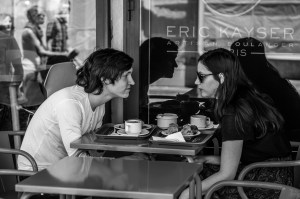
A Window for Two

Well, here’s the funny thing. Literally not until I sat down to draft this blog did it occur to me that I have in the last couple of days made what for me seem monumental changes. Or to be more exact, I have put into motion changes that are yet to reveal what if any transformations they might lead to.

You see, over the last few days I have been systematically deleting all my social media accounts (with the exception of a messenger app to speak to my son). I’ve had most of these accounts for up to 15 years or more. So, while I’m absolutely certain that this act of detachment from some of the things in the world that don’t sit well with my nature, I’m still feeling a bit lost, a little empty.

Okay, the butterflies: what have they to do with any of this? Transformation? Change? Lightness? And the ability to float through changes in life? Yes all of these. And we all know very well that butterflies undergo some pretty tough transformations as they evolve into what they are to become.

Who Invited the Lady Bugs?

Something I read once said that if you see a butterfly you should look at what you’re thinking; ask yourself what’s next for me? What changes are in store? Although all those butterflies of yesterday were ornaments on walls and so on, I have actually at other times been privileged to photograph living and flying ones.

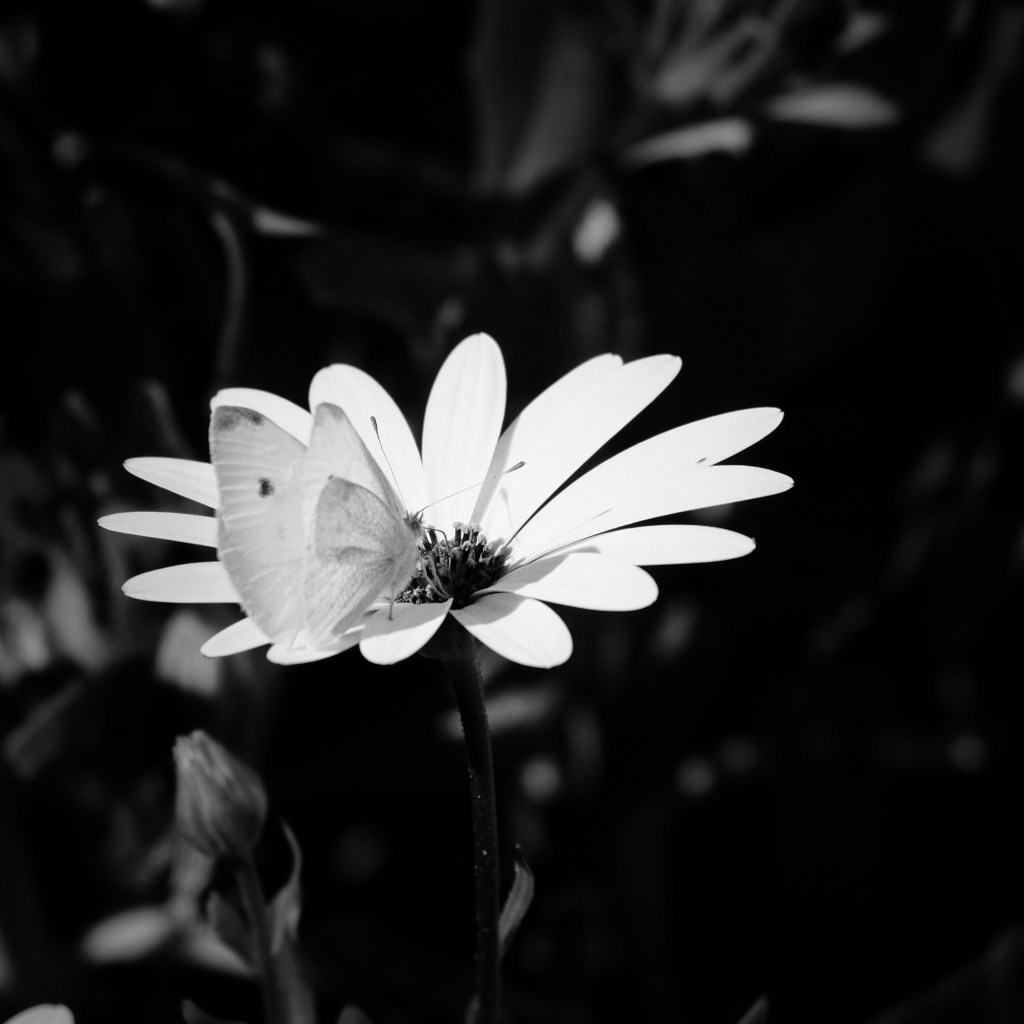
In fact just the day before yesterday I met a small white butterfly flitting from one white flower to flower. In the space of a very short time, this beautiful creature gifted me with a very small moment’s stillness, and it gave me a photograph. Here i share that one with you.

Early Christians associated the butterfly with the soul. So, yes, you could say that my meeting with that particular butterfly was a meeting of souls.

But what of the garden ornament, inanimate butterflies met yesterday?

Well, everything’s got soul don’t you think?

Peace and love

Homage to Holiness: A Story to Share with You

This morning as I do most mornings (trying to make it every morning) I sat for my practice starting with some prayers and reading a a few random verses from Bhagavad Gita.

Then I settled to spend some time in devotional chanting of mantra. For a change this morning, while chanting I listened to a lovely album of devotees chanting the Hare Krishna mantra:

Hare Krishna Hare Krishna
Krishna Krishna Hare Hare.
Hare Rama Hare Rama,
Rama Rama Hare Hare.

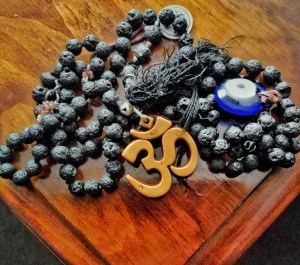
I reached for my mala (prayer beads or rosary) and as I mentally repeated these holy names in accompaniment to the recording, I held a bead between my fingers for each repetition, focusing on the chant.

Now, chanting is much like any other human activity: that is to say, the mind is always there. Usually it manages to bring up all kinds of irrelevant fears, memories, questions, you name it. Today, however, one of those supposedly random memories actually caught my attention in a good way and took me along.

As I continued handling my prayer beads I thought about a story I read in India nearly 15 years ago now. The story concerned prayer beads as it happens. Buddhist nuns, imprisoned in Tibet, were forced  to resort to making their own rosaries in secret after their meagre belongings had been seized.

Almost ten years later, after another extended stay in India, I finally was able to write about this story. In this instance it came into being as a poem I called Homage to Holiness. May I share it with you here?

Homage to Holiness

Threads harvested from threadbare clothing.
Pea-sized bits of bread, sliced from meagre rations,
secretly hoarded for sacred purpose.

Mala makers work at night
in the dark of the stinking and freezing stone cell.
Chewed bits of bread become dough again,

and, by feel, frozen fingers knead the dough
until tiny beads are created.
An even tinier twig, again by feel, pierces each bead through.

Then in solemn prayerful silence and focus,
the nun passes her harvested thread through the first bead.
She ties a knot, no easy task with freezing fingers in the frozen dark.

And so it goes; all sacred duties take their own time.
One by one; one bead of bread threaded; one knot knotted.
The nun nears collapse. But now, at last, her task is done.

As the last knot is knotted, the last bead in its place,
the nun sighs and mutters, whispers, a prayer of thanks.
One hundred and eight beads – plus one – made, and strung
Her Mala
Om Mani Padme Hum

Probably the most sacred and significant of all Buddhist Mantra, Om Mani Padme Hum, means something like ‘the jewel is in the lotus’. But many would say it goes a lot further than the mere literal translation of the words; It is said to be the actual path to Enlightenment. There is a huge amount of information on the Internet about this mantra, so if you’re interested a good place to start is at this link.

Whatever the actual literal meaning, interpretation, or who chants it,  I think we can all agree that the intent of this mantra is to have us focus on the divine, or on the Ultimate or Absolute reality. The same as any mantra one might choose actually. Remember last post? God is.

in any case, I think somewhere above I’ve used the word random. Well I should know better by now: no such thing as random. One of the Bhagavad Gita verses I read – in fact the final one I left marked with my bookmark – seems to me fit very nicely with that ‘random’ memory of a story read years ago, and my humble retelling of the story in a poem many years later

One who knows the Absolute and whose intelligence is fixed on the Absolute is not moved by pleasure or pain, pleasant or unpleasant happenings.

Bhagavad Gita 5:20

Did that nun imprisoned as she was in the dark and the cold feel that pain? Did she feel fear? Of course she did. The thing is, she was, as constantly as her circumstances allowed, fixed on the Absolute: the activity of making the mala, the intended use of the mala, and her prayerful attention and devotion as she worked, all enabling a complete fixing of mind, heart, and attention onto the Absolute.

The cold was still there; the hunger and fear too. But this nun was able to remain centred, you might even say calm and content, despite the dire situation.

Actually content was a word I read in relation to this nun and her sisters (she wasn’t alone in that prison cell): From what I read they were released after some time, and eventually escaped to India where they rejoined friends, family, and of course their leader the Dalai Lama

At the time the story was being recorded for posterity, the Mala Maker reported that she was happy and content and leading a full and fulfilling life. I imagine her as still being fixed on the Absolute.

Thank you for allowing me to share these moments with you
Love and peace

Tell Me: What is God? Dominus Est

Welcome dear reader

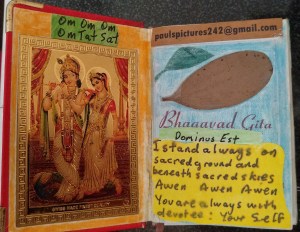
Have I shared with you my Bhagavad Gita? Well, I know I’ve mentioned a few times that it’s one of, if not the primary resource for study and guidance for me.

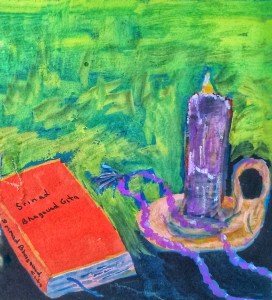
As you’ve probably guessed, this is a quick photo of the inside of the front cover. And, again as you’ve noticed, I like to stick things in my books, especially this little one. (Actually now I mention it, this is the only book in the traditional format as in made of paper, I own). It’s an old practice and for me adds multiple dimensions and depths to what is already a treasure.

Sometime I’d like to go through and describe to you all that I have added, but for today, do you see the little green section with the words Dominus Est printed?

In the religious tradition I was raised in, these two words have a specific meaning and use. However, it’s only recently that I’ve come to think of this little Latin phrase (well technically it’s a sentence, but …) in the sense of the literal meaning of the words themselves: God is.

That’s it. Or the Lord is, or the Master is. If we change the Dominus, we can use this tiny sentence to define our conception of the divine, the holy, in any way that seems right: Truth is, Beauty is, Art is. For me, God is, sits right. As do the others in this list. Same same.

So, God Is. What else could possibly be said that would add to this already very emphatic and simple statement? Nothing at all. It’s stand-alone, complete in itself.

Like asking who or what is God, we can answer: ‘I am this’ or ‘I am not that’. Or we can realise what for me is becoming the only answer:
I am.

Why? Well, if we were to add anything at all to these two words, such as God is Truth, or God is Love, or God Resides in …, or God is called … , then we are in fact stating only a little of the truth. Sure, God is truth and love, and goes by many names and is found in many forms, but once we say what something is, we are actually making more of a statement about what it is not.

In the beginning there was the word, and the word was with God, and the word was God.

Mind you, it’s perfectly natural, and for many of us helpful, even necessary, to ascribe to God a name and or form. We are ourselves material beings, living in a material universe; it’s logical that we would choose (or need) to see God in a word, a physical object, or attribute some other kind of materiality to our notions of the divine.

I must say that I am one of those who find it difficult to envisage an invisible, non-physical, and impersonal ‘God’. Of course, our little statement, God is, does indeed say just this doesn’t it? Isness is pretty non-corporeal, certainly not in the least physical. And isn’t even a ‘spirit’ or ‘entity’ of any kind; Isness just is. The moment we label something (including ourselves) we miss that isness, that essence.

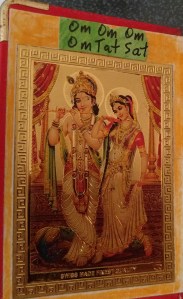
You see my picture of Krishna and Radha? This form, or forms, is one of the several that I feel right in having as a kind of focus, or centre of my devotion to and love for the divine; for love, for truth, and for it all.

You might be saying, this guy does believe in a personal God. He just told us. The truth is I don’t believe or not believe that Krishna (or any of the myriad names and forms we’ve invented) is God. God simply is. And my heart tells me that this is enough.

There are a pair of theological ideas known as Cataphatic Theology, and Apophatic Theology. Cataphatic describes or approaches the divine by stating what God is, while Apothatic (you guessed it) describes God by speaking only of what God is not.

My guess is that pretty much everybody, from whatever tradition, would approach the divine (and not only the divine) in one or other of these ways. But for me it was such a relief to realise that there was no need to go there at all. I could stop with the definitions and the descriptions, the what is and what is not. I have the freedom to not have to believe or not beleive. None of it matters. Dominus Est. God is.

Am I there yet? Have I let go of dualities? Hardly. Maybe the odd glimpse, but it’s rare. And it always will be for as long as I live in a physical body. But to paraphrase something Swami Ramdas said:

I’ve set my feet upon the path, so I am already at the goal.

Peace and love from me to you

God is My All: A Reaching Out, a Rap on time, & a (sort of) unrelated poem

Namaste and Welcome to you.

I can’t remember when I wrote my last post. And of course it isn’t relevant at all is it? I mean to say that in the contemplative life, time sometimes seems to take on some other kind of character.

Or at least I should say that one’s perception of the passage of time shifts; nothing unusal there I hear you say, and of course you’re right. Just thinking out loud I suppose.

For me, having a right perception of time is an important aspect of my Sadhana, my practice: yes, it’s true: time is seen to fly, or it is frustratingly felt to drag. But my aspiration is to see time as simply a human construction that we use to limit, structure, bind, define, and place all kinds of restrictions on our lives.

Which for me, simply means that there is only presence or Presence; only the ongoing continous moment (what we often call The Now). Easier said than done mind!

Swami Ramdas (known as Papa to his followers)

In any case, here I am, just where God would have me be. Feeling strongly to reach out to you, I remember the poem (it’s not really about time in the sense we’re discussing it so far) that emerged the other day after reading a quote from Swami Ramdas that seemed to be an answer to some thoughts I’d been having.

I’m grateul for this, all of this. And for you too, the reader of these musings offered with humility and thanks.

Peace and love from me to you.
GOD IS MY ALL

Thinking thoughts
as if battered by demons.
Memories arising of my own evil deeds, selfish and cruel.
Right away I turn to God:
God is my all;
Hare Krishna

Forego repentance,
relinquish regrets;
you are filled with God,
the supreme essence of life.
God is my all;
Hare Krishna.

Through Papa Ramdas
I hear the Universe speak:
Forgiveness is from God;
and it has been granted.
God is my all;
Hare Krishna.

Broken Hill, Australia
9 July 2022

Living the Life

Welcome to another musing from the hermits’ cave. It’s been a while hasn’t it?

Mind you, I’ve been busy: settling into the new hermitage here in the desert. Actually, it’s been cloudy since we arrived, and raining sometimes. It’s as if the Subtropics have followed us here, except that it’s been freezing.

And I’ve been busy colouring in as well. Not as in filling in a picture book designed for colouring, but in making my own patterns and shapes with the one aspiration of making colour happen.

Japanese calligraphy masters will tell you that God is in the ink, or in my case in the pigment of the colour pencils I use. I draw designs, sometimes complex, sometimes simple, then fill the spaces with colour. Sometimes just one or two, sometimes multiple colours.

Why? Well, the simple answer is because I like doing it. I like to see colour covering the page, seeing it slowly fill that empty space. I’m not good at ‘drawing’ and painting in the traditional sense, but one thing I can do is make colour. So I do.

And it’s a sacred act: God is in the ink remember? It’s the making of beauty. And that is a holy act. There’s that aphorism isn’t there? It’s better to light a candle than curse the darkness?

Or, I could say that it’s better to make colour and patterns than it is to be swamped by the darkness.

There’s a Bhagavad Gita verse I like that I came across again the other day:

If one’s thoughts are fully absorbed in the Absolute all his [sic] spiritual offerings also become a part of that same Absolute

Bhagavad Gita 4:24

In other words, all our actions – and we never cease from activity while we dwell in a material body – are not only prayers or offerings to that Absolute (or you can say to God, to beauty, to art, to love, to the universe, to life. Or you don’t have to name it at all. None of the names and forms are relevant) but in fact become that Absolute.

I am a hermit pilgrim, living a contemplative life devoted to the Absolute we just talked about. I have little to offer, but I offer all that I am. And with my photographs, and with my ‘colouring in’, I try to create a little bit of the sacred, a lit bit of colour and beauty to keep us all away from the darkness.

Peace and love
The Road Rises Up:  A poem about journeying

Today I’d like to share a poem with you. I wrote it exactly a year ago, but it’s about a day many many years ago. At other places on this site I’ve mentioned that cliched but for me ever so real question: Am I running away from something or am I running towards something?

In one of those other places I joke about my answer: ‘Neither. I’m just a journey person’. Well, this poem began life as a story of the day I first met Jesus freaks as I hitchhiked on just one more random excursion.

Then it becomes at the same time a piece about running, or journeying towards. And, there’s more: it then speaks about the journey as the point of the journey; the movement is the thing

But the thing morphed into a rap about journey beginnings, or at least in the sense of my ongoing attempted, and until a lot of years later, futile escapes from the madness of family and circumstance. That’s the running away bit.

You see, there was something holy felt then, as now, about those seemingly random hitching trips (not that I would dream of hitching in these times). Somehow I knew the Road was the escape route from the growing madness and horror.

Of course I was only able to partially articulate this at that time, but I remember even at 17 (no, it was a year earlier when I’d made my first attempt. I’d forgotten about that) feeling a sort of specialness about the covering of new (for me) ground, the movement, then the arrival at new (for me) places, new towns and cities.

Much of this pilgrimming (for that is what it was) was done in solitude – except for interactions with drivers of course (one of whom was on the day in question one of the said Jesus Freaks) and other necessary people along the way.

I felt a sense of belonging when on the Road; a kind of being in place and in sync. A sense of belonging that I kept fucking up as I let the trickster ego with its taunting messages of fear, loneliness, greed for things and status, and the rest, take control of me and lead me on twisting and tricky roads back to madness.

And now, these 50 years later, I survey the damage done, the cost to self and others. Especially others. No use of course, to look back with wishful thoughts of what if things had been done differently, what if other choices had been made. Such is not truth, not real. Well, none of it’s real anyway is it? Samsara is all it is –  it’s all a sea of madness and illusion isn’t it?

Anyway, here is the poem. May it speak to you.
Peace

The Road Rises Up

I woke up that morning marooned in Albion
in a village of warriors, on a street, in a house,
going mad in a nest of madness
on an island of madness, in a sea of madness.
Escape, refuge, safety – waking thoughts.
Waking dreams. Looking for a way out.

The Road. The Road rose up in my mind.
The Road will save me. Not the shrink
the patriarch screamed I needed to see.
The Road was waiting; I found it waiting for me.
And my thumb in silent salutation and prayer
held aloft in supplication as I trudged on that seemingly straight but trickster road.

Welcome to the pilgrims’ way, the Road greeted me
as I trod ever more lightly
and Babylon’s chariots hurtled past me bound for far nowheres.
Or maybe somewheres.
All in the fast lanes and howling deceptively
of invitations and rejections, attractions and aversions.
Then – in time – an invitation proffered and accepted.
This pilgrim was on his way.

ANSWERING THE CALL LEADS TO MORE QUESTIONS

Greetings and Welcome after what feels like a gap of forever since my last post.

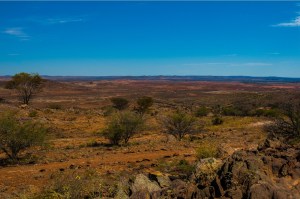
Two weeks today since I moved into a rented house way out here Outback in the mining town of Broken Hill, on the traditional lands of the Wilyakali people whose ongoing presence on this country I acknowledge and give thanks for.

And now, it is the location of my hermitage, my safe haven and refuge. But, no, therein lies the conundrum: I love it here; I know I’ve come to the right place to which I’ve been called. But after two weeks, I’m still not feeling grounded; I’m not really here yet.

Culture shock, fatigue, new environment, excitement; call it what you will; something has me not yet settled and in place. Yesterday a small poem came to me that I think expresses exactly the problem.

And now I’m sharing it with you as a way of explaining why the gap, why the block.

Peace and love from me to you.


The call to the desert
has been answered.
And now, I am here.
No, to tell the truth, I’m not actually. Here I mean.
So, where am I?

Not there, back there
where I came from.
Not even sure if ‘there’ really exists,
if you know what I mean.

Mind you, when I said ‘here now”
I meant it’s been a short now:
Now that I’m here. Just.
A short stretch – so far.

Here; there; now; so far;
it’s all too much.
And you know what?
It’s all in my head.
In my mind I mean.
                                             

A wise teacher once taught:
First thought, best thought.
But for here and now?
As in being here now?
No thought, more like,
is best thought.

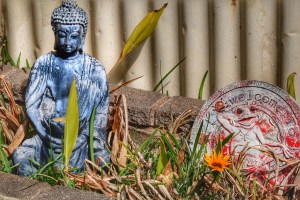
Lord Buddha graces the hermitage front garden