During the early days of the pandemic, I lived in a small town out on the edge of the Outback. But after a few months, the time felt right to head for the coast. Slowly. With that in mind and headed in the right direction, I spent six weeks in another small town in that semiarid zone, staying in a motel.
I liked it there, at the Maria Motel in Moree. Described as a low-key 1960s era motel, the Maria is right across the street from the Artesian Hot Pools, which are Moree’s claim to fame. For me (for us), it was another temporary hermitage and safe haven on the side of the road in which to take shelter for a while.
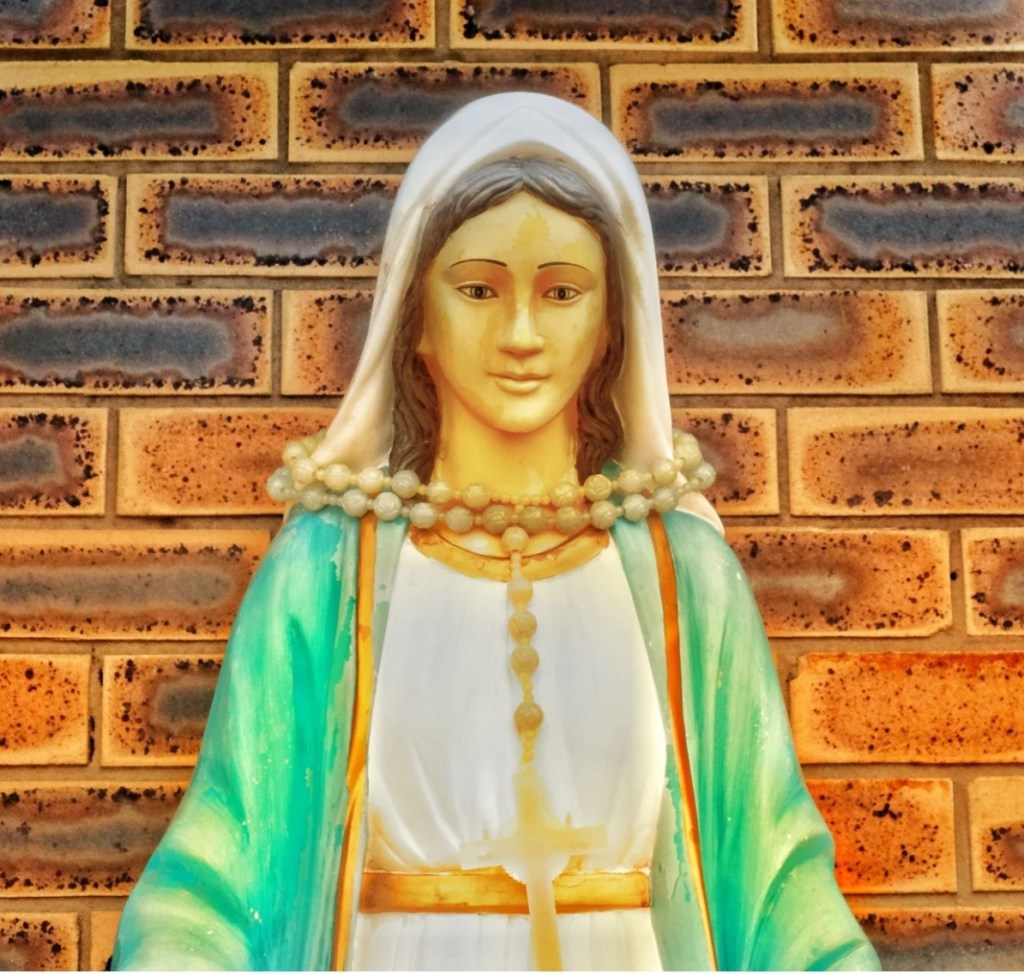
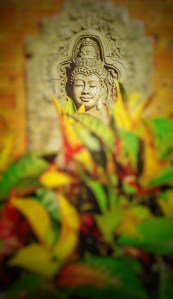
My favourite among the list of things I like about the Maria Motel is the statue of Mary out front in the courtyard. The Virgin Mary that is, Our Lady, the mother of Jesus. You know who I mean. And it isn’t only my Catholic upbringing and education that accounts for my fondness of Mary. It is more about what she symbolizes, what she stands for.
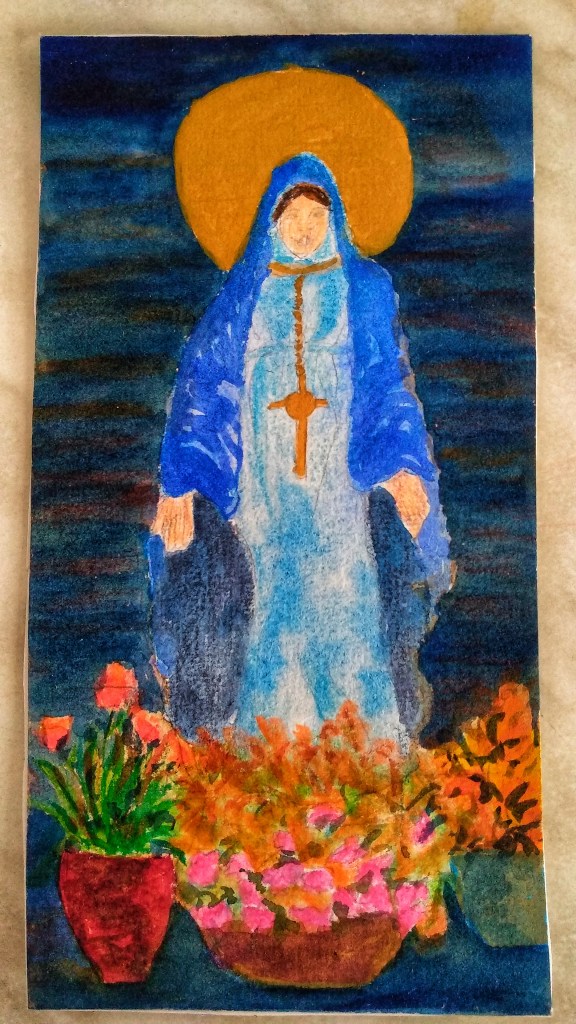
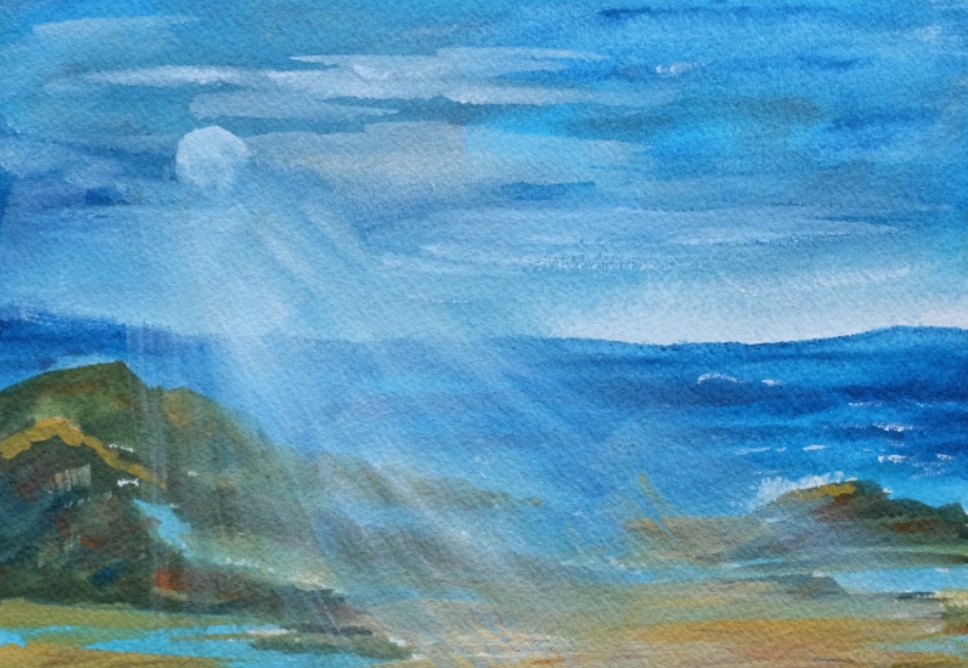
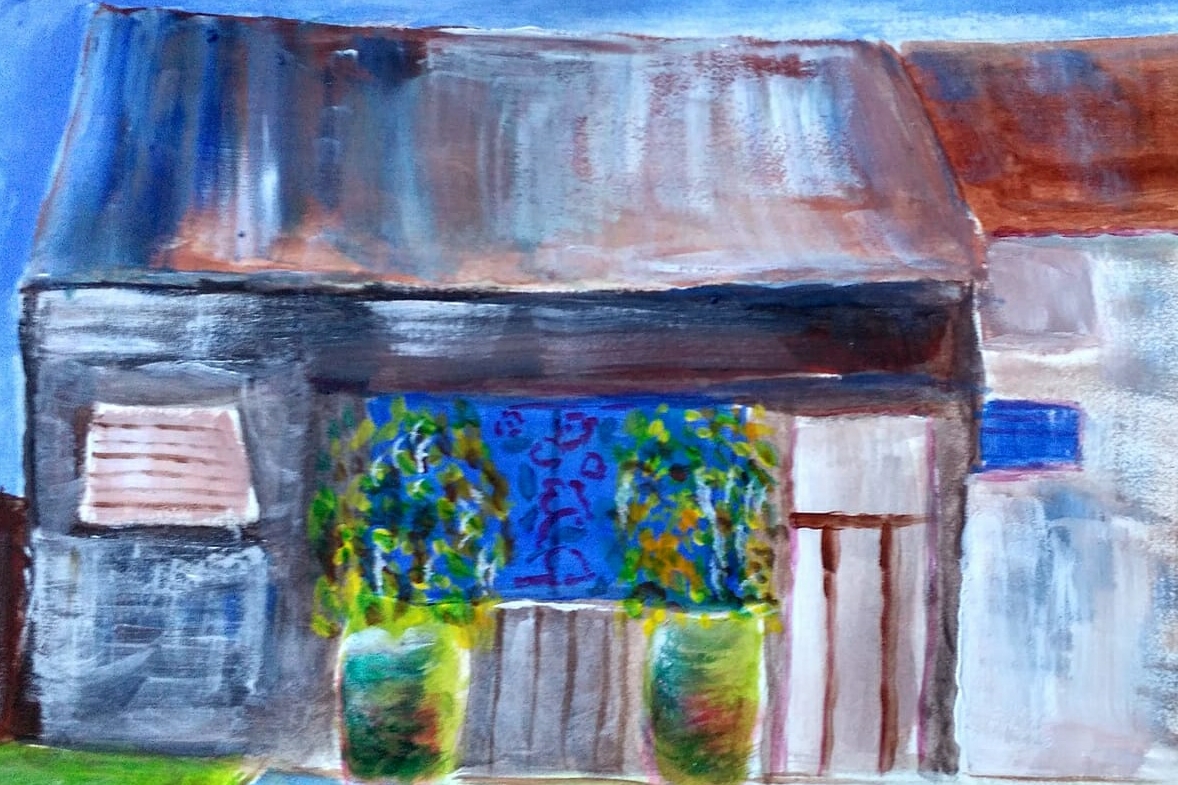
Watercolour by Pauline
For me Mary represents what I might call the feminine aspect of God. Some would call her the Earth Goddess. Mary is the mother, as in Mother Earth, Mother Nature. She is the feminine principle of the Universe. Respect and care for the mother is obviously the key to our survival.
This land from which this town was carved, has been inhabited since long before we began to mark time; since the beginning some say.
Those hot pools have been sacred for a very very long time. While nobody asked permission of the people who already lived here to build a town, at least when some of the invaders came they chose to honour the sacredness of the land they had appropriated by placing this statue representing the sacred feminine in sight of those ancient holy waters, and naming that temporary hermitage of mine, the Maria Motel.
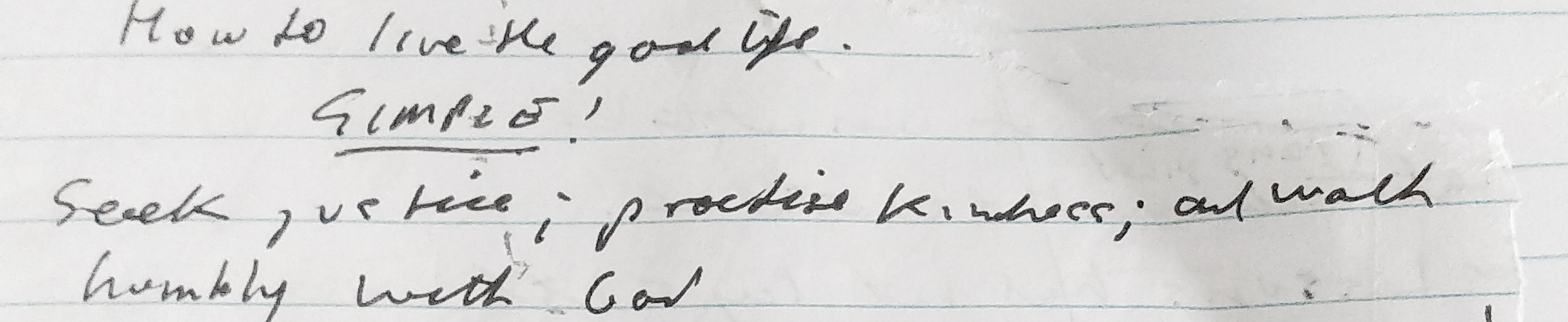
This morning I was just sitting, or at least trying to just sit. You know, being quiet, relaxing the mind. All that kind of thing. And of course, an idea sprung into that not so cooperative mind, so I grabbed my notebook. Just as I went to put this latest brainwave on paper I noticed a very extraordinary note I must have made I don’t know when:
I’ve just looked it up: It’s a slight paraphrase of a verse from the Old Testament, from the prophet Micah. Where I read it, I can’t say (the note is at least several weeks old). But to quote another little note from some unknown source, I always like to:
Let the noble thoughts come to me from all corners of the universe.
unknown
I’m just like everyone else, always wanting the easy solutions and you can tell that can’t you? ‘How to live the good life? Simple!’. I mean really; hardly humble in my approach in that note was I? Well, let’s talk about what Micah says, not my own lack of humility.
Seek justice; practise kindness; and walk humbly with [your] God.
There are numerous versions online of this verse (Micah, 6:8), so I will leave it to you to check those out for yourself. I’ve added the word your because all those versions do say ‘your God’. But even in this paraphrase it’s easy to see there is nothing at all simple about any of these injunctions.
I discovered that this verse is often invoked in times of grave injustice, or crisis. I think it goes without saying that we would be hard pressed to think of a time that was not a time of grave injustice or crisis. Certainly, we are living in one of those times of injustice and crisis.
There’s no need to or purpose served by getting into how ‘grave’ injustice is now compared to some other time; there’s no need or point to weighing up the relative severity of one crisis versus another. Injustice is injustice; a crisis is a crisis.
In other words, the present is always the time to heed the injunctions of this verse.
So, what do we do if we are to seek justice? Running the risk of sounding flippant, I would say that there are as many answers to this question as there are people to answer it. Now, you would think this would make the task impossible; too many cooks and all that. But actually it’s perfect. Why? Because it means that whoever you are, whatever your situation, you can actively seek justice.
Or, I am sorry: I should say I, me. Not you. I can actively seek justice. But, you say, you are a hermit; you live in a cave (not literally but I know what you mean); you hardly ever even talk to people in ‘real life’. Yes, all true. And I would say that the action I take is by no means at the level I know I want it to be. I’m doing nowhere enough.
Does that mean I’m leaving the cave? Going out into the world, onto the streets to join other brave souls seeking justice? Believe me, I ask myself such questions constantly. But to speak truth to you now, I will say that I know absolutely, in my heart, that my role is something different.
If anything, I need to go deeper into the cave; I need to go deeper into the inner world of my own Self. I know that in this way I will join with so many others in what I’ve come to call the Invisible Community of people all over the world living lives of contemplation and prayer. Or, speaking for me personally, trying to live a life of contemplation and prayer.
By so doing I am at least in a tiny way supporting those millions of others out there on the streets, in the aid groups, running campaigns, writing letters, helping the victims of injustice, in all kinds of miraculous, brave, and innovative ways.
So that’s my commitment to you. To deepen my prayer; to intensify my contemplation; to more fully realise my union with all living beings; and to really join with the invisible community in its efforts.
And, you ask, this blog? What’s it about then? Well, notes, musings, thoughts and reflections all aimed at reminding me of my responsibilities. And hopefully along the way, solidifying my union with you and the rest of creation, just a bit.
Peace and love
PS I haven’t forgotten ‘practise kindness’ or ‘walk humbly with your God’. Maybe another time.
In my last post I mentioned I would share a poem with you in this one. And here it is!
Just Passing Through … or Seeking Noble Truths, is, like the previous post, concerned with passing through, how as I go through life, I am always in some sort of passing through place. Before we get to the poem, just let me fill you in on a bit of the back story.
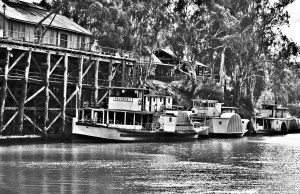
First, I wrote the poem as I walked home to our hermitage at the time in a town called Moama on the Murray River in Australia. Now, the Murray is the biggest river in the country and the then little town of Moama sits across the river from its bigger city sized sibling: Echuca, the biggest inland port in Australia.
Anyway, I’d just crossed the river bridge and the words just started coming to me. Not exactly as you read it here, but close. I am very lucky that I had only a few minutes walk left to get home, otherwise the whole lot could have been lost to memory.
The longer back back story? Well, as the poem suggests, I’d spent a lot of time hitchhiking, in Australia and a few other places too. It’s true what it says in the first lines: I’d done a lot of trudging through a rather large number of towns unknown to me then, and only some of which are better known to me now in much later years.
Okay, that’s enough back story to last a while, so let’s just present the star of the show. I share this, as I do all my efforts, with heart.
JUST PASSING THROUGH … OR SEEKING NOBLE TRUTHS
Many have been the nights I’ve trudged (and less often, strode) past illuminated windows framing. families sharing sit down meals. Or huddled worshipfully before flickering and silent (to my passing by ears) picture boxes in corners of cosy family rooms.
I am just one more invisible (to most), anonymous drifter. Just passing through the empty nighttime streets of one more anonymous town. Longing to enter the illumined frame. Longing to share one of those sit down meals. Longing to worship at the alter of the flickering picture box. Longing is loss.
The edge of town roadside summons this lonesome bodhisattva begging rides.
It’s just one more quiet and cold semi desert night. A high moon in a clear sky casts ghostly shadows through Eucalypts: my only company as the waiting game begins. Waiting to see headlights coming and going my way. Waiting to be rescued from this lonely edge of town roadside. Waiting for another ride, to another anonymous town. Waiting is wasteful
Better to be here, now, on this edge of town roadside. A place as good as any. Illumined by the moon, the ghostly gums create the frame in which this bodhisattva rests. And worships.
Thank you for allowing me to share these words with you. The road, as many of you will know, can be a teacher, a guru. I don’t hitch-hike anymore, but the road is still teaching me. And I am grateful.
Notes from the Hermit’s Cave is what this blog is called. I promised to publish musings or notes of all sorts: your regular text blog; photos or other pictures; poems; and other assorted bit and pieces.
Well, I’ve rediscovered a poem that I think would be great to share with you.
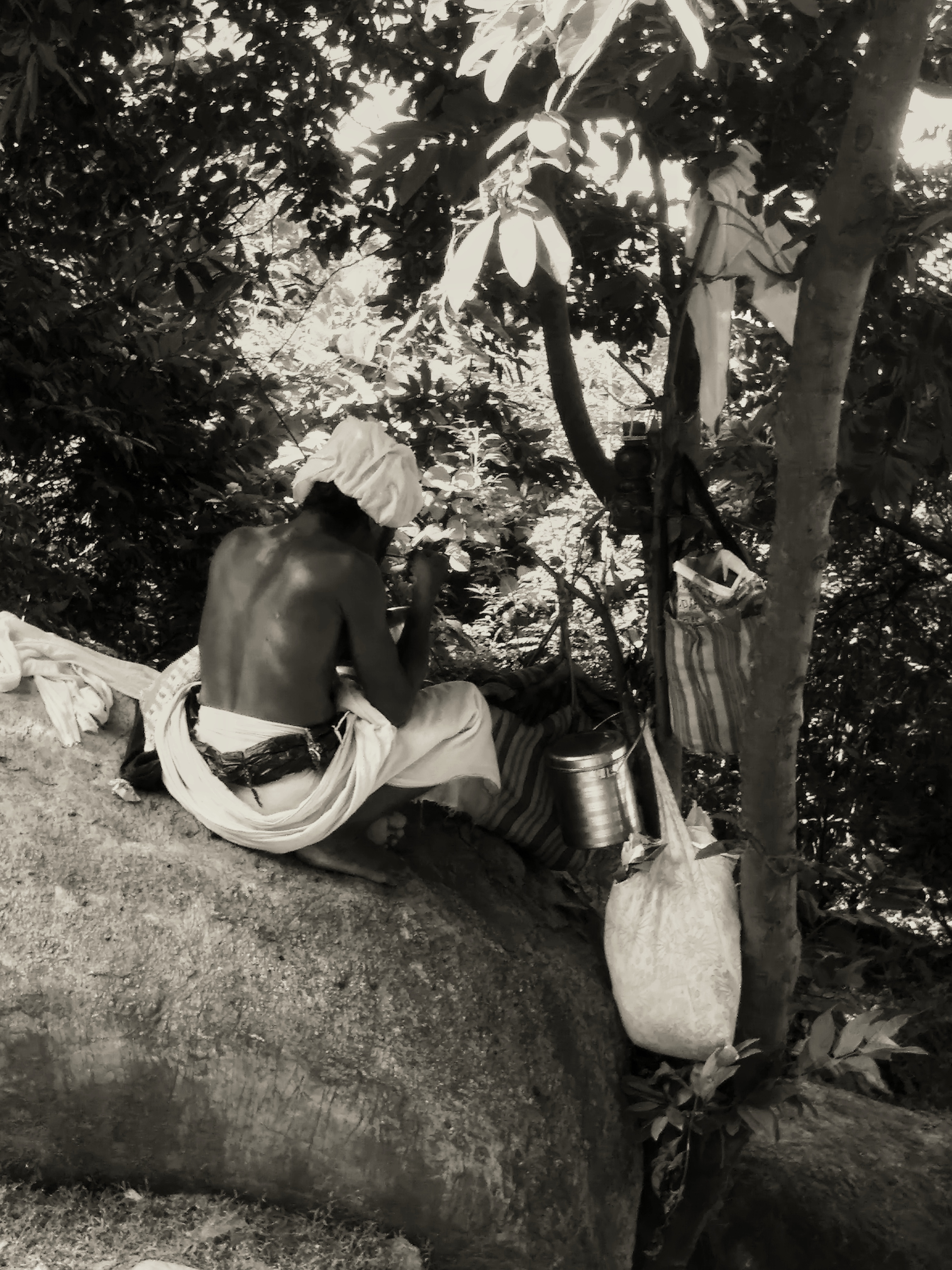
Looking through some posts saved from old blogs no longer active, I came across theaforementioned poem. It’s about a guy I met in a cafe in India back in 2006. This person kept me and a crowd of other travellers spellbound for a couple of hours one monsoon afternoon. Not to mention the many conversations focused on him that followed in the next few days and the several pages in my Journal recounting the whole experience.
Anyway, as soon as I saw this poem again, I thought I just have to post it here. That trip was a big step for me in my own healing and spiritual journey. And meeting this guy has played a part in all that.
So, please join me in making this small offering of thanks to that guy, whose actual name I never learned, and who forever will be known to several very fortunate travellers as the Cockroach Man
THE COCKROACH MAN
This is what he said. He’d lived many years in India, and, in that time he’d done many things. Even, he said, for a while he’d trained with a yogi, his guru. This is what he said.
Yogic training is not easy, he said, In fact, he said, one aspect made him sick for a year. This is what he said.
His Guru put beings in his head. Beings like parasites he said. Yes, yogic training, it made him sick. This is what he said.
Parasites implanted in the head? A part of yogic training? No. I don’t think so. Actually, inserted was the word he used. ‘inserted beings in my head.’ This is what he said.
All gone now, save one, he said. Only one remains—it’s like a cockroach. And it’s still in him making him sick. This is what he said.
At night, he said, there is sometimes relief. The cockroach leaves and floats just below the ceiling. Well, its astral body leaves his head and floats above his bed. This is what he said
‘You’re a healer. You understand,’ is what he says as he turns to me. Umm, no. Actually I don’t. But this is not what I said.
Where is he now, the Cockroach Man? ‘It’s winter soon. I’m gonna give blankets to the villagers.’ This is what he said.
He’s known suffering, he said. And you could tell he was tired from fighting the cockroach. ‘I’ll feed the poor.’ This is what he said.
A couple of days ago when this powerful and important statement in the form of this illustration showed up on my social media, I was struck by something I don’t think I’d noticed before. Suddenly I saw: ‘might not change the world”. Might not? Which gave me the idea: it could as easily say ‘Helping one person might change the world …’.
But, you know, my thinking went even further: I realized that might and might not have nothing to do with it. The reality is that every action we take, and that includes the action of helping other living beings, actually does change the world.
Well, firstly, which of our actions help other beings, and thus change the world, we can’t always know. And obviously we can’t always (actually it’s more like very rarely) see the impacts of our actions. And even if we do, it’s likely that we’ll only directly get to see what happens in a limited and local sense. Nevertheless, all actions have a tendency to result in a domino, or cascade effect that literally never stops.
But, wait, there’s more. I kept thinking about it, and came up with a couple of ideas about why it could be a good idea to change the might not in this marvelous saying, which speaks of a negative possibility, to always will, which points to something definite.
All is one on the physical and the non-physical levels
We’ve all had those moments when we sense a connection with the rest of the world; we feel that we are part of nature, part of something bigger than just the one of us.
But, have you ever felt you were even more than just a ‘part of’ the world or nature? Have you ever had a sense that you are nature? Maybe this sounds a bit esoteric: we are one Self; we are all manifestations of the divine; we are all sparks of the one light, and so on.
And of course we can’t know for sure what goes on beyond the physical world. But, even at the most basic level of the material world, especially as we get down to the microscopic and even atomic levels, it’s hard to see any ‘separation’ between any individual and another. Atoms merge and cross over, interact, and change, energy fields collide and mingle, between all living and non-living things.
So, who’s to say that one small action on my part, one small change, won’t have a cascading effect as the ripples (that’s a good way to put it isn’t it?) from that action spread through the world and beyond?
The ‘What can One Person Do?’ Dilemma
Our Sydney Smith quote partially answers this agonising question for us as we’ve seen. Still, you might think that one person can’t do a lot when the needs are so many and so vast, and when most problems in our world seem to be so intractable. Mr Smith says that there is always something you as one person, as an individual can do, even if it’s a small thing you do.
Just think how many people everywhere are asking this same question: ‘What can one person do?’ If even a tiny percentage of those individuals answered that they could do something, then you would start to see changes taking place for sure. How could all those actions not add up to a changed world?
The Multiplyer Effect
Just now I used the words ‘add up’. Well actually it’s more like a multiplication effect isn’t it? If we say we change the world by helping just one person, then there has to be a Multiplyer at work I think.
We have all heard that aphorism that if you give food to a hungry person then you feed them for a day, but if you teach that person to produce their own food, then you feed them for a lifetime. Another truism definitely.
Still, once again, I think we can go further. Is it possible that by teaching one person to produce their own food you can help the whole world eat properly? Let me tell you a story I heard on an online video just a few days ago.
A man was traveling in a poor part of a country he loved. He’d spent the previous few years in another part of the same country building a house and growing his own vegetables and fruits.
He met a local person who was renting a small block of land, and that person asked him if he could help them build a house and teach them to grow their own food. It was a poor area, and the land was pretty much a little slice of jungle.
Anyway, this man agreed to help, and has been there for a few years now. He showed that local person how to grow various fruits and what looked to me to be a huge variety of vegetables. And they didn’t forget the flowers either. As the seasons passed, seeds were gathered and more land turned over to growing food.
Apparently from the very start they had a surplus of the fruits and vegetables they were growing, so they began offering them to neighbours, most of whom were also very poor.
Our traveling friend then showed them how to collect seeds from the food they ate (and the flowers too) and began to show these neighbours how to plant, fertilise, care for, and harvest what those seeds produced. In this way they too were able expand the amount of food they could grow.
So, already there is a growing area of this one slice of one country, that’s becoming self sufficient in fruit and vegetables. Now, that’s not the whole world obviously, but you’d have to agree, it’s a good start.
Anyway, just think: those people now have skills and surplus food and seeds to share further afield. Who can say how far such action might spread? It all sounds quite simplistic put like this, but it is the way that many grassroots movements for change have worked. And remember, nobody can reliably predict the ongoing impacts of any actions.
So, yes it is true, helping one person does indeed change the world for that one person. But whatever we do for one person, it also does definitely change the world beyond. As we’ve said, we may not see how or that it changes everything in the world and certainly not all at once.
We may think of ourselves as just one separate little individual, but we are united with all life. We may think that it’s all too much; too many problems; what can I do? The road to changing the world seems to be blocked, seems to be impassable.
Well, one teacher I admire is Swami Ramdas who founded Anandashram in India. Among the many great things he said, this one stands out for me above them all. I may have the wording a bit wrong, but basically the message is:
Once you have set your feet upon the path, then you are already at your goal
Which is another way of saying that if you help one person, then you have already changed the world.
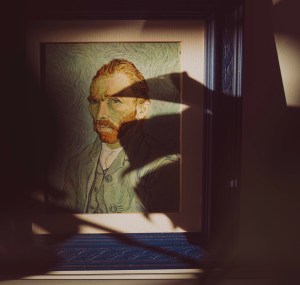
It is an old belief, and it is a good belief, that our life is a pilgrims progress.
Vincent Van Gogh
The usual definition of a pilgrim is a person who goes on a journey to a special place, a place that has significance for them, often as a spiritual exercise or quest. Sometimes the journey can be over long distances and a difficult road.
The key characteristic of a pilgrimage is that it is to be undertaken on foot, or put another way, a pilgrimage is a journey we (as the pilgrim) travel on by our own efforts, under our own steam as they say.
In this quote Vincent is talking about that other pilgrimage: the one that goes on on the inside. It’s referring to the idea that our lives can be an inner spiritual journey (or pilgrimage) from our present imperfect condition to a place or state of beatitude. Or as some might say Heaven or Nirvana. Others call it Self or God Realisation. And some other people call it Enlightenment.
You could say that Vincent is suggesting that a pilgrim is one who goes on a special quest to find the answers to life’s big questions; a pilgrim is a person who travels (either out there in the world, or inside on a journey of the heart, mind, and soul) to see, to learn, to do and to grow as a human being.
And, if all goes well, we end up in Nirvana, or a state of spiritual advancement as a kind of nice bonus at the end of the road
Spiritual for me in this context refers to the things that affect or relate to the human spirit or soul and might not be concerned simply with the physical or material aspects of life.
But here is the funny paradox about this kind of inner spiritual pilgrimage: as we learn, as we discover new ways of being and relating to people; as we find answers for ourselves and as we grow as people, we find that changes start to take place in our physical world.
From simply directing the wheres and whens of our activities in the material world, to pushing us in a direction of study, to influencing what people we meet, to the type of work we end up doing and to the actual state of our mental and physical health. It’s that inner pilgrimage that really is running the show of our lives.
So, as we travel the long road of our lives, let’s continue to learn. Let’s keep alert for those insights that come with a desire to grow and to work out what our lives and the world are all about. Above all, let’s keep on pilgriming down that road, and allowing ourselves to be open to new experience, new people, new ways of being.
Another quote from Vincent that I particularly resonate with. This time from a letter to his brother Theo and talking about the lot of the pilgrim:
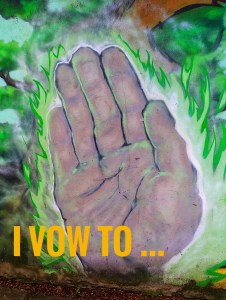
Welcome back to my little mini-series With These Words … , my reflections on how well my way of living measures up to the vows taken by many spiritual seekers, either in a community setting, or as a spiritually oriented hermit, or an individual ‘monk in the world‘ (and monk here has no gender specific meaning. A monk is a monk). Do these concepts work as a kind of philosophy of life for me?
Funny I used the expression measure up just now: You see, we’re at Part 4 which is Accountability. So, measuring up is the very thing we will be talking about right now! Oh, one thing: If you missed any of those earlier Parts to this series, you’ll find links in the PS at the bottom.
Accountability
It goes without saying that we are always accountable for the consequences of our actions, decisions, behaviours, and way of being in the world. Of course there is a deep mystical concept that it is only our material nature that carries out actions in the physical world and that the doer is actually the source of that material nature: God, Self, Brahman. Or you could say the Universe. As in I am a child of the Universe kind of thing.
But, you know, putting all that aside, we are actually living a physical life, and the truth is we are accountable for anything we do in this material world. And that means literally everything: thought, word, deed; the whole deal.
So, the question is not whether or not we are accountable: we just are. The real question is whether I myself acknowledge that accountability and act accordingly to change behaviours or whatever might be necessary.
To be honest, I truly feel that we all very often fail, sometimes even refuse, to even see the consequences of our actions, and therefore fail to make those necessary corrections or changes. Certainly you can put me high up on that list.
So, the big question: Do I feel ‘obligated to explain, justify and take responsibility for [our] actions and to answer to someone [for the consequences of those actions]? (Thanks Dictionary.com for the help here) That someone is very often yourself, or a partner, family member, work colleague, friend. You get it.
Personally, I would say definitely yes, sort of, sometimes. The problem comes up on those occasions when I fail to see, as I noted above. Now, again being very truthful about myself, I would say that most of the time I am aware of my actions, even when I’m not able to control them. But, still being truthful, I am often guilty of picking on the wrong stuff I do and end up blaming myself for innocent actions, and blissfully ignoring the other kind.
I am very big on taking responsibility once I’m aware of a not so good consequence or behaviour, or whatever. Of course like everyone else I do at times defend the indefensible. I’m particularly good with that sort of thing: it often takes me a long time to wake up. Not as long as it once did, but still.
In my attempts to live an authentic hermit life, I think naturally and, through my spiritual practice, meditation, study, and contemplation, not to mention self enquiry and heart level honesty, steadily making progress.
Like I said, being accountable is not the question. It’s about realising that I’m accountable and that I am thus responsible for taking whatever remedial action necessary. And it goes without saying I am also accountable for the consequences of those actions too.
Phew. That’s quite enough of this particular little episode of self enquiry. Okay. Just one more thought:
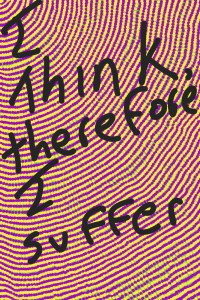
Remember my last post (I Think, Therefore I suffer. Sometimes) ? About how I was able to divert the ‘poor me’ thought train, to let the ‘I’m really and truly blessed’ express to roll on through? Well it occurred to me that this is a terrific example of accountability. Remember thoughts count as actions too.
I had the negative thoughts, which lead to the consequence of an onslaught of maudlin self-pity. and even in that sad state I realized that there could only be bad stuff come from that self-pity if left to fester – and it might not just be me who gets entangled: self-pity makes vibes, an atmosphere, and that affects everyone.
No, that was not going to happen, so other thoughts kicked in. In other words, I made changes: my thoughts of ‘woe is me’ transformed into ones of gratitude and acknowledgement of my true position.
Essentially I saw the consequences of my actions (or thoughts), realized at some level I was accountable to myself and others for those consequences (actual and potential), and I took action. As I said, this all was going on inside and happened in a flash really. Still, I am still witnessing the consequences of that little incident of being accountable for my actions and acting accordingly.
Enough I think I said? I realise that I have gone on and on and not given thought to the consequences to you, the suffering reader stuck with said verbosity. So, as a responsible hermit who has taken a vow to be a bit more silent at least sometimes, I will stop this post without further ado.
PS Just in case you’ve missed the previous posts in this series: Part 1 The Introduction and overview Part 2 Simplicity Part 3 Purity
Well here we are at Part 3 of the mini series in which we’re looking at whether or not my ‘philosophy of life’ might be well described by living according to the vows used by many contemporary nuns and monks and that are a reinterpretation or evolution of the traditional vows.
As I’ve mentioned, I haven’t taken these vows, but when I learned about them (Simplicity, Purity, Accountability, and for some, Presence.) I thought I’d look at how well I live up to the life they dictate.
So, welcome. And if you haven’t yet seen the first two parts, please feel free to have a look at them. Part 1 is a sort of introduction and overview, while in Part 2 I asked whether or not I actually do manage to live a simple life.
Well, do I? To be honest, it was a nice challenge looking at that question; I mean it got me thinking about the reality of my life (like the rest of these posts will as well, obviously) and I would say yes, I think I do live a quite simple life, especially in the context of the dominant culture we live in, and society’s demands and pressures.
Anyway, time to get on with the next part of our little exploration.
Purity
Purity. It’s one of those words isn’t it? I mean, probably all of us think we know what it means, but it’s not a word we use on a day-to-basis is it? It’s a word we’d use rarely if ever to describe our behaviour or approach to life. So, what words do I use then?
Which reminds me: purity gets a bit of a bad rap I think. It’s often used to describe standards imposed by some group, or authority, a moral code thrust upon us, from someone or something outside of ourselves.
For me, Purity is really about my approach to life, to myself and other living beings, to the world, to everything actually.
So, with your permission I will try for the rest of this post to use words and ideas that actually mean something to me in my daily life and in the way I try to live.
Clean is a word that comes to mind. It sounds strange (and redundent) to say, but I try to live a clean life. Obviously I bathe regularly, wear clean cloths and try to not spill stuff too often. But, you might not know this, but clumsy is my middle name, so, yes spilling stuff is a curse I live with! (I just had an orange and I think more juice ended up on my shirt than in my mouth).
Now, actually that’s a good start: I mean to say, we’re all fallible beings; we all have things we can’t quite get right all the time: Pu … oops … the P word is a concept to hold on to in an aspirational way; it’s not a hard and fast set of rules or standards where I’m in a I am either, or I am not, scenario. Actually it’s very much to do with the present, but that literally is a story for another day isn’t it?
How else do I try to live clean? Thinking. I try, consciously, and all the time, to practise clean or we can say right thinking. Right thoughts about others, whether I like what they do or not. Right attitudes to others too are important aspirations for me as well.
To be truthful I’m not yet at the stage where I could say that having right attitudes to others has freed me to neither like or dislike people, situations, or whatever. Perhaps now and again, but certainly not all the time. Like everyone else I’m attached to my likes and dislikes, to my prejudices, and biases. As I said, it’s aspirational, something to work on continually.
Part of that right attitude, as well as living clean, is having a compassionate approach to other living beings. Meaning that with my actions, thoughts or behaviour I try to do as little harm as possible. Actually, it’s more than that: compassion for me must be an active thing, not just a vague feeling or intention informing my life.
In other words, I have designed my life (diet, clothing, transport, thinking, and the rest) so that I cause no more death or harm to any living thing than I can possibly manage.
Of course I realise we human beings are simply one more species among the many millions sharing this planet. Nothing any of us do in any sphere of life (our actions in the world, our thinking) can be accomplished without an impact on our fellow dwellers on Earth. All we can do is what we can do.
Aspiration. That’s what it boils down to for me. Did I mention it (you know … P) isn’t a you are or you are not kind of thing? Like the other P word, presence, it has at its main characteristic an ongoingness; there is no time when we can say I am P … .
Nor will there ever be a time when we can say in a way that that’s actually truth, ‘I give up, It’s too hard. I’m never going to be P… .
Which leads very nicely to Accountability, the next of our words to live by. But let’s get into that next time! Thank you sharing this time with me.
One morning recently I opened my Journal, ready to write: ‘I woke up late today.’ But I didn’t (well I did get up late) I stopped as the thought went through my mind: what does late actually mean.
Well, I know what late means as I suppose we all do, but I Iooked it up anyway. And, of course it means exactly what we think it means: ‘after the expected, proper, or usual time.’
Expected, usual, or proper. Three words guaranteed to get me thinking. After all, who is it exactly that prescribes (or proscribes) what is the expected, usual or proper time or what is not?
Then the lyrics of a song called A Blessing in Disguiseby singer-songwriter Graham Connors came to me. One particular blessing he lists in the song is a watch that runs backwards. The watch owner’s friends all offer to have it fixed, but he says no thank you; it suits me just fine:
It reminds me that time is a state of mind a restriction we place on our lives.
Yes, exactly. I’m sure we all sometimes see time as a restriction. How many of us are tired of (not to mention exhausted by) appointments, schedules, alarms waking us up, too many hours at ‘waste of time’ jobs, too many hours when we’re not at that job, the endless hours spent hypnotized by one screen or another?
In other words, we live bound by restrictions we place (or allow others to place) on ourselves and then we wonder why we’re unhappy, frustrated, exhausted, angry, sad and in need of a break; in need of more time.
Well, time, as the song says, is a state of mind. It’s how we look at time; that’s the point. Forget the restrictions. No, I don’t mean quit your job (though I never suggest to anyone they not quit their job), ignore family or other ‘obligations’ (same disclaimer). What I am suggesting is that you find ways to look at time as the ongoing present, a state of mind to be in, to be in presence. Not future. Not past. And never ever static.
One can never be late. One can only ever be here and now, in that previously mentioned ongoing present. You are the one to decide what is ‘proper’ for you; it’s up to you to create your own unique ‘usual’
And as for ‘expectations’: well, if you have to have them (and expectations are really only imaginings about events, situations, and circumstances that aren’t real yet and may never be), at least make them your own. Peace
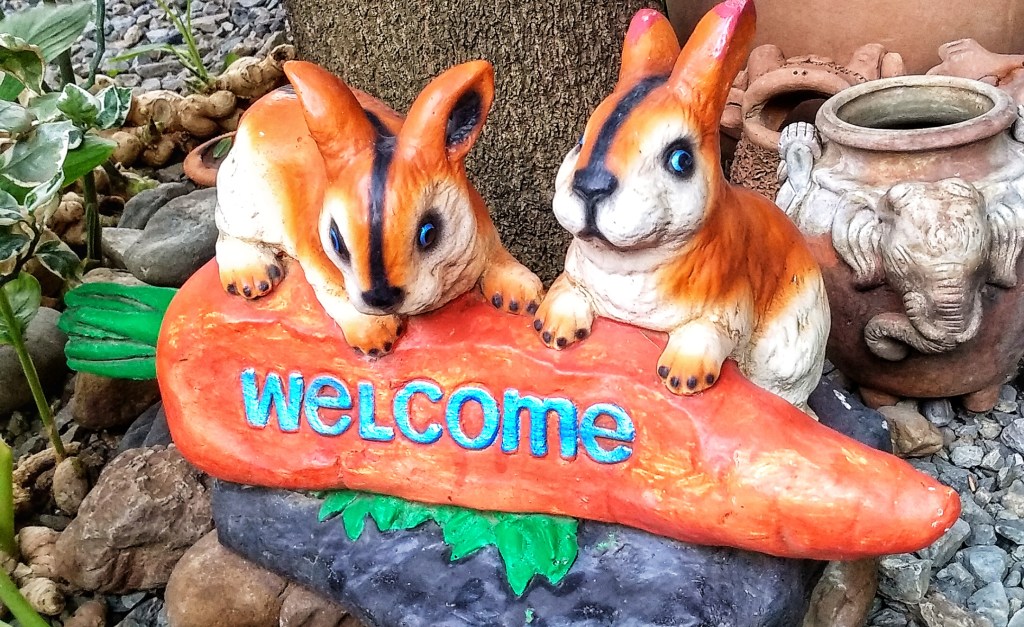
At this early stage in the life of this blog, no doubt most visitors will really have only seen the Welcome and the About Me pages. The question I’m asking myself is what else can I tell you about myself and my life that you can’t see for yourself on those pages?
Well, I realized that I’d already, on another blog, shared some insights in a kind of miniseries of posts that speak about my philosophy of life as I call it. So, join me as I get into Part 1.
By now you probably worked out that I call myself a hermit. Perhaps I have explained what I mean by this somewhere else on this blog, but in a nutshell being a hermit to me means living a quiet life, without a lot of physical contact with other people; I visit shops and other businesses and so on, as little as I can manage. For example, I haven’t been to a cafe, restaurant, or other social gatherings for several years.
Just one of many hermitages we’ve found by the side of the road. This one way out in the desert country in Australia’s Outback (Painting by my partner hermit Pauline)
Of course there are more esoteric or spiritual aspects to being a hermit, and I’m very much aware that it’s this spiritual quest side of things that is really the driver for the way I live. A quiet life lived apart from the world, means less distractions, more quiet, more time. All are great helps.
Obviously given the times we are living in right now, I’m far from the only one living a hermit life. At least I am blessed in that my way of living is by choice. At the same time, I’m actually quite excited to watch as the people of the world begin to slowly get back out there and into life again.
As no doubt I’m mentioned somewhere else, I was born with a nomadic nature and soul. So in a real sense it’s a pilgrimage I’ve always been on anyway. So perhaps I might be back out there on the road sometime soon
In the truest sense of the word, I aspire to live like a monk: A monk in (sort of), but not of the world you might say. However monks (and nuns) usually live in community, in a monastery or convent. It’s true to say that life with my partner has me living in community, though it’s only the two of us. Then there are the few places in cyberspace where I encounter and interact with others.
It’s well known that many monks and nuns take a number of vows when they join their communities. Traditionally these vows are: Poverty, Chastity, and Obedience. In many cases the additional vow of Stability is added, binding the monk or nun to a particular community in a particular place.
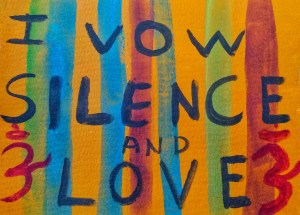
I’ve never been comfortable with those vows, so I’ve never made them. But as I have progressed in my spiritual journey, I have taken vows of various kinds. Mind you my vow to silence is having a hard time of it with me! As for the love part of this vow: well, that’s also a work in progress.
Anyway, recently I’ve been reading about communities (some religious, some secular, but always made up of people sharing the same or similar values, goals, and missions) who, also uncomfortable with those traditional vows, have reinterpreted them in a way that sits more comfortably.
That renewed version is : Simplicity, Purity, and Accountability. In the place of the vow to stability, there is now what you could say is a more precise concept: Presence.
While I can’t say I have formally taken these vows, it has occurred to me that, put together, they do make up a fairly precise set of principles that could be said to apply already as I attempt to live authentically as hermit, monk, and pilgrim!
Please join me in Part 2 (appearing soon) when I will put this theory to the test.













 Notes from the Hermit's Cave