In my last post, I spent some time contemplating a question:
If I’m actually praying a prayer, how could it even occur to me that I might in fact not be praying, but instead simply be reading the words of the prayer? (substitute here ‘reciting the words of the prayer in rote fashion’)
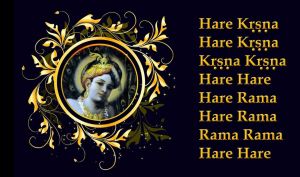
Well, for today’s post I have a poetic offering which I composed several days ago. It’s actually words of my own built around – embracing even – an already existing prayer: the Mahā-mantra, which is better known as the Hare Krishna mantra.
While making notes for that post, my mind at one point drifted to that poem. So, after finally publishing the post, I reread the poem a few times.
It struck me that, rather than creating a simple poem, I had instead composed another and distinct prayer of my own, which incorporates the Mantra. That was a revelation to me.
It’s a poem, no a prayer, of gratitude. And of praise also. It has a structure and a cadence that has me sensing that it is a prayer to be prayed, and not simply a poem to be read as words on a page – or screen.
It is with that gratitude and with love that I humbly offer these words – this prayer – to you.
TAKE THE LORD’S NAMES
‘Going to chant for a while’. Hare Krishna A refrain often heard Hare Krishna Here in this place Krishna Krishna In this hermitage Hare Hare In this place of abode of hermits Hare Rama In this paradise for hermits Hare Rama In this place of refuge Rama Rama In this safe haven Hare Hare Where we servants serve Hare Krishna
‘I’ll carry on with my Gita then,’ I said to my partner hermit after we’d been discussing something for a while.
‘I’m enjoying reading my prayers this morning. So I’ll read a few more then read a few verses’ (of the Bhagavad Gita).
‘Reading’ my prayers? Is that what I’m doing? Surely a prayer – prayers – are for praying? Anyway, not simply for ‘reading’.
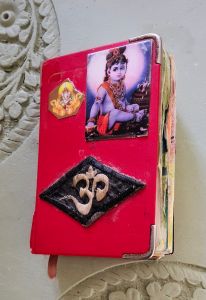
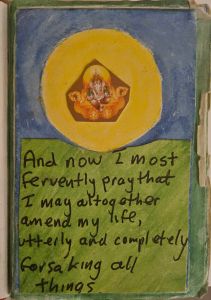
Of course in this particular instance, the forms the prayers are taking – on the most superficial, worldly, material level – are as words written by human hand (mine) on paper pages in a little book.
But, right now, the big question, the existential question really, is have I been merely reading those prayers? Or have I been praying those prayers?
Then there’s another, equally existential, concern that arises: How to know the difference. Reading? Or praying?
I feel like saying that the first thought that comes to mind – the first answer to reach the tip of my pen on this page – is this: Actually, the answer has come in the form of a rhetorical question:
If a prayer is prayed, how would it ever even occur to me query if it is in fact a prayer, and not just words on a page to be read?
Yes, first thought best thought here I think. When a prayer is prayed, even if its form is words written on a page, there is a movement beyond those words on the page. In fact, there is a transcendence of all that is of the material world that takes place.
A prayer is what it’s always been: a prayer. The forms prayers take are, I think, literally endless, uncountable, and can never be submitted to categorisation by us humans.
Prayer is for praying, that’s the lesson for me. Just pray.
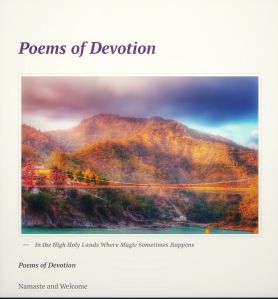
Have you seen the new page on the blog? It’s called Poems of Devotion (no prizes for guessing what’s on that page).
What you’ll see when you get there!
You are warmly invited to head over there to read and enjoy a poem. Or perhaps two, or seven! The choice is yours.
The page, as you already guessed, seeing right through the extremely obscure title, is dedicated solely to devotional poems I have composed. Many have been written in recent times, though there are some which are, well, no longer the new kids on the block (get it? New kids on the block? New page on the blog? Oh, okay, never mind).
I hope to continue my occasional practice of featuring a poem in a post (perhaps with its story or some other commentary). But, in time, all my devotional poetic pieces will be on the new page.
You are very welcome to visit the page, Poems of Devotion, to read, to contemplate, and if you so wish, copy anything you find there for your own reflections or to share with others.
Love & beauty; What else is there?
I’m grateful that I have come somehow to compose these poems of praise and love. I call it a gift of grace that has been granted me. It is a gift I now ask that I may share with you.
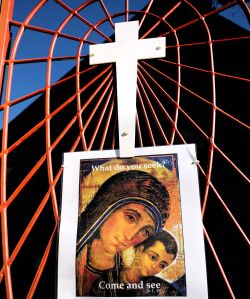
Growing up Catholic, attending Catholic schools from age six to fifteen, going to Confession most weeks, going to mass once a week, oftentimes more, I was deeply immersed in a particular cultural environment of Catholicism. Over time I was (we all were) inculcated with, among other things, a deep love and a reverence for Mary, the mother of Jesus.
I say deep love. No, I’m not being quite precise enough to let it slide. Sure we were taught to love her, but in a kind of limited way. We should love her because she is the mother of Jesus. Not that being the mother of Jesus was what you would label a ‘limited’ role of course. But other than that we were taught to view Mary as an intercessor for us, a conduit if you like between us and our wants, and her son Jesus. So love yes, but a kind of conditional love.
Mind you I was always very fond of Our Lady as we called her. Through a serious dedication (for a time) to The Rosary, and the numerous Hail Marys imposed as penances in Confession, I grew close to her.
And, even as I moved on and out of that Catholic sub-culture and began to explore other ideas and ways of being, I still maintained that fairly deep reverence for Mary, a reverence that has pretty much stayed with me all my life. I only realised today that it wasn’t until quite recently that I stopped calling her Our Lady.
But, in truth, my concept of her evolved beyond her being the mother of Jesus. Indeed, I came to a point when I realised it wasn’t at all relevant if Mary herself was an actual historical figure or not (this was much much later though).
For me Mary had come to represent or symbolise the female aspect of the Divine. Still, in the early days, very dualistic of course, but a huge step from the ‘second place’ she occupied in the earlier days when we weren’t even allowed to worship her as Divine. Worship was reserved for God – who was emphatically and indisputably male, sitting in heaven, entry to which was held tightly in the hands of more males in a male controlled and dominated institution. Which, it does have to be said merely reflected the world it operated in.
Anyway, let’s jump ahead half a life time of, (shall we say for our purposes here?) living, to put ourselves into the present day. Well, recent times anyway.
To put a very long story into one sentence (again for our purposes here today) I will simply say that I moved away from Christianity and especially the denomination of my childhood. Okay, we need another sentence: In more recent times, through a whole lot of circuitous meanderings, I have come to realise that there is only God.
That is to say, all there is is God, only God, nothing else. ‘Not one God, only God.’ as my teacher’s teacher used to say.
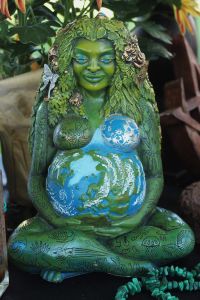
Earth Mother (Courtesy of Amber Avalona, CC0, via Wikimedia Commons)
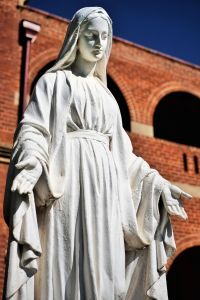
Nowadays I still love and revere Mary. As symbol. A symbol of the creative energies responsible for bringing the Universe into existence, and which is engaged in the ongoingness of its maintainance through the laws of nature. She is one manifestation among so many of this divine creativity. In a very real sense for me, she is the Divine Mother.
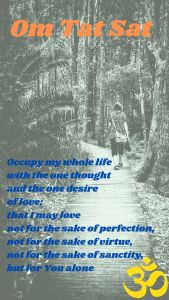
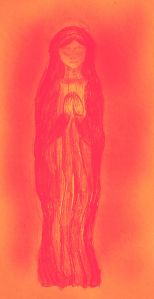
So, a prayer written by me to and for the Great Mother who manifests in whatever form – or no form – in which any of us may choose to worship and love her.




 Notes from the Hermit's Cave