Truth Is

Namaste friends. Welcome.

Fake news, propaganda, misinformation, disinformation, manipulative advertising. Such a tsunami of information threatening to swamp us, all of it claiming to be ‘facts’ or ‘true’, mean we are almost continually asking, what is true? Who can tell anymore? When we look at the world we live in today it is a rare thing when we are able to tell if something or someone is real or true.

For me there is only one solution: stop looking to the world as the source of any kind of answers to anything, and particularly when it comes to trying to sort out what is true and what isn’t.

The only place you will find the answer to the question ‘what is the truth of …?’ and know for certain that it is true, is within yourself. You are the only one who can decide what is true and what isn’t, what is right and what is wrong.

It doesn’t mean you ignore all information from external sources; it only means that you appeal to that inner part of yourself, the intellect and beyond, to help you reach your own truth sifted from all that information.

It’s a well trod path in philosophical circles: the debate around absolute versus relative truth(s) has been going on for a few thousand years already, and it’s unlikely to reach any kind of resolution anytime soon.

I’m not saying that a thing might be true for you and not true for someone else. At the same time I’m not saying that there is some kind of externally arbitrated single, absolute truth that is always true regardless of whether one agrees or not.

What I am saying is that, if you come to the truth of a thing, situation, person, whatever, from within yourself and it is accompanied by that inner ‘I just know this is right’ feeling one gets sometime, then putting it simply, it is truth. Period; fullstop; that’s all there is to it. End of story.

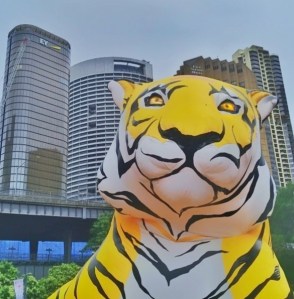
If someone tells me there is a tiger in the centre of town, how can I really know if there actually is a tiger in the centre of town? And if three (or three hundred) people tell me there is a tiger in the centre of town? Well even then, how can I really know for sure if there is a tiger? There might be, or there might not be.

Okay then, how do I find out? Putting it like that the answer seems obvious doesn’t it? I go and look for myself.

But you know even then, do my eyes deceive me? Do I know what a tiger looks like? You see, even if my physical eyes see what I’ve been led to believe is a tiger, I still need to use my intellect, or even my intuition, to assess its real identity, to figure out the truth for myself. I mean, for my Self.

Afterword:

The tiger example is from a Chinese fable from the Taoist tradition. I’ll put my slightly elaborated version in my next post, and once it’s there you can find it here.

Buddhism’s Three Refuges: They’re for Everyone

Greetings and Welcome

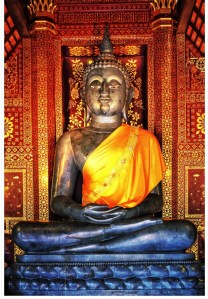
To become a Buddhist, , there are a number of things a person must commit to. One of these consists of a kind of three in one resolution that’s welcomed by any aspirant. In fact, some say that in order to be a Buddhist, one has to repeat The Triratna or The Three Jewels. Three refuges is the other name used.

I take refuge in the Buddha
I take refuge in the Dharma
I take refuge in the Sangha

The exact words used may vary, but The Three Jewels is common throughout the Buddhist world. And of course there will be many meanings ascribed to ‘take refuge’, but the one I like is the one that any of us might use in, say, a heavy downfall of rain. What do we usually do in when the rain starts falling? We look for shelter, we take refuge.

I don’t mean to suggest that becoming a Buddhist automatically means that one is seeking a safe dry cosy place out of the storm. Though, now I’ve said that, it does make sense. I know myself that (though I am not a Buddhist) sometimes the only way forward, the only means to seek the truth, and to find peace, is to take refuge somewhere or in someone or something.

Not being a Buddhist as I said, I’m not qualified to speak about Buddhism in any real detail. What I have in mind is I would like to borrow the Three Refuges and reflect on how we could all use what me might call a ‘secular’ interpretation as a way of putting into words our own commitment to finding a refuge, a safe haven as we tackle what is for all of us born into a physical body, a life of trials, tribulations, ups and downs, storms and lulls, happy times and sad times, and all the rest of the package that’s called living a life.

Let’s take a look at each of the Three Jewels (also known as the Three Treasures which I like a lot), and think about how we can apply it to our own life, to our own seeking of refuge.

I take refuge in the Buddha.

For a Buddhist, the Buddha is the Guru, the teacher, the one who holds the Truth and shows the way. Many people would say right now, well that counts me out. I don’t follow a religion. I don’t have a teacher or guru. I’m just another regular person trying to make my way through life.

While it may be true that you don’t have a teacher or priest or guru, or anyone else in the role of guide, there is one person who is always there with and for you, one person who is always thinking about you, who is making decisions for you on which way to go, what to do and all the rest: you.


Yes, you. Your Self. When it comes down to it, who knows you better than you do? Take refuge in you, in the Self. Need to make a hard choice? Look within. Feeling tired, or ill or fed up? Look within you for the answers to what can be done. Follow your intuition. You, plus intuition, plus you taking refuge in you, equals teacher, guide. You are your own guru.

I take refuge in the Dharma.

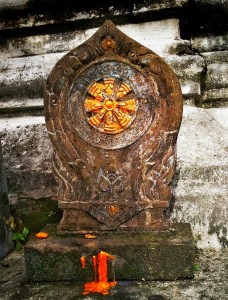
Once again there’s a myriad of ways to define dharma. And once again, I have a favourite: Dharma (often represented by a wheel) according to the religious tradition we know as Hinduism is cosmic or universal law that underpins right behaviour. It is the eternal and inherent nature of reality. In other words it is Truth.

We can all say, regardless of our beliefs say, I take refuge in the truth and in what is right. It’s a commitment to always acting in the best interests of everyone – including ourselves (maybe even especially ourselves). It is taking shelter or refuge in what is right. Living such a life in our messed up world is never going to be easy, so it is best to think in terms of doing the best one can. But having it as your ongoing guide will ease the path.

I take refuge in the Sangha.

A Sangha is an association or a community. Often used to describe monastic communities of monks or nuns, it may also include lay people. If we step outside of the religious framework, then a Sangha is a community that shares common bonds, beliefs, commitments, interests, and so on. Family, tribe, workmates, recreational and sports clubs. You name it: all sorts of groups might be sanghas or communities.

Of course, and perhaps very obviously, not all groups will be communities, And equally we may not think we are a part of any community; we may think of ourselves as being quite outside any group. However there are no rules that say a community has to have a set number of members. Besides, being in community is a condition and has nothing to do with group size or composition.

So, if you find yourself in a community of one – or two or however many – take refuge there. Make a commitment there. As with any other real community, this one begins with you and your truth.

The Buddha, the Dharma, and the Sangha. The Teacher, the Truth, and the Community. Making commitments to the Three Refuges can create a solid foundation as we continue our journey through the world and our lives. The refuges – the safe havens we can call them – we have sought and found will support us through good and bad times.

Actually, I just thought: if we are genuinely able to take true refuge in these three treasures then we will conditioning our Selves to be more present, more in the here and now of who we are, what we’re doing, and what’s happening to us.

Peace to you from me

Food & Drink of the Gods

Namaste and Welcome friends

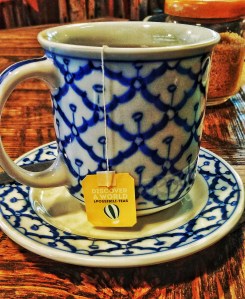
An idea that’s kept its hold on me for a while now concerns Black Tea and Dry Toast. It’s a part of my almost daily diet, and I’ve wanted to write about it. Anyway, here’s the note I first jotted down when the idea first came:

Black Tea and Dry Toast – In Reality is what we might call the food and drink of the Gods, of liberation, especially when I remember to offer it to Brahman and it becomes Prasada: simple, appetising, comforting, nourishing.
         What else?

Yes, sounds kind of weird, writing about such an apparently mundane subject. But, really, I  can say it definitely is for me the food and drink of the Gods. And as such, it moves beyond the little r reality of worldly food, of mundane considerations. It takes on the big R of Transcendental Reality.

Simple, plain food and drink. Pared down from all the extras and the padding, all the ‘additives’ we generally ply ourselves with. In a real sense this simplicity is in keeping with the uncluttered, minimal life I am called to live.

And everyone knows how comforting tea and toast is, how welcome it is pretty much any time of the day or night. Nourishing, too, for the spirit and the mind.

Actually for the body also. At least it is for me as a person who used to eat way too many biscuits, and take jam (thickly) on my toast. As I say, simple with no additives.

All of this equals in my view liberation. Freedom. Freedom at least sometimes, from harmful substances; Liberation from complicated preparations and the stresses and tedium that comes with it.

Black Tea and Dry Toast represents a snack (sometimes even a small meal) that at least for a short time can liberate us from stresses and tiredness. At other times, it gives us that freedom that comes from indulging in simple pleasures.

The food and drink of the Gods is not a complicated, invented and dressed up thing. It is plain, simple, comforting, nourishing.

And yummy.

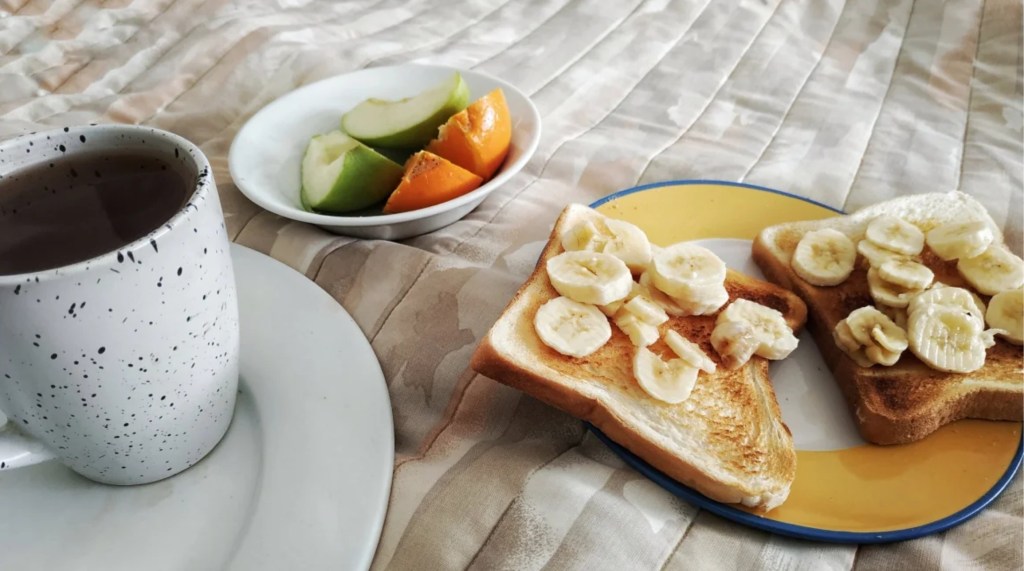
PS Okay. That photo stuck in the middle up there isn’t quite in keeping with the topic is it? Alright, I admit it: Sometimes I really indulge myself and add banana to my toast. And yes, sometimes apples and oranges too

Be Present in the Presence

Greetings and welcome

I write quite a lot about presence. I think a lot about presence, about being present, and all kinds of related ‘being in the moment’ kinds of musings.

Of course words like presence and present can have multiple meanings can’t they? About this time last year I read s book called Consider the Ravens. It’s about the history as well as the recent revival of interest in hermits and ways of living the hermit life.

If you are even remotely interested in living more in solitude, or living a simpler and more sustainable, life, or being more spiritually focused, then I can’t recommend this book highly enough.

There’s a paragraph from that book I’d like to share with you. It both describes some characteristics found in hermits and their way of life, as well as introducing us to a lovely phrase concerning the concept of presence.

Are hermits escapist? Yes. Is running away a bad thing? Like most choices it’s value is determined by its purpose. There are men and women who are selfishly seeking a sanctuary untouched by human pain. But there are others who deliberately choose to be powerless [in the eyes of the world], to live simply, and to use no more than their fare share of the world’s resources. They elect to be unknown, hidden, forgotten. And the goal? To become transparent to the Divine, or as [one hermit] succinctly phrased it: ‘to be always present to the Presence’.

Paul & Karen Fredette Consider the Ravens


I like that phrase; it’s what I’m aiming at. Actually, no. That’s not right: you can’t aim at being present, you can’t have presence as a goal to be attained in the future. I think that’s called an oxymoron. Anyway, all you can do is be; be present in the presence.

And it doesn’t matter what you call it: Presence; Truth; Reality; God; the Universe; the Cosmic Reality. They’re only names for that unnameable essence that we’d all agree can be called the Love that is in reality everything.

It’s that essence beyond all names – and forms. It’s what we sense is behind, above, and within all that exists in the world.

And, like a lot of people, I want to withdraw from that world of materialism. From the greed, the corruption, the cruelty and wilful ignorance, the … well, you get the point. My sense, and it is echoed in the quoted paragraph, is that presence is to be found in silence, and in solitude.

Of course it’s not necessary to be a hermit to be present – or in order to be present in the Presence. After all, few people believe they can go find a cave somewhere and withdraw totally from the world. (maybe it’s the belief that’s the problem?)

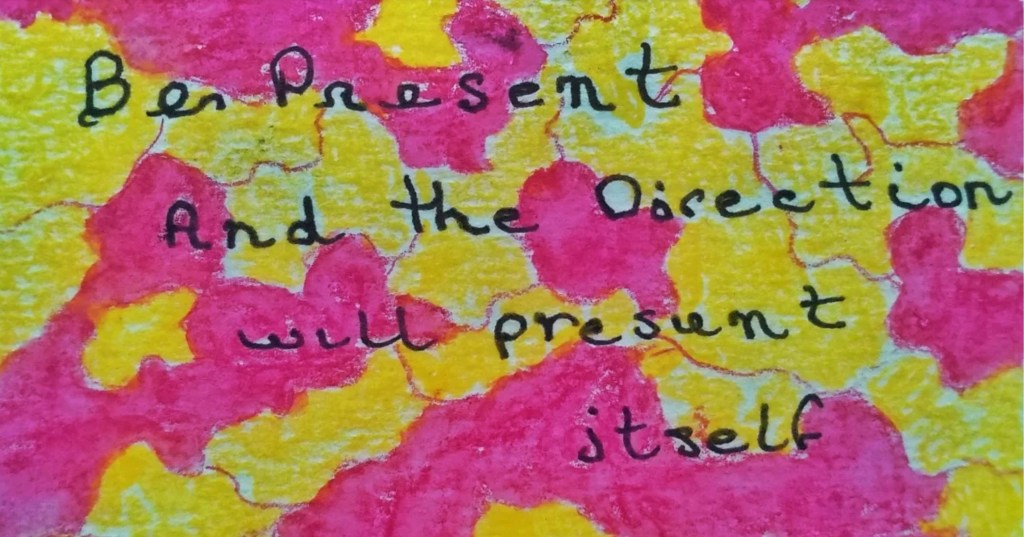
So, what to do? A wise person once gave a brilliant answer to that question and I have it on a card to remind me:

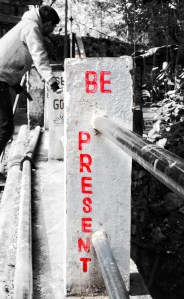
Yes. Be present and the direction will present itself.

Peace to you.

Seeking Justice: Commitments

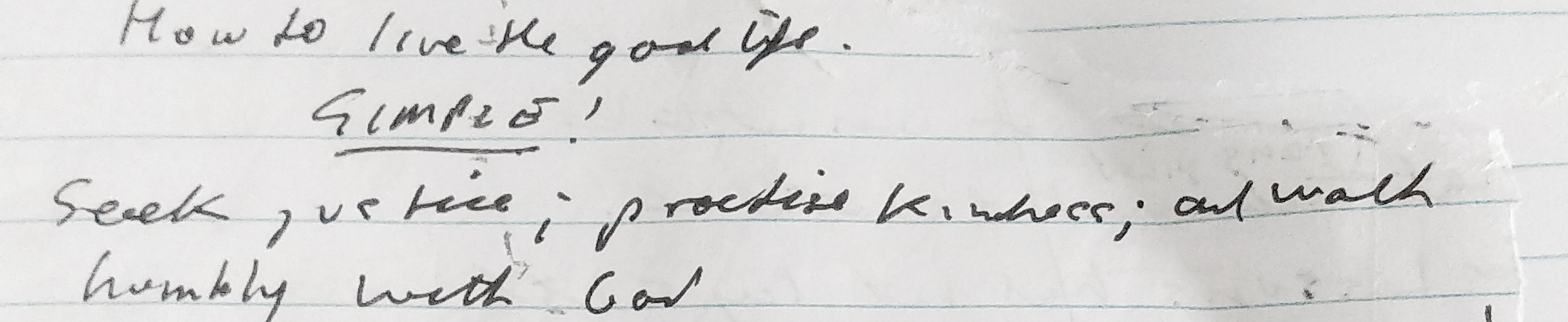
This morning I was just sitting, or at least trying to just sit. You know, being quiet, relaxing the mind. All that kind of thing. And of course, an idea sprung into that not so cooperative mind, so I grabbed my notebook. Just as I went to put this latest brainwave on paper I noticed a very extraordinary note I must have made I don’t know when:

I’ve just looked it up: It’s a slight paraphrase of a verse from the Old Testament, from the prophet Micah. Where I read it, I can’t say (the note is at least several weeks old). But to quote another little note from some unknown source, I always like to:

Let the noble thoughts come to me from all corners of the universe.

unknown

I’m just like everyone else, always wanting the easy solutions and you can tell that can’t you? ‘How to live the good life? Simple!’. I mean really; hardly humble in my approach in that note was I? Well, let’s talk about what Micah says, not my own lack of humility.

Seek justice; practise kindness; and walk humbly with [your] God.

There are numerous versions online of this verse (Micah, 6:8), so I will leave it to you to check those out for yourself. I’ve added the word your because all those versions do say ‘your God’. But even in this paraphrase it’s easy to see there is nothing at all simple about any of these injunctions.

I discovered that this verse is often invoked in times of grave injustice, or crisis. I think it goes without saying that we would be hard pressed to think of a time that was not a time of grave injustice or crisis. Certainly, we are living in one of those times of injustice and crisis.

There’s no need to or purpose served by getting into how ‘grave’ injustice is now compared to some other time; there’s no need or point to weighing up the relative severity of one crisis versus another. Injustice is injustice; a crisis is a crisis.

In other words, the present is always the time to heed the injunctions of this verse.

So, what do we do if we are to seek justice? Running the risk of sounding flippant, I would say that there are as many answers to this question as there are people to answer it. Now, you would think this would make the task impossible; too many cooks and all that. But actually it’s perfect. Why? Because it means that whoever you are, whatever your situation, you can actively seek justice.

Or, I am sorry: I should say I, me. Not you. I can actively seek justice. But, you say, you are a hermit; you live in a cave (not literally but I know what you mean); you hardly ever even talk to people in ‘real life’. Yes, all true. And I would say that the action I take is by no means at the level I know I want it to be. I’m doing nowhere enough.

Does that mean I’m leaving the cave? Going out into the world, onto the streets to join other brave souls seeking justice? Believe me, I ask myself such questions constantly. But to speak truth to you now, I will say that I know absolutely, in my heart, that my role is something different.

If anything, I need to go deeper into the cave; I need to go deeper into the inner world of my own Self. I know that in this way I will join with so many others in what I’ve come to call the Invisible Community of people all over the world living lives of contemplation and prayer. Or, speaking for me personally, trying to live a life of contemplation and prayer.

By so doing I am at least in a tiny way supporting those millions of others out there on the streets, in the aid groups, running campaigns, writing letters, helping the victims of injustice, in all kinds of miraculous, brave, and innovative ways.

So that’s my commitment to you. To deepen my prayer; to intensify my contemplation; to more fully realise my union with all living beings; and to really join with the invisible community in its efforts.

And, you ask, this blog? What’s it about then? Well, notes, musings, thoughts and reflections all aimed at reminding me of my responsibilities. And hopefully along the way, solidifying my union with you and the rest of creation, just a bit.

Peace and love

PS I haven’t forgotten ‘practise kindness’ or ‘walk humbly with your God’. Maybe another time.

Just Passing Through … or Seeking Noble Truths: A Poetical Sharing

Greetings friends

In my last post I mentioned I would share a poem with you in this one. And here it is!

Just Passing Through … or Seeking Noble Truths, is, like the previous post, concerned with passing through, how as I go through life, I am always in some sort of passing through place. Before we get to the poem, just let me fill you in on a bit of the back story.

First, I wrote the poem as I walked home to our hermitage at the time in a town called Moama on the Murray River in Australia. Now, the Murray is the biggest river in the country and the then little town of Moama sits across the river from its bigger city sized sibling: Echuca, the biggest inland port in Australia.

Anyway, I’d just crossed the river bridge and the words just started coming to me. Not exactly as you read it here, but close. I am very lucky that I had only a few minutes walk left to get home, otherwise the whole lot could have been lost to memory.

The longer back back story? Well, as the poem suggests, I’d spent a lot of time hitchhiking, in Australia and a few other places too. It’s true what it says in the first lines: I’d done a lot of trudging through a rather large number of towns unknown to me then, and only some of which are better known to me now in much later years.

Okay, that’s enough back story to last a while, so let’s just present the star of the show. I share this, as I do all my efforts, with heart.

JUST PASSING THROUGH … OR SEEKING NOBLE TRUTHS


Many have been the nights 
I’ve trudged (and less often, strode) 
past illuminated windows framing. 
families sharing sit down meals. 
Or huddled worshipfully before 
flickering and silent (to my passing by ears) 
picture boxes in corners of cosy family rooms. 

I am just one more invisible (to most), anonymous 
drifter. Just passing through 
the empty nighttime streets of one more 
anonymous town. 
Longing to enter the illumined frame. 
Longing to share one of those sit down meals. 
Longing to worship at the alter of the flickering picture box. 
Longing is loss. 

The edge of town roadside summons 
this lonesome bodhisattva begging rides. 

It’s just one more quiet and cold 
semi desert night. A high moon in a clear sky 
casts ghostly shadows through Eucalypts: 
my only company as the waiting game begins. 
Waiting to see headlights coming and going my way. 
Waiting to be rescued from this lonely edge of town roadside. 
Waiting for another ride, to another anonymous town. 
Waiting is wasteful 

Better to be here, now, on this 
edge of town roadside. A place as good 
as any. Illumined by the moon, 
the ghostly gums create the frame 
in which this bodhisattva rests. 
And worships. 

Thank you for allowing me to share these words with you. The road, as many of you will know, can be a teacher, a guru. I don’t hitch-hike anymore, but the road is still teaching me. And I am grateful.

What’s ‘Ordinary’ Got to do With It?

Perhaps shameful is too strong a word, but that’s kind of how it feels. You see, I’ve been thinking of giving up on the book I’m reading at the moment. And you are thinking, this is a big deal? If you don’t like it, put it aside and try something else.

Yes, excellent advice, thank you. And usually that’s what I would do. In fact now I think about it there was a time when I would force myself to complete a book, even if I wasn’t enjoying it or was bored with it. But I learned a long time ago that this is a waste of time, waste of mind, waste of energy, and unfair to me.

Yet, on this occasion, I started to have some thoughts that took it a bit deeper. It’s true to say that I’m a bit bored with this book; it’s as if I’m not overly interested in the story the author is telling, and in the way she’s telling it. As well I had this feeling that the book was ‘ordinary’: meaning that it was a kind of day to day telling of a segment of a life with its mundane and routine elements included along with the ‘good bits’.

And it was that feeling of being not so interested that got me thinking. The author’s vocation, thinking, activities, and the subject of the book itself, is exactly in line with areas I am very interested in reading about, not only for entertainment but for my learning, for my own spiritual journey and way of life.

The way she’s telling it? Now, this one got to me even more. The book was put together after the author’s death and is made up of extracts from the author’s journals and from the many letters she wrote to family and friends during the period of her life the book covers.

That’s what I do isn’t it? Keep a journal? Write letters? These and the many many blog posts (which in a way are a lot like letters, and even journal entries do you think?) I’ve written over many years, and the journal I’ve been keeping for most of my life, are the core of at least the personal writing I have done over my lifetime. By rejecting this book I started to feel that I was rejecting my own, for want of a better word, genres.

Or, worse than that, I’m rejecting the invitation to share a life. And illogically I’m rejecting the life story and insights of a person whose own experience I actually value for my own quest and from whom I could learn a great deal.

And what about the feeling of boredom and that the book was too ‘ordinary’ and mundane? Well, to borrow a well-worn phrase, this really does take the cake. I mean if you were to look at much of my past writings and look at my photography blogs from times past, you would see that one of my main statements of belief was:

There are no ordinary moments, nor are there any ordinary people.

And I still believe this. Indeed, spiritual practice and study has only deepened my instincts that all there is is the moment; all there is is all the beings of the world experiencing that ongoing presence, that never-ending moment. There can be nothing in the least ordinary about that.

I’ve saved the best – or is it the worst? – for last: what the book is about. It tells the story of a three year period in the life of a person just out of university who looking for a deeper meaning to life and to finding a true course for her life, travels from her home to Japan and enters a Zen monastery to become a monk.

Her journals and letters give the reader an intimate and in-depth account of her experiences: what she learned; insights into the language, culture, and history of Japan and Zen itself; the people she met and knew, her own feelings and reactions to what was a huge shift in her life.

After three years the author left the monastery to travel slowly back to see family at home. Sadly she was killed in a bus crash along the way.

Pretty much everything that has to do with living a life. And here’s me rejecting it because it was ‘ordinary’ and some details were ‘boring’.

So, I’m going to stay with this book. It’s taught me a lot already, and I think there is more there for me. Perhaps, I can better put into practice by own so strongly held idea that there are no ordinary moments or ordinary people.

Peace and love from me to you

Van Gogh: Mystic & Saint?

A few weeks ago I finished one of the most extraordinary books I have ever read. Yes, I know: we live in the days of hype and the redundant superlative. Everything is the best, biggest, greatest. Or, conversely, the worst, most tragic, saddest; it goes on and on.

In this case however I am not exaggerating. This book was amazing. It’s Learning from Henry Nouwen and Vincent Van Gogh: A portrait of a compassionate Life, by Carol A. Berry. From this book I’ve learned as much and more about Van Gogh’s motivations, his vision, his art, and yes, his very nature and soul, than in everything I’ve read, seen or heard about Vincent until now put together. And that includes from several visits to the magnificent Van Gogh museum in Amsterdam.

The book had its genesis in a course the author sat in on in the 1970s put on by Henry Nouwen for Theology students. The course aimed at helping future ministers and pastors learn to connect with their future parishioners. Basically it was about accessing the compassionate sides of their own natures so they might better help others. Nouwen used Van Gogh as a the model of a person who had lived a life built on compassion for others.

The author has mined Vincent’s letters (mostly to his brother Theo) and studied deeply his paintings and drawings, in order to understand and demonstrate what it means to live a life of compassion, and to highlight the artist’s mission in life. For me that mission is summed up very nicely in a quote from one of Van Gogh’s letters:

Art is to console those who are broken by life.

Vincent Van Gogh to his brother Theo

I had a vague sense of Vincent’s spiritual leanings (I knew he’d been a missionary living among poor miners and their families to better understand and help them), and he’d tried to become a preacher. But, before finding this book my thinking hadn’t gone much deeper than that.

But, through reading this book I discovered Vincent was really what many of us might call a mystic. The author goes further and after what i’ve learned, I tend to agree with her: she thinks Van Gogh is a saint.

A mystic in the sense that he tried to live a holy and compassionate life. He viewed all nature (of which he concluded humans are simply one equal part) as being expressions of the divine. And a saint in that he dedicated his life to making art that would inject light and colour into the darkness of people’s lives.

As I mentioned, Vincent had been a missionary for a time. But his radical way of living among the poor and sharing their lives in order to know and love them better was shocking and way too extreme for his bosses, and he had to move on.

So, he finally settled on full-on immersion in his art. His mission was to make paintings that offered comfort and consolation to those who are suffering. And that’s all of us to one degree or another isn’t it?

You can see by now that this supremely accessible (and pleasurable to read) work has had a profound impact on me. This book isn’t only for artists, nor is it a religious book; it is as I have said an inspiration and guide to living a compassionate and loving life.

I don’t want to just say ‘I can’t recommend highly enough that you read this book’; I want to say instead Please, please read this book. Then obviously act on what you have read!

I’ve always admired – loved – Vincent, now I think I know why. Or as Don McLean says in one of the most profound love songs (Vincent) in history (remember, I never exaggerate):

Now, I understand, what you tried to say to me
How you suffered for your sanity
How you tried to set them free
They would not listen, they did not know how
Perhaps they’ll listen now

Perhaps.

Love and Peace from me to you

If You … Don’t Quote Me on This

I don’t remember when I began to collect quotes; my early teens I think. I just started making notes of quotes from books (even comics in those far off younger days), from conversations overheard. Then, later, little excerpts from my own journals and other writings. Even slogans I’d see on t-shirts, billboards, or wherever else.

This doesn’t mean much in these times when you can type in a search for quotes on any subject, for any occasion, by anyone from anytime in history. But, in those long ago days before computers were in our hands, and certainly way before the Internet, it wasn’t so quick and easy.

Anyway, fast forward to the not so distant past;One day I sat at the computer (it was time for computers, thank goodness) and typed up all those collected quotes stored in several boxes full of little notebooks and scraps of paper.

The result is literally hundreds of pages of tightly typed quotes. That typing (which in fact took me quite a bit longer than one day) was in fact the genesis of a book that has remains half written.

You see, as I typed I saw so many great words of wisdom that I just felt compelled to put some of them together somehow.
Ive now been at that task for many years: its a very intense process and takes so much energy and, as any writer will tell you, the muse has to strike before we can begin to strike those keyboard keys! Anyway, it will be done when its done; the very notion of presence, of there only being now, is actually one of the major themes of the book.

As I got to the end of that original typing marathon, I noticed that, strangely, the very last quote in that long long list reads simply, If you. Clearly a sentence begun but left hanging. Who will ever know what would or should or could have come next but never did?

Some time ago I remembered that interesting little fact and began to think about its meaning. I decided to do a quick search of the whole collection for that little conditional phrase. The search revealed that there are 139 instances of quotes beginning with If you.

So, dear readers, dear friends and fellow travellers on life’s journey, here are eight (why pick ten like everyone else would?) of those quotes, chosen at random (is there such a thing really?).

No commentary or comment from me; you, the reader, can do very nicely without my two cents worth thrown in. Well, okay, just 2c worth: I have often learned a lot from quotes such as these (not necessarily these ones specifically); sometimes a simple quote has led to a healing or an important insight.

So, I thought it would be a great idea to share some of my collection with you and perhaps there will be one or more that strikes a chord:

If You …

  • If you allow things to surprise you, you will get easily confused.
  • If you always do your best, you will be free from regrets.
  • If you follow the eternal law, you can understand how to love.
  • When you forget who you are, and dont know what to do, act the way you would if you did.
  • If you really dont care, you arent going to know if something is wrong. The thought would never occur to you. The act of pronouncing something wrong is a form of caring.
  • If you have to ask questions all the time, you never get time to just know.
  • If you are not interested in this, then why are you here?
  • If you deny even one person entrance to your life, youll never get their uniqueness from anyone else.

So, there you are. Theres much to reflect on here. Lots to focus on, to meditate on, and contemplate.

Love and blessings from me to you

I love the Now. When else is there?

Over the last couple of months or so I’ve been listening on and off to Jimmy Buffett. I like Jimmy’s music, and I have liked it since the late 70s. I have at least ten of his albums in my Music folder.

Anyway, Buffett is an American singer/songwriter who writes and performs songs about beach life, sailing, exotic island paradises, and generally having a good time down at the beach and in and on the water. And preferably in sunny climes.

Yes. Hedonistic is a word that’s been used to describe his music and the lifestyle he celebrates. Still, I’ve liked him for a very long while now, and every so often I get into his ‘escapism’ and his relaxing in paradise kind of vibe.

Something a little rebellious about many of his lyrics too. But let’s not go there just now. What I want to talk about is a song I’ve listened to dozens of times, but when I played it again the other night, it got my attention in a way it never had before.

What I mean to say, is that for the first time I actually heard the song (Love the Now. Have a listen, you won’t regret it). I got what the writer was saying with his lyrics.

All the pain and the pleasure
I love the now
All the blood and the treasure

Then another verse:

The whole damn world’s gone crazy
The moon is jumping over the cow
How can you help
But not love the now?

It’s like he’s saying, ‘yeah, it’s all good.’ Not just hedonistic but nihilistic as well. Like he doesn’t care, doesn’t want to know. But, then, in another verse he writes:

It’s the only place I’ve ever been
It’s the only way that I know how

It is. That’s what he’s saying. ‘All the ranting and Ravin’ and ‘All the cussin’ and cravin’‘ are there for sure. Or, rather, they are all here. And now. But, dig a little deeper, read between the lines (so to speak).

Listen to this:

Don’t talk about your superstitions
Don’t talk about your cats meow
But don’t talk about tomorrow tonight
I Love The Now

You see? He doesn’t want to hear about your belief systems imposed on you by others. He doesn’t want to hear about your fears that have been manufactured by someone else to keep you in line. And he is not the slightest bit interested in your fancy material toys and other stuff (cat’s meow: a great expression coined in the 1920s meaning fancy, flashy, cool, awesome and other similar epiphets).

And don’t talk about some far off distant future (okay tomorrow night may sometimes seem awfully close to now, but you get the meaning).

The bottom line (literally and figuratively): he loves the now. And that’s because that’s all there is: the now.

So, on the face of it hedonistic, nihilistic even, as if he’s shrugging his shoulders in a ‘so what?’ kind of way. But he’s not doing that at all; he’s actually offering a solution to the overwhelming tidal wave of ‘things that are wrong with the world’, and about which many of us feel helpless and sometimes even hopeless.
The Now. It really is the only thing you’ve ever known, the only time and place you can ever hope to be. So why not love it? Why not just live it?

This is not resignation; it is not fatalism or a giving up (or in). In fact it is a courageous engagement with the total reality of life as it is right now.
Jimmy writes that:

Tomorrow’s right around the corner
I’ll get there somehow
But I’m stuck in [the] meantime

And, then, most importantly he says:

And I Love The Now