Lessons from Butterflies

Yesterday found me (for a couple of hours anyway) out on the suburban streets close to the hermitage. Camera in hand and trying to cultivate an attitude of Contemplation. Working for the moment my heart, my head, and my mind all came together to help my camera make a photograph.

Well, in terms of contemplative photography, the outing was a bit of a struggle: getting into the Zen Zone isn’t always easy. And come to think of it, it’s not always part of the plan is it?

I don’t mean the little plans and intentions the ego comes up with about how things are going to turn out. I’m talking here about The Plan: what the Divine has in the works for us.

Anyway back to my walk. I kept walking, sometimes making photos. As I said, it wasn’t easy getting in the zone. Suddenly my eyes were drawn to a particular house. As I looked through the viewfinder I noticed a butterfly on the wall. On the window actually.
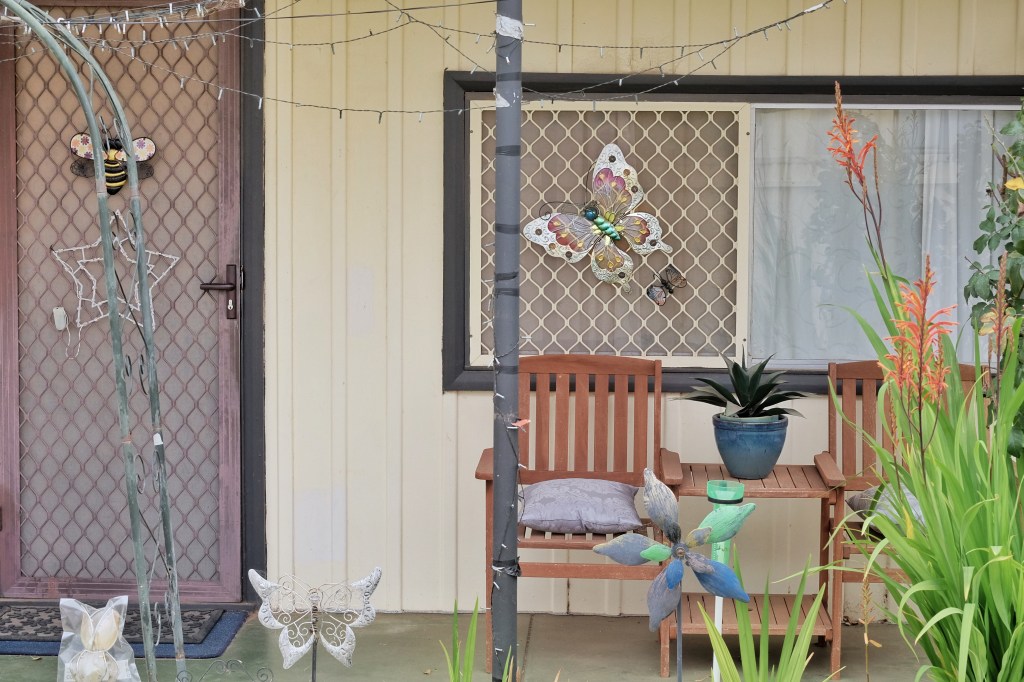

Not a living, flying, being as you can see. More of a kind of garden ornament attached to the front of the house. It struck me as I continued looking, that I’d already seen – and photographed – several ‘butterflies’ so far in that walk.
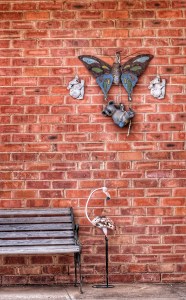
Four actually. In the space of an hour, and within a couple of streets of home. I’d seen them on walls, windows, and on doors.

Through time and in many places around the world, various cultures have looked at butterflies as symbols of transformation, for change, and renewal.

And, it seems to me, that butterflies can appear to us almost lighter than air. They kind of float on the air currents. They’re also known for their darting way of flying in what might seem to us one random direction then another.

So, butterflies have also been seen as symbolic of the human mind with its tendency to dart all over the place from one thought to another. They are said to remind us that we can in fact control and direct the mind.

In that case then, were these repeated encounters with butterflies – albeit of the ornamental variety – some sort of message for me? Perhaps I was to slow down, stop taking myself so seriously and to make changes? And of course remembering that I’m perfectly able to deal with consequences of any changes I make.
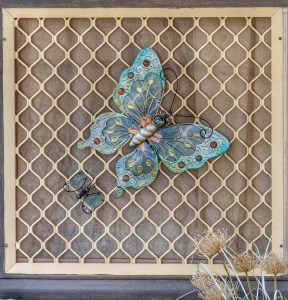
A Window for Two

Well, here’s the funny thing. Literally not until I sat down to draft this blog did it occur to me that I have in the last couple of days made what for me seem monumental changes. Or to be more exact, I have put into motion changes that are yet to reveal what if any transformations they might lead to.

You see, over the last few days I have been systematically deleting all my social media accounts (with the exception of a messenger app to speak to my son). I’ve had most of these accounts for up to 15 years or more. So, while I’m absolutely certain that this act of detachment from some of the things in the world that don’t sit well with my nature, I’m still feeling a bit lost, a little empty.

Okay, the butterflies: what have they to do with any of this? Transformation? Change? Lightness? And the ability to float through changes in life? Yes all of these. And we all know very well that butterflies undergo some pretty tough transformations as they evolve into what they are to become.
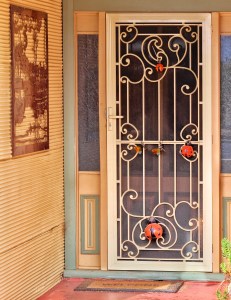
Who Invited the Lady Bugs?

Something I read once said that if you see a butterfly you should look at what you’re thinking; ask yourself what’s next for me? What changes are in store? Although all those butterflies of yesterday were ornaments on walls and so on, I have actually at other times been privileged to photograph living and flying ones.

In fact just the day before yesterday I met a small white butterfly flitting from one white flower to flower. In the space of a very short time, this beautiful creature gifted me with a very small moment’s stillness, and it gave me a photograph. Here i share that one with you.
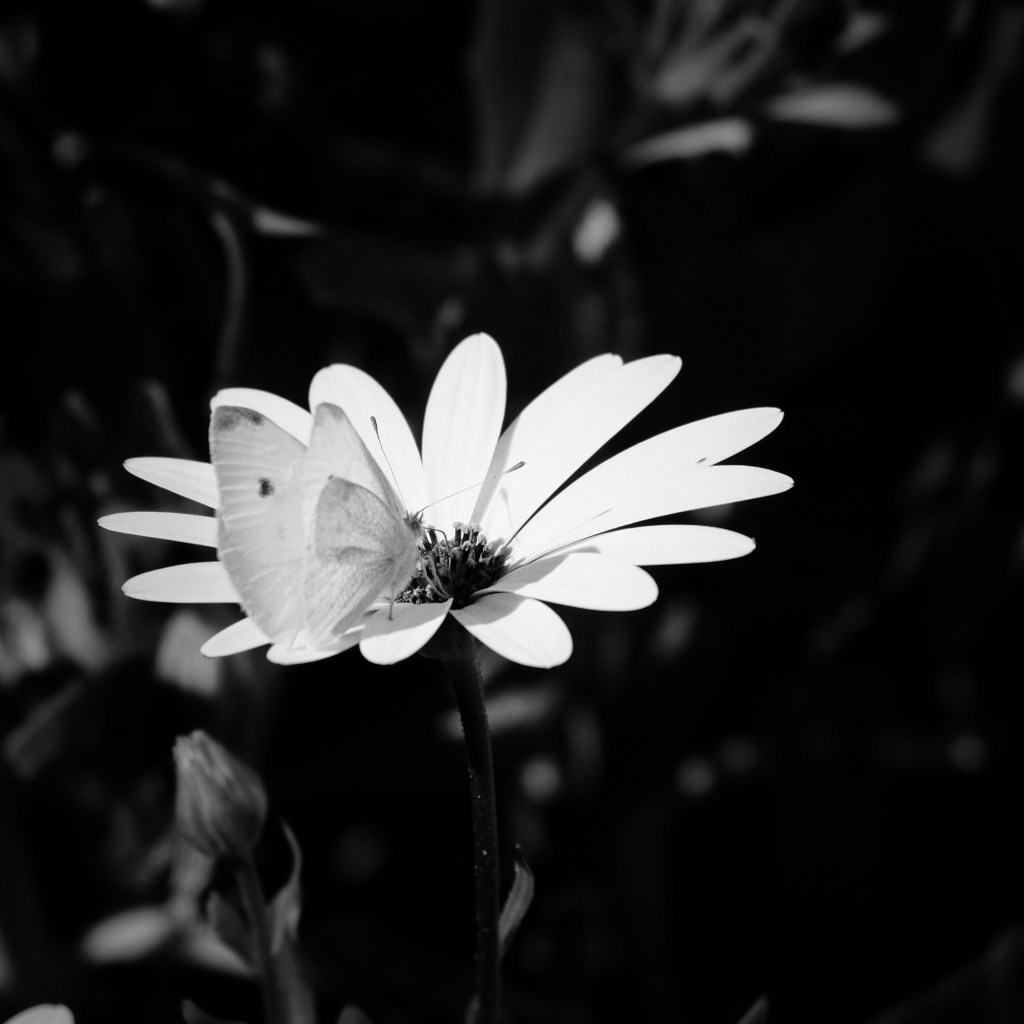
Early Christians associated the butterfly with the soul. So, yes, you could say that my meeting with that particular butterfly was a meeting of souls.

But what of the garden ornament, inanimate butterflies met yesterday?

Well, everything’s got soul don’t you think?

Peace and love
The Desert Called, and I Answered

Eventually.

Greetings friends. I welcome you from my new hermitage in desert country.

You know, it’s an old idea, a cliché even, to say that we, all of us, are on a pilgrimage called life, a Hero’s Journey as it’s called by the Mythologists. And, on any such journey there is what those same scholars call a Call to Adventure.

They are the times when we are challenged by life to commit to an action that will stretch us somehow, take us out of our comfort zone, change our life; to make a move; take a risk; embark on a journey either internally or out in the physical world.

So, when I tell you I got a call to come out here to the desert, and that I answered it, why the necessity to add ‘eventually’? What happened to delay that journey? Well, that’s what our Mythologist friends call The Refusal of the Call.

They’re the times when, once we’ve heard the call, and when we’ve felt its rightness, we still say no. Not now. And we come up with all kinds of perfectly reasonable explanations for our refusal.

In my case, I said, hey, it’s fine here; I’m near the beach; I really have no reason to move; there are plenty of ‘other places’ to check out first. The excuses went on and on.

All along though, there was this place, this country, calling. Of course ‘the desert’ isn’t always or for everybody the literal sand covered land, that gets very hot, and is generally thought of as barren and even hostile. It can also be a metaphor for any place – or no place in particular – that is a place of retreat, a quiet place, a place for living apart from the mainstream of human life.

For some people inclined to a life of contemplation and solitude, this place might be a small hut in a forest or a wood, or a camp on a remote beach on an even more remote island. Then there are others who are called to an actual cave high in the mountains, or on the banks of some sacred river somewhere.

And, equally, the desert, the place of retreat, quiet, solitude, and living apart, may well be an apartment or house in a suburb, or even in the centre, of a big city.

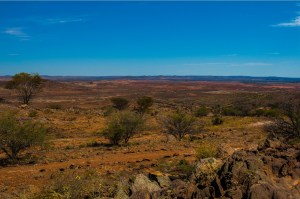
Then there’s me: called to this desert town of Broken Hill, almost but not quite in the centre of the continent of Australia. It is deep in the arid zone: it’s very far out back here in the Outback, 1500 kilometres inland from the east coast to be precise.

Yes, well this is all well and good, but shouldn’t I be answering my own question: why eventually? Well, we’ve covered the excuses, but really isn’t that just plain old procrastination? Yes indeed. If we get back to our Mythologist friends once more, we learn there is a stage in this Hero’s Journey that follows on from the Refusal: The Supernatural Act.

These are the times when things happen that seem to come at us out of the blue, from no rational, logical, or explainable source. Something that we might find hard to beleive at first because it’s way out there; supernatural like it says.

But that supernatural bit doesn’t have to take a spooky form, it might be that the ‘supernatural act’ is an internal insight or realisation triggered by a perfectly natural occurance. That’s what happened for me. What was this non-spooky, natural event that prompted such internal insights and realisations in me and got me moving?

Rain. Yes, rain. It rained almost every day for over six months. I am very very blessed that I wasn’t affected by flooding as so many in nearby area were, and I am thankful for that. But it’s safe to say that rain, mud, no sun, and limited or no access to the outside for days or weeks at a time, soured my romance with the coastal lifestyle.

You could say that through the sound of rain on the roof, I could still hear the call of the desert. In fact it got so loud that, eventually, I could no longer ignore it.

So, eventually, I answered the call, and here I am. Here is a small miner’s cottage and my new hermitage, my new safe haven by the side of the road. The cottage is situated in a mining town that sprung up in the 1880s. So this cottage has been home to miners and their families for generations, including the current owners.

In a sense it’s quite likely that I am the first occupant who hasn’t been or isn’t a miner. Though you might say that my excavations, rather than being in the dark underworld beneath the surface of Mother Earth, are taking place in the equally dark, hidden interior places of Self. A mining of another sort you might say.

Before flying out here, I was thinking about what was actually calling me to the desert (putting aside the rain for a moment). After all, I lived in a small cabin in a park like setting literally five minutes walk to a pristine Pacific Coast beach; I had trees and forest like spaces all round, as well as a small river two minutes walk. And that’s not even thinking about the abundance of wildlife.

And it occured to me that it is the stillness of the desert that was calling to me. This town of Broken Hill is a mid size town (actually a small city with about 15000 people), with the usual shops, cars, people, and the rest.

Yet there is a stillness. No longer can I hear the constant sound of seawaves crashing. No longer can I sense the never stopping coming in and going out of sea tides. And out here, it seems like even the people are moving quite a bit slower too. I’ve yet to see a single person rushing about. And they seem to smile a lot as well.

The street I live on is extremely quiet, and even on the so-called ‘busy streets’ there isn’t the mad acceleration and braking we’d see everywhere on the coast. Of course there is the odd driver who thinks every car is a racecar, but where don’t you get that?

But, actually it’s more than this. There is, beyond the actual literal quietness, a silence that seems to exist as an entity or state of being in its own right.

A stillness that is a solid thing, just as on the coast there was (is I suppose) a constant frenetic atmosphere that seemed to overlay everything. People rushing – on foot or in cars – even when there seems to be no reason for hurry (though of course you can never tell can you?). And not so many smiles either.

Contemplative people, those seeking solitude, and peace and quiet in which to pray, to live slowily, and to explore the divine, have been drawn or called to deserts (in all its forms) for thousands of years or longer. And I am fortunate enough to have finally (eventually) heeded the call myself.

Here, away from the incessant acceleration and braking (I do like this expresion), and in that stillness that envelops this land, perhaps I can dig a little deeper, uncover a bit of quiet, and discover a piece of solitude.

Out here, in the Outback, life can be harsh for all living beings, often dangerous in its aridity and isolation. It’s a long way from major cities, food and supply chains are extended to extreme limits, and the human hold on the land is precarious at best.

Yet, the paradox exists: out here far from the fertile coasts, the soft sandy beaches, the major urban centres where the mainstream of (human) life goes on, there is a quiet, a peace, a stillness that seems to pervade the very air one breathes.

A wise person wrote something short and sweet that sums all this up for me:

There is a stillness in the wildness.

Allow Me to Introduce My Mask

Greetings friends

At the moment I’m reading a book (Myths of Light: Eastern Metaphors of the Eternal) by Joseph Campbell, the brilliant, more than brilliant scholar, writer, teacher, and philosopher of all things having to do with myth.

Actually, to be honest, it’s truly riveting reading, but still, it’s a hard book to get my head around, but I’m taking it in little chunks, and the effort is, you can believe me, well worth it.

Campbell makes so many fascinating observations and his insights are genius. One section that gave me much to think about was where he talked about Carl Jung‘s idea of masks:

… he [Jung] points out that each one of us is invited by his [sic] society to play a certain role, a certain social function …
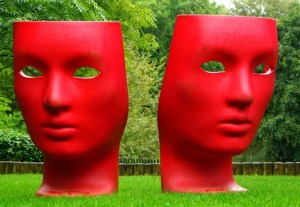
… We all have to put on a mask of some sort in order to function in the society. And even those who choose not to function in the society, to revolt from the society, put on masks too. They wear certain insignia that indicate, “I am in revolt.”

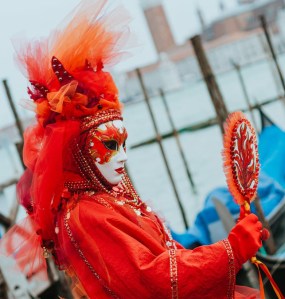
Yes, I know, it’s an idea we’re all pretty much familiar with: we all put on masks: work masks, school masks, relationship masks, masks to impress, masks to hide behind, all kinds of masks. But here’s what got me thinking: If you saw my last post, you’ll remember just near the end I said something like, ‘I am a hermit and a pilgrim’.

Now, normally, I tend to think I don’t wear masks. But, surely such a statement declares that I have simply put on one more mask? And, given the usual perceptions of hermits and even pilgrims, am I telling anyone who will listen (especially myself) that ‘I am in revolt’?

And that got me thinking more, about that ‘especially myself’ thing. I don’t think there’s anything wrong with wearing masks; after all as our quote says we wear them in order to function, to have a role or roles in our society.

But we also wear masks for ourselves, so we can give ourselves an identity, a role, a function. So a mask, you might say, is just how we get on in the world, and in our own minds; we take them off, and put them on according to the situation and needs of the moment.

Which says of course that we all are, I am, many things at different times and stages of our lives, our days, our careers, and so on. At this stage of my life I have put on the hermit/pilgrim mask I’ve carried around on the inside all my life. I am asking myself again, does this make me a rebel?

Well, before I donned the hermit/pilgrim mask properly, yes I wore the mask of the rebel, of the angry and outraged advocate of complete and total social change. And perhaps from some people’s point of view, I might still be a rebel: rebelling against the expectations, demands, and easy temptations of my society.

Anyway, I seem to have taken the very long route to the main point of my thoughts on all this rebel insignia stuff. The reality is, I’m not rebelling against anything. Except for those times (all too frequent) when I let anger and outrage slip through. After all, I am still human and have my weaknesses. ‘Tipping points’ as a wise person has called those moments when ‘it all gets too much’.

I see my role, the role of the mask I wear, as a creative one, one of building up, not tearing down.  This particular mask is still in the development stages, but isn’t that how everything works

There’s an aphorism I like very much:

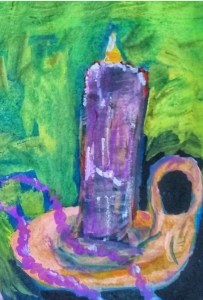
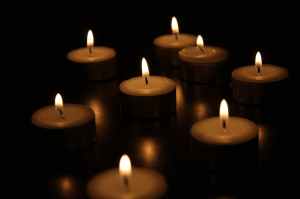
It is better to light a candle than curse the darkness.

(back in March I wrote a post describing a real-life event that illustrates this wonderful expression, both literally and metaphorically. If you missed it, do check it out).

Now, as of this moment in my life and in my progress on whatever path I’m on, I can truly say that I spend time – a lot of time – cursing the darkness. I mean, how could I not? That probably makes me still a bit of a rebel.

Yet, at the same time, I think I’m learning to understand the pointlessness of only cursing the darkness. Maybe it’s not a case of all one way or the other. Okay, I’m human, so I curse the darkness? There is a great deal of darkness to curse isn’t there?

Perhaps I can allow that cursing to lead me to action? And, well it has. At least that’s what I’m working on, aspiring to. Living as simply, quietly, and in as much solitude, as I am able; buying fewer things; letting compassion inform my eating, clothing, and travel choices (actually all my choices); having as little to do with what I call ‘the mainstream’ as possible; acting as far as I’m able in accordance with my true nature.  All these measures are aspects of the hermit/pilgrim role.

But I’ve missed the greatest, most important and vital aspect that goes with the responsibility of wearing the hermit/pilgrim mask: Prayer. Quiet prayer and contemplation. Sometimes just sitting (I know, it’s a favourite thing to do for me), letting the quiet come. Letting the light come.

You know, in some post, somewhere on this blog I’ve mentioned that often repeated statement:

It’s too late for thoughts and prayers

Well, more and more I am getting to grips with the notion that, far from being too late, this is precisely the exact moment when thoughts and prayers are needed most.

I hope that my little efforts can at least contribute in some small measure to the efforts of all the other people out there in the world who, while they may not be hermits or pilgrims, and while their natures might lead them to any number of differing activities in the world, nonetheless share with me the aspiration to light a few candles.

Buddhism’s Three Refuges: They’re for Everyone

Greetings and Welcome

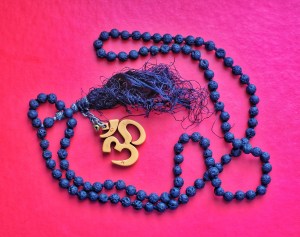
To become a Buddhist, , there are a number of things a person must commit to. One of these consists of a kind of three in one resolution that’s welcomed by any aspirant. In fact, some say that in order to be a Buddhist, one has to repeat The Triratna or The Three Jewels. Three refuges is the other name used.

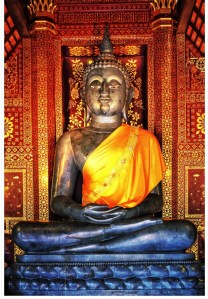
I take refuge in the Buddha
I take refuge in the Dharma
I take refuge in the Sangha

The exact words used may vary, but The Three Jewels is common throughout the Buddhist world. And of course there will be many meanings ascribed to ‘take refuge’, but the one I like is the one that any of us might use in, say, a heavy downfall of rain. What do we usually do in when the rain starts falling? We look for shelter, we take refuge.

I don’t mean to suggest that becoming a Buddhist automatically means that one is seeking a safe dry cosy place out of the storm. Though, now I’ve said that, it does make sense. I know myself that (though I am not a Buddhist) sometimes the only way forward, the only means to seek the truth, and to find peace, is to take refuge somewhere or in someone or something.

Not being a Buddhist as I said, I’m not qualified to speak about Buddhism in any real detail. What I have in mind is I would like to borrow the Three Refuges and reflect on how we could all use what me might call a ‘secular’ interpretation as a way of putting into words our own commitment to finding a refuge, a safe haven as we tackle what is for all of us born into a physical body, a life of trials, tribulations, ups and downs, storms and lulls, happy times and sad times, and all the rest of the package that’s called living a life.

Let’s take a look at each of the Three Jewels (also known as the Three Treasures which I like a lot), and think about how we can apply it to our own life, to our own seeking of refuge.

I take refuge in the Buddha.

For a Buddhist, the Buddha is the Guru, the teacher, the one who holds the Truth and shows the way. Many people would say right now, well that counts me out. I don’t follow a religion. I don’t have a teacher or guru. I’m just another regular person trying to make my way through life.

While it may be true that you don’t have a teacher or priest or guru, or anyone else in the role of guide, there is one person who is always there with and for you, one person who is always thinking about you, who is making decisions for you on which way to go, what to do and all the rest: you.


Yes, you. Your Self. When it comes down to it, who knows you better than you do? Take refuge in you, in the Self. Need to make a hard choice? Look within. Feeling tired, or ill or fed up? Look within you for the answers to what can be done. Follow your intuition. You, plus intuition, plus you taking refuge in you, equals teacher, guide. You are your own guru.

I take refuge in the Dharma.

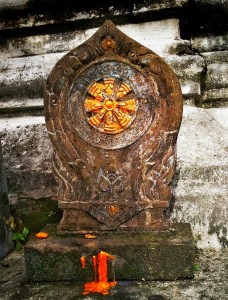
Once again there’s a myriad of ways to define dharma. And once again, I have a favourite: Dharma (often represented by a wheel) according to the religious tradition we know as Hinduism is cosmic or universal law that underpins right behaviour. It is the eternal and inherent nature of reality. In other words it is Truth.

We can all say, regardless of our beliefs say, I take refuge in the truth and in what is right. It’s a commitment to always acting in the best interests of everyone – including ourselves (maybe even especially ourselves). It is taking shelter or refuge in what is right. Living such a life in our messed up world is never going to be easy, so it is best to think in terms of doing the best one can. But having it as your ongoing guide will ease the path.

I take refuge in the Sangha.

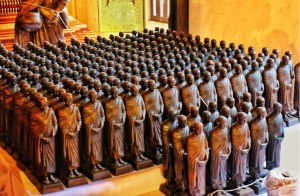
A Sangha is an association or a community. Often used to describe monastic communities of monks or nuns, it may also include lay people. If we step outside of the religious framework, then a Sangha is a community that shares common bonds, beliefs, commitments, interests, and so on. Family, tribe, workmates, recreational and sports clubs. You name it: all sorts of groups might be sanghas or communities.

Of course, and perhaps very obviously, not all groups will be communities, And equally we may not think we are a part of any community; we may think of ourselves as being quite outside any group. However there are no rules that say a community has to have a set number of members. Besides, being in community is a condition and has nothing to do with group size or composition.

So, if you find yourself in a community of one – or two or however many – take refuge there. Make a commitment there. As with any other real community, this one begins with you and your truth.

The Buddha, the Dharma, and the Sangha. The Teacher, the Truth, and the Community. Making commitments to the Three Refuges can create a solid foundation as we continue our journey through the world and our lives. The refuges – the safe havens we can call them – we have sought and found will support us through good and bad times.

Actually, I just thought: if we are genuinely able to take true refuge in these three treasures then we will conditioning our Selves to be more present, more in the here and now of who we are, what we’re doing, and what’s happening to us.

Peace to you from me

Seeking Justice: Commitments

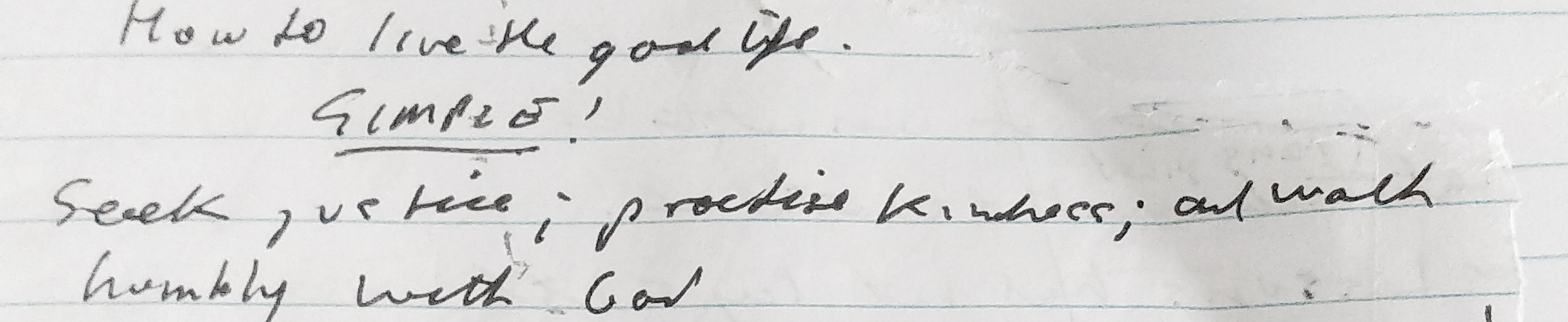
This morning I was just sitting, or at least trying to just sit. You know, being quiet, relaxing the mind. All that kind of thing. And of course, an idea sprung into that not so cooperative mind, so I grabbed my notebook. Just as I went to put this latest brainwave on paper I noticed a very extraordinary note I must have made I don’t know when:

I’ve just looked it up: It’s a slight paraphrase of a verse from the Old Testament, from the prophet Micah. Where I read it, I can’t say (the note is at least several weeks old). But to quote another little note from some unknown source, I always like to:

Let the noble thoughts come to me from all corners of the universe.

unknown

I’m just like everyone else, always wanting the easy solutions and you can tell that can’t you? ‘How to live the good life? Simple!’. I mean really; hardly humble in my approach in that note was I? Well, let’s talk about what Micah says, not my own lack of humility.

Seek justice; practise kindness; and walk humbly with [your] God.

There are numerous versions online of this verse (Micah, 6:8), so I will leave it to you to check those out for yourself. I’ve added the word your because all those versions do say ‘your God’. But even in this paraphrase it’s easy to see there is nothing at all simple about any of these injunctions.

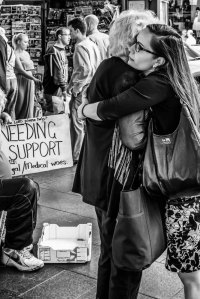
I discovered that this verse is often invoked in times of grave injustice, or crisis. I think it goes without saying that we would be hard pressed to think of a time that was not a time of grave injustice or crisis. Certainly, we are living in one of those times of injustice and crisis.

There’s no need to or purpose served by getting into how ‘grave’ injustice is now compared to some other time; there’s no need or point to weighing up the relative severity of one crisis versus another. Injustice is injustice; a crisis is a crisis.

In other words, the present is always the time to heed the injunctions of this verse.

So, what do we do if we are to seek justice? Running the risk of sounding flippant, I would say that there are as many answers to this question as there are people to answer it. Now, you would think this would make the task impossible; too many cooks and all that. But actually it’s perfect. Why? Because it means that whoever you are, whatever your situation, you can actively seek justice.

Or, I am sorry: I should say I, me. Not you. I can actively seek justice. But, you say, you are a hermit; you live in a cave (not literally but I know what you mean); you hardly ever even talk to people in ‘real life’. Yes, all true. And I would say that the action I take is by no means at the level I know I want it to be. I’m doing nowhere enough.

Does that mean I’m leaving the cave? Going out into the world, onto the streets to join other brave souls seeking justice? Believe me, I ask myself such questions constantly. But to speak truth to you now, I will say that I know absolutely, in my heart, that my role is something different.

If anything, I need to go deeper into the cave; I need to go deeper into the inner world of my own Self. I know that in this way I will join with so many others in what I’ve come to call the Invisible Community of people all over the world living lives of contemplation and prayer. Or, speaking for me personally, trying to live a life of contemplation and prayer.

By so doing I am at least in a tiny way supporting those millions of others out there on the streets, in the aid groups, running campaigns, writing letters, helping the victims of injustice, in all kinds of miraculous, brave, and innovative ways.

So that’s my commitment to you. To deepen my prayer; to intensify my contemplation; to more fully realise my union with all living beings; and to really join with the invisible community in its efforts.

And, you ask, this blog? What’s it about then? Well, notes, musings, thoughts and reflections all aimed at reminding me of my responsibilities. And hopefully along the way, solidifying my union with you and the rest of creation, just a bit.

Peace and love

PS I haven’t forgotten ‘practise kindness’ or ‘walk humbly with your God’. Maybe another time.