Tripping On the Sidewalk

Walking home, returning to the sanctuary of the hermitage, I fell over. Or to be exact, I tripped.

It’s not the first time I’ve tripped in my life, and I’m sure it won’t be the last. Mind you, I’m not supposed to be making speculations about the future; after all, I may never fall over (or trip) again.

Let me share with you how I came to find myself lying on the ground, fully conscious thankfully, with only a few grazes on arms and knees, and a sore spot on the side of my head.

Walking along the sidewalk quite freely, earbuds feeding my ears and my heart my favourite mantra to Ganesha – known as the remover of obstacles and the God of wisdom. (more on the earbud issue later)

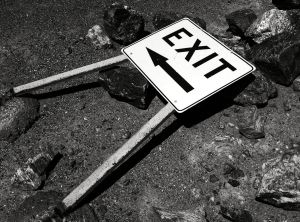
At one point I noticed, a few metres ahead, what appeared to be the back of a largish sign board leaning against the base of an electricity pole growing out of the pavement.

Not the actual sidewalk

Without any thought whatsoever, as I came up to that pole, I turned my head to the left to see what the sign read. Next thing I know, is I have the sense of falling. Later I remembered that at the exact moment I turned my head, my foot caught the broken and uneven edge of a slab of the pavement.

I was blessed by two passersby who stopped and helped me back to my feet, and stayed with me as I regained some semblance  of my bearings. Thank you to those two good and kind ones.

Now, I don’t like falling over (well, when you think about it, who does?), but in this case I can say through this fall, I have learned a couple of good lessons.

Presence – or lack thereof. Here I am, the hermit monk who is supposedly constantly practising being present, in the moment, here and now; yet I tripped over what I later discovered was a really obvious, clear obstacle on my path.

We all get distracted, you might be thinking. And, yes, it’s true. We can be paying close attention, fully focused, riveted to and in the moment, and, suddenly distraction barges in – in the form of a thought, an external noise, visual imput, and even a broken pavement. You name it, and mind will use any excuse it can to manifest a distraction.

Another lessen – intimately related to presence –  is pausing, or not! As I noticed that sign coming up, I could have chosen to pause to look at it once I reached it.

Then, rather than being a distraction, looking at that sign would have simply been another moment in the ongoing flow of the present. In other words, there’d have been no tripping.

The actual earbuds in question

Now, to the earbud issue. To be honest, my earbuds have more or less replaced my regular over the ears headphones. Because I was never comfortable going out and about with those clunky things on my head and earbuds have allowed me to listen to music pretty much whenever and wherever  I go. Even to me wearing them, they are barely noticeable. It’s possible that’s the problem right there: unnoticeable.

More than 30 years ago now, I spent every Tuesday evening for a year attending classes at a school of philosophy . To this day I still follow some of the practices I learned there. And, passed to me were so many good lessons, so much good knowledge drawn from many of the world’s spiritual and intellectual traditions. So many of these lessons have stuck with me.
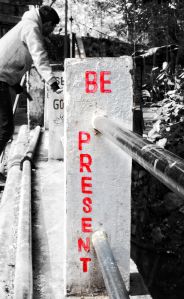
Presence, or rather the benefits and rewards of realizing  the present is all there is, was I would say, one of the cornerstones of those teachings.

One illustration about presence concerned driving, and although at the time I haddn’t learned to drive, it resonated with me. Our teacher told us that, when she was driving, she never listened to music or anything else. She told us that she simply put her full attention on the task at hand: driving.

She described how it often happened that when driving she’d reach her destination with little or no memory of the actual act of driving or any landmarks or events on the trip itself. She said it was if she was somehow unconscious, yet still able to drive ‘on autopilot’ was how she put it.

And of course it’s not a phenomenon limited to driving: how much of our routine daily activity runs on autopilot?

Anyway, back to the other day and me grooving to Ganesh in my ears and tripping in a moment of inattention.

I don’t recall being distracted by the mantra in my head, or moving on autopilot. But, thinking back, I was in one of the busiest sections of the little town that hosts our hermitage. I’d been to the supermarket, the parking lot of which is as busy – and crazy –  as one you would find in any big city.

Just another sidewalk tripper

So, I realise now, I had already kind of set myself up to fall for any distraction that happened to come along. While I don’t really remember myself as being ‘unconscious’ of my surroundings or of the path itself, clearly I wasn’t completely there, not in the here and now sense if you know what I mean. Just an after thought: who remembers ‘being unconscious? Nobody I think!

Whatever I say now, I wasn’t present; I wasn’t fully in the moment, not paying attention to either what I was doing or what was going on around me.

Since my little trip, I have vowed before my hermit community to not ever walk again in a built up and busy area wearing my earbuds.

Not only do I have a sense of danger lurking when I think of the idea of wearing them in those situations, but I also feel that it’s not exactly being present, in the here and now is it?

Another closed cafe on some other trip

Okay, I am very sure you are waiting with great anticipation to learn what what fateful sign, put in my way by the Universal Traffic Controller to push me into changing direction, actually said:

It was a handwritten advertisement for ‘great coffee’ to be had in a cafe across the road. A closed cafe I might add.

On Main Road –  a road that more than lives up to its name –  perhaps there are worse fates awaiting the inattentive than merely tripping on the sidewalk.

The Q&A in the Scripture: Part 2

Namaste

And welcome to Part 2 of The Q&A in the Scripture series in which we are looking at the answers given by Krishna to a list of questions asked by his cousin Uddhava in a scripture called the Uddhava Gita.

Remember the scene? Uddhava has asked Krishna a pile of questions about how to live a good life, how to live in the world with discernment.

These questions have become urgent because the cousins are about to leave their hometown which is on the brink of war. Both will be going their separate ways and both know they won’t be seeing each other for a while – perhaps never again.

Anyway, moving right along: In our last installment, we had Uddhava asking the first of his questions; this one happens to have two parts:

What is quietude and what is self-control?

We discovered that quietude is not the state in which one finds peace, silence, our true selves, or the Divine, but is itself that consciousness, that pervades and permeates all that is, silence, peace. In other words, quietude is  the Divine itself.

In the present post, we move to the second of Uddhava’s two-part question: what is self-control? Krishna’s answer is excellently short and sweet:

Dama  (self-control) is restraint of the senses.

Krishna in his response, makes it clear that restraining the (one’s own) senses includes mind as a kind of sixth sense in addition to the five physical senses. In the context you could almost say that it’s his mind that Uddhava is in most need of restraining. Maybe that’s the message for all of us?

Well, we are all well aware of the ways in which we have tried to control our senses; Uddhava knows too. But look at the situation these two cousins find themselves in:

It’s fine for Krishna: he’s returning home to Heaven, or wherever. But, Uddhava, who is also about to leave, is facing more uncertain prospects. He’s experiencing great turmoil, and fear over his and his familiy’s safety as the threat of war closes in. Most likely he’s also grieving over having to go into exile from his ancestral home.

Of course he’d be fearful for the future: where will he go? What will he do? How will he protect and provide for his family? Like I said, an onslaught of mental and emotional anguish.

Still, it does seem that Uddhava is maintaining quite a steady presence of mind. He’s thinking about the future; he is clear about the sort of stuff he needs to find out from his cousin (remember Krishna is God) in order to put and keep his life on the right track despite the challenges facing him now and in the future.

Then there’s the fact that this self-control thing is only one question on a list of 36. Clearly Uddhava is looking for a lot of advice.

Restrain the senses – all six of them – Krishna says. But how? What does it mean, ‘restrain the senses’? I think I alluded to the notion that we all have some ideas, some clues, about how we as individuals might restrain them, but let’s personalise this: What does it mean for me to restrain my senses?

Actually, now I’ve made that suggestion, I feel overwhelmed: Where would I start? Surely I need to do a whole series of posts, just on this one topic alone?

Oh wait, I can start right there. Exaggeration, hyperbole, over-dramatising, catastrophizing, all perfect examples of emotional reactions leaping from an unrestrained senses central: my mind.

Let’s put aside that mental stuff for a little while, and just say that all those emotional responses could do with a bit more restraining training. Just looking at the physical senses to begin with, I can easily say that they also, at least some of them sometimes, need various degrees of working on.

First, my sense of taste: it goes into overdrive sometimes, and then I eat too much. Not so much as in the past, but the restraint has a way to go still.

My sense of sight is pretty good, well restrained for the most part. But there are times when I lapse into old habits and spend too much time looking at a screen and scrolling in a mindless kind of way. Getting there though!

As for my sense of hearing: You might remember a post from a while ago when I talked about letting go of much of my music collection, some of which I’ve listened to my whole life.  I’m doing this because so much of what used to be ‘my favourite’ songs or artists, no longer serve my spiritual growth, nor does much of it reflect the view of life and the world that I’m trying to cultivate.

Well, I’ve made a good start, but occasionally I slip and find myself humming old tunes, or listening to an album that I really ‘should have’ deleted already. Restrained? Sort of, and I’m still encouraged.

Enough! Let’s get straight to the biggie: my mind. If I’m honest, I have to say that my mind, while not exactly in full agreement with my efforts at restraint, is starting to get into sync with me and my aspirations for a more controlled mind.

But still, those previously mentioned emotional reactions like exaggeration, over-dramatising and the rest, are still there. Falling into line, it’s true, still … .

Then there is the (more than) occasional first port of call reactions to pieces of news of various kinds: I’m prone to ask, just as I imagine Uddhava might have: Why don’t ‘they’ control themselves? Why can’t he or she or such and such country or politician show a little restraint?

Yes, I know, we’re all guilty of this one to some degree or other.

My quickness to anger is not quite, but almost, might soon be, won’t be long before it is, a thing of the past.

Then, there’s my tendency to ruminate: rehash endlessly real and imagined events and other stuff from the past – as well as the always imagined possibilities (as well as the impossibilities) for the future.

Again, I know I’m not alone in this emotional roller coaster ride, and I do know that I am nowhere near as much of a ruminator as I was; I have made great strides, significant inroads, and I am encouraged that the end of rumination is getting closer!

And now, here is the one thing I tend to think of one of my biggest, most tiresome and tedious, most annoying conditioned emotional responses: I talk too much. Not as much as I used to, but still too much for my comfort, and for the peace of mind of those around me. More restraint is called for.

Restraint has played its part in reducing my talking. But in a sense the major ally has been the ongoing quest I’m engaged in to discover my true nature, as consciousness, which is really my oneness with all that is.

And here our second question and answer leads us right back to the first: quietude.

I wrote in that post:

Quietude, calmness, peace of mind, are not where  you will find God, consciousness, or whatever we call it.  Quietude and the rest are God. They are consciousness.

Or putting it the other way round: cultivate silence, calm, peace of mind, and your senses will no longer need to be restrained. Your whole Self, including body and mind, will then be resting in Quietude, in your true nature.

That’s why I think these two questions are asked and answered together: Each leads to the other: by restraining our senses we are more easily able to achieve a state of calm, quiet, some level of peace of mind – in other words, Quietude.