Allow Me to Introduce My Mask

Greetings friends

At the moment I’m reading a book (Myths of Light: Eastern Metaphors of the Eternal) by Joseph Campbell, the brilliant, more than brilliant scholar, writer, teacher, and philosopher of all things having to do with myth.

Actually, to be honest, it’s truly riveting reading, but still, it’s a hard book to get my head around, but I’m taking it in little chunks, and the effort is, you can believe me, well worth it.

Campbell makes so many fascinating observations and his insights are genius. One section that gave me much to think about was where he talked about Carl Jung‘s idea of masks:

… he [Jung] points out that each one of us is invited by his [sic] society to play a certain role, a certain social function …
… We all have to put on a mask of some sort in order to function in the society. And even those who choose not to function in the society, to revolt from the society, put on masks too. They wear certain insignia that indicate, “I am in revolt.”
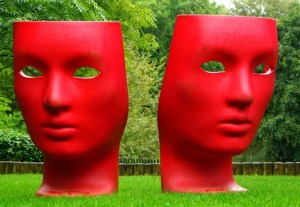
Yes, I know, it’s an idea we’re all pretty much familiar with: we all put on masks: work masks, school masks, relationship masks, masks to impress, masks to hide behind, all kinds of masks. But here’s what got me thinking: If you saw my last post, you’ll remember just near the end I said something like, ‘I am a hermit and a pilgrim’.

Now, normally, I tend to think I don’t wear masks. But, surely such a statement declares that I have simply put on one more mask? And, given the usual perceptions of hermits and even pilgrims, am I telling anyone who will listen (especially myself) that ‘I am in revolt’?

And that got me thinking more, about that ‘especially myself’ thing. I don’t think there’s anything wrong with wearing masks; after all as our quote says we wear them in order to function, to have a role or roles in our society.
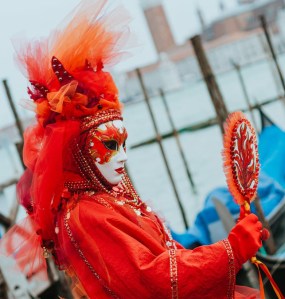
But we also wear masks for ourselves, so we can give ourselves an identity, a role, a function. So a mask, you might say, is just how we get on in the world, and in our own minds; we take them off, and put them on according to the situation and needs of the moment.

Which says of course that we all are, I am, many things at different times and stages of our lives, our days, our careers, and so on. At this stage of my life I have put on the hermit/pilgrim mask I’ve carried around on the inside all my life. I am asking myself again, does this make me a rebel?

Well, before I donned the hermit/pilgrim mask properly, yes I wore the mask of the rebel, of the angry and outraged advocate of complete and total social change. And perhaps from some people’s point of view, I might still be a rebel: rebelling against the expectations, demands, and easy temptations of my society.

Anyway, I seem to have taken the very long route to the main point of my thoughts on all this rebel insignia stuff. The reality is, I’m not rebelling against anything. Except for those times (all too frequent) when I let anger and outrage slip through. After all, I am still human and have my weaknesses. ‘Tipping points’ as a wise person has called those moments when ‘it all gets too much’.

I see my role, the role of the mask I wear, as a creative one, one of building up, not tearing down.  This particular mask is still in the development stages, but isn’t that how everything works

There’s an aphorism I like very much:

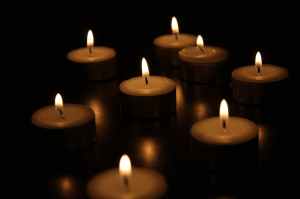
It is better to light a candle than curse the darkness.
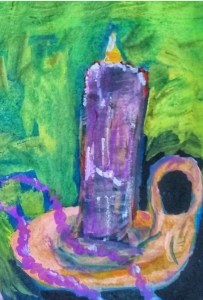
(back in March I wrote a post describing a real-life event that illustrates this wonderful expression, both literally and metaphorically. If you missed it, do check it out).

Now, as of this moment in my life and in my progress on whatever path I’m on, I can truly say that I spend time – a lot of time – cursing the darkness. I mean, how could I not? That probably makes me still a bit of a rebel.

Yet, at the same time, I think I’m learning to understand the pointlessness of only cursing the darkness. Maybe it’s not a case of all one way or the other. Okay, I’m human, so I curse the darkness? There is a great deal of darkness to curse isn’t there?

Perhaps I can allow that cursing to lead me to action? And, well it has. At least that’s what I’m working on, aspiring to. Living as simply, quietly, and in as much solitude, as I am able; buying fewer things; letting compassion inform my eating, clothing, and travel choices (actually all my choices); having as little to do with what I call ‘the mainstream’ as possible; acting as far as I’m able in accordance with my true nature.  All these measures are aspects of the hermit/pilgrim role.
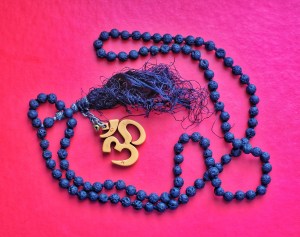
But I’ve missed the greatest, most important and vital aspect that goes with the responsibility of wearing the hermit/pilgrim mask: Prayer. Quiet prayer and contemplation. Sometimes just sitting (I know, it’s a favourite thing to do for me), letting the quiet come. Letting the light come.

You know, in some post, somewhere on this blog I’ve mentioned that often repeated statement:

It’s too late for thoughts and prayers

Well, more and more I am getting to grips with the notion that, far from being too late, this is precisely the exact moment when thoughts and prayers are needed most.

I hope that my little efforts can at least contribute in some small measure to the efforts of all the other people out there in the world who, while they may not be hermits or pilgrims, and while their natures might lead them to any number of differing activities in the world, nonetheless share with me the aspiration to light a few candles.

Is Life Too Short for Perfect Writing?

Greetings and welcome friends

Let me share a little secret with you: I have and always have had, atrocious handwriting. And it’s always been a major frustration (but a huge incentive to learn to type, which is one of the best things I’ve ever done).

Perhaps it’s because I had some sort of learning difficulty, maybe it happened because every state in Australia has a different way of teaching kids handwriting, or maybe its just that I was and am lazy. Actually, scratch this last one: I am not nor have I ever been lazy.

Anyway, it appears to be a fact of life, yet I do still get frustrated from time to time. But then there are times when I decide not to care, that it isn’t important, doesn’t matter. Being in one of those indifferent phases right now, has reminded me of an incident that should have taught me this lesson once and for all.

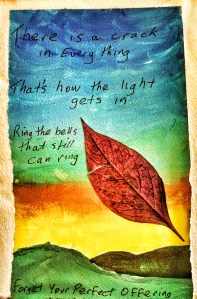
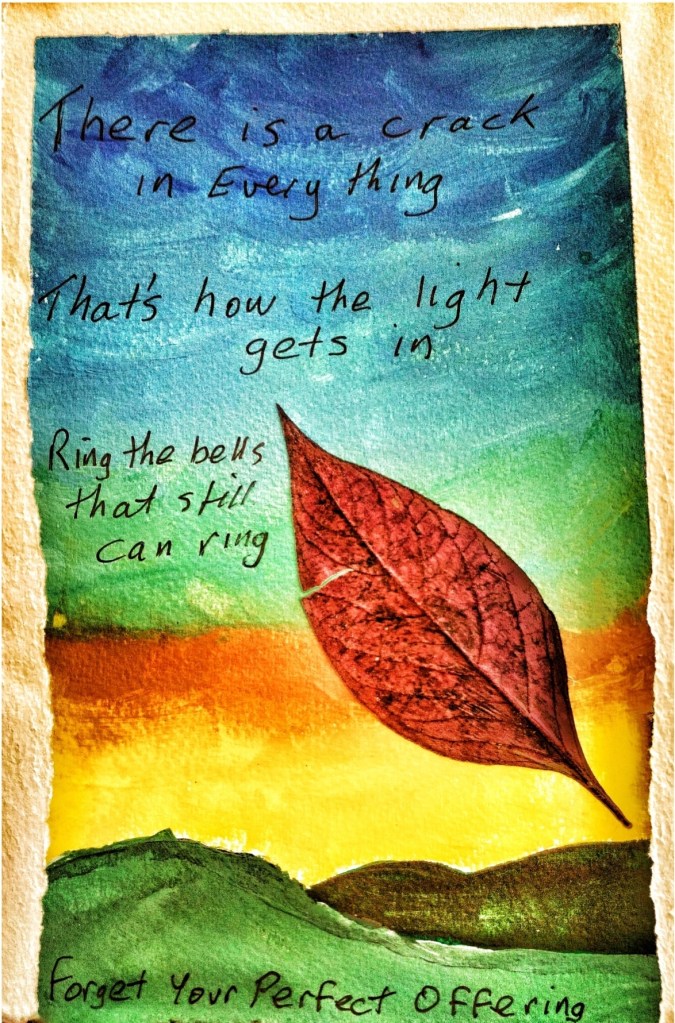
A while back I was gifted a small painting. The artist wasn’t satisfied with it as a background of a planned piece, and gave it to me thinking I might like to ‘do something with it’. I happened to think it quite a lovely painting in its own right actually, and as I was looking at it, I thought of a leaf I had collected a couple of weeks previously. A beautiful very soft and pliable purple leaf from a lovely shrub.

So, right away I just got to sticking that leaf onto the painting. As I pressed it down, a little tear appeared in the leaf. Immediately a lyric from Leonard Cohen‘s Anthem came into mind:

There is a crack, a crack in everything. Thats how the light gets in.

So, I began writing bits of the lyric onto the painting. Untidy, irregular and typically atrocious the hand writing, or printing, is. But then it struck me: that’s the point! I mean the point of Mr C’s sublime words:

Ring the bells that still can ring
Forget your perfect offering.
There is a crack, a crack in everything
Thats how the light gets in.

Here’s how I thought about what I’d written on the painting and how I’d written it: I rang a bell that I can still ring: I thought of and wrote down those beautiful lyrics to compliment the accident (is there any such thing as accident?) of tearing a leaf on a painting that ‘didn’t work’ for the artist, but that was working for me.

Therefore, the painting, the torn leaf and my handwriting was not a perfect offering in any kind of conventional sense as the world would view it. In other words there is a crack, both literal as in the tear in the leaf, and metaphorical as in the imperfections of the whole piece.

But—and here is the vital thing—this little painting, despite its initial rejection by the artist, and with its imperfections, its sloppiness, and its flaws, has provided a channel for light to get in. Into my life, into the piece itself, and now, through this sharing, into your life.

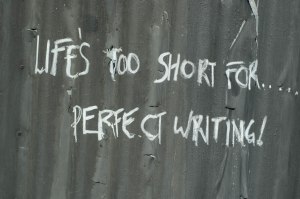
So, who cares if my handwriting is not conventionally perfect or is untidy, uneven, and even a bit tricky to read? I love the message in those lyrics; I felt that this lovely painting with its torn leaf to be the way to put that message in a concrete form. I mean, really, isn’t life too short for perfect (hand)writing?

PS I no longer collect leaves and trap them in this way. I may collect them, but after a time, I return them to their natural environment. Fallen leaves have their function in the cycles of nature too.

I’ll Try Not to Pass Them By

So, anyway, here I am. Just sitting. It’s what I do, when I can, when I’m able. Well, to be completely accurate, here I am sitting and typing. Writing yes.
But every day, I sit. I try to sit. On a comfortable chair or bed. Here is where I commune with the Divine. It’s where I say my prayers, empty my mind, try to be silent, sometimes read holy books.
Whatever I do when I am just sitting, the sitting bit isn’t always easy; it requires effort and patience. Just being still can be hard; everyone knows that. But it’s part of the practice, part of the sadhana, the way to liberation. All that.

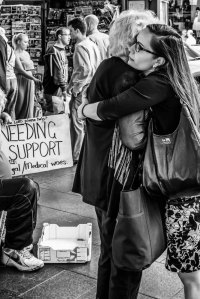
Of course I’m not the only one you might find just sitting. Why, just today on my way home from buying fruit I saw some other people sitting. One had his eyes fixed, completely transfixed on his phone’s flickering screen; head bowed, the world around him shut out.

The other sat, head bent forward, arms crossed; I couldn’t see her eyes. Perhaps she was sleeping, perhaps feigning sleep, perhaps trying for sleep. Whatever, resting it looked like.

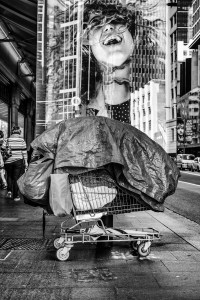
These two were a lot like me I thought: just sitting, being quiet, resting even. Mind you, they were younger than me. Though of course what’s age got to do with it? I carried shopping bags; they sat beside a very full shopping trolley.

But, wait, my bags held fresh fruits to top up our supply. Their trolley overflowed with, what shall we call them? All their worldly goods? Personal effects? All they own?

And another difference? I’m going home with my bags. They have no home to house those effects; no soft bed to rest upon or commune at leisure with the divine.

Whereas I sit under a roof, in a room, on a soft bed, they sit in a bus shelter. Sure, there’s a roof but it offers scant protection from the approaching storm, and none at all from the incessant wind that will soon be full of rain blowing.

It’s no use asking why am I in a comfortable house, and they are in a bus shelter, just as I was and they were, the last time I saw them. There’s nothing for me to say that will mean anything to them, to anyone else, or even to myself.

I suppose I or you or someone else might remind me (remind all of us) that the world can be hard, is hard: bad things happen to all of us. Of course that’s true. I actually truly believe that the world by its very being in existence is hard. What did The Buddha say? Life is suffering?

But, as they say, that just doesn’t cut it, does it? All just words don’t you think? It’s what I think today anyhow. Oh yes, I’ve been praying since I passed them by (and I did pass them by with no words, no smile or greeting, my face turned away. I am ashamed).

I thought of them as angels there to remind me of my own advantages and privilege. Even those very thoughts themselves prove my own failing to understand, to actually get it.

But, yes: all just words. Meaning very little. I suppose after all that perhaps all I can do is pray.

For all of us.

Peace

Not as if I don’t bloody live here is it?
Yeah. I know, I know. Its a bloody bus stop.
But, geez, a fella’s gotta live
somewhere. Don’t he?

An Aspiration. A Prayer

Hello friends and welcome

The last couple of posts have had me thinking about what I actually do to contribute to the world, to life, to making changes that could bring peace, a safe environment, and a better life for all.

I have to say my commitment to my life as a hermit, as a pilgrim aspiring to live a life apart from ‘the world’ all the while dedicating myself to what we might call Self or God Realisation, has been strengthened.

I have once again come to the conclusion that living a life focused on spiritual development, on art, on prayer, and on contemplation, is the most valuable way I personally can contribute to change, to love, to the good of all. My true nature, my inclinations, my faith, my life experience, all these equip me for this life that has chosen me.

And at the same time, these same factors have left me ill-equipped for life ‘in the world’

In those last two posts, I talked about how so few of us think we have anything to offer a world teetering on the edge. But of course, as I pointed out, the opposite is true. I think I made the point that there is some unique role for each and every one of us in the continued unfolding, upliftment, protection and prospering of all life in this world.

Having said all that, I have to say that for me it’s not always easy to actually realise this in my heart. Intellectually it’s an easy concept to explain (well sort of anyway), but on that deeper heart level, well it’s tricky. Guilt rears its ugly head: ‘It’s all falling apart; I have to do more; But what can I do? It’s useless. I’m useless’.

As I mentioned in one of those posts I think, people have turned away from the horror, injustice, cruelty, and murderous greed and lust for power, for as long as these things have existed – which is obviously for as long as our species has been around. At certain times in history this move away from ‘the world’ has accelerated and intensified. And we are living in one of those periods now.

In the last century so many people have taken up the contemplative life, and many have chosen to make that life one of complete or partial solitude in order that they may be free from distraction in their prayer, study, and contemplative life.

But, many will say, ‘You are in denial. Now is the time you are needed out there. The world and all of life is in danger. You can’t escape and hide in a cave’.(read here stop watching the news, ignore politics, stop spending, become a literal or metaphorical hermit, go traveling, shirk your responsibility to the rest of the world).

Again guilt trips us up and we just keep on trying to find ways to at least rid ourselves of the guilt over our perception that we can do nothing.

But many such people, and that includes me, rather than being in denial, rather than shirking responsibility, have looked at the material world with its horrors, and said, ‘This isn’t right’, and have started to look at other ways to live and, seeing that continuing to struggle against the weight of the world on the world’s terms is pointless, seek to find other ways they can contribute to change. Ways that don’t perpetuate the playing of the game.

And rather than escaping these people (including me, I say with humility) face the world head on, dedicating their lives to the world through creativity, through prayer and meditation, and through the expression of freedom in their choice of lifestyle. They are, as Mahatma Gandhi is supposed to have said, being the change they want to see in the world.

While Gandhiji didn’t actually say those words, (Actually there’s a post coming in a couple of weeks in which I share the full text this quote is apparently derived from. Stay tuned for the link here), he certainly lived his life being the change he wanted to see.

But sadly, this ‘quote’ has come to be seen as a kind of feel good cliché, something the privileged are accused of mouthing while not actually even thinking about changing their lives. Just one more platitude you might say.

But for many, like me in my own way, it is much more: it is a call to action, a respectful and heartfelt request that I embark upon the quest for a more authentic way of living that has love, compassion, service, and truth at the centre of all I do.

This is my aspiration. This is my prayer.

Peace from me to you

Put Me in My Place. Please

Reverence the place and learn from what you see


Coming across this note last night, I was stumped. I coudln’t think where it had come from, where I’d seen it; nothing at all came to mind. And an online search just now failed to turn up anything either. I mean I must have read it somewhere. Or is it possible it came from me?

Of course it’s all the same: there is only one source. At any rate, it’s an injunction one can relate to anywhere, any place. It’s surely about presence?

And about learning from all that is to be seen (heard, felt, intuited, known) in whatever place one is in now. I mean, the place I’m in now. I am here and it is now.

I’m reminded of the faith affirmation (is it a prayer?) that seems to have been written for this particular hermit pilgrim:

As a a hermit, I am a pilgrim dependent on a pure faith that I am exactly where God wold have me be now.

Sometimes I think that too much thinking about and angst over places other than the one I’m actually in right now, is a sure and certain way to resist and reject any reverencing of the place I’m in, not to mention what’s to be learned or gifted from the experience of being here.

And of course that angst, worry, wishful thinking, or whatever, comes with its own issues of distraction, and of a taking away of one’s Self from the present, the notion that here and now is the only time and place that exists.

A poem of mine I came across the other day while looking for something else says it all quite nicely. This poem is called Transcendental Injunctions, and it’s a rap on presence, about being here, and being now.

The central action describes how my senses can take me away from that here and now: I describe my habit of smelling my Bhagavad Gita (yes, as in putting my nose into the pages of the little book and inhaling the aroma of those pages) and how that takes me back to the shores of the River Ganges; another place, another time.

Anyway, allow me to share the final verse, which speaks of one such occasion:

Then, there is a voice:
I hear it with the ear of my heart:
There is no place to go.
What you seek is within.
There’s nothing to find:
God’s kingdom is within.

I suppose there is nothing left to say. I am here, and it is now

Peace to you from me

Karma Yoga & Contemplative Living: Creating Good Vibrations

Greetings friends

Not so long ago I read The Glass Bead Game by Herman Hesse. And I have to say it’s what I like to call a ‘real book’: written beautifully with an interesting and deeply engrossing story, full of detail, symbolism, thought-provoking ideas, and at the end of the day just plain and simply a delight to spend time with.

I won’t go into what the book is about here, but for the sake of this post, I will just tell you that it is about a mythical European province populated by an elite group of scholars of all sorts who have as their main cultural, social, and even political focus, the game of the book’s title.

Anyway, what I want to talk about here today is something said by the book’s main character, who in the course of the story becomes the master of the game and therefore a hugely influential figure.

This character is having a conversation with a friend. And he’s talking about the way this elite group conducts itself in the world. How it helps shape the country and history. He says to his friend:

We do not intend to flee from the vita activa (the active life) to the vita contemplativa (the contemplative life), nor vice versa, but to keep moving forward while alternating between the two, being at home in both, partaking of both.

Now, what struck me about this quote is that only a couple of days before I’d read a verse in the Bhagavad Gita that I felt said almost exactly the same thing. Krishna says to the warrior Arjuna:

Contemplative life and Karma Yoga are one and the same and takes one to the same destination. One who perceives this sees things as they are.

Bhagavad Gita Ch 5 Verse 5

Karma Yoga is usually defined as taking action without desiring reward for oneself or being attached to the fruits of the action. It is very much the taking of selfless action that is for the benefit or others. However, because as living beings in the world, we are always taking action and actually can’t not be acting, Karma Yoga is also described as being simply the yoga of action.

The Contemplative Life is most often ascribed to monks and nuns, and others living a life of deep thought, study, meditation and prayer. But any of us can lead a contemplative life because such a life is about being mindful, it’s about considering the consequences of our actions.

Such a life is lived slowly and thoughtfully and would be called ‘spiritual’ by some people. We could also call it an examined life. It is about cultivating an inner life, a life of mindfulness in all aspects of our lives.

And living in a contemplative manner helps create more peaceful communities; people living in this way project a calm that can have profound impacts on others. Such people help to set up what some us like to think of as good vibrations

Of course it’s one thing to talk about the Contemplative Life versus the active life in a novel and in an ancient book of scripture. It’s a whole other thing to be trying to figure out what sort of life we should be living in the world here and now, with the urgency of climate change, wars, despotic leaders, increasing poverty and the rest. Or is it?

Is it better for us to take action by protesting, joining activist groups, writing letters? Or is better that we live apart in some way, spending time contemplating, meditating, ‘praying’?

To me it seems there’s a real struggle going on right now between these two points of view. There are those who will tell us that it is too late for ‘thoughts and prayers’, and then there are those who say, we can’t achieve world peace (in its many facets), until we have attained inner peace on an individual level, and that the only way to reach that state is to meditate, live a contemplative life, and slow down.

Obviously, and you already knew I was going to say this, the two are not mutually exclusive; both approaches are required and serve their own purposes. There is no dilemma; there is no conflict. And above all, neither approach is superior to the other.

Many of us are suited to an active life; some of us less so. Some of us are suited to silence and to quiet reflection and study, some of us aren’t. And oftentimes if we try to act contrary to our true natures, then we have great difficulty in achieving anything. And we don’t help anyone when that happens.

Karma Yoga or the Contemplative life. An active life or a life of silence and contemplation. Only you are able to know which is for you. Of course there’s always a crossover to some degree or other. Being fully active and engaged in the world, doesn’t stop one from spending time in a contemplation, and perusing one’s life mindfully.

Equally, leading a totally or partially contemplative life doesn’t mean you aren’t taking action in the world. Obviously you are. For me, the contemplative life is a way to find some personal peace, to create those good vibrations I mentioned, and it allows me to connect with others of like mind, who are working for the highest good. Those living in the invisible community I think I’ve mentioned some other time.

Balance. The key is to find the balance that expresses you and your nature best. So, take some action right now and begin contemplating!

Buddhism’s Three Refuges: They’re for Everyone

Greetings and Welcome

To become a Buddhist, , there are a number of things a person must commit to. One of these consists of a kind of three in one resolution that’s welcomed by any aspirant. In fact, some say that in order to be a Buddhist, one has to repeat The Triratna or The Three Jewels. Three refuges is the other name used.

I take refuge in the Buddha
I take refuge in the Dharma
I take refuge in the Sangha

The exact words used may vary, but The Three Jewels is common throughout the Buddhist world. And of course there will be many meanings ascribed to ‘take refuge’, but the one I like is the one that any of us might use in, say, a heavy downfall of rain. What do we usually do in when the rain starts falling? We look for shelter, we take refuge.

I don’t mean to suggest that becoming a Buddhist automatically means that one is seeking a safe dry cosy place out of the storm. Though, now I’ve said that, it does make sense. I know myself that (though I am not a Buddhist) sometimes the only way forward, the only means to seek the truth, and to find peace, is to take refuge somewhere or in someone or something.

Not being a Buddhist as I said, I’m not qualified to speak about Buddhism in any real detail. What I have in mind is I would like to borrow the Three Refuges and reflect on how we could all use what me might call a ‘secular’ interpretation as a way of putting into words our own commitment to finding a refuge, a safe haven as we tackle what is for all of us born into a physical body, a life of trials, tribulations, ups and downs, storms and lulls, happy times and sad times, and all the rest of the package that’s called living a life.

Let’s take a look at each of the Three Jewels (also known as the Three Treasures which I like a lot), and think about how we can apply it to our own life, to our own seeking of refuge.

I take refuge in the Buddha.

For a Buddhist, the Buddha is the Guru, the teacher, the one who holds the Truth and shows the way. Many people would say right now, well that counts me out. I don’t follow a religion. I don’t have a teacher or guru. I’m just another regular person trying to make my way through life.

While it may be true that you don’t have a teacher or priest or guru, or anyone else in the role of guide, there is one person who is always there with and for you, one person who is always thinking about you, who is making decisions for you on which way to go, what to do and all the rest: you.


Yes, you. Your Self. When it comes down to it, who knows you better than you do? Take refuge in you, in the Self. Need to make a hard choice? Look within. Feeling tired, or ill or fed up? Look within you for the answers to what can be done. Follow your intuition. You, plus intuition, plus you taking refuge in you, equals teacher, guide. You are your own guru.

I take refuge in the Dharma.

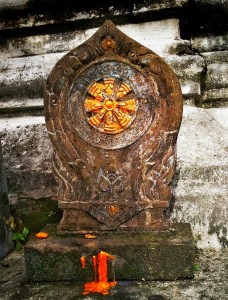
Once again there’s a myriad of ways to define dharma. And once again, I have a favourite: Dharma (often represented by a wheel) according to the religious tradition we know as Hinduism is cosmic or universal law that underpins right behaviour. It is the eternal and inherent nature of reality. In other words it is Truth.

We can all say, regardless of our beliefs say, I take refuge in the truth and in what is right. It’s a commitment to always acting in the best interests of everyone – including ourselves (maybe even especially ourselves). It is taking shelter or refuge in what is right. Living such a life in our messed up world is never going to be easy, so it is best to think in terms of doing the best one can. But having it as your ongoing guide will ease the path.

I take refuge in the Sangha.

A Sangha is an association or a community. Often used to describe monastic communities of monks or nuns, it may also include lay people. If we step outside of the religious framework, then a Sangha is a community that shares common bonds, beliefs, commitments, interests, and so on. Family, tribe, workmates, recreational and sports clubs. You name it: all sorts of groups might be sanghas or communities.

Of course, and perhaps very obviously, not all groups will be communities, And equally we may not think we are a part of any community; we may think of ourselves as being quite outside any group. However there are no rules that say a community has to have a set number of members. Besides, being in community is a condition and has nothing to do with group size or composition.

So, if you find yourself in a community of one – or two or however many – take refuge there. Make a commitment there. As with any other real community, this one begins with you and your truth.

The Buddha, the Dharma, and the Sangha. The Teacher, the Truth, and the Community. Making commitments to the Three Refuges can create a solid foundation as we continue our journey through the world and our lives. The refuges – the safe havens we can call them – we have sought and found will support us through good and bad times.

Actually, I just thought: if we are genuinely able to take true refuge in these three treasures then we will conditioning our Selves to be more present, more in the here and now of who we are, what we’re doing, and what’s happening to us.

Peace to you from me

Food & Drink of the Gods

Namaste and Welcome friends

An idea that’s kept its hold on me for a while now concerns Black Tea and Dry Toast. It’s a part of my almost daily diet, and I’ve wanted to write about it. Anyway, here’s the note I first jotted down when the idea first came:

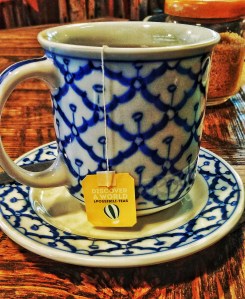
Black Tea and Dry Toast – In Reality is what we might call the food and drink of the Gods, of liberation, especially when I remember to offer it to Brahman and it becomes Prasada: simple, appetising, comforting, nourishing.
         What else?

Yes, sounds kind of weird, writing about such an apparently mundane subject. But, really, I  can say it definitely is for me the food and drink of the Gods. And as such, it moves beyond the little r reality of worldly food, of mundane considerations. It takes on the big R of Transcendental Reality.

Simple, plain food and drink. Pared down from all the extras and the padding, all the ‘additives’ we generally ply ourselves with. In a real sense this simplicity is in keeping with the uncluttered, minimal life I am called to live.

And everyone knows how comforting tea and toast is, how welcome it is pretty much any time of the day or night. Nourishing, too, for the spirit and the mind.

Actually for the body also. At least it is for me as a person who used to eat way too many biscuits, and take jam (thickly) on my toast. As I say, simple with no additives.

All of this equals in my view liberation. Freedom. Freedom at least sometimes, from harmful substances; Liberation from complicated preparations and the stresses and tedium that comes with it.

Black Tea and Dry Toast represents a snack (sometimes even a small meal) that at least for a short time can liberate us from stresses and tiredness. At other times, it gives us that freedom that comes from indulging in simple pleasures.

The food and drink of the Gods is not a complicated, invented and dressed up thing. It is plain, simple, comforting, nourishing.

And yummy.

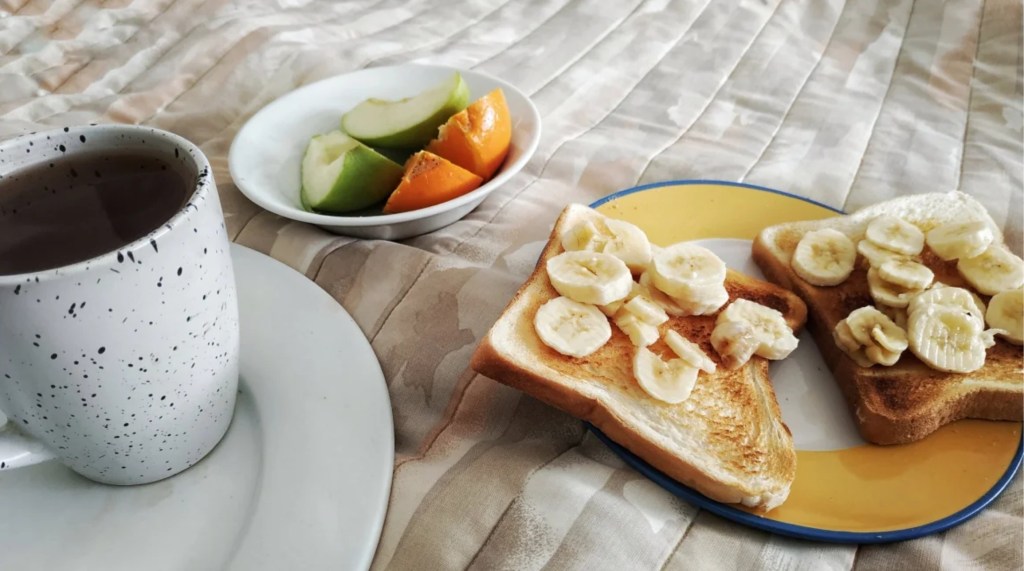
PS Okay. That photo stuck in the middle up there isn’t quite in keeping with the topic is it? Alright, I admit it: Sometimes I really indulge myself and add banana to my toast. And yes, sometimes apples and oranges too

Be Present in the Presence

Greetings and welcome

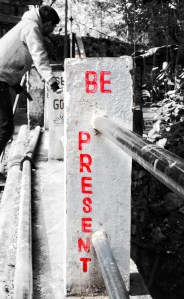
I write quite a lot about presence. I think a lot about presence, about being present, and all kinds of related ‘being in the moment’ kinds of musings.

Of course words like presence and present can have multiple meanings can’t they? About this time last year I read s book called Consider the Ravens. It’s about the history as well as the recent revival of interest in hermits and ways of living the hermit life.

If you are even remotely interested in living more in solitude, or living a simpler and more sustainable, life, or being more spiritually focused, then I can’t recommend this book highly enough.

There’s a paragraph from that book I’d like to share with you. It both describes some characteristics found in hermits and their way of life, as well as introducing us to a lovely phrase concerning the concept of presence.

Are hermits escapist? Yes. Is running away a bad thing? Like most choices it’s value is determined by its purpose. There are men and women who are selfishly seeking a sanctuary untouched by human pain. But there are others who deliberately choose to be powerless [in the eyes of the world], to live simply, and to use no more than their fare share of the world’s resources. They elect to be unknown, hidden, forgotten. And the goal? To become transparent to the Divine, or as [one hermit] succinctly phrased it: ‘to be always present to the Presence’.

Paul & Karen Fredette Consider the Ravens


I like that phrase; it’s what I’m aiming at. Actually, no. That’s not right: you can’t aim at being present, you can’t have presence as a goal to be attained in the future. I think that’s called an oxymoron. Anyway, all you can do is be; be present in the presence.

And it doesn’t matter what you call it: Presence; Truth; Reality; God; the Universe; the Cosmic Reality. They’re only names for that unnameable essence that we’d all agree can be called the Love that is in reality everything.

It’s that essence beyond all names – and forms. It’s what we sense is behind, above, and within all that exists in the world.

And, like a lot of people, I want to withdraw from that world of materialism. From the greed, the corruption, the cruelty and wilful ignorance, the … well, you get the point. My sense, and it is echoed in the quoted paragraph, is that presence is to be found in silence, and in solitude.

Of course it’s not necessary to be a hermit to be present – or in order to be present in the Presence. After all, few people believe they can go find a cave somewhere and withdraw totally from the world. (maybe it’s the belief that’s the problem?)

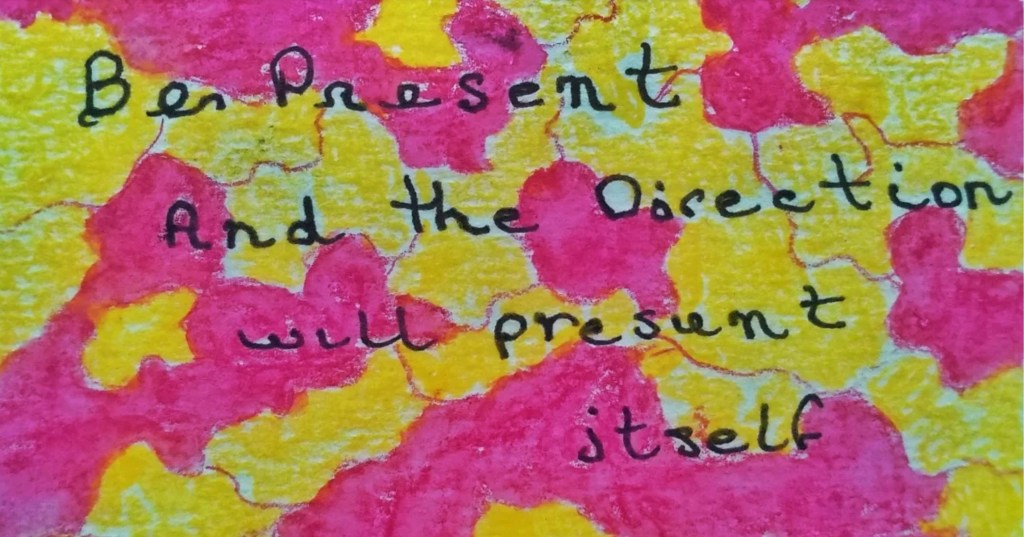
So, what to do? A wise person once gave a brilliant answer to that question and I have it on a card to remind me:

Yes. Be present and the direction will present itself.

Peace to you.

Seeking Justice: Commitments

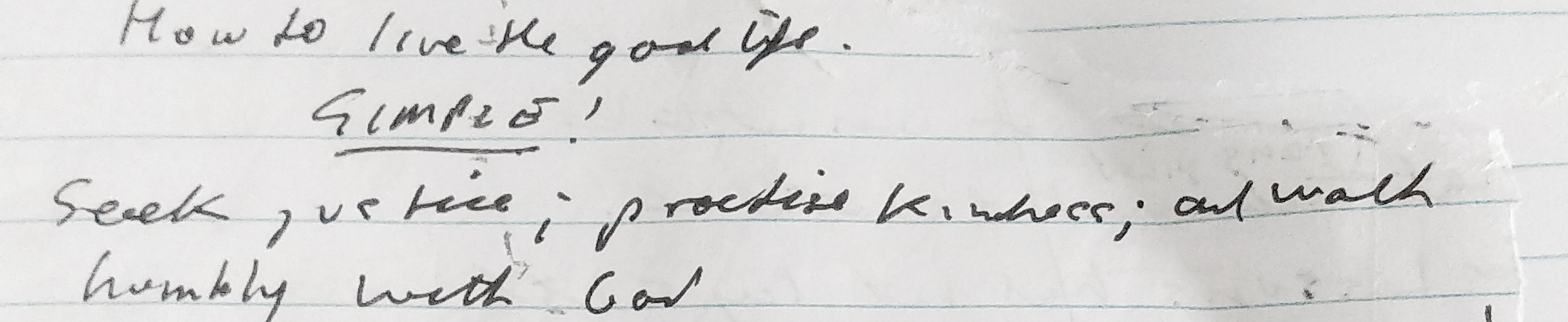
This morning I was just sitting, or at least trying to just sit. You know, being quiet, relaxing the mind. All that kind of thing. And of course, an idea sprung into that not so cooperative mind, so I grabbed my notebook. Just as I went to put this latest brainwave on paper I noticed a very extraordinary note I must have made I don’t know when:

I’ve just looked it up: It’s a slight paraphrase of a verse from the Old Testament, from the prophet Micah. Where I read it, I can’t say (the note is at least several weeks old). But to quote another little note from some unknown source, I always like to:

Let the noble thoughts come to me from all corners of the universe.

unknown

I’m just like everyone else, always wanting the easy solutions and you can tell that can’t you? ‘How to live the good life? Simple!’. I mean really; hardly humble in my approach in that note was I? Well, let’s talk about what Micah says, not my own lack of humility.

Seek justice; practise kindness; and walk humbly with [your] God.

There are numerous versions online of this verse (Micah, 6:8), so I will leave it to you to check those out for yourself. I’ve added the word your because all those versions do say ‘your God’. But even in this paraphrase it’s easy to see there is nothing at all simple about any of these injunctions.

I discovered that this verse is often invoked in times of grave injustice, or crisis. I think it goes without saying that we would be hard pressed to think of a time that was not a time of grave injustice or crisis. Certainly, we are living in one of those times of injustice and crisis.

There’s no need to or purpose served by getting into how ‘grave’ injustice is now compared to some other time; there’s no need or point to weighing up the relative severity of one crisis versus another. Injustice is injustice; a crisis is a crisis.

In other words, the present is always the time to heed the injunctions of this verse.

So, what do we do if we are to seek justice? Running the risk of sounding flippant, I would say that there are as many answers to this question as there are people to answer it. Now, you would think this would make the task impossible; too many cooks and all that. But actually it’s perfect. Why? Because it means that whoever you are, whatever your situation, you can actively seek justice.

Or, I am sorry: I should say I, me. Not you. I can actively seek justice. But, you say, you are a hermit; you live in a cave (not literally but I know what you mean); you hardly ever even talk to people in ‘real life’. Yes, all true. And I would say that the action I take is by no means at the level I know I want it to be. I’m doing nowhere enough.

Does that mean I’m leaving the cave? Going out into the world, onto the streets to join other brave souls seeking justice? Believe me, I ask myself such questions constantly. But to speak truth to you now, I will say that I know absolutely, in my heart, that my role is something different.

If anything, I need to go deeper into the cave; I need to go deeper into the inner world of my own Self. I know that in this way I will join with so many others in what I’ve come to call the Invisible Community of people all over the world living lives of contemplation and prayer. Or, speaking for me personally, trying to live a life of contemplation and prayer.

By so doing I am at least in a tiny way supporting those millions of others out there on the streets, in the aid groups, running campaigns, writing letters, helping the victims of injustice, in all kinds of miraculous, brave, and innovative ways.

So that’s my commitment to you. To deepen my prayer; to intensify my contemplation; to more fully realise my union with all living beings; and to really join with the invisible community in its efforts.

And, you ask, this blog? What’s it about then? Well, notes, musings, thoughts and reflections all aimed at reminding me of my responsibilities. And hopefully along the way, solidifying my union with you and the rest of creation, just a bit.

Peace and love

PS I haven’t forgotten ‘practise kindness’ or ‘walk humbly with your God’. Maybe another time.