Just For Today

There is a song by George Harrison that I like very much. Actually there are many songs of his that mean a great deal to me. He’s been a kind of mentor or teacher for me since the early 70s. But, having said that, there is something about Just for Today that really does resonate deeply within me. It’s not even one of his ‘biggies’, and was released in 1987 on the album Cloud Nine

In fact, if you read the lyrics of the song. Or even better, listen to George actually doing the song himself, you’ll most likely agree that this is more than a song. This is a refrain, a plea, even a prayer. No ordinary pop song anyway.

If just (for) today
I could try to live through this day only
Not deal with all life’s problems
Just for today

Then, the other verse (there are only two):

If just for tonight
I could feel not sad and lonely
Not be my own life’s problems
Just for one night
How many times have I made these same pleas? I don’t think I’d be able to count them. Of course I’d guess we all have at some time or other (or even quite often, all the time, every day, ahhhhh!!!!!!) wished or prayed for the problems (whatever they may be) to just go away, even for just a day. No, not even a whole day. How about just for a few minutes?

So, I’m not alone then. Still, it’s no consolation is it, to know that we all go through the same wishful thinking to be rid of the same or similar problems? I think, though, in this song George has given us a clue to what we can do to bring ourselves a little more into the present when it comes to the angst we weigh ourselves down with over ‘all life’s problems’.

And actually, he’s suggesting not that we focus fully on the present moment, the micro if you like, which can be tricky at the best of times. He’s given us a bit of a an easier task: Just look at this day only. Perhaps we can better look at a whole day than this ‘moment’ or ‘second’. A day is sort of a macro moment, a bit easier to get hold of.

But, that last little question, about always me being my own life’s problem, that’s what I really try to get to grips with. I am my own life’s problem. The problem is not the family I was born into. It’s not the less than idyllic childhood I endured. It’s not even the bullies I seem to have attracted to myself over many years in far-off school days.

The problem is not even the anxiety that I seem to have been born with, or that’s evolved over time. Nature vs nurture?

And I can’t even say that the problem is the kinds of choices I’ve made about life, work, thinking, and all the rest, over the years.

No. None of this. The problem is me. And, let’s get really trippy here: the problem isn’t even me. It’s the physical manifestation that thinks it’s me and which exists in relationship to the physical world.

So, who is the real me? Who am I? Ah, well, these are the really big questions. Asking these questions is called Self Enquiry. And I think it’s helping me.
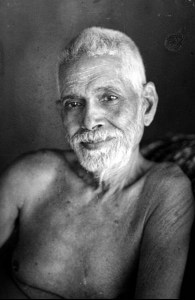
Whenever one of those life’s problems, or anxieties pops up I try to remember to ask: ‘To whom is this feeling/thought/memory occuring?’ That answer is (obviously) to me. And then I ask, ‘Who is this me? Who am I?’ Then, for the minutest of tiny moments, it all stops. Sometimes.

You see, I’m not really able to answer that Who am I question. The best I can come up with is a never-ending list of who I’m not, or what I’m not. It’s called Neti Neti: not this, not that. So, if I keep returning to who am I every time one of those ‘I’m not …’ comes up, what happens?

Well, in theory, nothing.  The idea is that asking Who am I stops the mind. It can’t answer. If a mind can’t answer, there can be no thought. And if there is no thought, then mind ceases to exist. (I’m not talking of brain here, but mind. It seems to me that the mind has no existence as a distinct entity of its own. It is more what we could say a ‘place’ that comes into being when thought happens. No thought, no mind.)

This cessation of thought is only a momentary thing. Thoughts soon come barging back (it also seems to me that while mind might not actually exist, it has a way of making its presence known in no uncertain terms). One thing I try to remember that causes me no end of extra thinking, is the fact that if we are not having a thought, then we can’t ever know it. You can’t have a conscious thought that says ‘hey, I’m not thinking now’

I see this Self Enquiry as a way (in a long term, lifetime kind of way) to rid myself of my incessant thinking and the confused (confusing too) and useless thoughts that arise all the time. For me it is, in a sense, a way to become mindless.

In that moment, when thought ceases, there is no pain. There are no questions, and there is no anxiety. There is no dread; no hope even. Basically you can say there is nothing for that tiny moment.
And that’s me, the real me. In that little moment (who can measure the length of a moment?), there is presence, as in I (the real I) am present, right here, right now.

Actually there is no time, as we measure it in the world, in that little moment (or whatever we choose to call it). Perhaps it’s more accurate to call it a state of being.

And it’s a state I’d like to be in more often. Not, as I say, that I’d know I was in it. Only by what you might call the spin-off effects of more calm, more clarity, less anxiety, all that sort of thing. In a way I would call that a state of grace.

All I can say is that it is exactly where and when and how I want to be.

Just for today.

I’ll Try Not to Pass Them By

So, anyway, here I am. Just sitting. It’s what I do, when I can, when I’m able. Well, to be completely accurate, here I am sitting and typing. Writing yes.

But every day, I sit. I try to sit. On a comfortable chair or bed. Here is where I commune with the Divine. It’s where I say my prayers, empty my mind, try to be silent, sometimes read holy books.

Whatever I do when I am just sitting, the sitting bit isn’t always easy; it requires effort and patience. Just being still can be hard; everyone knows that. But it’s part of the practice, part of the sadhana, the way to liberation. All that.

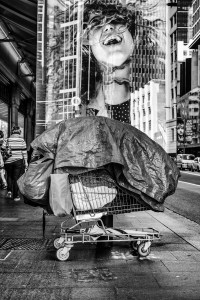
Of course I’m not the only one you might find just sitting. Why, just today on my way home from buying fruit I saw some other people sitting. One had his eyes fixed, completely transfixed on his phone’s flickering screen; head bowed, the world around him shut out.

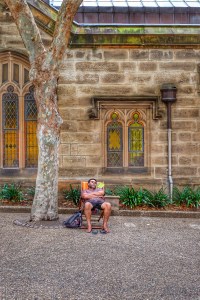
The other sat, head bent forward, arms crossed; I couldn’t see her eyes. Perhaps she was sleeping, perhaps feigning sleep, perhaps trying for sleep. Whatever, resting it looked like.

These two were a lot like me I thought: just sitting, being quiet, resting even. Mind you, they were younger than me. Though of course what’s age got to do with it? I carried shopping bags; they sat beside a very full shopping trolley.

But, wait, my bags held fresh fruits to top up our supply. Their trolley overflowed with, what shall we call them? All their worldly goods? Personal effects? All they own?

And another difference? I’m going home with my bags. They have no home to house those effects; no soft bed to rest upon or commune at leisure with the divine.

Whereas I sit under a roof, in a room, on a soft bed, they sit in a bus shelter. Sure, there’s a roof but it offers scant protection from the approaching storm, and none at all from the incessant wind that will soon be full of rain blowing.

It’s no use asking why am I in a comfortable house, and they are in a bus shelter, just as I was and they were, the last time I saw them. There’s nothing for me to say that will mean anything to them, to anyone else, or even to myself.

I suppose I or you or someone else might remind me (remind all of us) that the world can be hard, is hard: bad things happen to all of us. Of course that’s true. I actually truly believe that the world by its very being in existence is hard. What did The Buddha say? Life is suffering?

But, as they say, that just doesn’t cut it, does it? All just words don’t you think? It’s what I think today anyhow. Oh yes, I’ve been praying since I passed them by (and I did pass them by with no words, no smile or greeting, my face turned away. I am ashamed).

I thought of them as angels there to remind me of my own advantages and privilege. Even those very thoughts themselves prove my own failing to understand, to actually get it.

But, yes: all just words. Meaning very little. I suppose after all that perhaps all I can do is pray.

For all of us.

Peace

Not as if I don’t bloody live here is it?
Yeah. I know, I know. Its a bloody bus stop.
But, geez, a fella’s gotta live
somewhere. Don’t he?

An Aspiration. A Prayer

Hello friends and welcome

The last couple of posts have had me thinking about what I actually do to contribute to the world, to life, to making changes that could bring peace, a safe environment, and a better life for all.

I have to say my commitment to my life as a hermit, as a pilgrim aspiring to live a life apart from ‘the world’ all the while dedicating myself to what we might call Self or God Realisation, has been strengthened.

I have once again come to the conclusion that living a life focused on spiritual development, on art, on prayer, and on contemplation, is the most valuable way I personally can contribute to change, to love, to the good of all. My true nature, my inclinations, my faith, my life experience, all these equip me for this life that has chosen me.

And at the same time, these same factors have left me ill-equipped for life ‘in the world’

In those last two posts, I talked about how so few of us think we have anything to offer a world teetering on the edge. But of course, as I pointed out, the opposite is true. I think I made the point that there is some unique role for each and every one of us in the continued unfolding, upliftment, protection and prospering of all life in this world.

Having said all that, I have to say that for me it’s not always easy to actually realise this in my heart. Intellectually it’s an easy concept to explain (well sort of anyway), but on that deeper heart level, well it’s tricky. Guilt rears its ugly head: ‘It’s all falling apart; I have to do more; But what can I do? It’s useless. I’m useless’.

As I mentioned in one of those posts I think, people have turned away from the horror, injustice, cruelty, and murderous greed and lust for power, for as long as these things have existed – which is obviously for as long as our species has been around. At certain times in history this move away from ‘the world’ has accelerated and intensified. And we are living in one of those periods now.

In the last century so many people have taken up the contemplative life, and many have chosen to make that life one of complete or partial solitude in order that they may be free from distraction in their prayer, study, and contemplative life.

But, many will say, ‘You are in denial. Now is the time you are needed out there. The world and all of life is in danger. You can’t escape and hide in a cave’.(read here stop watching the news, ignore politics, stop spending, become a literal or metaphorical hermit, go traveling, shirk your responsibility to the rest of the world).

Again guilt trips us up and we just keep on trying to find ways to at least rid ourselves of the guilt over our perception that we can do nothing.

But many such people, and that includes me, rather than being in denial, rather than shirking responsibility, have looked at the material world with its horrors, and said, ‘This isn’t right’, and have started to look at other ways to live and, seeing that continuing to struggle against the weight of the world on the world’s terms is pointless, seek to find other ways they can contribute to change. Ways that don’t perpetuate the playing of the game.

And rather than escaping these people (including me, I say with humility) face the world head on, dedicating their lives to the world through creativity, through prayer and meditation, and through the expression of freedom in their choice of lifestyle. They are, as Mahatma Gandhi is supposed to have said, being the change they want to see in the world.

While Gandhiji didn’t actually say those words, (Actually there’s a post coming in a couple of weeks in which I share the full text this quote is apparently derived from. Stay tuned for the link here), he certainly lived his life being the change he wanted to see.

But sadly, this ‘quote’ has come to be seen as a kind of feel good cliché, something the privileged are accused of mouthing while not actually even thinking about changing their lives. Just one more platitude you might say.

But for many, like me in my own way, it is much more: it is a call to action, a respectful and heartfelt request that I embark upon the quest for a more authentic way of living that has love, compassion, service, and truth at the centre of all I do.

This is my aspiration. This is my prayer.

Peace from me to you

The Ananda Mart is Closed Today

Hello and welcome dear reader

Almost four years ago now, we spent a couple of months in Bali. For a big portion of that time we based ourselves in a town called Ubud, on a street called Gautama. Yes, indeed, most auspicious.

Anyway, one day I was walking down the street, going somewhere, and for a change without my camera. I passed a small shop that somehow looked unusual. and I stopped to make a photo with my phone.

That’s it: The Ananda Mart is closed today, I remember thinking. In the few weeks we’d been there, I don’t think I’d ever seen it closed before. On most days the man who runs the shop could be found sitting on the front steps. And mostly he’d have his dog for company.

In the early days of our time on Gautama Street, we’d buy bottles of water at the Ananda Mart. Each time I would smile, say hello, and enquire after the shopkeeper’s health. And while he always responded, it was never with what you’d call a friendly smile or a cheery wave. Probably grumpy grunt would be a more accurate way to describe his replies.

You know you’re on Gautama Street when you see the man himself at the corner

And each time I passed the shop, I would say hello. Again on a lucky day I’d get a grunt, but mostly he would say nothing and ignore me. Just as he ignored everyone who passed him and his dog. Eventually after a particularly rude response to me trying to purchase water, I, as they say, took my custom elsewhere.

Often in such situations I have been known to become irritable, angry even, and end up being just as rude (or ruder) than the other person. For some reason, this time I didn’t react that way. Instead I was interested in figuring out why the shopkeeper acted in this way and seemed to be in a world of his own which, from what I could see, he shared only with his dog.

Of course, being the overthinking speculator champion of the galaxy, I made many guesses: he is the owner of the Ananda Mart and is totally over people; being I thought in his 60s, maybe he’s just hanging out till he can retire. Given that the Ananda Mart is only one component of what looks to be a multi-armed business this could be a good guess. He’s one of the family elders, doing his part.

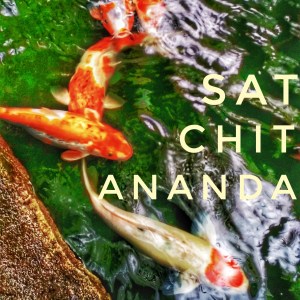
Above the door beneath the name it reads ‘cheap and friendly’. And it’s interesting to check the meaning of Ananda. In Hinduism, Buddhism, and Jainism it refers to extreme happiness, one of the highest states of being. In Sanatana Dharma philosophy for example, God is sat-chit-ananda or existence, consciousness, bliss.

Now, before I ramble on too long, I will just say that really and truly ‘the real story’ is absolutely none of my business. I suppose what I’m getting at is, rather than dismiss him as a grumpy man in a shop, My reaction to our, shall we call it, our relationship was one of compassion and curiosity. Let’s just say my sense was that the Ananda Mart shopkeeper is perhaps not a happy man.

You see what I mean? I tell you that it’s none of my business, then I tell you how I kept sticking my mind in where it doesn’t belong. Makes me human I guess!

Paramhansa Yogananda, one of the first teachers to bring Yogic philosophy to the so-called West, and the author of Autobiography of a Yogi, says in that book that Ananda is different from the temporary happiness that comes from sense pleasures such as eating and other ‘material pursuits’. He said , too, that Ananda is not the kind of joy that we’d call monotonous and that always stays the same.

Yogananda wrote in Finding the Joy in Life, that Ananda refers to a joy that ‘changes and dances itself in many ways to enthral your mind and keep your attention occupied forever’.

It’s anybody’s guess really isn’t it? Whether our seemingly unhappy and not so friendly shopkeeper, has that kind of joy in his life. And perhaps his aloofness and ‘grumpiness’ is merely an expression of his weariness of the temporary joys of the material word with its emphasis on pleasures of the senses.

Anyway, as I say, it’s none of my business.

Peace to you from the Hermit

Put Me in My Place. Please

Reverence the place and learn from what you see


Coming across this note last night, I was stumped. I coudln’t think where it had come from, where I’d seen it; nothing at all came to mind. And an online search just now failed to turn up anything either. I mean I must have read it somewhere. Or is it possible it came from me?

Of course it’s all the same: there is only one source. At any rate, it’s an injunction one can relate to anywhere, any place. It’s surely about presence?

And about learning from all that is to be seen (heard, felt, intuited, known) in whatever place one is in now. I mean, the place I’m in now. I am here and it is now.

I’m reminded of the faith affirmation (is it a prayer?) that seems to have been written for this particular hermit pilgrim:

As a a hermit, I am a pilgrim dependent on a pure faith that I am exactly where God wold have me be now.

Sometimes I think that too much thinking about and angst over places other than the one I’m actually in right now, is a sure and certain way to resist and reject any reverencing of the place I’m in, not to mention what’s to be learned or gifted from the experience of being here.

And of course that angst, worry, wishful thinking, or whatever, comes with its own issues of distraction, and of a taking away of one’s Self from the present, the notion that here and now is the only time and place that exists.

A poem of mine I came across the other day while looking for something else says it all quite nicely. This poem is called Transcendental Injunctions, and it’s a rap on presence, about being here, and being now.

The central action describes how my senses can take me away from that here and now: I describe my habit of smelling my Bhagavad Gita (yes, as in putting my nose into the pages of the little book and inhaling the aroma of those pages) and how that takes me back to the shores of the River Ganges; another place, another time.

Anyway, allow me to share the final verse, which speaks of one such occasion:

Then, there is a voice:
I hear it with the ear of my heart:
There is no place to go.
What you seek is within.
There’s nothing to find:
God’s kingdom is within.

I suppose there is nothing left to say. I am here, and it is now

Peace to you from me

A Little Blogging Balance is Called For

Hello and welcome

In yesterday’s post I made mention of how Notes from the Hermit’s Cave is a month and ‘a bit’ old now. I thought when I typed that, ah yes, so it is; I don’t think I’d given a lot of thought to details like that.

So, first things first: Thank you for being there at the other end of all this, and for joining me on this new venture. Adventure really.

Anyway, as you could tell if you read that post, I just kept on typing with hopefully something reasonable coming out at the end!

Later when I told a wise one I know about that realisation, this person said to me:

‘Are you sure you’re getting enough new imput to keep coming up with new ideas for more writing?’

Good question. Wasn’t yesterday’s post about precisely the issue of an idea that wouldn’t (or maybe couldn’t) evolve into a post? But, wait, not having any ideas isn’t a problem is it? Or is it? So, what’s ‘enough new imput’?

So now I had two pieces of information that had me thinking: the running out of ideas is a possibility; having ideas that won’t or don’t work is a certainty. Together these bits of information came together to form a little bit of knowledge.

That’s how it’s supposed to work: we gather information, then we turn that information into knowledge. The trouble happens when we are overloaded with too much information and can’t sort out any of it to form anything like coherent knowledge.

Anyway, here am I getting distracted! What I was about to say was that the knowledge which came from those three pieces of information, was:

There’s a potential for ideas to run dry, but the other problem is that just because there are ideas apparently available now, doesn’t mean they are any good, or can be used, want to be used, or for a myriad of other reasons, I can’t connect with them. Either way, I am definitely going to need some new, perhaps different imput

What to do? Now, this is where the formation of wisdom comes into the picture: first there were seemingly random bits of information, which then came together to form a little parcel, nugget, insight (what do you call a piece of knowledge?). Some knowledge.

As we all know, simply gathering information, even if we somehow are able to turn that information into knowledge, is no guarantee that wisdom will follow.

However in this particular instance, wisdom did emerge. After some thinking, and some not thinking, I thought, I know: I’ll have a couple of days off. No posts. No blog (except to answer people who reach out to me obviously) stuff at all.

Ah wisdom. So simple really when you look at it isn’t it? I’ll just have a couple of days without thinking about, or looking at Notes from the Hermit’s Cave. So, what will I do instead? Well it’s not as if my time isn’t rather (very rewardingly) full with the other practices incumbent upon me as a hermit and a pilgrim. And a monk.

Still, I thought, I could use a bit more time just sitting still. You know: being quiet, eyes closed, not doing anything. Then, I’ve been a bit light on listening to music this last little while. And not listening to enough music is enough to cause trouble with anybody’s creative self isn’t it?

So, decision made. More time sitting and being. In silence so the inner mind is open to receive new ideas, to process existing ones, and to well, just be quiet. And some more music. Doesn’t matter what it is {well to a point it doesn’t): ideas come from and because of music.

Perhaps by this point, it has occured to you as it has to me, that there is an irony at work here. Here I am writing a blog post on the very first day of a couple of days off from writing blog posts. Okay, I get it. Time off starts … now!
No-post weekend starts … now!

Alright, I can’t make any promises; The creative spirit arises when it does; my heart opens when it does. Besides, as that same wise one said to me by way of an injunction on how to approach everything and anything:

No overthinking

PS I was just thinking, there’s a book I’ve been meaning to get to for weeks now, so … Never mind

Karma Yoga & Contemplative Living: Creating Good Vibrations

Greetings friends

Not so long ago I read The Glass Bead Game by Herman Hesse. And I have to say it’s what I like to call a ‘real book’: written beautifully with an interesting and deeply engrossing story, full of detail, symbolism, thought-provoking ideas, and at the end of the day just plain and simply a delight to spend time with.

I won’t go into what the book is about here, but for the sake of this post, I will just tell you that it is about a mythical European province populated by an elite group of scholars of all sorts who have as their main cultural, social, and even political focus, the game of the book’s title.

Anyway, what I want to talk about here today is something said by the book’s main character, who in the course of the story becomes the master of the game and therefore a hugely influential figure.

This character is having a conversation with a friend. And he’s talking about the way this elite group conducts itself in the world. How it helps shape the country and history. He says to his friend:

We do not intend to flee from the vita activa (the active life) to the vita contemplativa (the contemplative life), nor vice versa, but to keep moving forward while alternating between the two, being at home in both, partaking of both.

Now, what struck me about this quote is that only a couple of days before I’d read a verse in the Bhagavad Gita that I felt said almost exactly the same thing. Krishna says to the warrior Arjuna:

Contemplative life and Karma Yoga are one and the same and takes one to the same destination. One who perceives this sees things as they are.

Bhagavad Gita Ch 5 Verse 5

Karma Yoga is usually defined as taking action without desiring reward for oneself or being attached to the fruits of the action. It is very much the taking of selfless action that is for the benefit or others. However, because as living beings in the world, we are always taking action and actually can’t not be acting, Karma Yoga is also described as being simply the yoga of action.

The Contemplative Life is most often ascribed to monks and nuns, and others living a life of deep thought, study, meditation and prayer. But any of us can lead a contemplative life because such a life is about being mindful, it’s about considering the consequences of our actions.

Such a life is lived slowly and thoughtfully and would be called ‘spiritual’ by some people. We could also call it an examined life. It is about cultivating an inner life, a life of mindfulness in all aspects of our lives.

And living in a contemplative manner helps create more peaceful communities; people living in this way project a calm that can have profound impacts on others. Such people help to set up what some us like to think of as good vibrations

Of course it’s one thing to talk about the Contemplative Life versus the active life in a novel and in an ancient book of scripture. It’s a whole other thing to be trying to figure out what sort of life we should be living in the world here and now, with the urgency of climate change, wars, despotic leaders, increasing poverty and the rest. Or is it?

Is it better for us to take action by protesting, joining activist groups, writing letters? Or is better that we live apart in some way, spending time contemplating, meditating, ‘praying’?

To me it seems there’s a real struggle going on right now between these two points of view. There are those who will tell us that it is too late for ‘thoughts and prayers’, and then there are those who say, we can’t achieve world peace (in its many facets), until we have attained inner peace on an individual level, and that the only way to reach that state is to meditate, live a contemplative life, and slow down.

Obviously, and you already knew I was going to say this, the two are not mutually exclusive; both approaches are required and serve their own purposes. There is no dilemma; there is no conflict. And above all, neither approach is superior to the other.

Many of us are suited to an active life; some of us less so. Some of us are suited to silence and to quiet reflection and study, some of us aren’t. And oftentimes if we try to act contrary to our true natures, then we have great difficulty in achieving anything. And we don’t help anyone when that happens.

Karma Yoga or the Contemplative life. An active life or a life of silence and contemplation. Only you are able to know which is for you. Of course there’s always a crossover to some degree or other. Being fully active and engaged in the world, doesn’t stop one from spending time in a contemplation, and perusing one’s life mindfully.

Equally, leading a totally or partially contemplative life doesn’t mean you aren’t taking action in the world. Obviously you are. For me, the contemplative life is a way to find some personal peace, to create those good vibrations I mentioned, and it allows me to connect with others of like mind, who are working for the highest good. Those living in the invisible community I think I’ve mentioned some other time.

Balance. The key is to find the balance that expresses you and your nature best. So, take some action right now and begin contemplating!

Food & Drink of the Gods

Namaste and Welcome friends

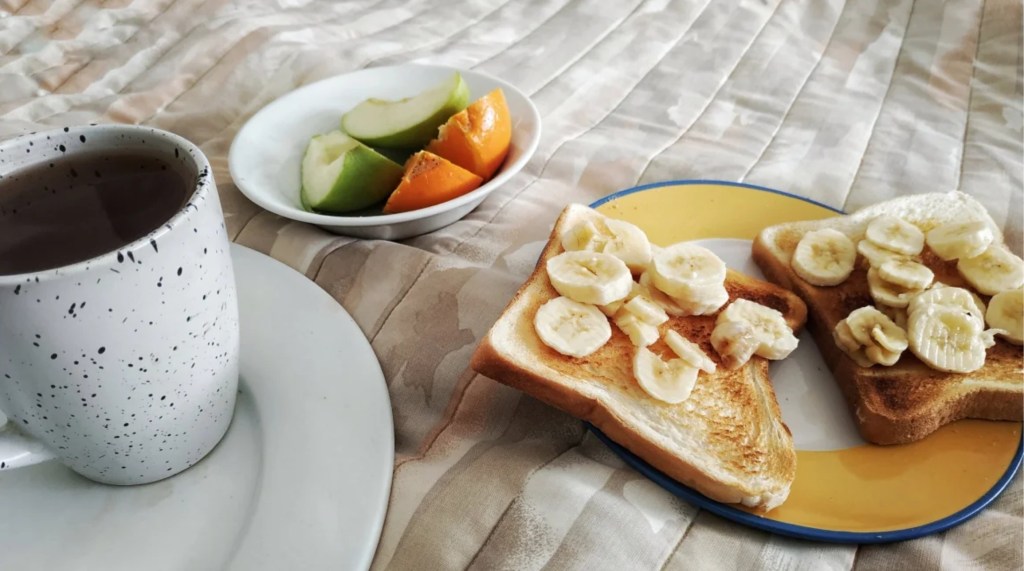
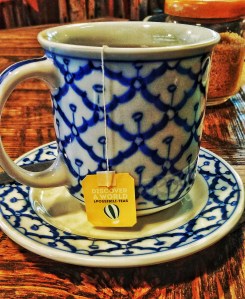
An idea that’s kept its hold on me for a while now concerns Black Tea and Dry Toast. It’s a part of my almost daily diet, and I’ve wanted to write about it. Anyway, here’s the note I first jotted down when the idea first came:

Black Tea and Dry Toast – In Reality is what we might call the food and drink of the Gods, of liberation, especially when I remember to offer it to Brahman and it becomes Prasada: simple, appetising, comforting, nourishing.
         What else?

Yes, sounds kind of weird, writing about such an apparently mundane subject. But, really, I  can say it definitely is for me the food and drink of the Gods. And as such, it moves beyond the little r reality of worldly food, of mundane considerations. It takes on the big R of Transcendental Reality.

Simple, plain food and drink. Pared down from all the extras and the padding, all the ‘additives’ we generally ply ourselves with. In a real sense this simplicity is in keeping with the uncluttered, minimal life I am called to live.

And everyone knows how comforting tea and toast is, how welcome it is pretty much any time of the day or night. Nourishing, too, for the spirit and the mind.

Actually for the body also. At least it is for me as a person who used to eat way too many biscuits, and take jam (thickly) on my toast. As I say, simple with no additives.

All of this equals in my view liberation. Freedom. Freedom at least sometimes, from harmful substances; Liberation from complicated preparations and the stresses and tedium that comes with it.

Black Tea and Dry Toast represents a snack (sometimes even a small meal) that at least for a short time can liberate us from stresses and tiredness. At other times, it gives us that freedom that comes from indulging in simple pleasures.

The food and drink of the Gods is not a complicated, invented and dressed up thing. It is plain, simple, comforting, nourishing.

And yummy.

PS Okay. That photo stuck in the middle up there isn’t quite in keeping with the topic is it? Alright, I admit it: Sometimes I really indulge myself and add banana to my toast. And yes, sometimes apples and oranges too

Be Present in the Presence

Greetings and welcome

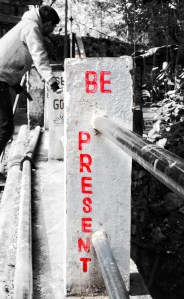
I write quite a lot about presence. I think a lot about presence, about being present, and all kinds of related ‘being in the moment’ kinds of musings.

Of course words like presence and present can have multiple meanings can’t they? About this time last year I read s book called Consider the Ravens. It’s about the history as well as the recent revival of interest in hermits and ways of living the hermit life.

If you are even remotely interested in living more in solitude, or living a simpler and more sustainable, life, or being more spiritually focused, then I can’t recommend this book highly enough.

There’s a paragraph from that book I’d like to share with you. It both describes some characteristics found in hermits and their way of life, as well as introducing us to a lovely phrase concerning the concept of presence.

Are hermits escapist? Yes. Is running away a bad thing? Like most choices it’s value is determined by its purpose. There are men and women who are selfishly seeking a sanctuary untouched by human pain. But there are others who deliberately choose to be powerless [in the eyes of the world], to live simply, and to use no more than their fare share of the world’s resources. They elect to be unknown, hidden, forgotten. And the goal? To become transparent to the Divine, or as [one hermit] succinctly phrased it: ‘to be always present to the Presence’.

Paul & Karen Fredette Consider the Ravens


I like that phrase; it’s what I’m aiming at. Actually, no. That’s not right: you can’t aim at being present, you can’t have presence as a goal to be attained in the future. I think that’s called an oxymoron. Anyway, all you can do is be; be present in the presence.

And it doesn’t matter what you call it: Presence; Truth; Reality; God; the Universe; the Cosmic Reality. They’re only names for that unnameable essence that we’d all agree can be called the Love that is in reality everything.

It’s that essence beyond all names – and forms. It’s what we sense is behind, above, and within all that exists in the world.

And, like a lot of people, I want to withdraw from that world of materialism. From the greed, the corruption, the cruelty and wilful ignorance, the … well, you get the point. My sense, and it is echoed in the quoted paragraph, is that presence is to be found in silence, and in solitude.

Of course it’s not necessary to be a hermit to be present – or in order to be present in the Presence. After all, few people believe they can go find a cave somewhere and withdraw totally from the world. (maybe it’s the belief that’s the problem?)

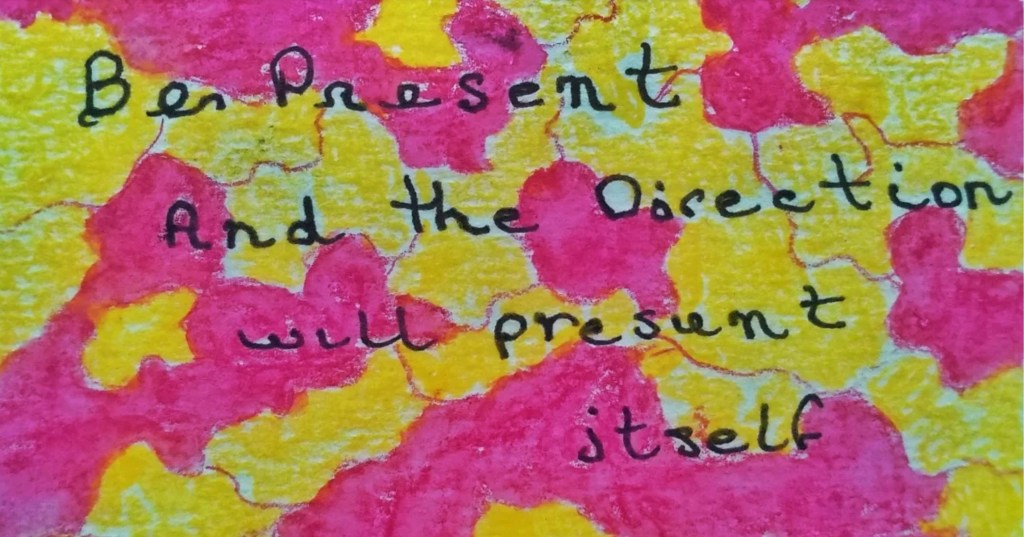
So, what to do? A wise person once gave a brilliant answer to that question and I have it on a card to remind me:

Yes. Be present and the direction will present itself.

Peace to you.

An Idea From a Not So Random Corner of the Universe

Namaste and Greetings friends

Remember in my last post I mentioned that I like to ‘Let the noble thoughts come to me from all corners of the universe’? Well I’ve been exploring, investigating, studying, in one of those corners for a few years now.

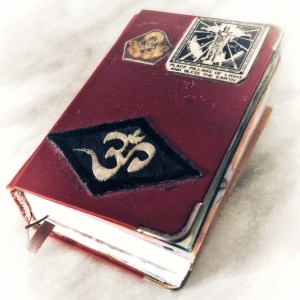
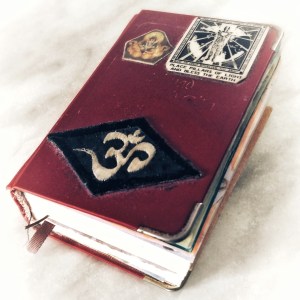
In 2016, in India, I gifted myself a small copy of the Bhagavad Gita. It’s a little red book, my Gita; no commentaries, just a plain, simple, and easy to understand translation of the 5000-year-old text known as the ‘Song of God’

Of course there are many sources of divine wisdom. No. That’s not right. Start again. Everything is a source of divine wisdom, of the word of God, universal knowledge, Truth, the Dharma. We can call it what we like.

But every living thing – human and non-human – every experience we have, and the entirety of the material and non-matieral creation, is divine wisdom in action.

Speaking for myself, I don’t always remember or realise (as in believe, trust, know) this never-ending, inexhaustible supply of wisdom. So I have to make use of some physical forms that help me narrow my focus, to centre my attention. It happens that the Bhagavad Gita is for me, one of those physical forms.

So today I want to talk about a verse from the Gita that really leapt out at me when I opened the book at random yesterday.
That verse comes from a chapter titled Self Knowledge and Enlightenment. It’s where Krishna – representing our Higher Self, Divine Wisdom; the real us, the real me – is telling Arjuna – the ego self, or little self, the us that thinks ‘this is me’, ‘puny, small, little me, just a sack of bones’ – all the various attributes and qualities of the Higher Self, the real us.
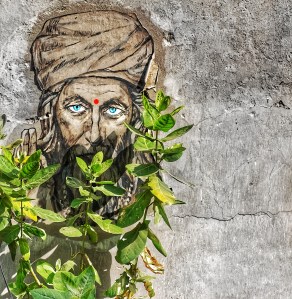
In other words, our Higher Self is helping our lower self to realise what we really are, trying to get us to see that there is a lot more to us than meets the (physical) eye.

Anyway, to the verse:

Of the strong, I am strength devoid of desire and passion, and I am love that is virtuous.

Bhagavad Gita Ch 7 verse 11

My sense is that the entire Bhagavad Gita is designed to help rid us of our attachments to the dualities of the world. Of course material life is obviously a state of dualities: we like good things, don’t like bad things; sometimes we’re happy, sometimes full of sorrow; we might at one time have many material possessions, then at another have nothing. You know where I’m going here; after all you dwell in the same world as I do!

Naturally none of us want bad things to happen, so we try to develop ways to be strong, to gather strength so we can face the bad stuff when it (inevitably) happens. And there’s nothing wrong with being strong, nothing amiss about having strength, but here Krishna (Higher Self) says that we don’t need to desire to get strength: we already are strength. Remember: Krishna is our Higher Self, so if Krishna is strength then that means we all are.

The desire and passion he talks about is really our attachment to outcomes, to expectations, to labelling things good or bad, or this or that, or wanting to feel this emotion but not that one. In other words, we are strength without any of these attachments;

So, when those inevitable ‘bad things’ happen, we already have the ability to flow with them, to cope with them, without judgements, without fear. Equally, when the inevitable ‘good things’ happen, we can rejoice, but we are strength, so there’s no need to hang onto them, wishing them to keep on happening, or being fearful of them changing.

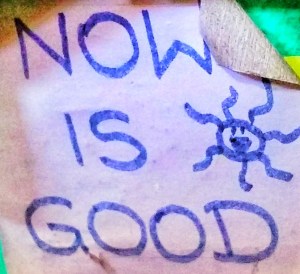
You know there is an expression I used to loathe: It’s all good. It’s one of those non-commital, bland platitudes that really doesn’t mean anything. Well I don’t hate it quite as much as I used to but I still have trouble with it. Maybe we can take it a bit further?

Perhaps we could say instead: It all is. No good or bad; no joy or sorrow; no dualities of any kind. Sounds like heaven doesn’t it?

Well, while we’re in physical bodies here on Earth (and who can say what kind of bodies if any we’ll get to inhabit in the future), then the most that can ever happen is a glimpse – or maybe a few glimpses – of isness. Moments when we actually stop labelling, stop seeing dualities, and really and truly can know, it all is. For real.

And the love bit? Well, here we have Krishna (our Higher Self) saying he is love. He means us. He’s actually telling us that we are love. And virtuous love at that. Mind you, is there any other kind?

Peace