Greetings and Welcome
To become a Buddhist, , there are a number of things a person must commit to. One of these consists of a kind of three in one resolution that’s welcomed by any aspirant. In fact, some say that in order to be a Buddhist, one has to repeat The Triratna or The Three Jewels. Three refuges is the other name used.
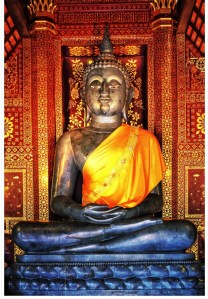
I take refuge in the Buddha
I take refuge in the Dharma
I take refuge in the Sangha
The exact words used may vary, but The Three Jewels is common throughout the Buddhist world. And of course there will be many meanings ascribed to ‘take refuge’, but the one I like is the one that any of us might use in, say, a heavy downfall of rain. What do we usually do in when the rain starts falling? We look for shelter, we take refuge.
I don’t mean to suggest that becoming a Buddhist automatically means that one is seeking a safe dry cosy place out of the storm. Though, now I’ve said that, it does make sense. I know myself that (though I am not a Buddhist) sometimes the only way forward, the only means to seek the truth, and to find peace, is to take refuge somewhere or in someone or something.
Not being a Buddhist as I said, I’m not qualified to speak about Buddhism in any real detail. What I have in mind is I would like to borrow the Three Refuges and reflect on how we could all use what me might call a ‘secular’ interpretation as a way of putting into words our own commitment to finding a refuge, a safe haven as we tackle what is for all of us born into a physical body, a life of trials, tribulations, ups and downs, storms and lulls, happy times and sad times, and all the rest of the package that’s called living a life.
Let’s take a look at each of the Three Jewels (also known as the Three Treasures which I like a lot), and think about how we can apply it to our own life, to our own seeking of refuge.
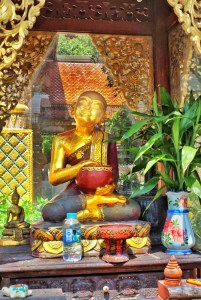
I take refuge in the Buddha.
For a Buddhist, the Buddha is the Guru, the teacher, the one who holds the Truth and shows the way. Many people would say right now, well that counts me out. I don’t follow a religion. I don’t have a teacher or guru. I’m just another regular person trying to make my way through life.
While it may be true that you don’t have a teacher or priest or guru, or anyone else in the role of guide, there is one person who is always there with and for you, one person who is always thinking about you, who is making decisions for you on which way to go, what to do and all the rest: you.
Yes, you. Your Self. When it comes down to it, who knows you better than you do? Take refuge in you, in the Self. Need to make a hard choice? Look within. Feeling tired, or ill or fed up? Look within you for the answers to what can be done. Follow your intuition. You, plus intuition, plus you taking refuge in you, equals teacher, guide. You are your own guru.
I take refuge in the Dharma.
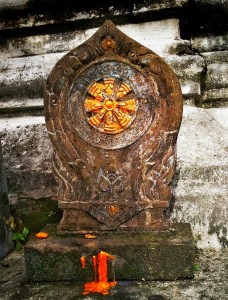
Once again there’s a myriad of ways to define dharma. And once again, I have a favourite: Dharma (often represented by a wheel) according to the religious tradition we know as Hinduism is cosmic or universal law that underpins right behaviour. It is the eternal and inherent nature of reality. In other words it is Truth.
We can all say, regardless of our beliefs say, I take refuge in the truth and in what is right. It’s a commitment to always acting in the best interests of everyone – including ourselves (maybe even especially ourselves). It is taking shelter or refuge in what is right. Living such a life in our messed up world is never going to be easy, so it is best to think in terms of doing the best one can. But having it as your ongoing guide will ease the path.
I take refuge in the Sangha.
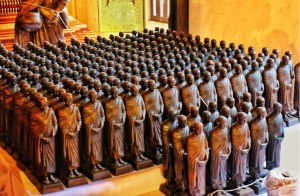
A Sangha is an association or a community. Often used to describe monastic communities of monks or nuns, it may also include lay people. If we step outside of the religious framework, then a Sangha is a community that shares common bonds, beliefs, commitments, interests, and so on. Family, tribe, workmates, recreational and sports clubs. You name it: all sorts of groups might be sanghas or communities.
Of course, and perhaps very obviously, not all groups will be communities, And equally we may not think we are a part of any community; we may think of ourselves as being quite outside any group. However there are no rules that say a community has to have a set number of members. Besides, being in community is a condition and has nothing to do with group size or composition.
So, if you find yourself in a community of one – or two or however many – take refuge there. Make a commitment there. As with any other real community, this one begins with you and your truth.
The Buddha, the Dharma, and the Sangha. The Teacher, the Truth, and the Community. Making commitments to the Three Refuges can create a solid foundation as we continue our journey through the world and our lives. The refuges – the safe havens we can call them – we have sought and found will support us through good and bad times.
Actually, I just thought: if we are genuinely able to take true refuge in these three treasures then we will conditioning our Selves to be more present, more in the here and now of who we are, what we’re doing, and what’s happening to us.
Peace to you from me



 Notes from the Hermit's Cave