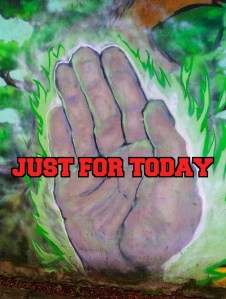
Just For Today

There is a song by George Harrison that I like very much. Actually there are many songs of his that mean a great deal to me. He’s been a kind of mentor or teacher for me since the early 70s. But, having said that, there is something about Just for Today that really does resonate deeply within me. It’s not even one of his ‘biggies’, and was released in 1987 on the album Cloud Nine

In fact, if you read the lyrics of the song. Or even better, listen to George actually doing the song himself, you’ll most likely agree that this is more than a song. This is a refrain, a plea, even a prayer. No ordinary pop song anyway.

If just (for) today
I could try to live through this day only
Not deal with all life’s problems
Just for today

Then, the other verse (there are only two):

If just for tonight
I could feel not sad and lonely
Not be my own life’s problems
Just for one night

How many times have I made these same pleas? I don’t think I’d be able to count them. Of course I’d guess we all have at some time or other (or even quite often, all the time, every day, ahhhhh!!!!!!) wished or prayed for the problems (whatever they may be) to just go away, even for just a day. No, not even a whole day. How about just for a few minutes?

So, I’m not alone then. Still, it’s no consolation is it, to know that we all go through the same wishful thinking to be rid of the same or similar problems? I think, though, in this song George has given us a clue to what we can do to bring ourselves a little more into the present when it comes to the angst we weigh ourselves down with over ‘all life’s problems’.

And actually, he’s suggesting not that we focus fully on the present moment, the micro if you like, which can be tricky at the best of times. He’s given us a bit of a an easier task: Just look at this day only. Perhaps we can better look at a whole day than this ‘moment’ or ‘second’. A day is sort of a macro moment, a bit easier to get hold of.

But, that last little question, about always me being my own life’s problem, that’s what I really try to get to grips with. I am my own life’s problem. The problem is not the family I was born into. It’s not the less than idyllic childhood I endured. It’s not even the bullies I seem to have attracted to myself over many years in far-off school days.

The problem is not even the anxiety that I seem to have been born with, or that’s evolved over time. Nature vs nurture?

And I can’t even say that the problem is the kinds of choices I’ve made about life, work, thinking, and all the rest, over the years.

No. None of this. The problem is me. And, let’s get really trippy here: the problem isn’t even me. It’s the physical manifestation that thinks it’s me and which exists in relationship to the physical world.

So, who is the real me? Who am I? Ah, well, these are the really big questions. Asking these questions is called Self Enquiry. And I think it’s helping me.
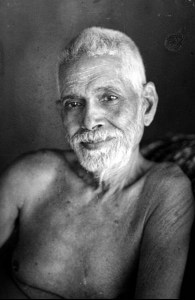
Whenever one of those life’s problems, or anxieties pops up I try to remember to ask: ‘To whom is this feeling/thought/memory occuring?’ That answer is (obviously) to me. And then I ask, ‘Who is this me? Who am I?’ Then, for the minutest of tiny moments, it all stops. Sometimes.

You see, I’m not really able to answer that Who am I question. The best I can come up with is a never-ending list of who I’m not, or what I’m not. It’s called Neti Neti: not this, not that. So, if I keep returning to who am I every time one of those ‘I’m not …’ comes up, what happens?

Well, in theory, nothing.  The idea is that asking Who am I stops the mind. It can’t answer. If a mind can’t answer, there can be no thought. And if there is no thought, then mind ceases to exist. (I’m not talking of brain here, but mind. It seems to me that the mind has no existence as a distinct entity of its own. It is more what we could say a ‘place’ that comes into being when thought happens. No thought, no mind.)

This cessation of thought is only a momentary thing. Thoughts soon come barging back (it also seems to me that while mind might not actually exist, it has a way of making its presence known in no uncertain terms). One thing I try to remember that causes me no end of extra thinking, is the fact that if we are not having a thought, then we can’t ever know it. You can’t have a conscious thought that says ‘hey, I’m not thinking now’

I see this Self Enquiry as a way (in a long term, lifetime kind of way) to rid myself of my incessant thinking and the confused (confusing too) and useless thoughts that arise all the time. For me it is, in a sense, a way to become mindless.

In that moment, when thought ceases, there is no pain. There are no questions, and there is no anxiety. There is no dread; no hope even. Basically you can say there is nothing for that tiny moment.
And that’s me, the real me. In that little moment (who can measure the length of a moment?), there is presence, as in I (the real I) am present, right here, right now.

Actually there is no time, as we measure it in the world, in that little moment (or whatever we choose to call it). Perhaps it’s more accurate to call it a state of being.

And it’s a state I’d like to be in more often. Not, as I say, that I’d know I was in it. Only by what you might call the spin-off effects of more calm, more clarity, less anxiety, all that sort of thing. In a way I would call that a state of grace.

All I can say is that it is exactly where and when and how I want to be.

Just for today.
An Aspiration. A Prayer

Hello friends and welcome

The last couple of posts have had me thinking about what I actually do to contribute to the world, to life, to making changes that could bring peace, a safe environment, and a better life for all.

I have to say my commitment to my life as a hermit, as a pilgrim aspiring to live a life apart from ‘the world’ all the while dedicating myself to what we might call Self or God Realisation, has been strengthened.

I have once again come to the conclusion that living a life focused on spiritual development, on art, on prayer, and on contemplation, is the most valuable way I personally can contribute to change, to love, to the good of all. My true nature, my inclinations, my faith, my life experience, all these equip me for this life that has chosen me.

And at the same time, these same factors have left me ill-equipped for life ‘in the world’

In those last two posts, I talked about how so few of us think we have anything to offer a world teetering on the edge. But of course, as I pointed out, the opposite is true. I think I made the point that there is some unique role for each and every one of us in the continued unfolding, upliftment, protection and prospering of all life in this world.

Having said all that, I have to say that for me it’s not always easy to actually realise this in my heart. Intellectually it’s an easy concept to explain (well sort of anyway), but on that deeper heart level, well it’s tricky. Guilt rears its ugly head: ‘It’s all falling apart; I have to do more; But what can I do? It’s useless. I’m useless’.

As I mentioned in one of those posts I think, people have turned away from the horror, injustice, cruelty, and murderous greed and lust for power, for as long as these things have existed – which is obviously for as long as our species has been around. At certain times in history this move away from ‘the world’ has accelerated and intensified. And we are living in one of those periods now.

In the last century so many people have taken up the contemplative life, and many have chosen to make that life one of complete or partial solitude in order that they may be free from distraction in their prayer, study, and contemplative life.

But, many will say, ‘You are in denial. Now is the time you are needed out there. The world and all of life is in danger. You can’t escape and hide in a cave’.(read here stop watching the news, ignore politics, stop spending, become a literal or metaphorical hermit, go traveling, shirk your responsibility to the rest of the world).

Again guilt trips us up and we just keep on trying to find ways to at least rid ourselves of the guilt over our perception that we can do nothing.

But many such people, and that includes me, rather than being in denial, rather than shirking responsibility, have looked at the material world with its horrors, and said, ‘This isn’t right’, and have started to look at other ways to live and, seeing that continuing to struggle against the weight of the world on the world’s terms is pointless, seek to find other ways they can contribute to change. Ways that don’t perpetuate the playing of the game.

And rather than escaping these people (including me, I say with humility) face the world head on, dedicating their lives to the world through creativity, through prayer and meditation, and through the expression of freedom in their choice of lifestyle. They are, as Mahatma Gandhi is supposed to have said, being the change they want to see in the world.

While Gandhiji didn’t actually say those words, (Actually there’s a post coming in a couple of weeks in which I share the full text this quote is apparently derived from. Stay tuned for the link here), he certainly lived his life being the change he wanted to see.

But sadly, this ‘quote’ has come to be seen as a kind of feel good cliché, something the privileged are accused of mouthing while not actually even thinking about changing their lives. Just one more platitude you might say.

But for many, like me in my own way, it is much more: it is a call to action, a respectful and heartfelt request that I embark upon the quest for a more authentic way of living that has love, compassion, service, and truth at the centre of all I do.

This is my aspiration. This is my prayer.

Peace from me to you

Right Understanding:First Step on The Eightfold Path

In my last post, I reflected upon a lovely Buddhist mantra, an invocation for peace and happiness for all beings (Lokah Samastah Sukhino). We discovered along the way, that it is no ordinary mantra: it actually amounts to a solemn promise to contribute to the peace and happiness of others (and Self obviously).

Then we thought about how to actually go about acting on this promise: Be kind. That’s what I came to. That’s all that is required. But, as you will recall, being kind sounds easy but quite often isn’t. The Buddha himself came to our rescue with  The Eightfold Path,

At the end of that last post, I declared I would devote this next one to looking at Right Understanding, the first of the principles in The Eightfold Path. I said I would just sit at the keyboard and see what emerges as I thought about what is Right Understanding.

Before we get started, let me make the point that The Eightfold Path is not a kind of ‘to do’ list where you tick off one item and move onto the next. The Path is more about integrating the principles into our lives, letting them overlap when they do and moving forward in one area, while (possibly) moving backwards in another as our lives unfold with all the usual twists and turns.

The Eightfold Path is a life-long (some would say lives-long) process; don’t think in terms of goals to be achieved.

Does this mean we will need to explore all eight principles on the Path? Well, we’ll have to see how this evolves over time. Although as I say it’s not a to-do list, I think it more than possible to at least think about the principles or steps on the Path one at a time.

The second thing to say by way of introduction is this: As I mentioned in my previous post, there are virtually unlimited places on the internet where one can source The Buddha’s Teachings, including many commentaries on The Eightfold Path.

I’ve made no use of any of these sources. I have sought only to put down some of my own ideas and learnings, as well as just letting my heart have its say.

If in that process I’ve made any errors of any kind, forgive me. I merely follow The Buddha’s own instruction: Don’t take my word for it; Ask questions; Do your own analysis; Think for yourself.

Now that’s all out of the way, let’s just describe briefly the Four Noble Truths. This is necessary because the injunction to follow The Eightfold Path, comes in the Fourth of those Noble Truths.

Putting them as succinctly as I can, The Four Noble Truths are as follows: The first truth tells us that life is suffering, the second that the cause of suffering is desire (or we can also say attachment), the third that there is a cure for suffering and the fourth tells us what that cure is.

That’s where The Eightfold Path comes in: it’s what you might call The Buddha’s prescription for the alleviation of suffering. At this point I would like to suggest that if you are not familiar with the Four Noble Truths, please take some time to check out the topic for yourself.

The Eightfold Path does, as I mentioned last time, in fact sound very easy when put it in list form like this:

  1. Right understanding
  2. Right thought
  3. Right speech
  4. Right action
  5. Right livelihood
  6. Right effort
  7. Right mindfulness
  8. Right concentration

Remember, though, as I said, it’s not a to-do list we can work through one item at a time. Or perhaps we can put it another way: It is possible to work on one item at a time, but it’s not about getting that one completed before one can move on to the next item on the list.

The first step on this Noble Path we have embarked upon is Right Understanding. Actually it’s not only the first, it is the ongoing one; and it is the final step also on this particular Path of Liberation. And it seems to me that I’m right in this: my life has been one continual search for undetstanding.

Not many people know this, but I spent some time working as a journalist. One of the fundamental principles (aside from telling the truth of course) that I followed was the, Who? What? When? Where? Why? and How? set of questions.

Now, I wouldn’t say that it was necessary to ask every one of these questions in every situation. But, as a general rule, they served as a useful guideline to getting as much information on all relevant aspects of an event, a person, or whatever the subject of a story was. And I have to say that I find myself quite often using this list or some varient of it when I’m trying to understand or figure out something.

Why those questions? Where do they lead? What am I trying to do by asking them? How do they help me? (See what I mean? I can’t help myself) If we sum it up, then we would say that asking the WWWWWandH questions have the potential to lead us closer to understanding.

Let’s say you are unhappy with the work you do on a daily basis. You don’t understand why; After all, it pays okay; the hours aren’t too onerous, the work itself is fairly easy as work goes. What’s the problem then? You just don’t understand. You know there’s something not quite right, but you just can’t put your finger on it.

Who is doing that job? I am, you say. But, really, who are you? Is it you doing the job or just a part of you that you kind of section off from the real you for the working day?

What are you doing that makes you unhappy? Is it being in that workplace? Is it the work itself? It might be ‘okay as far as work goes’, but is it really okay?

When are you at that job? I guess this question is about how many hours, what percentage of your life you spend doing that job. And, even more to the point of the when question: When are you really there? How much of your work day are you actually off somewhere else? (refer to the where question)

Where are you? Are you where you want to be? And, kind of getting back to the Who question, who is it that’s there? Is it the real you? Or is it that sectioned off bit of yourself you access during work hours while the real you is off somewhere else?

Why are you doing that job/work? Well most likely your answer will be something like: I have rent to pay, food to buy, bills to pay, family to support. Well, those answers have to do with what you do with the money you earn from doing that job. The question lingers: Why are doing that job? I mean, the real you; why?

How can you be happier at your work? By now you’ve got the hang of this. If you have answered all the W questions then you will already be getting some clues about the answer to the H question.

Asking variations of this set of W and H questions can help us in many aspects of life where we seek understanding. They don’t have to be put as formal questions, and they don’t have to all be asked in every situation. Also they don’t have to be thought based queries either, if you know what I mean.

The answers may well come by simply asking the question, and ‘sleeping on it’. By that I mean you don’t have to tirelessly mull over a question. Meditate on it, think about it, of course, but then forget it consciously and let the answer come to you. And, of course you can always literally sleep on it.

There’s a small art gallery in a desert mining down almost in the heart of Australia. On their window they used to have a quote by  Claude Monet:

I know we aren’t talking about art here (or maybe we are?), but I think this quote applies to many of us as we try to understand our lives and our place in the world. Especially when it comes to what makes us happy. All of us spend a lot of time, not so much pretending as in going through the motions. That’s because sometimes it’s just too hard to try and understand.

But, keep at it. Ask the questions but don’t worry about the answers: they will emerge when they’re ready. True understanding is close to love, as Monet says.

Peace to you from me

I love the Now. When else is there?

Over the last couple of months or so I’ve been listening on and off to Jimmy Buffett. I like Jimmy’s music, and I have liked it since the late 70s. I have at least ten of his albums in my Music folder.

Anyway, Buffett is an American singer/songwriter who writes and performs songs about beach life, sailing, exotic island paradises, and generally having a good time down at the beach and in and on the water. And preferably in sunny climes.

Yes. Hedonistic is a word that’s been used to describe his music and the lifestyle he celebrates. Still, I’ve liked him for a very long while now, and every so often I get into his ‘escapism’ and his relaxing in paradise kind of vibe.

Something a little rebellious about many of his lyrics too. But let’s not go there just now. What I want to talk about is a song I’ve listened to dozens of times, but when I played it again the other night, it got my attention in a way it never had before.

What I mean to say, is that for the first time I actually heard the song (Love the Now. Have a listen, you won’t regret it). I got what the writer was saying with his lyrics.

All the pain and the pleasure
I love the now
All the blood and the treasure

Then another verse:

The whole damn world’s gone crazy
The moon is jumping over the cow
How can you help
But not love the now?

It’s like he’s saying, ‘yeah, it’s all good.’ Not just hedonistic but nihilistic as well. Like he doesn’t care, doesn’t want to know. But, then, in another verse he writes:

It’s the only place I’ve ever been
It’s the only way that I know how

It is. That’s what he’s saying. ‘All the ranting and Ravin’ and ‘All the cussin’ and cravin’‘ are there for sure. Or, rather, they are all here. And now. But, dig a little deeper, read between the lines (so to speak).

Listen to this:

Don’t talk about your superstitions
Don’t talk about your cats meow
But don’t talk about tomorrow tonight
I Love The Now

You see? He doesn’t want to hear about your belief systems imposed on you by others. He doesn’t want to hear about your fears that have been manufactured by someone else to keep you in line. And he is not the slightest bit interested in your fancy material toys and other stuff (cat’s meow: a great expression coined in the 1920s meaning fancy, flashy, cool, awesome and other similar epiphets).

And don’t talk about some far off distant future (okay tomorrow night may sometimes seem awfully close to now, but you get the meaning).

The bottom line (literally and figuratively): he loves the now. And that’s because that’s all there is: the now.

So, on the face of it hedonistic, nihilistic even, as if he’s shrugging his shoulders in a ‘so what?’ kind of way. But he’s not doing that at all; he’s actually offering a solution to the overwhelming tidal wave of ‘things that are wrong with the world’, and about which many of us feel helpless and sometimes even hopeless.
The Now. It really is the only thing you’ve ever known, the only time and place you can ever hope to be. So why not love it? Why not just live it?

This is not resignation; it is not fatalism or a giving up (or in). In fact it is a courageous engagement with the total reality of life as it is right now.
Jimmy writes that:

Tomorrow’s right around the corner
I’ll get there somehow
But I’m stuck in [the] meantime

And, then, most importantly he says:

And I Love The Now

With These Words … Part 5

Well my friends, here we are at Part 5 of my little mini series. As it happens, it’s also the final part.

It’s been a fascinating trip, this little journey we’ve shared. Reflecting on the set of vows usually made by nuns and monks, and how my way of living fits with these undertakings. How well do I live these vows? As a philosophy directing my life, do they work?

Let’s get on shall we? The final vow is Presence, which is the new interpretation on the vow of Stability taken when a person makes a life commitment to a particular place and or community. Obviously for one who moves as much as I do, presence is probably the appropriate concept to take its place

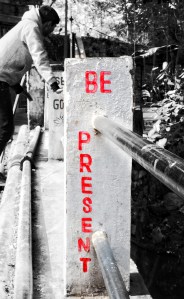
Presence

Just now I was thinking that by far the easiest of the topics we’re looking at here, is Presence. Yet at the same time it is the absolute hardest to write about – even worse to think about.

Why easy? Well, because in a very real sense there is nothing we can say about presence or the present. Of course I could spend the rest of my life reading books, studying, and even writing about it myself; how to live here and now. But all the time the obvious would be staring me in the face.

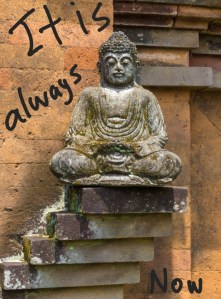
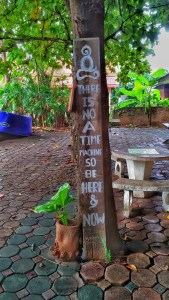
How can we be anything but present? How is it possible to be anywhere but here? And surely it’s always now? A thing called ‘the past’ doesn’t exist except in memory, and the future? Well, where is it? it doesn’t exist. Never will. I know it’s kind of common to hear things like ‘We’re living in the future’, but are we really? Of course not. So, end of story right there I guess.

Except that it’s not, is it? This is where it gets to be the hardest topic to talk about. It seems none of us – us humans anyway – can get our heads around the aforesaid obvious fact of life: we are always here, and it is always now. Why is this so?

Well, speaking only for myself, you understand, I think about it too much. I seem to have convinced myself (courtesy of my ever-busy mind) that there is a way to learn to be present; a how to guide, that I can read or invent myself that will finally allow me to put myself into the present, in the here and now.

And all Along I am sitting here, thinking and writing about how to be present or put another way, how to sit in this spot right now.Do you see where this is going? If I’m not here and it isn’t now, then where am I? And when is it?

Sorry, but I have no answers. Even asking the questions is denying the obvious: I am here, it is now. The trouble is my mind isn’t at all ever content and happy with the present, regardless of how I might feel about it.

In that case, can I say that in my way of living I am committed to presence? To be in the present? Well, speaking for me personally – whoever that me is – perhaps the better question might be: Do I fully realise that I can only be here and now because that’s all there is?

To that I would have to say definitely not. My mind is continually on the run between the deep past and the unreal and unknowable future and all points in between. And my mind loves repeat journeys too!

So how do I intend to come to that place of the realisation of presence? Well, before we go on, you can’t actually intend to be present. Intention is about …

Enough!!!! Enough mind stuff. Please

The truth is, there is nothing for me to DO. I am here; it is now. That’s all there is.

Except one more thing to do: I just have to wake up