You’re Already There.

There are many blessings that come with the living of the hermit life. And I am especially blessed as I am not a ‘hermit alone’ – I share my life, the Hermitage, and my spiritual practice with another hermit. We are partner hermits.
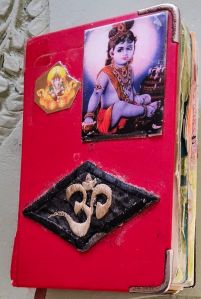
One component of that spiritual practice is our times spent together reading a few verses from the Bhagavad Gita. We pursue our own personal studies, but sometimes one or the other of us will share an especially resonant verse, or an insight or thoughts.

This morning my partner hermit told me, in a casual almost by the way manner, that she’d just read a verse that spoke about not disturbing others, and not letting ourselves be disturbed by others.

At first, I had no memory at all of this verse; I just couldn’t place it. Which might sound a little worrisome, given I’ve been studying this text for seven or eight years.

So, it wasn’t till she gave me chapter and verse and I looked it up for myself, that it finally clicked into place. Of course I knew this verse, but it had slipped from conscious memory.

And that surprised me: this verse seems to me to be speaking to a key concept in the teaching of the text as a whole, as well as to my personal aspirations. Surely, I would think, it should be, what’s the expression? Top of mind?

He [sic] who disturbs no one, and who is never perturbed by anyone, who is unattached to happiness, impatience, fear, and anxiety is dear to Me.

               Bhagavad Gita 12:15

This verse is full of meaning for me. It’s like a one-stop how to lesson in avoiding the personal suffering that’s brought about through attachments. Mind you, once again I can’t help wondering after years of study, and with how much this verse resonates for me, why I had such a hard time remembering even seeing it before.

I suspect the power of the ego and the mind have a lot to do with it. Ego – along with its master, the mind – love attachments to the world, to anything really. I guess they are always doing their best to keep me attached to my compulsions and aversions.

Imagine though, not being disturbed by anything – or anyone – and me actually not doing anything that disturbs anyone or anything?

Not just people and other living entities in my immediate physical environment, but out there in the wider world – in the Universe even.

It’s about vibes isn’t it? What vibrations am I putting out into the world? Are they vibrations and waves of love, peace, compassion, detachment, equinimity? Or at they vibes of discord, dislike, anger and sorrow over the stuff I can’t control?

And just think what it would be like if I weren’t so attached to the idea that my happiness depends on getting pleasure or ‘results’ from worldly things, activities based on the senses? Imagine really understanding that the only true and real and lasting happiness and satisfaction can only come come from within my Self?

This doesn’t mean at all that I can’t be happy, or can’t have fun or enjoyment. It is merely saying that, if I can accept whatever comes to me in life without clinging to the things I want, or running away from the things or situations I don’t want, then there will be less suffering.

Ego is jumping in now and wants me to note that, while I may in fact be on the path to detachment and freedom, I’m not far along enough yet to escape its clutches. Anyway, moving right along.

Impatience, fear, and anxiety are tricky presences in the attachment arena. I’m even less far along the path to letting go of these stubborn attachments. But, again, at least I’m on the path.

And what is that path? Where’s it going? Well (paradox alert), on the path in this instance is another way of saying I’ve not realised fully that I am already at the path’s destination. I just think I have a long way to go.
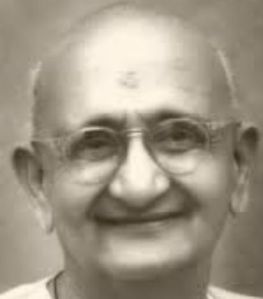
Swami Ramdas (1884-1963) Courtesy Wikipedia

I think Swami Ramdas said: ‘When you set foot upon the path, you have reached the destination.’ I think!

That’s the ‘dear to me’ bit of the verse explained. The ‘me’ in this phrase represents the aspired to full realisation that I am free, liberation or enlightenment some call it. It’s a place, or state of mind in which I move through the world with peace, calm and equilibrium, where nothing disturbs me, and I disturb no one.

That state of liberation doesn’t mean I have given up, or will have to give up, all desires for things I want, nor will I have escaped the things I have aversions to. It simply means I will no longer be driven by those desires and aversions, I will no longer be attached.

It means, too, that I will no longer be concerned in an attached way, to who says or does what to whom, when, where, why or whatever. At that stage I will be in the world, but not of it.

Of course, I am a hermit; you would think it’s easy for me being secluded from the world (well it’s not total seclusion). If only that were true.

I still have the clingings, cravings, and aversions; I’m even attached to the clingings and the aversions.

The one desire, the one I permit myself to cling to, is the desire to free from all other attachments, the attachments that cause so much suffering.
As long at I have that desire guiding my life, then I will be satisfied, when I can be, knowing that one day I will fully realise that I’m already free, unattached, liberated and happy.

There’s a song I wish I could remember the name of, or at least who sings it, but there’s a line in the lyrics that, says something like ‘I don’t want to go searching for what I already have.’ That’s me!
We are Many, Yet We are One

To ‘check the weather’ is to actively seek knowledge – news – of the world; it’s asking, what’s going on out there? Kind of an attachment, and in most cases, most of the time, I don’t seek out news of the world, but in certain circumstances it does sometimes seem necessary.

So, because it’s been raining heavily, and there have has been some minor flooding not too far from us, I checked the Bureau of Meteorology earlier this morning – I have an app on my phone.

Along with the air temperature, the measured and predicted rainfall, and other weather related details, there is list of ‘Current Severe Weather Warnings’.

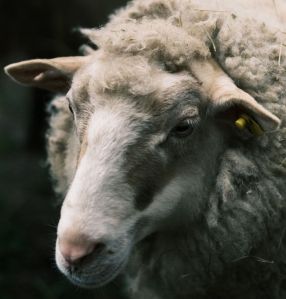
There were three listed: big surf (we’re a couple of kilometres from the coast), big winds, and a third which leapt out and grabbed me, or putting it more accurately, it reached out and grabbed my heart.

A ‘Sheep Graziers’ Warning’ it’s called. It’s purpose is to warn farmers, that due to cold temperatures, heavy rain, and high winds, there is a risk of ‘losses to lambs and sheep exposed to these conditions.’

In other words, lambs and sheep might die if left out in the weather.

That casual check of the weather has now exposed me to some of that information of the world, the news, that I usually avoid. And that news has impacted my heart, my soul.

The risk of ‘loss’ to those sheep – and lambs – is to me as devastating as it would be when any other being is at risk of suffering or death. And, obviously, I’m absolutely aware at the same level that many creatures of many and varied species – including my own – are at this moment exposed to the very same risks.

One of the thoughts that occur to me is this: The very reason for these warnings is so that farmers can take the appropriate action to protect and safeguard the creatures in their care.

Another thought: the sheep have no choice. Like the rest of us living beings they are subject to the conditions that play out in the material world. Of course we can add a little perspective to this: I am making these notes in a warm, dry and safe hermitage.

(Then, as I began to type up those notes just now, there was a very short but powerful thunder and lightning storm accompanied by very heavy hail. Once again I am warm, dry and safe.)

All beings are prisoners in a sense, to their material bodies, and, as I said, subject to suffering due to the material world. What we, as individual beings, or individual species, can do to reduce our suffering is going to always vary from individual to individual, from species to species.

I suppose what I’m getting at is that all of us – all beings – need help of one sort or another at some point, to release us or protect us from suffering.

I must admit that very often feel helpless when it comes to what I’m able to do to relieve the suffering of the world – my own, the suffering of those close to me, and that of all beings.

You know, I don’t not watch the news so I can avoid being upset or sad or angry which are often my reactions when seeing or reading news of the world. While I don’t enjoy those emotions when they come, it’s more the emotion they lead to that really bothers me: more and more feelings of helplessness.

And helplessness for me causes paralysis: whatever little I might otherwise be able to do, I cannot. For example, since checking that weather report I haven’t been able to settle to my prayers, my meditation, my chanting, and study; I am not, right now able to do any of the things I would normally do as my way of contributing to the welfare of other beings. Paralysis.

So, here I am making notes that will become a post to share with you. A story of checking the weather; of empathy with other beings; my feelings of inadequacy at not being able to relieve their suffering – as well as my own for that matter.

But, I will pray. I promise. Prayer is healing, prayer banishes helplessness.

Those sheep – as well as all other beings – and I are not separate; I am them and they are me. We are the One.

You’re the Voice, Try and Understand It

One of the things I like about one of our local coffee shops is that they play a nice wide selection of music. Mostly popular songs from pretty much every decade back to the ’60s. I think they have one of those looping playlists you hear sometimes in shops and cafés.

It must be quite a long list because you don’t necessarily hear the same songs repeated at every visit. Which is a nice thing too.

Anyway, yesterday the chorus of a song I heard played got stuck in my head. The song, You’re the Voice, was a hit around the world in 1986 when it was released by Australian singer John Farnham.

It’s essentially a protest song reminding us that we all have a voice, and encouraging us to use our voices to stand up against corruption and war. One of the co-writers Chris Thompson missed out on going to an anti-nuclear protest because he slept late. He felt so badly about sleeping in that he wrote the lyrics reminding us about taking personal responsibility and making our voices heard.

Okay, back to the chorus getting stuck in my head.

You’re the voice, try and understand it
Make a noise and make it clear Oh woah.
We’re not gonna sit in silence
We’re not gonna live in fear Oh woah

You see? It’s very catchy, and an excellent piece of advice too. And, for a hermit monk, it’s actually advice I could and do aspire to live by. Just not quite in the sense the song intends perhaps.

This morning, when my partner hermit suggested we just sit in silence for a while, I spontaneously started singing the chorus, though a slightly modified version:

We’re just gonna sit in silence
We’re not gonna live with fear.

Then, as I sat in said silence, I got to thinking about the words of the chorus.  Nobody wants to live in fear, yet it is an aspect of the human condition and something so many people live with constantly all over the world. All through human history as well.

The message of the song reminds us all that we have a voice which we can use to help create a state of affairs in which we don’t have to live in quite so much fear, fear that’s coming at us from so many sources.

For me, this is a vital, fundamental, and absolutely essential principle. Without those who do stand up, those who do use their voices to try to right wrongs, then, well I can’t think of what that might mean.

Yet, for me, I’ve chosen silence. Not only chosen I must admit: temperament, my own nature, health, all are factors that have made silence the best course for me to take. Silence as in seclusion from the world, minimizing outside imput, and reducing as much as possible the attachment to the world and its things and fears.

And this way of living ironically allows me to use my voice in my own ways to address the Truth as I see it; to help effect change and contribute to the healing so sorely needed.

Being ‘out there’ and engaged with worldly things and activities and interacting with people constantly causes me so much anxiety that it threatens my health and ability to act in the world.

There is also the personal choice aspect, common to so many who live a contemplative life. Silence – when I can actually achieve such a state – gives me the energy and clarity to write; it gives me the mental, emotional and spiritual ‘space’ and energy to pray, to contemplate, and to foster the ‘good vibrations’ I feel are also necessary to turn the world towards peace, healing, and truth, as well as to assist in maintaining the wellbeing of all life.

The world, and all of life, needs both those who can’t or won’t be silent (I’m definitely not suggesting the world needs more noise). We all need people who can and do raise their voices against war, poverty, corruption, and all the ills that plague us.

And it needs those who are able to ‘just sit in silence’. The work to be done is the same; the outcomes perused are the same; and in essence the means themselves aren’t all that different either. Silence as mentioned can include the use of our voices in ‘quiet’ ways, in ways that don’t have to relate so directly the affairs of the world.

It really is a symbiosis: Those of us living secluded and contemplative lives with our prayers, our witness, our creative endeavours, support those active and vocal ones out there trying to heal the world.

And at the same time those out there in the world support the secluded and contemplative ones. Their efforts and hard work, and simply knowing they are there, are encouraging and nurturing for the secluded and contemplative ones.

We are One after all.
Yet our voices are all unique, each and every one.
That’s what I understand to be true.

What Will Please You Lord? A Prayer Contemplated

Namaste my friends

In my last post I reflected upon the meaning for me personally of a Bhagavad Gita verse that had particularly struck me as I carried on with my renewed inspiration to read the text from the beginning.

Today, I didn’t even get to the place where my reading left off yesterday. Before reading I like to pray some or all the prayers I have pasted in the front (and the back now). As I was deep into this practice, one prayer in particular stopped me, just as with that verse yesterday.

This one seemed to speak to me, asking ‘What do I mean to you?’ So, I made a mental note (always a risky proposition with me), and carried on with my prayers, determined to take time later to think about that prayer, and try to answer its question. So, here I am, later in the day, making these notes.

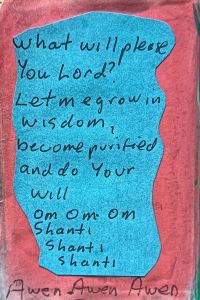
The prayer itself I am fairly sure comes from Thomas Merton, monk, mystic, and writer. Not completely sure, but I know that whoever composed it was one clearly inclined towards living the life of the mystic.

What will please you Lord?
Let me grow in wisdom,
become purified,
and do your will.

For whoever composed this prayer, it is an expression of a genuine longing. I can say that for me it is a deep plea, expresses my own longing. Each time I recite it, in fact, I can say that, although this is the first time I’ve addressed the big what does it mean question, I do sense the longing and grasp the meanings of the various words and ideas in the prayer. Actually, now I think about it, I do say this prayer or parts thereof in one form or another very often.

What will please you Lord?

When I begin to pray these words, what I feel I am actually doing is asking the Universe, the Divine, Self, God – the I AM – how can I live my life so that it is attuned to the natural order and flow of the Universe.

I am asking, what do I need to do to let go of attachments to worldly things which arise from material desires? How do I find the grace to accept when things aren’t going completely my way?

In other words, I’m asking how can i live a good, truthful, happy life in harmony with all other beings and with the Universe.

Let me grow in wisdom

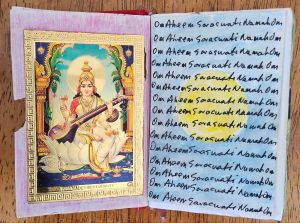
Another of my prayer pages. This one devoted to Maa Saraswati, goddess of, among other things, wisdom

A good place to start, a great first step. But, again I have to ask myself, what does growing in wisdom mean to me?

To me wisdom is not merely knowledge. Though, having said that wisdom needs to rest on a firm foundation of knowledge, otherwise what’s there to be ‘wise’ about?

I’m not talking about worldly knowledge here, though obviously it takes some degree of knowledge for any of us to live in the world. Also it’s relevant to the next part of our prayer; we’ll see that soon.

I’m referring instead to a special kind of knowledge that will (I pray) lead me somewhere closer to acquiring some degree of wisdom – one day.

Self-knowledge is what I’m getting at. And I go about my attempt to obtain self-knowledge in a couple of different ways. I study, sacred texts like the Bhagavad Gita, as well as the words of those wiser than me (which is rather a large selection of people I can tell you) both living and historical.

I meditate (not nearly enough!) as a way to enquire into my own ‘real’ or true nature: who am I? what am I? Just digging deep within to reach some realisation of the answers to those questions.

When I have answered those questions, I will understand that I have reached a true level of self-knowledge. I sense that, at least being on the path to that realisation, I would never be able to develop any level of wisdom.

Mind you, I do feel that all humans are born with some degree of wisdom potential ‘built in’ so to say. As for me, I don’t feel especially wise just yet.

Become purified

For me, becoming purified goes hand in hand with the cultivation of wisdom. In fact I would say that in the very efforts to become purified, it might be possible for me to develop some wisdom as a result of those efforts.

So, here we go again: What does it mean? To become purified? For me it means living a Dharmic life. By Dharmic I mean a life steered and driven by Truth, Right Living, Right Speech, Right Conduct , Right … The Buddha taught The Noble Eightfold Path. That is in my opinion the very best, topmost, pinnacle of self directed means to living a Dharmic or purified life.

The Eightfold Path is not a set of dogmas, rules, or anything like a list of commandments or instructions . The eight steps are merely signposts, a roadmap, pointers for me to follow in order to purify my life, live a Dharmic life. No behaviours are prescribed: it’s entirely my choice what forms my behaviour, actions, and the rest take.

Obviously the path to becoming purified is a life-long one, though some would say that many lifetimes are required. Personally, I can’t even hint that I might be anywhere near close; some days I feel further away than ever.

But, as I work towards ‘growing in wisdom, with the help of my becoming purified path, I pray that some day I might actually learn what I call proper discernment.

This discernment is the ability to act in the world and to react to the joys and sorrows that are inevitable, with compassion, love, and wisdom. To face those inevitabilities with calm and equanimity. Acting with proper discernment will mean that I am living in Truth.

… and do your will

As I reread the words I’ve just written, I realise that, by the time I reach the state described in that last paragraph, I will have succeeded in ‘doing your will.
I will have aligned my self perfectly with the order of the Universe. I will know my place as a tiny fragment of that very order.

If I’m honest however, I have to say that I think it’s going to be a very very long time before such a state come to pass. So, what to do in the meantime?

Well, along with my attempts to live Dharmically, and to cultivate wisdom, I have committed myself to a life of devotion. Devotion, prayer, contemplation.

Devotion to what? To whom?

To the Universe, Divinity, God; all that is represented by all those names we humans have put on the Absolute Reality, that is all there is.

Everything. And everybody, is what I’m saying. There really is no separation except a kind of superficial one we allow ourselves to imagine by applying so many names and forms to the material objects, things and so on, that appear to us as separate one from another, whereas there is in fact only one, without a second.

That’s where the contemplation comes in. It’s a going within, inward to what we imagine is a kind of ‘space’ where all merges into one, the one that is all there is.

I think that’s what ‘pleases the Lord’. While I am indescribably, gravely, deficient at all the steps described above, one course I know to be right for me is to continue to engage with those steps, and to devote myself and my life to the Divine, to the Truth.

That’s what pleases me. I pray that it pleases the Lord.

My take on Dharma, Karma, & Living a Good Life Part 2

The inclination to seek knowledge is, for me, a gift, a blessing. And we live in a time when there are so many sources, so many resources available, and many are freely available too. There seems to be no limit to what the genuine seeker of knowledge can uncover.

Yes, of course, we’re swamped with information from all sides. We are deceived by fake news. And everything these days is a commodity, a thing to be bought, sold, acquired, or otherwise used for profit in the material world.

All true. However, this is where one’s discernment comes into play. It’s up to each of us as seekers of knowledge (on whatever topic or subject) to discern for ourselves the truth or otherwise of the information we use to form the knowledge we are seeking.

In my last post, I began to talk about two notes that I made in my notebook. These notes were quickly jotted down while seeking knowledge from two different sources about two distinct topics. Feel free to have a look at that post here if you happened to miss it.

Do your duty
Follow Dharma
Live a righteous life

These three lines are the sum of what remains of a session with my teacher, Swami Tadatmananda. It’s his short, succinct summary of the teachings I was trying to absorb from him that day.

You’ve probably guessed I am not a great note-taker; I like to just let sink in what wants to sink in, absorb what resonates for me. Perhaps on that day, I felt the summary was all I needed as a basis for later contemplation.

With that in mind, I would like, in this post, to reflect on these three injunctions, try to work out how I’m doing when it comes to taking notice of them, and actually where I’m at with actually living by them.

Do Your Duty

What does it mean, ‘Do your duty’? And what does it mean, for me, to do my duty?

Firstly, let me try to define duty. Not from the dictionary meaning, not from some outside ‘authority’. No, this is me talking about how I define duty.

Duty, for me, is defined by the activities I choose to prioritize in my life. These are the things that I believe best serve my true, essential nature. Acting in accordance with this true nature includes responsibilities such as taking care of my physical, emotional, and mental health. While this may not always be easy and sometimes feels impossible, it is my duty because my mind and body are manifestations of my true self, of the divinity.

Duty, again for me, means persuing activites – in the world as well as within myself – that nurture, protect, and grow, who or what I percieve that Self to be.

This Self I refer to is not restricted to the apparently separate entity I call ‘me’. That apparent separation is just that, an appearance: Self is all there is; I am not simply bonded or joined with all other living (and non-living) beings: I am those beings, just as they are me.

As such, my duty is to act in ways that benefit (or at the very least do as little harm as possible to) all beings, all life. Here, I guess, we could talk about Karma. But let’s leave that for now. It’s enough to say that nobody can tell me – or you – what is our duty. In fact, the truth is I already know the full extent of my duty, as we all do.

The only thing lacking for me is what I might call a full disclosure of what that duty is. That full disclosure can only come from me – as in the Self. As they say, I might know in my head what my duty is, but I’ve yet to fully realise it in my heart. And if I’m honest with myself I can say that my aspiration to do my duty is a constant reminder and motivation to do always the best I can to fulfill my duty.

In some areas I think I do my duty pretty well, but in others I have a long way to go.

Courtesy of @travellinghermit3

In my next post (and the final one in this series: there just seems to be such a lot to think about when contemplating this topic), I will look at what it is to follow Dharma. Once again, it’ll be a very personal, subjctive answer because, to put it perhaps too simply, I like to think that I know right from wrong.

I hope this post has been of at least a little interest and value to you. I will look forward to seeing you here for my next post.

Thank you and I wish you peace.

Right Understanding:First Step on The Eightfold Path

In my last post, I reflected upon a lovely Buddhist mantra, an invocation for peace and happiness for all beings (Lokah Samastah Sukhino). We discovered along the way, that it is no ordinary mantra: it actually amounts to a solemn promise to contribute to the peace and happiness of others (and Self obviously).

Then we thought about how to actually go about acting on this promise: Be kind. That’s what I came to. That’s all that is required. But, as you will recall, being kind sounds easy but quite often isn’t. The Buddha himself came to our rescue with  The Eightfold Path,

At the end of that last post, I declared I would devote this next one to looking at Right Understanding, the first of the principles in The Eightfold Path. I said I would just sit at the keyboard and see what emerges as I thought about what is Right Understanding.

Before we get started, let me make the point that The Eightfold Path is not a kind of ‘to do’ list where you tick off one item and move onto the next. The Path is more about integrating the principles into our lives, letting them overlap when they do and moving forward in one area, while (possibly) moving backwards in another as our lives unfold with all the usual twists and turns.

The Eightfold Path is a life-long (some would say lives-long) process; don’t think in terms of goals to be achieved.

Does this mean we will need to explore all eight principles on the Path? Well, we’ll have to see how this evolves over time. Although as I say it’s not a to-do list, I think it more than possible to at least think about the principles or steps on the Path one at a time.

The second thing to say by way of introduction is this: As I mentioned in my previous post, there are virtually unlimited places on the internet where one can source The Buddha’s Teachings, including many commentaries on The Eightfold Path.

I’ve made no use of any of these sources. I have sought only to put down some of my own ideas and learnings, as well as just letting my heart have its say.

If in that process I’ve made any errors of any kind, forgive me. I merely follow The Buddha’s own instruction: Don’t take my word for it; Ask questions; Do your own analysis; Think for yourself.

Now that’s all out of the way, let’s just describe briefly the Four Noble Truths. This is necessary because the injunction to follow The Eightfold Path, comes in the Fourth of those Noble Truths.

Putting them as succinctly as I can, The Four Noble Truths are as follows: The first truth tells us that life is suffering, the second that the cause of suffering is desire (or we can also say attachment), the third that there is a cure for suffering and the fourth tells us what that cure is.

That’s where The Eightfold Path comes in: it’s what you might call The Buddha’s prescription for the alleviation of suffering. At this point I would like to suggest that if you are not familiar with the Four Noble Truths, please take some time to check out the topic for yourself.

The Eightfold Path does, as I mentioned last time, in fact sound very easy when put it in list form like this:

  1. Right understanding
  2. Right thought
  3. Right speech
  4. Right action
  5. Right livelihood
  6. Right effort
  7. Right mindfulness
  8. Right concentration

Remember, though, as I said, it’s not a to-do list we can work through one item at a time. Or perhaps we can put it another way: It is possible to work on one item at a time, but it’s not about getting that one completed before one can move on to the next item on the list.

The first step on this Noble Path we have embarked upon is Right Understanding. Actually it’s not only the first, it is the ongoing one; and it is the final step also on this particular Path of Liberation. And it seems to me that I’m right in this: my life has been one continual search for undetstanding.

Not many people know this, but I spent some time working as a journalist. One of the fundamental principles (aside from telling the truth of course) that I followed was the, Who? What? When? Where? Why? and How? set of questions.

Now, I wouldn’t say that it was necessary to ask every one of these questions in every situation. But, as a general rule, they served as a useful guideline to getting as much information on all relevant aspects of an event, a person, or whatever the subject of a story was. And I have to say that I find myself quite often using this list or some varient of it when I’m trying to understand or figure out something.

Why those questions? Where do they lead? What am I trying to do by asking them? How do they help me? (See what I mean? I can’t help myself) If we sum it up, then we would say that asking the WWWWWandH questions have the potential to lead us closer to understanding.

Let’s say you are unhappy with the work you do on a daily basis. You don’t understand why; After all, it pays okay; the hours aren’t too onerous, the work itself is fairly easy as work goes. What’s the problem then? You just don’t understand. You know there’s something not quite right, but you just can’t put your finger on it.

Who is doing that job? I am, you say. But, really, who are you? Is it you doing the job or just a part of you that you kind of section off from the real you for the working day?

What are you doing that makes you unhappy? Is it being in that workplace? Is it the work itself? It might be ‘okay as far as work goes’, but is it really okay?

When are you at that job? I guess this question is about how many hours, what percentage of your life you spend doing that job. And, even more to the point of the when question: When are you really there? How much of your work day are you actually off somewhere else? (refer to the where question)

Where are you? Are you where you want to be? And, kind of getting back to the Who question, who is it that’s there? Is it the real you? Or is it that sectioned off bit of yourself you access during work hours while the real you is off somewhere else?

Why are you doing that job/work? Well most likely your answer will be something like: I have rent to pay, food to buy, bills to pay, family to support. Well, those answers have to do with what you do with the money you earn from doing that job. The question lingers: Why are doing that job? I mean, the real you; why?

How can you be happier at your work? By now you’ve got the hang of this. If you have answered all the W questions then you will already be getting some clues about the answer to the H question.

Asking variations of this set of W and H questions can help us in many aspects of life where we seek understanding. They don’t have to be put as formal questions, and they don’t have to all be asked in every situation. Also they don’t have to be thought based queries either, if you know what I mean.

The answers may well come by simply asking the question, and ‘sleeping on it’. By that I mean you don’t have to tirelessly mull over a question. Meditate on it, think about it, of course, but then forget it consciously and let the answer come to you. And, of course you can always literally sleep on it.

There’s a small art gallery in a desert mining down almost in the heart of Australia. On their window they used to have a quote by  Claude Monet:

I know we aren’t talking about art here (or maybe we are?), but I think this quote applies to many of us as we try to understand our lives and our place in the world. Especially when it comes to what makes us happy. All of us spend a lot of time, not so much pretending as in going through the motions. That’s because sometimes it’s just too hard to try and understand.

But, keep at it. Ask the questions but don’t worry about the answers: they will emerge when they’re ready. True understanding is close to love, as Monet says.

Peace to you from me

May All Beings be Happy & Free

Lokah Samastah Sukhino

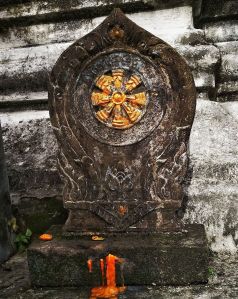
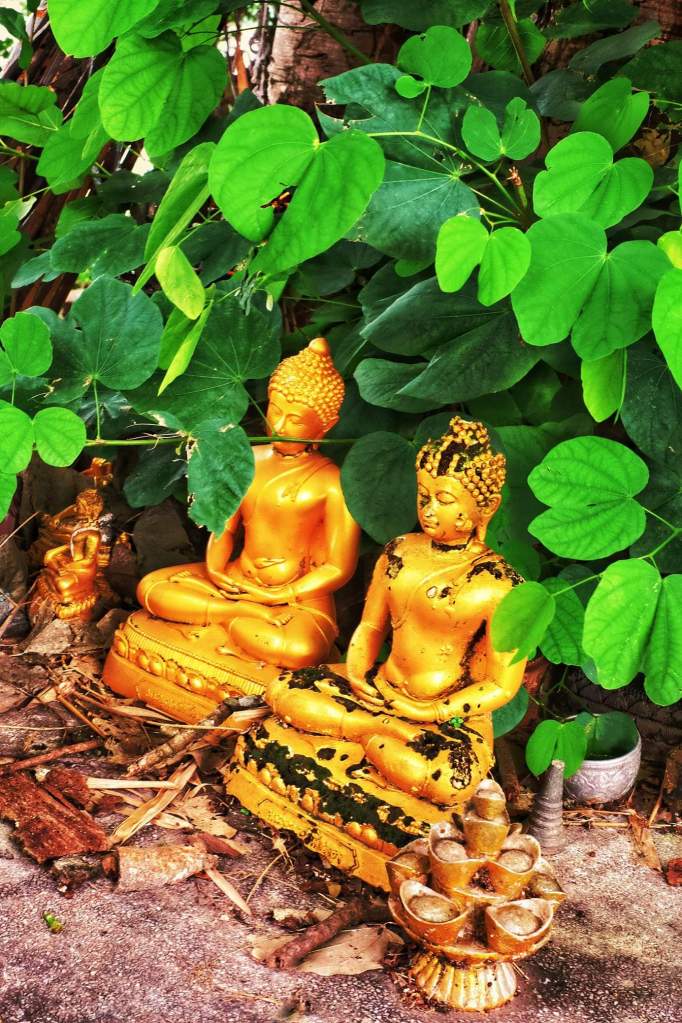
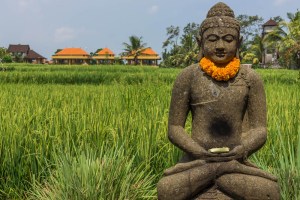
There is a little shrine at the foot of a huge and ancient tree, outside a Buddhist temple above the banks of the Mekong River in a little town called Chiang Khong in the far north of Thailand. As I looked at this obviously highly revered sacred site, through the viewfinder of my camera, I knew what I would call the photo:

Lokah Samastah Sukhino

Now, I already knew that this translates to: May all beings everywhere be happy and free. A friend of my son’s used to use this ancient Sanskrit mantra a lot and I’d long since discovered its meaning. Or so I thought.

Anyway, later as I readied this (what turned out to be quite a lovely image in my ever so humble opinion) I thought I would look up the mantra again. Just to make sure I had the right spelling and so on.

It was then I had a surprise. May all beings everywhere be happy and free is only the first part of this beautifully expressive mantra. I quickly discovered that this mantra is not simply some vague wish or prayer for universal peace and happiness; it is also a call to action. Here’s the complete translation as I found it:

May all beings everywhere be happy and free, and may the thoughts, words, and actions of my own life contribute in some way to that happiness and to that freedom for all.

But, wait. There’s more.

As I read more deeply into the meaning of all the words in the mantra, I discovered that it’s more than a call to action or a simple invocation. I learned that the mantra as I knew it was missing a final word: Bhavantu. So with this word missing, a vital element of the mantra was lost: the use of the suffix antu at the very end in the original Sanskrit turns the whole thing into a solemn promise. Antu means it must be so.

This all got me thinking: How? I mean, how do we transform our ‘thoughts, words, and actions’ so that they will contribute to the happiness of all beings? And how can we actually make it a promise?

Then it suddenly occurred to me: the action required was summarised very nicely by the Buddha in what he called The Eightfold Path. We are meant to start living according to the principles in that teaching.

Now, The Eightfold Path is, on the face of it, a fairly straightforward set of life principles that, when understood and integrated into one’s life and being, will lead to the cessation of suffering.

Now, this sounds all very well and good, but I’ve been wondering if there was a way I could sum it up in just a few words.

Something succinct, and to the point.

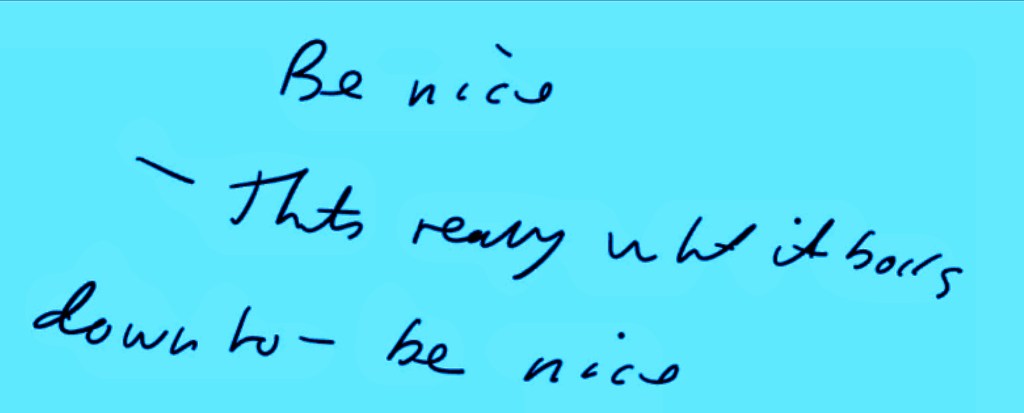
Then I found myself (again suddenly, right out of the blue) scribbling a note on my phone:

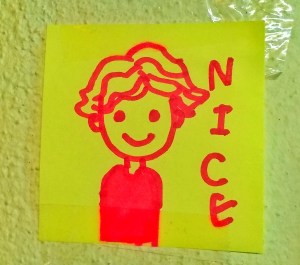
Be nice.

That’s really what it boils down to

Kindness in all our intereractions with all the forms that life has taken: other humans; other animals; plants; Earth herself; the rivers; the oceans; the forests. You name it. All forms that life has taken.

So, how do we be nice?

When I say it like that, it almost sounds silly; I mean, how hard can it be? Be nice? Easy.

Well, I guess I can say for myself that it’s true, sort of, sometimes. Yes it is often extremely easy for me to be nice. And, then, other times I have to try to be nice. And then there are those times when try as I might, nice just doesn’t happen.

Which means, I guess, that it might not be quite that simple after all.

There are so many wonderful explanations of the Buddha’s teachings, including The Eightfold Path, on the Internet. On the face of it, that might seem confusing. However Buddha himself advised that each person should question the teachings and come to their own conclusions. In other words, he said, don’t take my word for it, check it out for yourself.

The Eightfold Path. I might know that lovely list by name (Right Understanding, Right Thought, Right Speech, and so on), and I’ve read a little about them, but maybe it’s time to dig a bit deeper.

I’m going to make a start with Right Understanding simply because it’s the first on the list, and has always seemed to be a pretty important starting point.

So, next post (or perhaps a later one) that’s what I’m going to do. Just sit and see what comes out of my heart and onto the page (or screen). Please join me then and we’ll see what happens.
Peace and love from me to you