Slowly & Mindfully: A Reminder

Among the physical exercises I try to perform on a daily basis, are a couple for strengthening the hips. One of these begins with me standing upright, feet together, eyes level, looking ahead.

Then I swing one leg at a time for ten repetitions in a kind of arc like motion out to side, keeping it level with the side of my body, bringing the leg back to the rest position with feet together. It’s a pendulum motion.

Anyway I’d been merrily going along doing these exercises more or less every day for ages, months really, until one day my partner hermit was watching me, and said:

‘You’re supposed to be doing it slowly and mindfully’. Or words to that effect.

You see I had been quite happy swinging each leg out in turn at a fast pace, kind of like an aerobic sort of thing. Just to get it done if I’m honest. Wrong! Supposed to be slowly and mindfully.

Lift one leg slowly in an arc like motion out to the side of the body. Pay attention to the movement as it’s happening; no need to push the leg out, just lift it to a comfortable position. Just let the arm trail loosely and of its own accord, along with the leg. Then, again slowly and paying attention to the process of the movement, bring the leg back.

And I do have to say there’s been an amazing difference. I can actually feel the muscles working during the exercise, and can sense the minute incremental motion as the leg swings slowly. It’s a way better exercise than it was, and now I wouldn’t do it any other way.
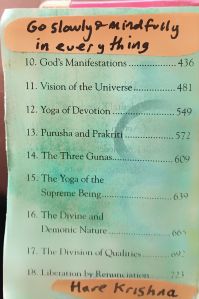
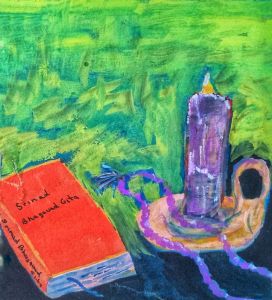
I was reminded of this incident this morning as I came across a short admonition, a little reminder to myself I have stuck on a Table of Contents page in my Bhagavad Gita.

Go slowly and mindfully in everything

What’s interesting is that, despite seeing and reading this so-called reminder more or less every day, and despite proofs of the benefits of actually listening to the reminder, such as what I’ve just described with the exercise , the reminder seems to mostly go right over my head, in one ear and out the other as they say.

Today, for some mysterious reason, it actually got my attention. At the same time, again who knows why, it triggered a truly relevant and appropriate memory to act as a kind of metaphor to illustrate the point to me.

I suppose it’s stating the obvious, but I can say that doing that (or any) exercise slowly and mindfully – in a watchful and observant manner – acts as an exercise in presence. Otherwise I’d not be sensing or feeling the muscles and the movement, or the peace of no random thoughts.
Did I mention that, having corrected my modus operandi with that particular exercise , I’m feeling the benefits? It definitely feels like things with legs and hips are loosening up, getting stronger. I’m actually walking further now without my legs aching on me.

More than that, I actually find myself wanting to do the exercise as opposed to ‘wanting to get it done’. Why is this? Well, I think it’s because I’m yearning to rediscover that feeling of presence; it’s a bit like a meditation, and in the same way clears the mind of random thoughts – at least for the short duration of the exercise. Having said that, even a short duration clarity plays its part in reconditioning a stubborn mind.

So, mental clarity, good exercise for the body, for the heart, even the soul?I think it’s the perfect metaphor for how I aspire to be living my life.

Slowly and mindfully.

Note to Self: Have a Little Faith Will Ya?

As a hermit, I am a pilgrim, dependent on a pure faith that I am exactly where God would have me be. I am here, and it is now.

I forget in which of his books I read this, but it’s a prayer written by Thomas Merton shortly after he’d finally moved into his hermitage full time. The ‘I am here, and it is now’ I added, though of course it’s also borrowed.

It’s a prayer, an affirmation, I recite at least once a day. And, like Merton, I aspire to that ‘pure faith’. Faith is a strange thing: it may grow and develop and then it does indeed support me in my intentions and living, not to mention the comfort it provides..

But, all of a sudden it can just flow away, leaving me adrift, bereft, and not sure of anything.

I am a pilgrim, it’s true. But as Bhajan (a bhajan is a sacred song, a hymn) singer Krishna Das sings:

I am a pilgrim/the road’s so long.

And sometimes it seems a lot longer than this particular pilgrim would like. Still, as they say, how long’s a piece of string? And it’s rougher than I’d like as well. but again how rough is rough? Layers of meaning in that word longer.

Yes, I am a  hermit, and my mind’s not the same, as Jackson VanHorn sings. Same as what? Whose mind is mine different from? Is my mind somehow not that same as it once was? True though: my mind is hardly ever the same.Here’s the whole chorus as it spoke to me:

Yes I am a hermit
My mind is not the same
Yes I am a hermit and ecstacy’s
my game.

For this hermit, ecstacy is not a stage experienced all that often. Mind you, there are fleeting moments, but like the pilgrim road, there are long distances to be trod between one of those moments and the next.

And as for Tim Moore claiming he’s

‘… sittin’ peacefully on Hermit Rock’?

Well, yes the rock – the hermitage – has much potential for peacefulness; a peace expereienced quite often actually. It’s a sacred space

But, as in any way of living, any way of being, peace comes and peace goes. And when it goes, it can seem like it never existed, and that ‘sittin’ peacefully’ is, and always will be a fantasy never to be realised or made real.

It’s about equinimity 

That’s something else I heard today. Well, there’s not a lot of equinimity in this hermit pilgrim today. Seems, then, that there needs to be some shifting of perspective; some peace needs to be restored

My Lord Ishvara

Deep withn the still centre of my being

May I find peace.

Silently withing the quiet of the grove

May I share peace.

Gently and powerfully in the wider circle of humankind

May I radiate peace.

Om Tat Sat

Om Shanti Shanti Shanti

Afterword:

A few hours have passed since I made these notes; I have regained a little balance, but still thought it was important to publish this post.

Thank you for your patience

Love and peace

Paul the hermit

A Gift Came to Me in an Email

Even a Leaf

A couple of days ago I recieved a beautiful gift in an email. I often receive wonderful things through the email, and this one, as with so many of the others, has profound meaning for me.

Not only that, but this gift has served as a reminder to me of that significance. I’d like to share with you that gift, as well as some thoughts on its importance and meaning to me.

There are a multitude of sources online where you can learn all the technical stuff, word meanings, history, origin, when it’s used and all the rest. I would like, however, to just ‘think out loud’ in my own words, and follow my own heart’s promptings.

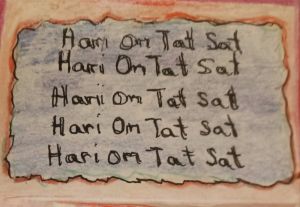
Hari Om Tat Sat, is actually two mantras in one: Hari Om, and Om Tat Sat.

Hari Om represents the totality of what we might call God. Hari refers to the manifested cosmos, as well as the creative impulse in its manifest form. I call that Ishvara, but it doesn’t have a name I’m sure!

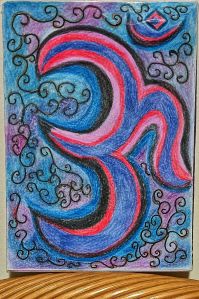
Om, is the unmanifested universal consciousness, the Absolute Reality. Meaning, as I understand it, existence itself. I call it Brahman, or God, but again, names are just labels we humans apply to things to make it all seem so neat and tidy!

They say that Om Tat Sat is the most sacred of mantras (in Hinduism). It’s used at the completion of prayers and rituals as a way of invoking the presence of the divine and ‘bringing it all together’ you might say. Well not so much bringing, more like a reminder that everything is one already.

I really like the chanting of Hari Om Tat Sat. It’s a centering practice I would say, a way to remember the oneness of all. And I say it, as the traditionalists do, as a closing to prayers or other practice; it’s like ‘Amen’ or ‘It is so’ or ‘Let it be so’ or, well it’s endless – and personal and subjective.

As mentioned, Om means Brahman – or God in the unmanifested state; Tat, not only sounds like that but does in fact mean all that is. In other words, Brahman or the Absolute. Sat means Truth, Absolute Truth or, once again Brahman.

For me it is a little prayer of its own actually. And I’ve heard it used as a greeting many times. It’s a means I think of honouring the divine within the one being greeted, while at the same time I have a sense that it is a recognition, or acknowledgement rather, of the oneness, the unity of the greeter and the greeted along with everything else.
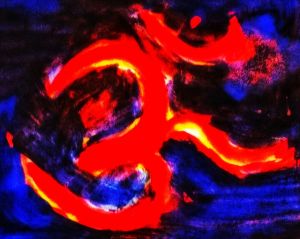
This is why I don’t really feel the need to break the mantra down to explain in technical detail all the constituent syllables (even I were qualified to do so, which I most surely am not).

It really is a way to acknowledge the oneness of all, the Absolute, which includes, obviously, me and you. The Truth is absolute, it says, so must we be, absolute.

Hari Om!
Om Tat Sat

A Lesson in Humility

Opening my Bhagavad Gita this morning for my daily reading, I noticed that I was about to begin a new chapter. I always like when that happens, but this post isn’t about that; it’s inspired by a small scrap of paper glued on the facing page.

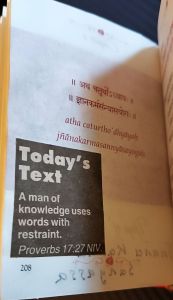
In years long gone, a less minimalist me would collect bits and pieces cut from newspapers, magazines or wherever (no Internet in those days). This particular strip of paper was cut from a newspaper (makes me shudder a bit to think how I would devour newspapers every day if I could. Shudder in horror) and has the title Today’s Text. It was a daily quote, usually a verse, from the Bible, and I’d often cut out those that appealed to me. As this one obviously did.

No longer collecting such bits and pieces, this one somehow survived the now ancient culling of excess material stuff, and has ended up in my Bhagavad Gita. Don’t ask me how or when.

Anyway, before I get off track, or too far down the track, here’s the quote we’re talking about

A man of knowledge uses words with restraint.
    Proverbs 17:37

I paused when I read this. As you probably are already guessing, I just had to write it down and added some notes of my own before getting on with my Bhagavad Gita reading.

What comes next is essentially what those full of first thought notes said, plus a little context setting to begin with.

In addition to the Bhagavad Gita, I am also reading, bit by bit, another sacred text. A couple of times (including today) I’ve been frustrated at having to plough through a page and a half (for example) of a description of a concept or idea that I’ve thought could have been said in no more than a couple of sentences.

Is he, the author, a person of knowledge? He most certainly is. He has wisdom too. He was a respected teacher and scholar. Some, many, say he was a saint.

So, perhaps it’s me demonstrating my own lack of knowledge here. Perhaps it is me, also lacking in wisdom, who is using words without restraint. Just because my opinion proposed using fewer words, does not mean by any means that they are better words.

Perhaps it’s me in error: passing judgement on an author I consider knowledgeable and wise, and who is certainly more than intimate with the topics he’s commenting on.

So, allow me to put another perhaps into this mix: Perhaps if such a person takes one and a half pages to describe an idea, then it might just mean that I am in need of more knowledge than I think I have. Surely I am missing something.

At the very least I am being prompted to reread the sections in question, that I was so hasty to dismiss as too wordy. Perhaps (what is it with this word today? Have to nominate it word of the day – perhaps) there is something for me to actually learn before letting my mind run away with critical thoughts based on quick and ill-informed judgements.

To Sleep or To Not Sleep?

One of the stories I’ve been telling myself for pretty much as long as I can remember, is that my life has been impacted, influenced, directed, controlled, by depression and fatigue. As with all stories, there are elements of fact, fiction, fantasy, real life experience, truth, and the not so true in this one.

Anyway, with the fatigue factor in mind, I’ve recently made an intention (I call it a sankalpa) to lie down for an hour or two every day whether I ‘felt like’ it or not. The idea was that a daily break would be like a catch up, a preemptive measure if you like. Even if I didn’t sleep, it’d be an opportunity to just be still, listen to nice music, relax for a while, a quiet time.

Today, just after breakfast, and getting deeply into my spiritual practice, I suddenly experienced an epiphany. Or to be a little less grandiose about it, I had a little insight which has lead to me to make these notes.

Despite that feeling of exhaustion, and despite the previously mentioned intention to rest more, I resisted going to lie down, thinking I can lie down later in the day.

Why? Surely a person who thinks their life has been ruled by depression and fatigue, would welcome any pretext to lie down, to sleep, to shut the world out for a while.

And, then comes the insight: All of a sudden I realised why I was resisting taking rest: Well, the fact was that I didn’t want to sleep because, well, I’d be asleep. I’d not be able to continue my practice, read, write, to ‘live now’. Putting it another way, I simply wanted to keep on keeping on doing exactly what I was doing.

But wait, I hear you asking: how can you fully live now when you’re so tired?

Excellent question; the exact question in fact that I asked myself. The answer I got from Self was interesting: fatigue as a symptom and outcome of depression is one thing; fatigue resulting from living a full life with enthusiasm (sort of sometimes) is quite a different thing.

Actually, now I think about it, there’s another little insight making its way to the surface of this over-active, over-full mind: The very fact that I thought I had living to do now is a very clear signal that, for at least the moment, depression is not dragging me around, or down, or anywhere else.

Just that concept of wanting to be awake to live this moment? Well, isn’t that a joyful thing? But what about being so tired? Should I go and lie down now anyway?

Ummm… Actually I don’t know; I can’t say really. So, I think I will just keep on doing what I was doing when I began these notes.

Which was chanting the names of God.

Hare Krishna Hare Krishna Krishna Krishna Hare Hare
Hare Rama Hare Rama Rama Rama Hare Hare.

Now that should wake me up for a bit.

PS It’s a bit later in the day, and I’m typing up the notes as a post for the blog. I did in fact carry on chanting for a while, I’ve had lunch, and I think after I post this, I might go for a walk around the neighbourhood. And no, I haven’t had to lie down yet.

Maybe later!

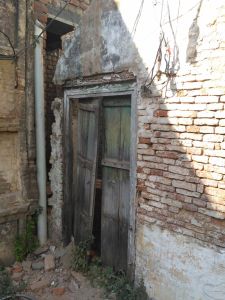
A Story of a Door

The walk from the Hermitage to the coffee shop at the Village Green takes around five minutes or so. This morning, noticing a pause in the rain, we thought we might take the opportunity to get some fresh air and a walk, at the end of which there would be coffee. So, we stepped bravely forward, with the faith that the gods of the rain were indeed taking a break.

‘Look over there, ‘ said my partner hermit as we passed through the centre of the village. ‘There’s a door that can only be opened from the inside.’

‘I’ve never noticed that before,’ I replied, looking across the street to a wall into which was set a door with no visible handles or lock. The only things that suggested that it was in fact a door were the hinges on one side, as well as its size and shape.

Now don’t ask me how many times I’d passed that spot. Most likely dozens of times, on both sides of the road. Still, now that I had been shown it, I was intrigued. Mentally I was captured: I thought, what a wonderful thing: the one or ones on the other side of the door have complete control over who or what is allowed to enter.

With such a door, one that only opens from your side, you could easily choose to rarely – or even never – open it. Ah, peace at last went my thoughts.

But, right away, those thoughts were dismissed, sent packing: too simplistic, too extreme, to heavy a response. Though, you know, I do feel strongly that such a response to the world – shutting it all out completely – is perfectly understandable, completely reasonable, and oftentimes even an absolute necessity .

Still, I had that feeling towards my reactive thoughts of ‘too extreme’ (inner editor’s note: he has no idea what he’s saying does he? If you ask me, right this minute he will be thinking his initial reaction was spot on and he’d love to have a door like that. Anyway, we’ll let him have it his way).

Some further, more careful thought is required here I think. For a start, here’s a question: If I were to keep the door shut all the time, how would I ever be able to allow my own light, my own love, my own Self, out into the world?

Maybe there’s a way to keep the door open sometimes, then at other times choose to keep it closed to bar access to unwanted intruders in the form of people, thoughts, events, emotions and so on.

After all, it is my door (in this little fantasy at least), the door to the inside, where resides the ‘real’ me, the Self within, beyond and above, the physical form that I so tenaciously cling to as as being the real me. Talk about attachment!

Perhaps slightly exagerated, but this is close to how I see my actual door working as distinct from the story I’m telling in this post.

Where was I? Oh yes. With that door that opens only from the inside, I might come – eventually – to realise that there is nothing to disturb me – unless I open the door and let whoever or whatever that is unwanted, through the door.

I am my own gatekeeper, and without my consent my gate (door) cannot be opened and entered.

And, getting back to the choices I am able to make to sometimes open the door to allow some light and love to flow out from me, out the door and into the world. The more I’m able to discern when, and for how long, to open the door as a way to control what comes in, to what can reach me, the more resources of said love and light I shall be able to build up.

Which, in turn, will lead to more and more opportunities I’ll have to open the door in order to share some of that good.

I can envisage a state reached where my door could quite possibly be left to stand ajar all the time.

You see, the more love and light pouring out, the less that disturbs me can get in. Love and light is transforming, isn’t it?

Yes. Now I’ve noticed – recognised – the door that can only be opened from the inside: It’s me! Now, where did I leave my door keys?

I’m ‘Giving Up’ … To Amend My Life

Renunciation. It’s a popular topic here at the Hermitage. Perhaps popular isn’t the right word; let’s say it’s a subject of conversation, thought, and contemplation on a quite frequent basis. As it is, I think, for most people attempting to live a spiritually focused life. For today, however, I really want to focus on some of my own thoughts around renunciation.

For those of us oriented towards the quest to live a spiritual, prayerful, and dharmic or truthful life, renunciation tends to mean the giving up of things, activities, and behaviours (including thoughts, attitudes, and the like). The theory is the very act of renunciation itself predisposes one to more authentic and close identification with their own true natures. It places them nearer to realisation of the Divine, of God, Absolute Reality.

And of course when harmful things, situations and attitudes are released, one has less to distract from the spiritual quest and life,  Of course, most acts of renunciation don’t result in a one off quick fix: I heard in one of our hermitage conversations a few days ago the perfect quote to help make this point:

You just have to keep renewing the renunciation.

In other words, it’s a full-time, life-long job!

But, in the attempt at renouncing, we can potentially find some help towards a clearer focus on the spiritual side of life as well as more sensitivity towards what is good and what is not good for us.

A person free from both hatred & desire is always renounced. Indifferent to dualities, he is free from all bondage and easily attains liberation

Bhagavad Gita Ch 5:V 3

Which is where every one of us knows exactly what it means to try to give up what’s bad for us. It ‘ain’t easy is it? Still, we’re here to talk about me, not you or anyone else. So …

There are a few things that in perusing  the monkish life, that I didn’t have to renounce; some things like eating flesh, drinking and smoking, going out to clubs, pubs and the rest, are things I’ve either never engaged in, or haven’t done for a very long time.

Which brings me to a good point to mention here. Any renunciation whatsover has to be a personal decision taken only after serious reflection and thought. And it must be made without outside coercion or pressures. While others may think they know what’s good (or bad) for you, in truth, it’s only you who really knows.

Anyway, as I was saying, or about to say, renouncing things hasn’t always a piece of cake for me. Actually, I love cakes of many and varied kinds and have had to renounce all of them. But that was more for my body’s health than for my spirit, though obviously the two go hand in hand.

Then, just a couple of days ago in a momentous event which in fact was the trigger for all this reflection on renunciation, I vowed to give up a particular breakfast cereal I’m really very fond of.

This renunciation – not the first attempt I might add – being prompted by the fact that I tend to experience quite strong indigestion, huge bloating, and general feeling yuck, when I’ve indulged in this cereal for any length of time.

There is nothing trivial about attempting to renounce foods and so on that harm our health; as I said, it’s a lifetime’s effort. And equally daunting are the non-physical things like attitudes and behaviours.

Any renunciation whatsover has to be a personal decision taken only after serious reflection and thought.

Here is an example, or group of examples, which along with the above-mentioned cereal saga, played a serious role in bringing about this post. They are behaviours and attitudes which very emphatically interfere with my quest for a Dharmic, prayerful, and spiritually focused life,

What I absolutely hate, despise, detest, am revolted by … Oops sorry; I forgot my monkish manners there for a minute. Let me try to rephrase.

I have a strong aversion to gossip, to judgemental thoughts and comments. I am averse to it on a couple of levels. Firstly, I do not like, for one second, the idea of not minding my own business, of commenting on what other beings do or say, or don’t do or don’t say, or how they behave.

Surely, my thinking goes, I have enough of my own business to mind, why do I need to mind the world’s business?

That’s the key one I think. But I really dislike the feelings such behaviour and attitudes invoke in me: anger, frustration, guilt, inappropriate thoughts, words and conversations. There is even a physical component sometimes when I make myself sick in some way through the stress of such things.

There is another point too, just as key if not more so. I’m routinely disgusted by the notion that these criticisms, judgements, not minding my own business, really do impact on what I call the vibes of life for all of us. Call it vibes, energies, whatever, but I sense that our own behaviour has a ripple effect beyond our immediate relationships and environments to the wider world beyond.

So, by now it’s pretty clear that I am in need of some serious renunciation of my judgemental, critical thought and words, as well as the anger, disgust and the like, I feel and express towards those I deem worthy of my judgement. Okay, not just others: all we’ve been saying here applies equally to myself.

Perhaps it’s to do with family, school, or societal conditioning? And like any full-on conditioning it can tend to preoccupy, even possess, one’s life.

These are all old stories. They come from a past that doesn’t exist. For real, it’s gone right? Actually, when you think about it, there really is no such thing as the past.

Long ago, decades really, I was big into affirmations. I had a whole collection in a little folder that I kept in my pocket of on my desk or wherever was handy.

There are a few I remember even now thirty or more years later, and there are one or two that come to mind that might be helpful that I can resurrect to share here.

I release and let go of all that is unlike love. There is plenty of time and space for everything I want to do.

You let go of all that’s unlike love, what’s left? Love. Love is all. All is love. And this affirmation has an added bonus: no regrets, it’s never too late, there is time –  and space – aplenty.

And the second one. I think it’s just as good:

I am at peace with my own feelings. I am safe where I am. I create my own security. I love and approve of myself.

This one I’ve rewritten as a prayer; I might share that one sometime. The helpfulness  here is easy to get: I’m safe; it’s okay to have my own feelings.

There’s no outside threat – nothing to attack, nothing to defend – and, finally, I have no need to be entangled with all that unwanted stuff, that – as I’ve already said a couple of times – is none of my business.

For my community, the invisible and the visible, with love

It’s Dhal Day Today

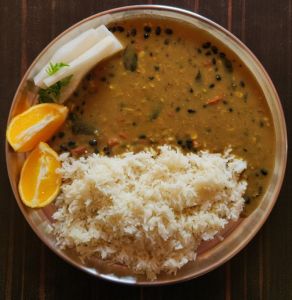
This morning I announced here in the Hermitage to anyone within range, that today, I would be making lentils. No, I thought, I can’t ‘make’ lentils; my job is to cook them so they might become Dhal.  Jokingly to myself I stated by way of correction in my best mentally affirmative voice ‘It’s Dhal day today.’

Dhal is an important staple for us here at the hermitage. Please don’t imagine I’m exaggerating  when I say that we eat it everyday. Actually, come to think of it, it might be just an ever so slight exaggeration.

Very very occasionally we choose some other evening meal, always vegan. But to tell the truth, we all like Dhal so much that we hardly ever feel the need for a change.

Anyway, as I say, it’s one of my relished responsibilities to once a week, or thereabouts, play my part in producing the Dhal that sustains the community for the next week.

Just a little aside: Lest you think Dhal is all we eat, I should mention we eat lots of fruits and vegetables, rice and breads, beans and various other things that come to us one way or another.

Please, the inner editor is begging me, can we just get on with today’s topic? Actually, the topic is the Dhal making that has taken place today. So, really, we are still kind of on track.

Right then. Not long after my announcements to the community and to myself, I got to it,  to the task at hand. First, I pour red lentils into a largish saucepan.

Not my picture. Just to give you an idea of what I saw that prompted my feelings

I watched as the lentils streamed from the packet to form a little mountain, first at the bottom of the saucepan, growing to full saucepan scale. Funny thing to say but I was kind of mesmerized by this mountain building. I was struck by the thought – more like a feeling – this is wonderful, this is important.

I mean to say that I felt a little awestruck by the abundance. In a sort of gratitude induced reverie, I scooped a handful of said lentil mountain, letting lentils stream back to Lentil Mountain in the saucepan.

Then it’s rinsing time. You see, you need to rinse the lentils to get rid of excess starch, bits of dirt,  little stones, or twigs. This is a vital step in the process according to the Dhal Grand Master who taught me this life-sustaining art.

In any case, it’s at this stage that you’re allowed to get your hands right into the mix. Run water, swish the lentils around, drain off now starchy, twiggy, stony water. And repeat five, six, or more times determined by the clarity of the water after each rinse.

I like that bit too actually: kind of pleasant sensation as lentils swirl through fingers and you get experience something of the lentils themselves. Nice feeling.

Next step, fill a giantish sized saucepan (I call it the big pot) with the rinsed lentils, add water (very exacting amounts too, but don’t ask me for precise details), bring to the boil occasionally scooping off any remaining bits and pieces as you watch the alchemy happen.

Then, once boiling, it’s time to stir in various spices. Once again, exact amounts are called for, but, well it’s kind of a trade secret. By which I mean, I couldn’t tell you measurements; one just knows. Could be a cook thing. Or maybe it’s a monk thing?

Enough cooking (sometimes the inner editor doesn’t know when to leave the writer alone).

Okay then.

Gratitude. And wonder. Both experienced today – and not for the first time.

Wonder at & gratitude to Surya (the Sun) which gives and sustains all life, including lentils

Wonder at the aforementioned alchemy that transforms dried, red lentils, a few spices, and water, into a delicious, substantial, healthy and nourishing, food that satisfies and sustains.

Gratitude that I am able to take a small part in this alchemy. Gratitude for the beings who sustain us – me, our community, you, all of us on Earth. Gratitude for the grace I have been granted that actually allows me access to such wonders and abundance.

It’s a lot to be grateful for. All I can add is that it is my deep gratitude that will keep me ‘making lentils’ always.

Don’t Stick Your Feet Out

Just now (as in earlier today) I had some perfectly natural, normal, and expected thoughts about my prayer life. If I’m to be honest though, and perhaps a tad overly tough on myself, the thoughts I had felt slightly ridiculous given my professed commitment to praying constantly, and my supposed understanding of the meaning and function of prayer.  In other words, there I was again: putting some kind of unrealistic expectations on myself – again!

Anyway, enough of that. To sum up those thoughts: I was thinking they – my prayers – aren’t working. Nothing is happening. And I was asking myself questions: What’s been achieved? What’s coming from all the effort? Where are the results?

And then, exactly at the moment I was writing down those thoughts and questions, I lifted my eyes from my notebook to see my partner-hermit approaching.

‘It’s my blessing at the moment,’ she said walking by my chair.

Why did she say that?

Because, right there before my eyes was evidence that none of my ridiculous thoughts and questions on my prayer life, had any meaning whatsoever. There was the answer, walking past me.

As I said, right there before my eyes.

Let’s Talk

I feel like talking more … Sorry. Start again. It’s not what it seems and, well rather than get into it now, just read on a bit and all shall become clear.

Anyway, there’s an old joke that goes like this: One friend says to another friend: ‘How come you’re always talking to yourself?’ To which the second friend replies: ‘Well, you see, I always like to talk to the most intelligent person in the room, so I look around and usually I find that it’s me. So I end up talking to myself’.

Okay, maybe not so funny. Could be taken as bad manners or rude come to think of it. But that’s how jokes often are isn’t it?

Anyway, and here we get to the little bit of clarity I promised, you’re probably going to remind me that I have often said I would like to talk less, and be quiet more often.

That’s still true, but this is different. You see, lately I’ve been feeling the need to talk more about various aspects of my ‘inner life’. You know the sort of thing: confusions and worries; niggling issues bugging me; that kind of stuff.

And my community hear and experience quite enough of my inner life, with its contradictions, mood swings, and the rest; I have no intention of being more of a burdon than I probably already am.

So, I look around and ask who’s left? Me! Myself! I! Not exactly the most intelligent person in the room, so there the joke breaks down, but it does indeed look like I might end up talking to myself after all.

Well, it’s kind of a yes and no sort of thing. ‘Myself’ is the individual with this mind and body, making these words appear on the screen. It’s the ego self, the me that’s the being who walks, talks, breathes, and … Well you know what else.

But, and this is the brilliant bit, if I separate the words to read My Self, will it’s a whole other story. For a start, Self is not ‘mine’. Self is that part of me that is consciousness; and it’s not a different entity than ‘your’ consciousness, or anyone or anything else’s.

So, if I start talking to this Self that’s actually anyone and everyone, and not just me, who is it that I am in fact talking to?

Sounds to me like I’d be talking to you, and you, and everyone else; to the trees, the birds; everybody!

And yes, that’s exactly right. For me, there is only Self – consciousness – that is indeed anyone, anything, everyone, and everything in the Universe, both seen and unseen.

In other words, I’d be talking to God; the Divine; the Absolute Reality; the Thou Art That described by at least one of the world’s great spiritual traditions.

Which is to say, I want – need – to spend some more time talking to, and in conversation with, God.

Phew. I’m glad I figured that out.

You might remember the prayer I wrote a while ago to the Divine Mother? Seems like a good place to share it with you again.

Love and Peace from Paul the Hermit