All I Can Afford is a Loving Heart

Our post today is closely related to our last one. In fact, so close is the relationship, we can call them sibling posts, even twins.

Anyway to begin, I’d like to share one verse from a song I’ve loved and not loved for years. The song’s called You’re Just a Country Boy by Alison Krauss:
Never could afford a store bought ring
with a sparklin’ diamond stone.
All you can afford is a loving heart,
the only thing you own.

It’s easy to start disliking this song right from reading the title: ‘Just‘? As in only? As in ‘Is that all you are?’. And ‘country boy’? What’s wrong with people – of whatever age or gender – who come from rural areas?

But, there is some to love as well: The lyrics are clever (cleverer than I’d thought, as you will see soon); the singer has a lovely and skilled voice that I like a lot; and there is a generally relaxed, easy listening kind of vibe to the whole tune.

Still, there is more to dislike: The song is addressed to said country boy, perhaps as well meant advice from a friend who is trying to let the country boy down easy as they say. ‘Get real my friend,’ she seems to be saying. ‘You have nothing that anyone wants. You’re poor, you’re from the country, and no way will anyone ever want you.’
The lyrics are like an affirmation or confirmation of what we know already: the world turns on material objects and money, and you aren’t anyone or going anywhere if you don’t have that stuff.

But, then on the other hand, there is much more to love. And this verse kind of sums it up. For the first time today, rereading the lyrics as I ate my lunch, I finally got it: it’s IRONY!
‘What?’ the lyrics seem to say. ‘You mean to say that the only thing you own is a loving heart? What use is that for goodness sake? Nobody wants that. Everyone wants money, jewels, and other material things’.

Well, I think I’d actually gotten it already; it’s just (there’s that troublesome little word again) that today is the first time the word itself came to mind. How ironic to come to the realisation of the irony of this song after all this time?

I like the use of the word afford. Clearly our country boy is broke, has no money, little material worth, and being a ‘country boy’ he obviously has limited prospects.

The irony is, of course, obvious: if one has a loving heart (or an awakened heart as we reflected on in our last post), what else do they need to be able to afford?
Our friend has most likely earned his loving heart over and over again anyway as he’s lived his life with its inevitable trials, tribulations, joys and sorrows. Riches galore right there. Afford? Of what value are material riches when one already possesses the most valuable asset to which a human being can aspire – a loving heart?

Just thought I’d look up the lyrics to another song I also quote from quite often. It’s also about that ‘all I have’ idea. The song is Words by the Bee Gees. These two lines I like:

It’s only words and words are all I have
to take away your heart

Or, as I might reinterpret it: ‘I know these are only words, but they’re all I’ve got to try to speak to your heart from my heart’.

If I’m to dig deep, be honest, and all that, I would have to say that this idea has been a major guiding force in and for my life in one way or another – whether I’ve been conscious of it or not. As has been aspiring to a loving heart, though that aspiration has at times been bogged down in the mire of the mess of life.

Words are good and sacred, and I’ve always seemed to have a lot of them (it’s not the words that are at fault, it’s the one who uses or abuses them). Really, as I think about it now, all I want is to continue using them – words – to express what’s in this (aspirational) loving heart.

All I can afford is a loving heart.
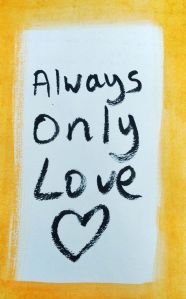
PS Now I’ve actually truly and really seen the irony in the lyrics, maybe I don’t have to dislike this song quite so much
Tripping On the Sidewalk

Walking home, returning to the sanctuary of the hermitage, I fell over. Or to be exact, I tripped.

It’s not the first time I’ve tripped in my life, and I’m sure it won’t be the last. Mind you, I’m not supposed to be making speculations about the future; after all, I may never fall over (or trip) again.

Let me share with you how I came to find myself lying on the ground, fully conscious thankfully, with only a few grazes on arms and knees, and a sore spot on the side of my head.

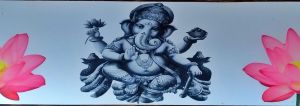
Walking along the sidewalk quite freely, earbuds feeding my ears and my heart my favourite mantra to Ganesha – known as the remover of obstacles and the God of wisdom. (more on the earbud issue later)

At one point I noticed, a few metres ahead, what appeared to be the back of a largish sign board leaning against the base of an electricity pole growing out of the pavement.

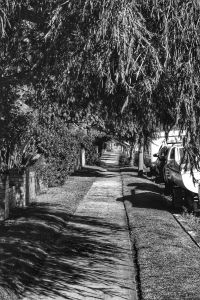
Not the actual sidewalk

Without any thought whatsoever, as I came up to that pole, I turned my head to the left to see what the sign read. Next thing I know, is I have the sense of falling. Later I remembered that at the exact moment I turned my head, my foot caught the broken and uneven edge of a slab of the pavement.

I was blessed by two passersby who stopped and helped me back to my feet, and stayed with me as I regained some semblance  of my bearings. Thank you to those two good and kind ones.

Now, I don’t like falling over (well, when you think about it, who does?), but in this case I can say through this fall, I have learned a couple of good lessons.

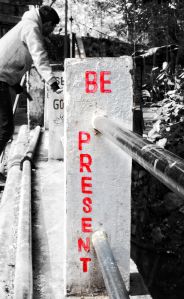
Presence – or lack thereof. Here I am, the hermit monk who is supposedly constantly practising being present, in the moment, here and now; yet I tripped over what I later discovered was a really obvious, clear obstacle on my path.

We all get distracted, you might be thinking. And, yes, it’s true. We can be paying close attention, fully focused, riveted to and in the moment, and, suddenly distraction barges in – in the form of a thought, an external noise, visual imput, and even a broken pavement. You name it, and mind will use any excuse it can to manifest a distraction.

Another lessen – intimately related to presence –  is pausing, or not! As I noticed that sign coming up, I could have chosen to pause to look at it once I reached it.

Then, rather than being a distraction, looking at that sign would have simply been another moment in the ongoing flow of the present. In other words, there’d have been no tripping.

The actual earbuds in question

Now, to the earbud issue. To be honest, my earbuds have more or less replaced my regular over the ears headphones. Because I was never comfortable going out and about with those clunky things on my head and earbuds have allowed me to listen to music pretty much whenever and wherever  I go. Even to me wearing them, they are barely noticeable. It’s possible that’s the problem right there: unnoticeable.

More than 30 years ago now, I spent every Tuesday evening for a year attending classes at a school of philosophy . To this day I still follow some of the practices I learned there. And, passed to me were so many good lessons, so much good knowledge drawn from many of the world’s spiritual and intellectual traditions. So many of these lessons have stuck with me.

Presence, or rather the benefits and rewards of realizing  the present is all there is, was I would say, one of the cornerstones of those teachings.

One illustration about presence concerned driving, and although at the time I haddn’t learned to drive, it resonated with me. Our teacher told us that, when she was driving, she never listened to music or anything else. She told us that she simply put her full attention on the task at hand: driving.

She described how it often happened that when driving she’d reach her destination with little or no memory of the actual act of driving or any landmarks or events on the trip itself. She said it was if she was somehow unconscious, yet still able to drive ‘on autopilot’ was how she put it.

And of course it’s not a phenomenon limited to driving: how much of our routine daily activity runs on autopilot?

Anyway, back to the other day and me grooving to Ganesh in my ears and tripping in a moment of inattention.

I don’t recall being distracted by the mantra in my head, or moving on autopilot. But, thinking back, I was in one of the busiest sections of the little town that hosts our hermitage. I’d been to the supermarket, the parking lot of which is as busy – and crazy –  as one you would find in any big city.

Just another sidewalk tripper

So, I realise now, I had already kind of set myself up to fall for any distraction that happened to come along. While I don’t really remember myself as being ‘unconscious’ of my surroundings or of the path itself, clearly I wasn’t completely there, not in the here and now sense if you know what I mean. Just an after thought: who remembers ‘being unconscious? Nobody I think!

Whatever I say now, I wasn’t present; I wasn’t fully in the moment, not paying attention to either what I was doing or what was going on around me.

Since my little trip, I have vowed before my hermit community to not ever walk again in a built up and busy area wearing my earbuds.

Not only do I have a sense of danger lurking when I think of the idea of wearing them in those situations, but I also feel that it’s not exactly being present, in the here and now is it?

Another closed cafe on some other trip

Okay, I am very sure you are waiting with great anticipation to learn what what fateful sign, put in my way by the Universal Traffic Controller to push me into changing direction, actually said:

It was a handwritten advertisement for ‘great coffee’ to be had in a cafe across the road. A closed cafe I might add.

On Main Road –  a road that more than lives up to its name –  perhaps there are worse fates awaiting the inattentive than merely tripping on the sidewalk.

A Love Song to a Love Song

Deceptively simple is how I’d thought to describe the lyrics of a love song by John Lennon I heard again recently for the first time in years.

But, no I thought straight away, that’s not right. The message of the song is simple, and the lyrics convey that message to us just as simply.

Of course why the song is so powerful – and personally significant to me and so many others – is that, while the message may be simple, the ramifications of really hearing the lyrics, really digging the words and trying to put them into action, are far from simple or limited and have few if any boundaries of any kind.

The one word title of the song I’m talking about says it all: Love. Lennon included Love on his first solo album with the Plastic Ono Band, which was released in 1970. So not actually a solo album, but you know what I mean.

The original purpose of this post was to share with you a poem I wrote in response to reconnecting with this masterpiece.

While I will still be sharing that poem, I thought I would first let you see the lyrics of Love put together through my own listenings to the song itself. No copyright breach is intended here. I only print the lyrics for illustration purposes, and besides, if you can’t share a song called Love, by John Lennon, what can you share?

If before or after reading the lyrics you prefer to actually listen to the song being sung by John, then just head here for a great early version.

Love is real, real is love.
Love is feeling, feeling love.
Love is wanting to be loved.

Love is touch, touch is love.
Love is reaching, reaching love.
Love is asking to be loved.

Love is you,
You and me.
Love is knowing
We can be.

Love is free, free is love,
Love is living, living love.
Love is needing to be loved.

You see? Simple lyrics, simple melody, but the message! It’s all about the message. Or is it an invocation? A love mantra?

Mind you, the song is presented in such a light-hearted and gentle soft manner, that it might be easy for some to dismisss the message as being merely wishful or fluffy thinking. But, there really isn’t anything fluffy about love is there?

Now, to my response. Well one response among many I should say. I offer this poetic effort in humility and gratitude – indeed, in and with love.

‘Cos as John wrote in another great anthem:

All you need is love

Peace from Paul the Hermit

JOHN WROTE A LOVE SONG

John was a singer and a writer of songs.
John was a friend of mine – yet never known personally.
Yet known by me all my life.
A fab friend for everyone.

John wrote songs, songs he sang,
lyrics given life by voices
very few heard.
It was hysterical.

He wrote a love song, a song I heard and loved.
In fact, a whole lot of love songs he wrote.
One verse, in that one song, caught my ear, snatched at my heart.

This is the verse,
    the stanza I love:
       Love is you
       You and me
       Love is knowing
       We can be.

No sickly, sweet sentiment this.
Not like some plastic bobble-head
lurking in some grubby rear window.
No, as the song he wrote says:
Love is real.

Love not for the sake of getting it right all the time;
Love not for the sake of always looking like the good guy;
Love not for the sake of a distant and cold devotion;
But love,
Love for you alone.

Oh No! Another Blog About Chanting

Not too long ago, I completed what I’m now calling my first formal (structured) study of the entire Bhagavad Gita. Of course this wasn’t my first exposure to that text: I’d been reading it on my own for a few years before I came upon a teacher to act as guide.

Anyway, since that bitter-sweet day of completion, I’ve been looking at ‘random’ verses on a more or less daily basis as a way to keep in touch and to act as a reminder of what I’ve learned.

Just opening my Bhagavad Gita at random, just to see what the universe wants me to think about.

Today, I happened to open it up at what are a series of my favourite verses. (I know I’ve got a lot of favourites; it’s that kind of book). In these particular verses, Krishna describes the meaning and significance of the mantras Om Tat Sat.

In a nutshell, these three syllables, these mantras, are a way of describing the Absolute Reality of the Universe, or God, Consciousness, the Truth, the laws of nature and the universe. Whatever names we might use to encompass all existence.

Krishna details when and why to use the mantras (it’s one mantra made of three, for the technically minded). Again in a nutshell, it’s a mantra to use whenever we perform our duties, basically any actions, with a devotional mood.

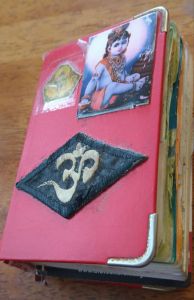
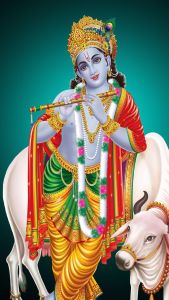
By the way, that, and the inclusion of my favourite image of Krishna, doesn’t necessarily imply that our actions have to have a ‘religious’ intent or flavour: Any action we undertake, for whatever purpose as long as it is motivated by Truth, Love and right thinking, qualifies as being devotional.

While you can see the actual verses yourself via the Om Tat Sat link above, I would like to share with you my very liberal paraphrasing of Krishna’s teaching on the mantra. Also, I am adding a few observations of my own that I hope serve to clarify this great teaching. Oh, please forgive any repetitions, if they occur.

The syllables Om Tat Sat are the symbolic representation of the Supreme Absolute Truth; what I choose to describe simply as all that is. It is called by any number of names or none. It’s existence itself.

It’s an ancient practice, this chanting of these three syllables as a mantra. It is recited when one is engaged in any action in a mood of devotional service. Meaning any act that is imbued with a prayerful attitude and feeling, and with a mood or attitude of devotion to and recognition of, Truth in all things.

And it includes any and every action we undertake, from washing the dishes, to sitting in meditation or silent contemplation. And everything in between.

Om

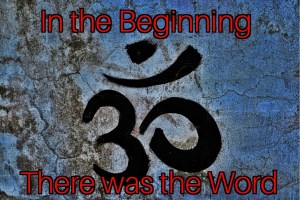
Om is sometimes called the primordial sound, the creative principle, the word from which all creation sprung. I’ve also heard it defined as being the Big Bang, from which the universe emerged.

Om is considered the sacred sound and word by many cultures around our world. Consider the opening of John’s Gospel in the Christian New Testament :

Om is to be chanted when beginning and performing any and all actions motivated and driven by Truth. Chanting Om assists us to actually realise or understand with our heart and not just our mind, the presence of the divine or the universal consciousness in all that we do.

Tat

Tat is chanted by those wishing to be freed from attachment to material things, which includes the desire or compulsion to enjoy the fruits or rewards of our actions.

In the beginning was the word, and the word was with God, and the word was God

John 1:1 New Testament

Attachment is when we depend for our well-being or happiness (physical, mental, or spiritual) upon another thing (money, job, status, etc), person, or desired outcome. Attachment (and clinging, extreme longing, compulsivity), Buddha told us, is the cause of suffering: when things are going well with the things or people we are attached to we are elated; when things aren’t going so well, we are miserable and we suffer.

Sat

The syllable Sat indicates both reality and goodness. In other words, Sat is used to represent that Absolute Truth or Universal Consciousness that we’ve been discussing.

Sat follows very nicely on from Tat as it helps to strengthen our Dharmic (motivated by what’s right and true) actions, so that they actually become Sat – Truth.

So, chanting Om Tat Sat when performing any or all our activities in the world (as well as within) will help us to come to realise or understand that there is only the one Absolute Reality, the one consciousness that is not only universal in nature, but is actually the universe itself.

Oh one more quick note: Often you hear the chant with an extra word up front: Hari Om Tat Sat. Hari is a way to address that which removes darkness, that aids in the shining of the light of knowledge.

It’s a word that represents that Absolute Reality that we’ve talked about here. It can also refer to King or Lord, or otherwise influential entity. I find it rounds out the chant, and I like it!

Please feel free to explore Om Tat Sat for yourself. You will find a lot of great recordings of the chant on YouTube, and the wikipedia link at the beginning of this post is very Illuminating as well.

Om Tat Sat

Some Say Love It Is a Flower

You know how YouTube will recommend videos? Well one that’s constantly recommended to me actually is illustrated with my photos.

So, when it came up again today, I thought I would take a look. It’s been a while since I last watched it. To be honest with you I found it really quite moving, watching it again. Anyway let me share the brief story of how this all came about.

I’d met folk singers Susan and Colin Parrish through the community radio station I once managed. I loved their music and style right away and now, over ten years later I’m still drawn to their music and listen to them very often.

We became friends and after sharing some of my photos with Colin, I was truly surprised when he used them as the visuals for a video he put together of Sue and his cover of The Rose, a terrific song made famous by Bette Midler.

An extraordinary take on a beautiful and powerful song. And to see my photos accompanying was a real thrill. Then as it is now.

I thought I would share it with you here. One thing I hadn’t remembered: Colin’s description :

I was surprised to see my words there. And you know something? I think this song, my photos and that little forgotten quote from me, are all a perfect match. Love is. That’s it really: love is. We, each of us, all are merely expressions of love made manifest in the material world.

I hope you enjoy watching and listening. My little quote really is only echoing lyrics from the song:

Some say love it is a flower and you it’s only seed

Amanda McBroom The Rose

Peace