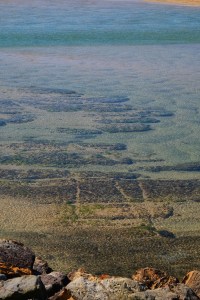
Here there are remnants
of sea cliffs.
Cliffs that have not towered
since ancient times.

Here there are remnants
of sea cliffs.
Cliffs that have not towered
since ancient times.
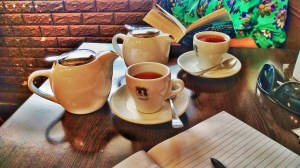
About a year or so ago I stopped keeping a journal. And, when I say stopped keeping, I mean keep as in both senses of the word. Let me explain.
I began writing my life in a journal in my teens. I stopped for a while in my late teens and early twenties, then later in my twenties, took to it again. I then kept my Journal going ever since. That is, until last year.
Of course, some periods saw a more intense, even daily journal keeping. And then there were periods where the journal only saw me every now and again. On the whole though, I’d been completely dedicated to my Journal for more than 40 years.

So, why suddenly end it? What prompted me to just stop keeping it – again in both senses of the word – after almost a lifetime committed to it?
Yes. A good, good question. First of all, it wasn’t a sudden decision; I didn’t ‘just stop’. For some time I hadn’t been feeling quite so committed, quite as excited about keeping a journal (as in using it to write my feelings, ideas, and essentially my life). And, just as with so many of the decisions we make thoughout our lives, this one had a practical, even a pragmatic ‘seed’ as well:
See the picture above? That’s my journal. The rest of the Old blue tin trunk would get itself filled with all kinds of stuff not needed on rhe road. The trunk lived with my cousin for a few years, then it was my sister’s turn; she had it on and off for many years.
As you are no doubt beginning to guess, this arrangement began to wear thin. We (the hermit pilgrims) were constantly asking ourselves, what’s the point of storing this stuff for years? Do we really need it?
My answer had always been yes. I needed my journal. I might read it again someday; I might need it to write books or whatever. So, we’d keep the trunk, filling the remaining space with stuff and things.
Then, on the penultimate occasion we had the old blue tin trunk shipped to us in our latest (then) current roadside cave, I looked at it, and thought: What’s the point?
Somehow the attachment – the compulsion to hold onto my Journal – had gone. It was a liberation, a freeing of my mind. I suddenly realised that the prospect of me ever rereading the thing, or needing it for some other purpose, was remote. Actually such a prospect was also extremely unappealing.
I should add here that that particular aversion and disinterest in rereading my journal, seemed to cement my already growing disinterest in keeping a journal in that sense I mentioned earlier of writing down feelings, ideas and so on. Now, both the idea of keeping the journal in the sense of storing the physical volumes for a rainy day, and that need to keep a journal by constantly writing my life, collided. Time to stop keeping!
So, I sat and leafed through every volume, more as a kind of farewell ritual than anything else. I did ‘rescue’ the odd bit and piece, most of which have since gone the way of their host volumes. Then I simply set the lot on its way to oblivion.
I mentioned that this whole chain of events happened on our penultimate reunification with the old blue trunk; what about the ultimate time? Well, we’d kept it full of various pieces of art by both of us; with various household things; ornaments; and other stuff I can’t remember.
Repacking it to ship back to my sister’s as we got ready to move on from that particular cave, we both just said, let’s leave it all behind.To cut a long story short, that’s exactly what we did. My son, a couple of charity shops, and the house we’d been sheltering in, were all recipients of the last of the contents of that old blue trunk – and the blue trunk itself.
Now, do I miss my journal? Well yes and no.
No I don’t miss having the thing as in owning it. Or maybe it’s better to say I don’t miss always having it in storage and out of reach the great majority of time. Like I said, I went completely off the idea of holding onto it – keeping it – just in case someday I might want to read it all again or use to for research. Now I think, why would I ever want to do that? (okay, I think I might have already said that)
The yes is kind of qualified. Yes, I miss writing in it. Yes I miss having a vehicle for expressing feelings, thoughts, and ideas.
I say that this yes is qualified because while I say this to myself from time to time, I don’t actually seem to ever really feel it. So perhaps it’s less a yes and no than it is an unequivocal no.
Besides if I have the urge to write, to put pen to paper, fingers to keyboard, then there’s nothing to stop me.
After all, that’s precisely what I’m doing now isn’t it?
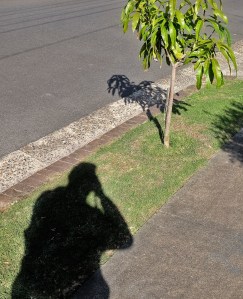
I was out and about photographing for a few hours this morning. On such walkabouts I like to walk at a slow but steady pace, and in a contemplative frame of mind.
Usually I’ll also chant mantras as a way of focusing my mind, of keeping random thoughts from distracting my attention. And so it was today.
Deep into today’s walk, I was feeling ‘in the zone’, as I like to call it. Making photos and chanting mantra. All of a sudden I heard myself singing a bhajan (sacred song or hymn) in place of the mantra I’d been reciting.
This particular bhajan was By Your Grace, by Krishna Das, It’s a beautiful devotional song that you can listen to here. I’ve been listening to it and singing it for years, and I love it. I find it puts me in a nice prayerful state of mind, Anyway, here are the lyrics:
Closer than breath, you are the air
Sweeter than life itself, you are here
I am a wanderer, you are my peace
I am a prisoner, you are release
Jai Gurudev…
I am a pilgrim, your road so long
I am the singer, you are the song
Held in the open sky, so far above
I am the lover, you are the love
Jai Gurudev…
I follow your footsteps through the flame
All that I ever need is in your name
Carry your heart in mine, vast as space
All that I am today is by your grace.
By your Grace…
I live by your grace.
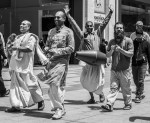
Now, the song was written by Krishna Das as a way of thanking and praising his Guru. But, the words and the power of the song can be dedicated to any of our own individual concepts of the Truth. Whether we call it the Absolute Reality, the Supreme Being, the Life Force, the inner Divinity, Nature, Consciousness, God, Guru, the Universe. After all, these are all simply names and forms.
I guess what I’m saying here is that the song is a fine prayerful and meditative way to express our gratitude to, our love for, and devotion to whatever it is in our heart of hearts we know as our support, our teacher, our creator, our Guru. Our very own Truth
Peace blessings from me to you
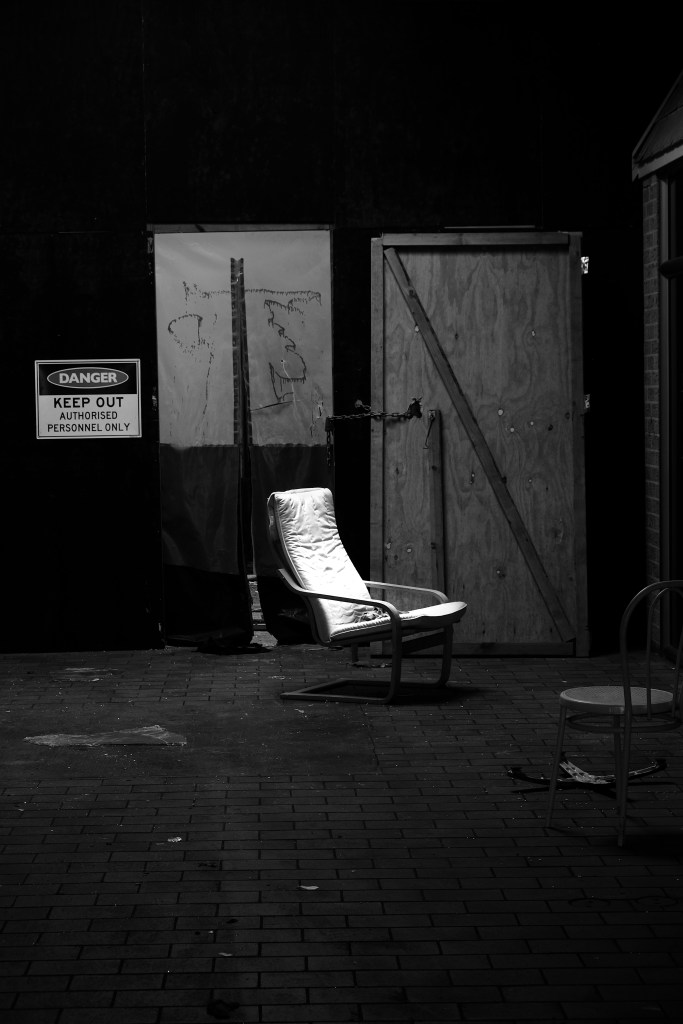
‘Looks like a comfy chair’.
That was the first thing my partner said when I showed her this photo. Her eyes – and perhaps even her heart – had found that which is illuminated by the sun, even though it’s surrounded by wreckage and ruin.
The wreckage by the way, of an abandoned and trashed store front. One of several in a small arcade, that’s long sat empty.
Ah, I thought: one more illustration of a metaphor I’ve been hearing a lot lately in my studies about consciousness.
Allow me, please, to adopt our teacher’s metaphor which, for me, really clarifies this concept of consciousness, or Atma as it’s called in Sanskrit.
Is the brilliant light streaming into this room and onto this chair affected in any way whatsoever because the chair is sitting amidst all that wreckage?
Is the sun shining any less brightly on the chair than it would if the chair was sitting in a luxuriously decorated space instead?
Of course the answer to both questions is no. The sun, and its brilliance remains undimmed, and completely unaffected, untouched, regardless of what it shines on.
The ‘I’ that photographed this scene, and my partner’s ‘I’ whose eyes were drawn to the chair in the scene, are both consciousness. Not ‘my’ consciousness; not ‘her’ consciousness. Consciousness is all; all there is. Boundaryless, infinite, all pervading. We can’t even say there is one consciousness, because there is only consciousness.
Ah, I hear you say: there is one sun shining on our world; and the sun isn’t ‘all there is’. Well, as our teacher likes to remind us, all metaphors are flawed: you can only take them so far.
Metaphors, are only meant to illustrate, to show us the way, point us in the right direction as it were. In our little example here, the metaphor is meant to help us gain some knowledge.
The knowledge that we are not what we see, hear, taste, touch, think or feel. We are that light – consciousness – that allows us to know what we experience with our senses.
One more thing: The light of the sun, flooding the chair with its brilliance, enabled my partner to see that it was comfy, even though it was sitting in that wrecked, abandoned and lonely place.
Just as in our lives, when everything seems to be crashing down around us and we feel we are the ones stranded in that wreckage, we can remember that the light of our own consciousness, is the way in which we may shine our attention on the truth of our unchanging eternal, and true nature, that is who we really are: perfect, eternal, absolutely unaffected by anything at all.
Peace and love

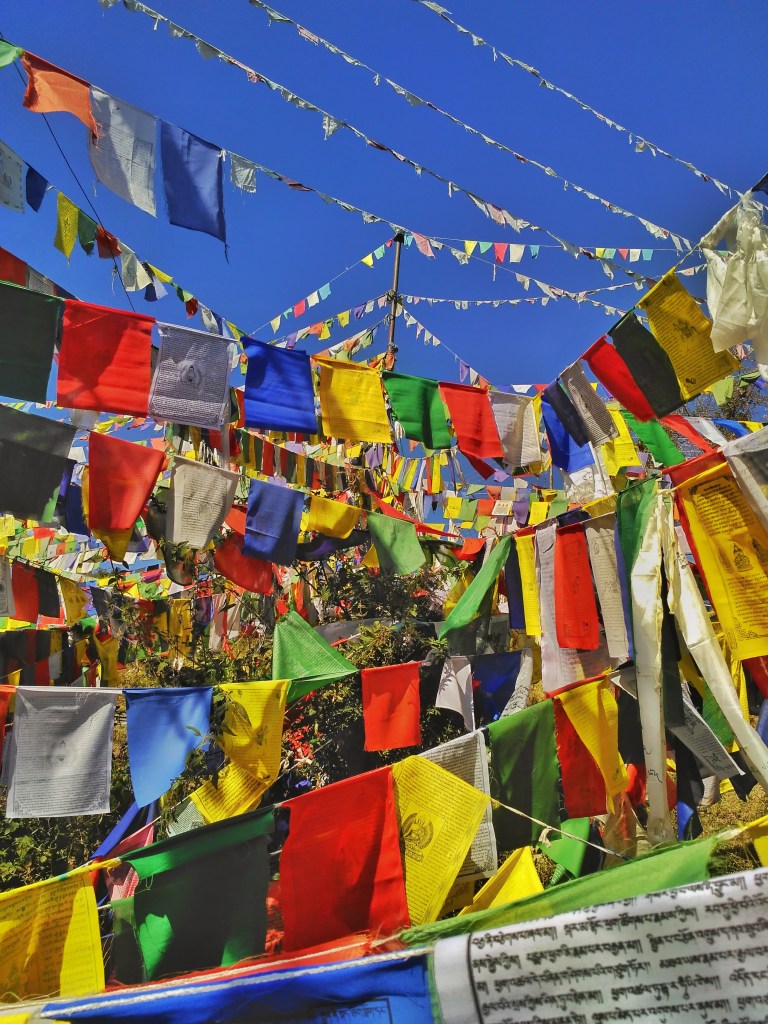
The hand of the monk
agéd, insistent, but gentle too,
takes and holds mine.
The monk sits, the Dharma before him,
sacred texts resting in their saffron shroud.
My presence completes
this circle.
Mountain monastery
calling him; it’s not home.
Other mountains
he’s climbed. Escape.
High places divide
this world from that,
that time from this.
His loving touch, his smile,
linger in rarefied air.
Air drenched with the warmth
of the Dharma,
in this late monsoon
restaurant of the Snow Lion,
south of his land.

HOMAGE TO HOLINESS
Threads harvested from threadbare clothing.
Pea-sized bits of bread, sliced from meagre rations,
Secretly hoarded for sacred purpose.
Mala makers work at night
in the dark of the stinking and freezing stone cell.
Chewed bits of bread become dough again,
and, by feel, frozen fingers knead the dough
Until tiny beads of bread emerge.
A tiny twig, again by feel, pierces each bead through.
Then in solemn prayerful silence and focus,
the nun passes her harvested thread through the first bead.
She ties a knot, no easy task with freezing fingers in the frozen dark.
And so it goes; all sacred duties take their own time.
One by one; one bead of bread threaded; one knot knotted.
The nun nears collapse. But now, at last, her task is done.
As the last knot is knotted, the last bead in its place,
The nun sighs and mutters, whispers, a prayer of thanks.
One hundred and eight beads plus one.
She has made her Mala.
Om Mani Padme Hum
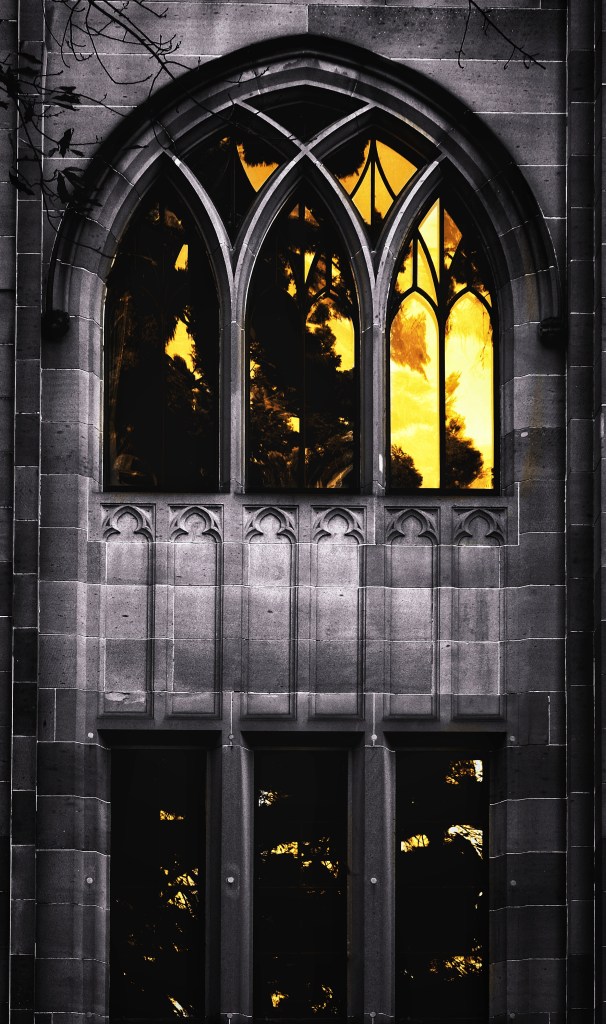
AS GAIA TURNS
Surya illumines
with his fiercely gentle life-giving light.
Gothic panes receive and reflect
golden impressions
as Gaia turns.

Mother, mother ocean, I have heard you call
Wanted to sail upon your waters since I was three feet tall
You’ve seen it all, you’ve seen it all
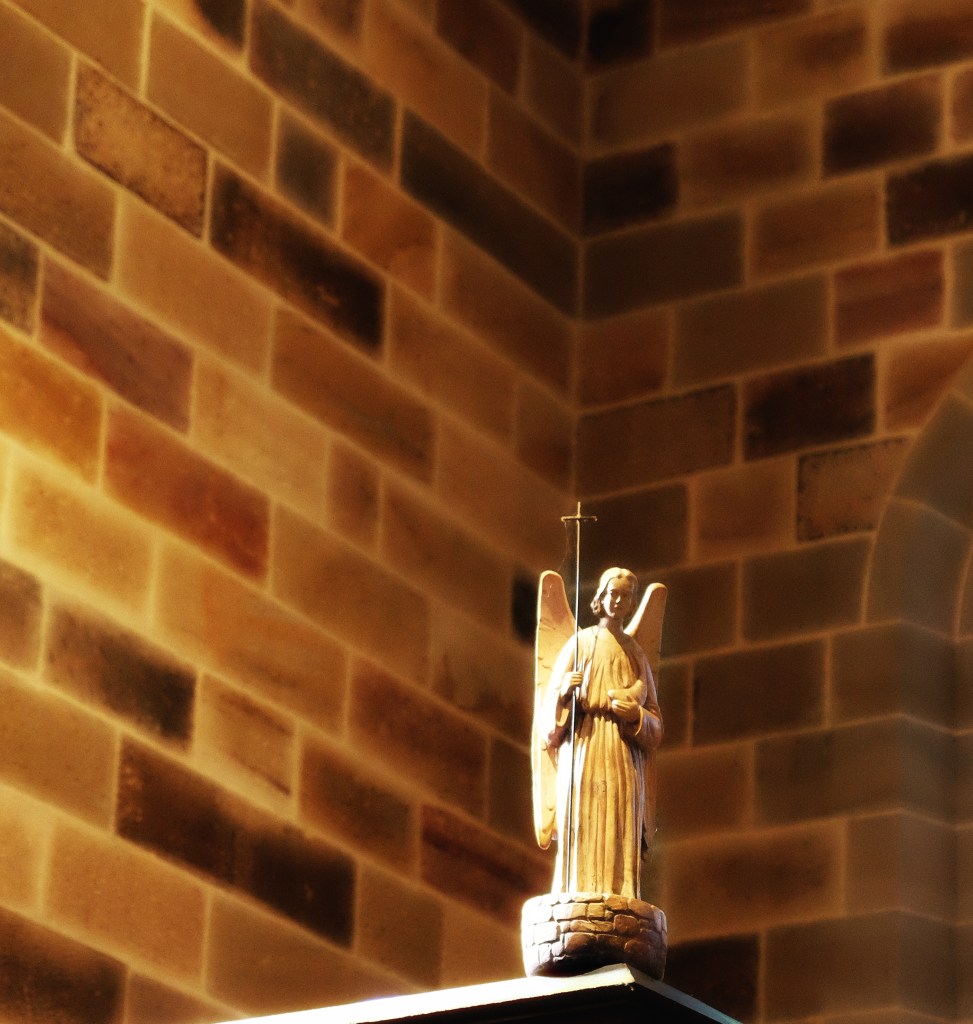
Just call me angel of the morning, angel.
Just touch my cheek before you leave me.
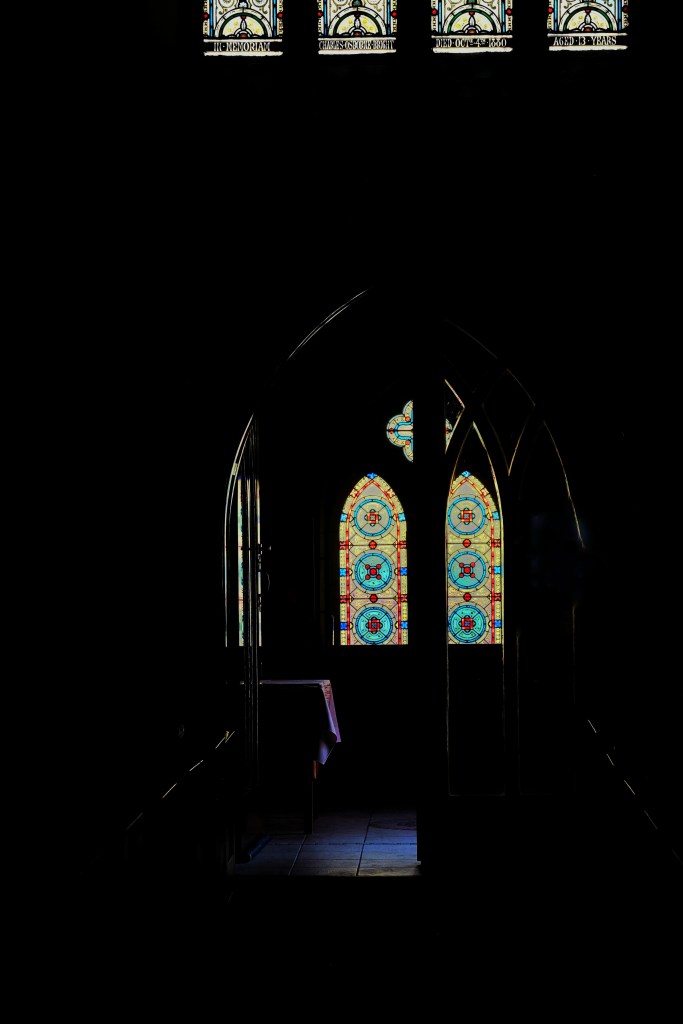
At the entrance to the temple, the Way is illumined
 Notes from the Hermit's Cave