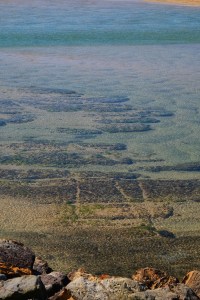
Remnants of Sea Cliffs

Here there are remnants
of sea cliffs.
Cliffs that have not towered
since ancient times.

My take on Dharma, Karma, & Living a Good Life Part 1

Most likely I’m not alone when I say that when first listening to new information, a lecture, teachings or anything else for that matter, I will often forget either part of what I’m trying to learn or even all of it. In fact, I’m sure there are more than a few scholarly research papers that will tell us all about this universal phenomena with all facts and figures along with all the whys and wherefores.

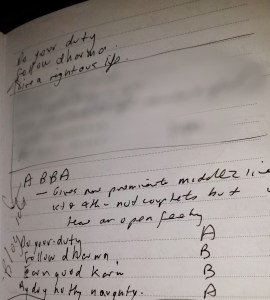
Anyway, I was listening to my teacher ( Swami Tadatmananda) recently. He summarized the teachings he was giving on that occasion in three succinct, pithy lines. Thinking back now, I have no memory of the teachings being presented, and all I have is a quick note jotted down of the teacher’s summary:

Do your duty
Follow Dharma
Live a righteous life.

Fast forward a couple of days and I was watching a video about 19th Century English poets. Once again I’m not able to tell you the names of all those poets or what the show was about (actually to be honest, I got bored and stopped watching half way).

And, again, all that remains is a scribbled note about the pioneering of a particular rhyming scheme by one of the featured poets.

That revolutionary rhyming scheme is ABBA (where the first line of a verse rhymes with the fourth, and the middle two rhyme with each other). It’s as well that I did jot down a note: I have never been able to take in, much less retain in memory, all the technical stuff to do with poetics. Never.

But for some reason this particular idea appealed to me. Maybe it’s to do with how I was once a big fan of the Swedish pop group Abba? (okay, maybe I still am)

As it happens, my note on this appears in my notebook just below the first one I mentioned above. So, as I thought about ABBA (the rhyming scheme, not the pop group), I saw that first note and started playing with it:

Do your duty
Follow Dharma
Earn good Karma
Do nothing naughty

Okay, I know, it’s not exactly great literature is it? Never mind; it’s only an experiment. But, having said that, I do quite like this little, what shall we call it? This little ditty. It seems to be a nice, even quirky, little rephrasing of my teacher’s own summary.

This is all very well and good you might think, but what does it all mean? Does it actually mean anything? Well, my short answer is yes: for me it does indeed definitely mean something.

Actually, it means a lot. But as this post seems to be dragging on a bit, perhaps we will have to continue in another post.

Meanwhile, be blessed

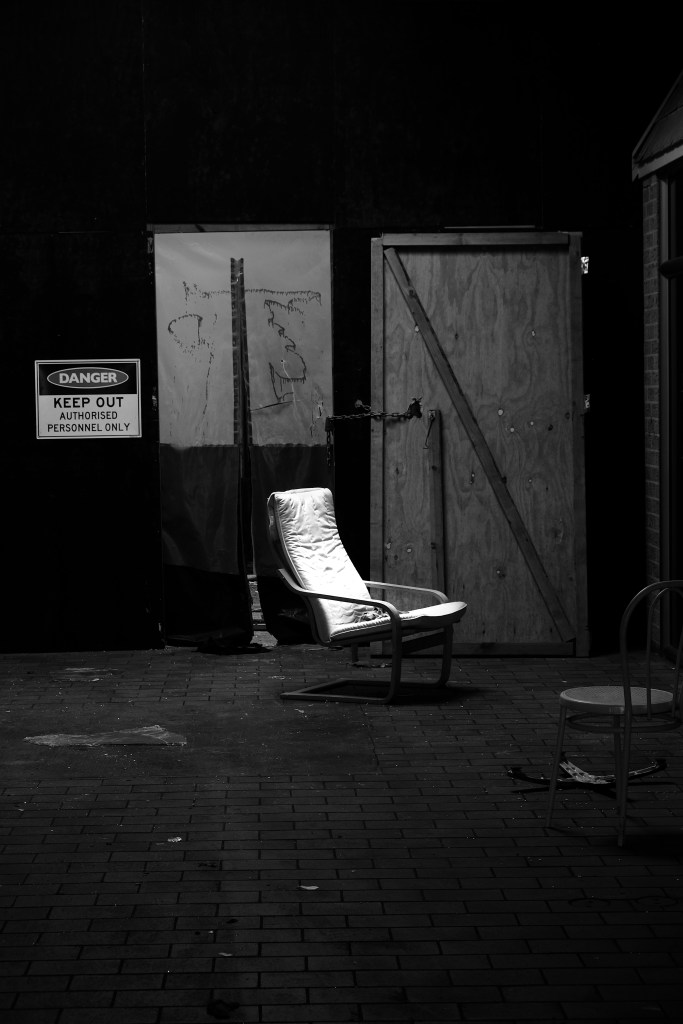
Looks Like a Comfy Chair

‘Looks like a comfy chair’.

That was the first thing my partner said when I showed her this photo. Her eyes – and perhaps even her heart – had found that which is illuminated by the sun, even though it’s surrounded by wreckage and ruin.

The wreckage by the way, of an abandoned and trashed store front. One of several in a small arcade, that’s long sat empty.

Ah, I thought: one more illustration of a metaphor I’ve been hearing a lot lately in my studies about consciousness.

Allow me, please, to adopt our teacher’s metaphor which, for me, really clarifies this concept of consciousness, or Atma as it’s called in Sanskrit.

Is the brilliant light streaming into this room and onto this chair affected in any way whatsoever because the chair is sitting amidst all that wreckage?

Is the sun shining any less brightly on the chair than it would if the chair was sitting in a luxuriously decorated space instead?

Of course the answer to both questions is no. The sun, and its brilliance remains undimmed, and completely unaffected, untouched, regardless of what it shines on.

The ‘I’ that photographed this scene, and my partner’s ‘I’ whose eyes were drawn to the chair in the scene, are both consciousness. Not ‘my’ consciousness; not ‘her’ consciousness. Consciousness is all; all there is. Boundaryless, infinite, all pervading. We can’t even say there is one consciousness, because there is only consciousness.

Ah, I hear you say: there is one sun shining on our world; and the sun isn’t ‘all there is’. Well, as our teacher likes to remind us, all metaphors are flawed: you can only take them so far.

Metaphors, are only meant to illustrate, to show us the way, point us in the right direction as it were. In our little example here, the metaphor is meant to help us gain some knowledge.

The knowledge that we are not what we see, hear, taste, touch, think or feel. We are that light – consciousness – that allows us to know what we experience with our senses.

One more thing: The light of the sun, flooding the chair with its brilliance, enabled my partner to see that it was comfy, even though it was sitting in that wrecked, abandoned and lonely place.

Just as in our lives, when everything seems to be crashing down around us and we feel we are the ones stranded in that wreckage, we can remember that the light of our own consciousness, is the way in which we may shine our attention on the truth of our unchanging eternal, and true nature, that is who we really are: perfect, eternal, absolutely unaffected by anything at all.

Peace and love

One Way to Look at Life

Peace & love

Yes, it’s true: life is precious.
But gold? Silver?
And what about diamonds?
Something to think about.

Received Wisdom: A Good Thing?

Namaste to all of you. In keeping with my ongoing (and ever frustrating) resolve to live fully in the present, I won’t comment on my long absence from the pages of this blog. Suffice it to say the hermit has been in his cave and acting as monk-like as he has been able. And as well, it’s good to be back!

One thing I have been doing during this, let’s call it, blog sabbatical, is continuing my study of the Bhagavad Gita. Not long ago I rediscovered a couple of verses in my notebook along with some notes I’d made that got me thinking about a kind of trap that gets us all at some time or another, and some of us all the time.

First, let me quote the verses for you so you get a picture before we proceed too far.

Forgoing all religious injunctions, take exclusive refuge in me. I shall deliver you from all sinful reactions. Do not fear. (Bhagavad Gita 18:66)

Just a quick side note: in this verse I think ‘sinful reactions’ refers to the risk of accumulating bad karma. You get it I’m sure.

Now that second verse:

When your mind is fixed and unmoved and not confused by scriptural injunctions you shall attain yogic samadhi. (Bhagavad Gita 2:53)

I don’t think it likely that any scriptural text would be telling us to bypass or ignore the very content of that text. Still, that’s exactly what both these verses seem to be saying.

In any case, here is where we can leave the verses themselves and look at what they are actually saying. The underlying message here I think is really a hint at how to live our lives, how to approach all we hear, see, learn and do. Which kind of sums up what you’d think a good scripture should be doing doesn’t it?

Anyway, it seems to me the essential message here is, don’t believe everything you read. Or hear or see or learn. Don’t slavishly follow any so-called rules laid down by others. Fix your mid on God, or we can say, fix your attention, model your actions and focus your thoughts, on Truth.

Ask questions, think for yourself, and then you will reach truth. Don’t rely on (don’t automatically dismiss either) ‘received ‘wisdom’, whatever the source.

Of course none of this sanctions us to do whatever we like without regard to the consequences of our actions. After all, we all know the difference between right and wrong.

If we focus on doing right (focusing on what is true) and staying away from what is wrong (what is untrue) we won’t necessarily always succeed in actually doing right. But the river of your life will be flowing in the right direction.

Hommage aux Ailés

Creatures of the Air,
the Winged ones.
Same like you and me:
Bound to material nature.

God is in the Ink

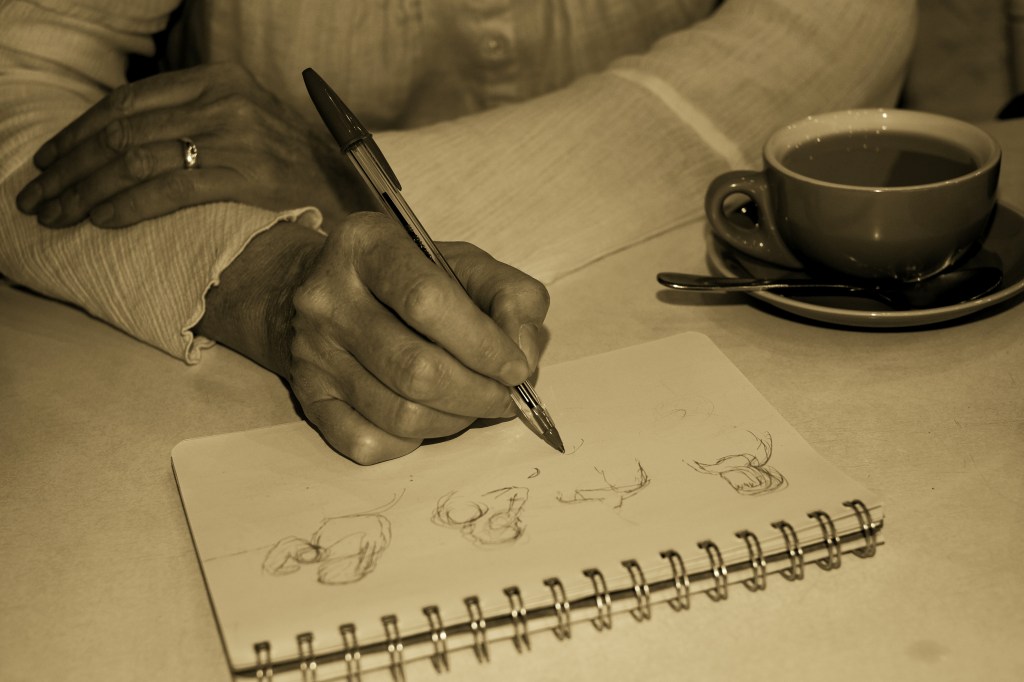
My eyes follow the line her pen inscribes
across the page, its whiteness coming alive.
In such moments, I know that it is true :
I know that God is truly in the ink.

Suffer the Little Children

Suffer the Little Children

A sculpture of a young child, on a busy street corner in the heart of downtown Sydney. I like many thousands of others, have passed it by many times only giving passing thought to the origins, meaning, or significance of the statue itself.

Until a couple of days ago that is.

As a subject for contemplation and for a photograph, it is a powerful image: striking in its presence. Once one actually stops to look and reflect that is.

After several minutes of standing with the statue and asking myself who is it? What does it mean? (there is no plaque or sign to steer the way), I made this photo and I moved on.

Only later, at home, did I notice the little plant growing through the pavement in the corner. And zooming in on the plant I saw the little moth sitting on a leaf.

I decided to research online, see if I could learn more about this site. The sculpture is called Youngster and was created by artist Caroline Rothwell. It seeks to highlight the plight of refugees, in particular children.

There isn’t much online, but you can read a media article which gives some more insight into the sculpture here.

That article focuses mainly on the sudden appearance of a plaque at the site. Presumebly placed by a citizen with strong feelings on the subject, the plaque wasn’t ‘official’, so was later removed.

Actually, the text on this plaque pretty much sums up my own strongly held and often expressed feelings. Though, these days as a contemplative monk and hermit, I try hard to not have opinions, or make judgements on the way in which things in the material world play out.

But, obviously I am still human, and this is only one of so many issues that cause me distress, sadness, even rage. Actually, rage is a big one. But then, how could anyone of goodwill not be outraged? It is the very reason I am struggling hard to get this post down, to somehow make it all clear.

You see, at the same time as being so affected on the human heart level, I am very aware at the same time that it is the conditioning of material nature that leads to the very obvious fact that life is suffering.

Eating, sleeping, mating, and defending. Every single activity of every living being is motivated by one or more of these activities or a desire for their fullfillment. They are the basic drives that rule all life.

So what to do? As I’ve said (probably many times) I am not a warrior – I used to be but not now. However I am just like every other life form motivated by conditioning, either from my experiences in this life, or by that conditioning inherent in all material nature.

To a great extent I have retreated from the world. Not in order to escape or so I can ignore the suffering. I haven’t abandoned the world.

In fact the exact opposite is true: I have withdrawn, become a hermit monk, precisely so that I might be able to dedicate every ounce of my energy, my heart, my love, to prayer; to creating and maintaining a quiet and contemplative silence.

My prayer is not of the asking or begging kind, beseeching some invisible ‘god’ to give me something. Instead, I attempt to be still (never ever easy); to free and open my mind so that I may be more receptive to the Divine, to the will of the Universe; and to  become more mindful in every activity and moment.

In this way I am aspiring to realize fully my oneness with all life.  All life. I want to become fully awake to the fact that everything is Self. That there is nothing else.

And of course Self includes this child and all she symbolizes; it includes that little green plant growing through the pavement in the corner; and it includes the little moth perched on one of its leaves.

As well, my prayer, my aspiration for full self realization and union includes all those who are warriors, those whose activism and engagement with the material or physical world is every day alleviating and attempting to alleviate suffering and its causes in whatever form it takes on this planet we all share.

I am extremely flawed: I’d like to tell you I am always full of love and light, but there is much of darkness in me still to be rid of. So, all I’ve shared with you till now are still only aspirations and I have far to go. Nobody can say if I will ever reach that full realisation. In the meantime I intend to keep doing what I can to participate in the work of change.

Peace and love

I’m Not Afraid of Your Tears

What a piece of magic this is!

Sarah Bernhardt as Prince Hamlet (Public Domain image)

No, it’s not a quote from Shakespeare. Mind you, now I think about it, there’s a line in Hamlet, where the man himself is monologuing about the human condition and declaims a strong-felt sentiment:

What a piece of work is man! [sic]

The reality is that first quote is from someone far more mundane than the bard: me. The occasion on which I uttered this equally impassioned statement was as I sat holding my smartphone and listening to the music flowing from it through bluetooth fairy land and into the headphones I was wearing.

The truth is I was at that moment just awestruck and a bit overwhelmed with what I was hearing, and just as significantly, with how I was hearing a particular song.

Not being a materialist by any measure, my phone and headphones are nowhere the latest or top of the line models, but still, to me, what I was hearing was magnificent. It’s the only word that fits really.

Anyway, that isn’t exactly what I want to write about today. Reflecting on the experience described above, got me thinking about the actual song I was listening to. And that’s what I want to write about now.

The song in question is written and sung by Australian singer-songwriter Cyndi Boste (died 2018) and is called Cry Down on Me. Here are the lines that have struck me particularly:

I’m not afraid of your tears.
Cry down on me
I’ll make sure nobody hears
Cry down on me.

Before we go on, a short note. Until I started research for this post I had my own idea of what ‘Cry down on me’ means. Seems I got it wrong. However, for this post I am choosing to believe that the songwriter agrees with me. If you look up the meaning and then listen carefully to the lyrics, you’ll see that perhaps I didn’t get it wrong after all.

Essentially here we have the singer/protagonist reassuring another person (friend? lover? sibling? We don’t really find out, but if I had to guess, I’d say they are lovers) that they are safe to share their tears, their sadness, anger, fears and so on. Most of us at some time or another (or always?) have been afraid to express or share our emotions, to show our tears.

So, why is our protagonist going to make sure nobody hears the other’s tears? Well, she is obviously aware that the other is at the very least embarrassed, perhaps afraid of being ridiculed, rejected, or perhaps they’re worried about appearing ‘weak’ or making themselves seem vulnerable.

And how did she come to that awareness? I think she has seen this other with the eyes of her heart, seen their need. And now she’s telling them: ‘Look don’t worry, I am listening to you with my heart and I can hear you.’

We are exposed to so much ‘noise’ from everywhere all the time. Even the tears of a loved one can be lost in the overall din that sometimes threatens to smother us all.

And of course we’re not just talking about literal tears here, and the sound the shedding of them makes: anything said, written or otherwise made known that is of substance, or real importance and meaning, is threatened with annihilation by all the trivia, gossip, advertising, round the clock news, and what I often call the general blah blah, that passes for life in the modern materialistic world.

Of course to protect ourselves from all that noise, it’s no surprise that we so often only listen with our physical ears, see with our physical eyes. Actually having said that, I know from my own experience that even that level of engagement and attention can be a struggle sometimes. And doesn’t that struggle sometimes lead us to closing down altogether?

I guess the answer lies in what Buddha call The Middle Way or Path: The bottom line is that we can choose what we listen to (or look at) and what we don’t. No need to switch off and isolate ourselves completely from the ‘outside’. Nor is it necessary to leave ourselves wide open to all that noise.

Like our protagonist in the song, we can listen with the ears of our hearts; we can see with the eyes of our hearts. It is in our hearts that love lies, where Truth lives. We can say to that other that we are listening and seeing with our hearts, while at the same time reassuring them that nobody, including us, is going to simply be hearing or seeing you only with physical ears and eyes.

The last time I listened to the song (yesterday: it’s become a big favourite) I had the thought that maybe our protagonist is reminding her Self that she’s listening. Sometimes our ‘real’ self can feel like a stranger, as if that Self is someone unknown, and living as a separate entity outside of us can’t it?

It’s at that heart level where we can truly listen, truly see, the other. And whether that other is one’s Self or another person, the truth is there really is no difference: your heart is truth, the other’s heart is truth, and it’s the same Truth.