The Desert Called, and I Answered

Eventually.

Greetings friends. I welcome you from my new hermitage in desert country.
You know, it’s an old idea, a cliché even, to say that we, all of us, are on a pilgrimage called life, a Hero’s Journey as it’s called by the Mythologists. And, on any such journey there is what those same scholars call a Call to Adventure.

They are the times when we are challenged by life to commit to an action that will stretch us somehow, take us out of our comfort zone, change our life; to make a move; take a risk; embark on a journey either internally or out in the physical world.

So, when I tell you I got a call to come out here to the desert, and that I answered it, why the necessity to add ‘eventually’? What happened to delay that journey? Well, that’s what our Mythologist friends call The Refusal of the Call.

They’re the times when, once we’ve heard the call, and when we’ve felt its rightness, we still say no. Not now. And we come up with all kinds of perfectly reasonable explanations for our refusal.

In my case, I said, hey, it’s fine here; I’m near the beach; I really have no reason to move; there are plenty of ‘other places’ to check out first. The excuses went on and on.

All along though, there was this place, this country, calling. Of course ‘the desert’ isn’t always or for everybody the literal sand covered land, that gets very hot, and is generally thought of as barren and even hostile. It can also be a metaphor for any place – or no place in particular – that is a place of retreat, a quiet place, a place for living apart from the mainstream of human life.
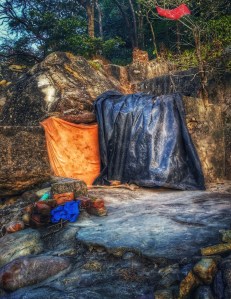
For some people inclined to a life of contemplation and solitude, this place might be a small hut in a forest or a wood, or a camp on a remote beach on an even more remote island. Then there are others who are called to an actual cave high in the mountains, or on the banks of some sacred river somewhere.

And, equally, the desert, the place of retreat, quiet, solitude, and living apart, may well be an apartment or house in a suburb, or even in the centre, of a big city.

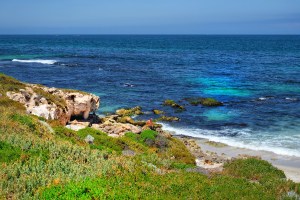
Then there’s me: called to this desert town of Broken Hill, almost but not quite in the centre of the continent of Australia. It is deep in the arid zone: it’s very far out back here in the Outback, 1500 kilometres inland from the east coast to be precise.

Yes, well this is all well and good, but shouldn’t I be answering my own question: why eventually? Well, we’ve covered the excuses, but really isn’t that just plain old procrastination? Yes indeed. If we get back to our Mythologist friends once more, we learn there is a stage in this Hero’s Journey that follows on from the Refusal: The Supernatural Act.

These are the times when things happen that seem to come at us out of the blue, from no rational, logical, or explainable source. Something that we might find hard to beleive at first because it’s way out there; supernatural like it says.

But that supernatural bit doesn’t have to take a spooky form, it might be that the ‘supernatural act’ is an internal insight or realisation triggered by a perfectly natural occurance. That’s what happened for me. What was this non-spooky, natural event that prompted such internal insights and realisations in me and got me moving?

Rain. Yes, rain. It rained almost every day for over six months. I am very very blessed that I wasn’t affected by flooding as so many in nearby area were, and I am thankful for that. But it’s safe to say that rain, mud, no sun, and limited or no access to the outside for days or weeks at a time, soured my romance with the coastal lifestyle.

You could say that through the sound of rain on the roof, I could still hear the call of the desert. In fact it got so loud that, eventually, I could no longer ignore it.

So, eventually, I answered the call, and here I am. Here is a small miner’s cottage and my new hermitage, my new safe haven by the side of the road. The cottage is situated in a mining town that sprung up in the 1880s. So this cottage has been home to miners and their families for generations, including the current owners.

In a sense it’s quite likely that I am the first occupant who hasn’t been or isn’t a miner. Though you might say that my excavations, rather than being in the dark underworld beneath the surface of Mother Earth, are taking place in the equally dark, hidden interior places of Self. A mining of another sort you might say.

Before flying out here, I was thinking about what was actually calling me to the desert (putting aside the rain for a moment). After all, I lived in a small cabin in a park like setting literally five minutes walk to a pristine Pacific Coast beach; I had trees and forest like spaces all round, as well as a small river two minutes walk. And that’s not even thinking about the abundance of wildlife.

And it occured to me that it is the stillness of the desert that was calling to me. This town of Broken Hill is a mid size town (actually a small city with about 15000 people), with the usual shops, cars, people, and the rest.

Yet there is a stillness. No longer can I hear the constant sound of seawaves crashing. No longer can I sense the never stopping coming in and going out of sea tides. And out here, it seems like even the people are moving quite a bit slower too. I’ve yet to see a single person rushing about. And they seem to smile a lot as well.

The street I live on is extremely quiet, and even on the so-called ‘busy streets’ there isn’t the mad acceleration and braking we’d see everywhere on the coast. Of course there is the odd driver who thinks every car is a racecar, but where don’t you get that?

But, actually it’s more than this. There is, beyond the actual literal quietness, a silence that seems to exist as an entity or state of being in its own right.

A stillness that is a solid thing, just as on the coast there was (is I suppose) a constant frenetic atmosphere that seemed to overlay everything. People rushing – on foot or in cars – even when there seems to be no reason for hurry (though of course you can never tell can you?). And not so many smiles either.

Contemplative people, those seeking solitude, and peace and quiet in which to pray, to live slowily, and to explore the divine, have been drawn or called to deserts (in all its forms) for thousands of years or longer. And I am fortunate enough to have finally (eventually) heeded the call myself.

Here, away from the incessant acceleration and braking (I do like this expresion), and in that stillness that envelops this land, perhaps I can dig a little deeper, uncover a bit of quiet, and discover a piece of solitude.
Out here, in the Outback, life can be harsh for all living beings, often dangerous in its aridity and isolation. It’s a long way from major cities, food and supply chains are extended to extreme limits, and the human hold on the land is precarious at best.

Yet, the paradox exists: out here far from the fertile coasts, the soft sandy beaches, the major urban centres where the mainstream of (human) life goes on, there is a quiet, a peace, a stillness that seems to pervade the very air one breathes.

A wise person wrote something short and sweet that sums all this up for me:

There is a stillness in the wildness.
You Say You Want a Revolution, Well You Know …

Welcome friends to another post

I’m actually scheduling this one to publish sometime in the future. The reason is that, as I reread it now, I see I’ve used ideas, and even some sentences here that appear in a couple of recent posts. The thing is, I think this is a post worth reading, so I’m kind of sneaking it in via a touch of time travel. In any case, please enjoy, and by the way, thank you for sticking with me for this long (however long this is).

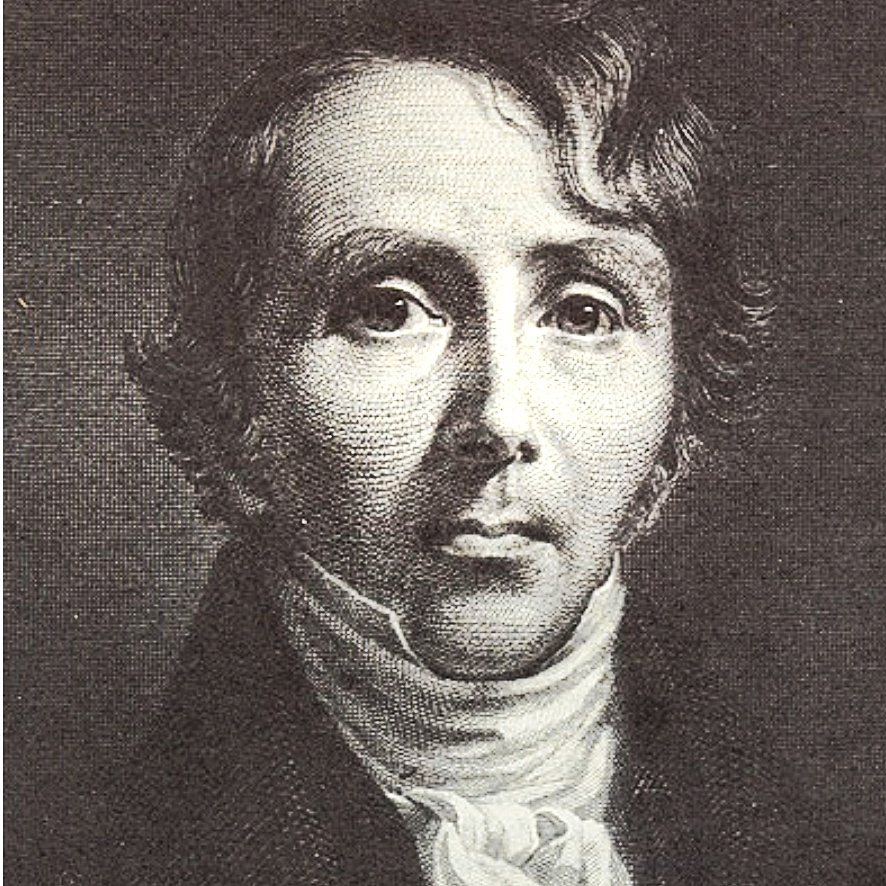
It was a revolutionary idea for its time, the early 19th Century. Come to think of it, it still is. A reform minded Christian minister, William Ellery Channing proposed that the proper goal for each of us human beings is perfection.

William Ellery Channing (Public Domain)

Or rather, the goal should be a  realisation of the perfection that is already our true natural state, our true selves, which we’ve forgotten as we have got on with the rarely easy business of living in a material world. You see? I did say it was a revolutionary idea.

After all, he wasn’t talking about the obsessive perfectionism that often curses so many of us anxious types. Or the myths propogated by mass media of what it means to be ‘perfect’. No, he was proposing a complete and thorough shift in the prevailing thinking about the nature of humans, and in reality, of all life.

Anyway, he posed the question:

Do you ask in what this perfection consists?

He then proceeded to answer his own rhetorical question:

I answer: in knowledge, in love, and in activity

When I came across this little vignette in an unrelated book I’ve recently finished reading, I was a little bit mind-blown. Channing’s formula is more or less identical to that presented over millennia in a number of the world’s religious or spiritual traditions.

For example in the tradition I am studying these last years, Sanātana Dharma, this little formula constitutes pretty much the foundation for any kind of spiritual growth. It could be said that in a real sense it is the very basis of all Yoga:

Jnana Yoga (knowledge, study, includes meditation, contemplative practices and so on), Bhakti Yoga (Divine Love. In the sense that love is always divine) and Karma Yoga (often called the Yoga of action. It basically includes everything we do in the physical world. The Karma bit is about our actions becoming selfless).

In other words, just sitting there on their own these three Yogas offer a pretty succinct answer to the question many of us ask ourselves constantly: How can I live a good life?

We pursue knowledge for many reasons: it may be a reluctant pursuit as we sit through the interminable years of high school; or later as we head to university or college to train for a career that we hope will support us. The thirst for knowledge might arise when we come upon a topic or an area of interest and fascination that we just have to learn more about.

Just as with the infinity of knowledge, love comes in equally infinite guises. Unlike knowledge, however, I don’t think there are ‘reasons’ we can give for love. Love is love; it is its own reward (and it’s own torture), it just is what it is. Divine is as good a word as any. Any love, all love, is love for all and for everything.

And then there is the kind of knowledge we pursue as we try to answer what I like to call the Who am I? questions. Things such as: What’s the meaning of life? Where am I from? Where am I going? Is this all there is? Oh, and of course the real biggie: Who am I?

Now, at the risk of having to take the prize for the most obvious statement ever made, let me make the point that all living things have to take action all the time if they are to remain alive. So obvious that I’m even having to take several different actions in order to tell you this. So, you might well ask, what’s the big deal? What’s Channing and all the others through the ages getting at? What activity?

Well, I think Channing was getting at the notion that every action we take needs to be informed by knowledge and love. But, what knowledge? Well, clearly we are caught in a tsunami of information much of which goes to making ‘fake’ knowledge, propaganda, deceptive advertising, biased education, and the rest.

In other words how often do we see knowledge not used correctly? And, how often is humanity’s use of knowledge – our actions – informed by love? Now we can begin to realise how revolutionary this idea is, and always has been.

I think that’s why the Sanātana Dharma teachings and world view embody the concept Bhakti, or divine love. As I noted, all love is divine. These teachings tell us that all action is to be undertaken with love, without attachment to rewards or outcomes, and dedicated to the welfare of all life.

Channing had the same idea: for him all life is pure and perfect already. And of course it follows I think that all actions we take have the potential to be informed by a wisdom gained from proper use of knowledge, and to be informed by love, whether it’s for self, for other people, other animals, Earth herself.

So, pretty revolutionary stuff eh? I guess a lot of us have heard that famous quote from Gandhi:

Be the change you wish to see in the world.

Well, here’s the freaky bit. Just now as I looked up the quote to make sure I got it right, I discovered that he never actually said those words. Not in that form anyway. Here’s what he actually did say. It’s a long quote but I think it’s an interesting note to finish on. I think for me it clarifies many of the questions this little discussion has raised in my own mind, as it will for you I hope.

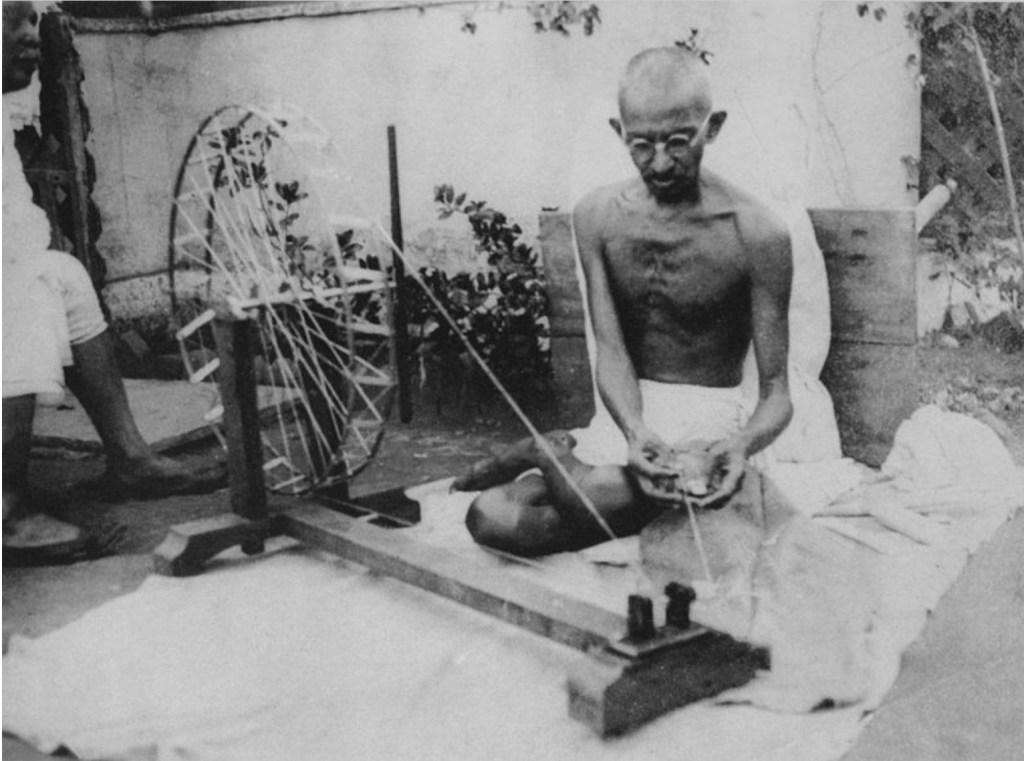
Gandhiji at his spinning wheel (thank you Wikimedia Commons)

Knowledge; Love; Activity

We but mirror the world. All the tendencies present in the outer world are to be found in the world of our body. If we could change ourselves, the tendencies in the world would also change. As a man [sic] changes his own nature, so does the attitude of the world change towards him. This is the divine mystery supreme. A wonderful thing it is and the source of our happiness. We need not wait to see what others do.

Mohandas Gandhi

Peace from me to you

Let Me Tell You About a Visitor I had This Morning

Greeting and Welcome to you

Quite a long time ago now I half wrote a book. I mean to say, I wrote half the thing before giving up. The book was going to be called When a Pet Dies, and was about, well exactly what the title suggests. All the practical stuff that you’d expect, as well as ways to deal with the grief over the loss of a companion animal .

I thought at the time that the reason it was only half written is that, once I got through that practical stuff and was ready to tackle the grief and loss parts, some kind of lethargy set in, or I got lazy. Or perhaps, I was thinking also, the muse for that particular project had simply left and was gone. So it remains half written.

So, why am I musing over this half done, half forgotten project from long ago? Well, let me tell you about a visit I had this morning.

I was sitting, focusing on chanting my mantra. Suddenly I felt an absolutely overwhelming sense of loss and sadness. I don’t recall thinking of anything in particular beforehand, but the sense was overpowering. Flooded with grief is what they call it I think.

Lofi (on the right) with his sister Shanti

And then, just as powerfully, I sensed the presence of Lofi, my cat who died in my arms over ten years ago. Immense feeling of presence is what I wrote in my notebook. Now, I’m not saying he was literally there with me. I’m also not saying he wasn’t. All I can say is that it was among the most intense of similar experiences I’ve had over the years. Anyway, that’s most likely what got me thinking about my incomplete book.

Later this morning I was sitting with my partner on a benchseat overlooking the sea, the bit of the Pacific coast I’ll be leaving behind next week.

Actually, now I’ve mentioned that, you might remember from my last post how keen I am to get out there to the desert. That excitement and anticipation doesn’t mean for a second that I’m not feeling quite sad about leaving the coast.

Anyway, we were just sitting there and chatting on and off, when suddenly a thought seemed to push its way to the surface. I all of a sudden knew why I stopped where I did when writing that book. I realized in a strong and convincing way that you can’t build a structure to define what grief is or how or if it should be experienced, by whom and when.

I’m not talking about the ‘truism’ that one hears all the time that says that the ‘stages of grief’ are in a set order, until they’re not. Actually come to think about it, I’m not even sure this is true. I mean, I’m not sure it (grief) is a thing to be labelled, quantified, recorded, predicted, analysed.

I mean, who’s to ever say how any other individual, or even oneself, will feel about anything at all? Sure, there might be a ‘typical’ set of responses to any given circumstance, such as a loss, but even the proponents of such theories will tell you that none of us is typical.

Which kind of leads me back to my feeling of oneness with my Lofi earlier in the day. Obviously I’m not alone in having such feelings. How often has any one of us heard other people say, after they’ve lost a loved one:e, ‘S/he was really here. It was so real’.

Such experiences can occur anytime, even decades after the loved one has left. I’ve mentioned somewhere else that I’m reading (in little chunks) a great book by Joseph Campbell, the renowned scholar of myth. Let me share with you a quote from the section I’ve been reading today where he’s talking about how art in India seeks to portray the divine in all things:

This is the wonderful song that one hears when one reads the Bhagavad Gītā or any of the great texts of Eastern philosophy. This is the song of that immortal spirit that never was born and never die.

Of course this isn’t meant to be a consolation to myself or anyone else. After all, we are physical beings, living in a material, solid and apparently ‘real’ world. So, naturally, we experience loss, like everything else in that context.

Our bodies react (or don’t) as do our minds, creating physical sensations and emotional responses. Or not. These physical and emotional responses, or lack of them, are totally unpredictable, unexpected, and most definitely unclassifiable by anyone outside of oneself (myself)

Anyway, there are no rules. Even the grief and loss experts will tell you this. Mind you, I can and will only speak for myself, and my experience. Basically that experience has taught me that I have an intuitive resistance to ever thinking in terms of there being a ‘roadmap’ for grief.

Or a statistically valid ‘pattern’ or ‘process’, or that there are even such things as ‘stages of grief’.

My grief for my Lofi is unique, just as everyone’s is. I’m pretty sure I don’t even want to define it, label it, ‘try to get closure’, ‘come to terms with my loss’. No. None of that. It’s like I’ve said someplace else, or at some other times:

Sometimes we make way too many words for something for which there are no words.

Thank you for allowing me to share these words with you. I pray that they are not ‘too many’

peace and love

Quiet and Free (A Haiku of Sorts)

Much speech leads to exhaustion;
guard your inner being.
And keep it free.
A bit of blue sky coming.

When a Day Off Isn’t a Day Off

Namaste and welcome

You know by now that I study the Bhagavad Gita. I’ve been at it a few years now, and it gives me a great deal of joy and comfort, not to mention the help it is to me as I struggle to understand Self and life, the Universe and everything (to borrow a well-worn phrase).

Yes, I love this book which is the story of a warrior king and his charioteer getting ready for battle. Arjuna, the warrior, is us. Or rather he is our ego, our lower self, the us that lives as a material entity in the material world.

The charioteer is actually Krishna, and he represents our Higher Self, the Self that is what some people call God, or the Divine, spirit, universal consciousness. In other words, my Higher self is having a conversation with my lower self as I battle or struggle with living in the material world.
Anyway, it’s enough to say that I am very fond of this book, the lessons it holds, the guidance I sometimes glean from it. And I try to spend time with it as often as I can. Daily mostly, but not always. I have to admit that sometimes I just want to give it a break, leave the words alone, just be with Self for a bit.

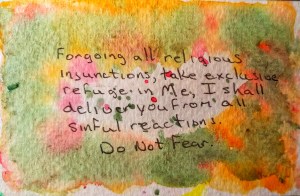
Actually, there is a verse that I wrote down long ago that does in fact sanction the student (that’s me) to take a break.

Forgoing all religious injunctions, take exclusive refuge in me. I shall deliver you from all sinful reactions. Do not fear

Bhagavad Gita Ch 18:66

This is Krishna speaking, giving instructions to Arjuna. Essentially it’s the higher Self telling our little selves to ignore outside rules, regulations and all that, and rely instead on what comes from within the Self; in other words, what our hearts tell us.

Now, he’s not saying ignore laws of the world, that’s not what this story is about. He’s telling Arjuna, look, don’t take notice so much of what the religious leaders tell you, or what instructions you read in holy books.

Then, after more or less consistent study over years, I came across yet another verse quite recently that confirms this one, but that hadn’t ever spoken to me before:

When your mind is fixed and unmoved and not confused by scriptural injunctions you shall attain yogic samadhi

Bhagavad Gita Ch 2:53

This verse actually says: don’t confuse yourself with stuff you read in the scriptures; instead keep your mind fixed and unmoved by the outside world. And if you do that, you will achieve that level of peace, self-realisation, and happiness, that you’re after.

So, do we have here a book of scripture that is in fact telling me not to take any notice of what it says in that book? That doesn’t sound very likely does it? No, I think what both these verses are getting at is this: The first and primary thing to do if you want to achieve happiness, peace, self-realisation, is focus inwards, on the Self.

Or God, or spirit, the Universe. We all call it by different names. But the point being made is that we aren’t going to find all the answers only in a book, or in the instructions from ‘religious’ leaders; overdoing the books or the slavish following of teachers only causes us (sorry I mean me) confusion.

Higher Self here (in the guise of Krishna, who is in the guise of a charioteer) is advising us to look to our Selves, not to the words of others to reach union with that Self. At least, that’s how I’ve chosen to interpret it.

What’s interesting here is that these are two of the very few verses for which I haven’t looked at commentaries or interpretations by other people. What I’ve done in other words, is take the advice given in these verses and looked inwards.

I don’t mean to suggest that I use these verses as ‘have a day off’ cards; most likely the contrary is true. On days when I don’t look at the Bhagavad Gita, I like to think I spend more time ‘just sitting’, perhaps chanting mantra, and contemplating.

Of course it doesn’t always work out like that naturally. But, at least on those occasions there is the heart and mind space available for a more direct communication or connection with Self. With that part of me that is one with all.

Peace and love

Is Life Too Short for Perfect Writing?

Greetings and welcome friends

Let me share a little secret with you: I have and always have had, atrocious handwriting. And it’s always been a major frustration (but a huge incentive to learn to type, which is one of the best things I’ve ever done).

Perhaps it’s because I had some sort of learning difficulty, maybe it happened because every state in Australia has a different way of teaching kids handwriting, or maybe its just that I was and am lazy. Actually, scratch this last one: I am not nor have I ever been lazy.

Anyway, it appears to be a fact of life, yet I do still get frustrated from time to time. But then there are times when I decide not to care, that it isn’t important, doesn’t matter. Being in one of those indifferent phases right now, has reminded me of an incident that should have taught me this lesson once and for all.

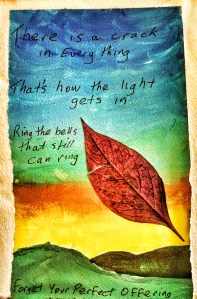
A while back I was gifted a small painting. The artist wasn’t satisfied with it as a background of a planned piece, and gave it to me thinking I might like to ‘do something with it’. I happened to think it quite a lovely painting in its own right actually, and as I was looking at it, I thought of a leaf I had collected a couple of weeks previously. A beautiful very soft and pliable purple leaf from a lovely shrub.

So, right away I just got to sticking that leaf onto the painting. As I pressed it down, a little tear appeared in the leaf. Immediately a lyric from Leonard Cohen‘s Anthem came into mind:

There is a crack, a crack in everything. Thats how the light gets in.

So, I began writing bits of the lyric onto the painting. Untidy, irregular and typically atrocious the hand writing, or printing, is. But then it struck me: that’s the point! I mean the point of Mr C’s sublime words:

Ring the bells that still can ring
Forget your perfect offering.
There is a crack, a crack in everything
Thats how the light gets in.

Here’s how I thought about what I’d written on the painting and how I’d written it: I rang a bell that I can still ring: I thought of and wrote down those beautiful lyrics to compliment the accident (is there any such thing as accident?) of tearing a leaf on a painting that ‘didn’t work’ for the artist, but that was working for me.

Therefore, the painting, the torn leaf and my handwriting was not a perfect offering in any kind of conventional sense as the world would view it. In other words there is a crack, both literal as in the tear in the leaf, and metaphorical as in the imperfections of the whole piece.

But—and here is the vital thing—this little painting, despite its initial rejection by the artist, and with its imperfections, its sloppiness, and its flaws, has provided a channel for light to get in. Into my life, into the piece itself, and now, through this sharing, into your life.

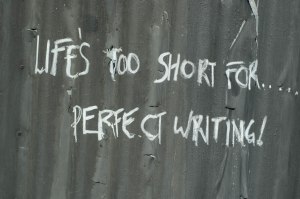
So, who cares if my handwriting is not conventionally perfect or is untidy, uneven, and even a bit tricky to read? I love the message in those lyrics; I felt that this lovely painting with its torn leaf to be the way to put that message in a concrete form. I mean, really, isn’t life too short for perfect (hand)writing?

PS I no longer collect leaves and trap them in this way. I may collect them, but after a time, I return them to their natural environment. Fallen leaves have their function in the cycles of nature too.

Just For Today

There is a song by George Harrison that I like very much. Actually there are many songs of his that mean a great deal to me. He’s been a kind of mentor or teacher for me since the early 70s. But, having said that, there is something about Just for Today that really does resonate deeply within me. It’s not even one of his ‘biggies’, and was released in 1987 on the album Cloud Nine

In fact, if you read the lyrics of the song. Or even better, listen to George actually doing the song himself, you’ll most likely agree that this is more than a song. This is a refrain, a plea, even a prayer. No ordinary pop song anyway.

If just (for) today
I could try to live through this day only
Not deal with all life’s problems
Just for today

Then, the other verse (there are only two):

If just for tonight
I could feel not sad and lonely
Not be my own life’s problems
Just for one night

How many times have I made these same pleas? I don’t think I’d be able to count them. Of course I’d guess we all have at some time or other (or even quite often, all the time, every day, ahhhhh!!!!!!) wished or prayed for the problems (whatever they may be) to just go away, even for just a day. No, not even a whole day. How about just for a few minutes?

So, I’m not alone then. Still, it’s no consolation is it, to know that we all go through the same wishful thinking to be rid of the same or similar problems? I think, though, in this song George has given us a clue to what we can do to bring ourselves a little more into the present when it comes to the angst we weigh ourselves down with over ‘all life’s problems’.

And actually, he’s suggesting not that we focus fully on the present moment, the micro if you like, which can be tricky at the best of times. He’s given us a bit of a an easier task: Just look at this day only. Perhaps we can better look at a whole day than this ‘moment’ or ‘second’. A day is sort of a macro moment, a bit easier to get hold of.

But, that last little question, about always me being my own life’s problem, that’s what I really try to get to grips with. I am my own life’s problem. The problem is not the family I was born into. It’s not the less than idyllic childhood I endured. It’s not even the bullies I seem to have attracted to myself over many years in far-off school days.

The problem is not even the anxiety that I seem to have been born with, or that’s evolved over time. Nature vs nurture?

And I can’t even say that the problem is the kinds of choices I’ve made about life, work, thinking, and all the rest, over the years.

No. None of this. The problem is me. And, let’s get really trippy here: the problem isn’t even me. It’s the physical manifestation that thinks it’s me and which exists in relationship to the physical world.

So, who is the real me? Who am I? Ah, well, these are the really big questions. Asking these questions is called Self Enquiry. And I think it’s helping me.

Whenever one of those life’s problems, or anxieties pops up I try to remember to ask: ‘To whom is this feeling/thought/memory occuring?’ That answer is (obviously) to me. And then I ask, ‘Who is this me? Who am I?’ Then, for the minutest of tiny moments, it all stops. Sometimes.

You see, I’m not really able to answer that Who am I question. The best I can come up with is a never-ending list of who I’m not, or what I’m not. It’s called Neti Neti: not this, not that. So, if I keep returning to who am I every time one of those ‘I’m not …’ comes up, what happens?

Well, in theory, nothing.  The idea is that asking Who am I stops the mind. It can’t answer. If a mind can’t answer, there can be no thought. And if there is no thought, then mind ceases to exist. (I’m not talking of brain here, but mind. It seems to me that the mind has no existence as a distinct entity of its own. It is more what we could say a ‘place’ that comes into being when thought happens. No thought, no mind.)

This cessation of thought is only a momentary thing. Thoughts soon come barging back (it also seems to me that while mind might not actually exist, it has a way of making its presence known in no uncertain terms). One thing I try to remember that causes me no end of extra thinking, is the fact that if we are not having a thought, then we can’t ever know it. You can’t have a conscious thought that says ‘hey, I’m not thinking now’

I see this Self Enquiry as a way (in a long term, lifetime kind of way) to rid myself of my incessant thinking and the confused (confusing too) and useless thoughts that arise all the time. For me it is, in a sense, a way to become mindless.
In that moment, when thought ceases, there is no pain. There are no questions, and there is no anxiety. There is no dread; no hope even. Basically you can say there is nothing for that tiny moment.

And that’s me, the real me. In that little moment (who can measure the length of a moment?), there is presence, as in I (the real I) am present, right here, right now.

Actually there is no time, as we measure it in the world, in that little moment (or whatever we choose to call it). Perhaps it’s more accurate to call it a state of being.

And it’s a state I’d like to be in more often. Not, as I say, that I’d know I was in it. Only by what you might call the spin-off effects of more calm, more clarity, less anxiety, all that sort of thing. In a way I would call that a state of grace.

All I can say is that it is exactly where and when and how I want to be.

Just for today.

I’ll Try Not to Pass Them By

So, anyway, here I am. Just sitting. It’s what I do, when I can, when I’m able. Well, to be completely accurate, here I am sitting and typing. Writing yes.

But every day, I sit. I try to sit. On a comfortable chair or bed. Here is where I commune with the Divine. It’s where I say my prayers, empty my mind, try to be silent, sometimes read holy books.

Whatever I do when I am just sitting, the sitting bit isn’t always easy; it requires effort and patience. Just being still can be hard; everyone knows that. But it’s part of the practice, part of the sadhana, the way to liberation. All that.

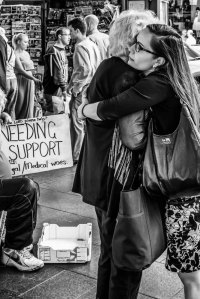
Of course I’m not the only one you might find just sitting. Why, just today on my way home from buying fruit I saw some other people sitting. One had his eyes fixed, completely transfixed on his phone’s flickering screen; head bowed, the world around him shut out.

The other sat, head bent forward, arms crossed; I couldn’t see her eyes. Perhaps she was sleeping, perhaps feigning sleep, perhaps trying for sleep. Whatever, resting it looked like.

These two were a lot like me I thought: just sitting, being quiet, resting even. Mind you, they were younger than me. Though of course what’s age got to do with it? I carried shopping bags; they sat beside a very full shopping trolley.

But, wait, my bags held fresh fruits to top up our supply. Their trolley overflowed with, what shall we call them? All their worldly goods? Personal effects? All they own?

And another difference? I’m going home with my bags. They have no home to house those effects; no soft bed to rest upon or commune at leisure with the divine.

Whereas I sit under a roof, in a room, on a soft bed, they sit in a bus shelter. Sure, there’s a roof but it offers scant protection from the approaching storm, and none at all from the incessant wind that will soon be full of rain blowing.

It’s no use asking why am I in a comfortable house, and they are in a bus shelter, just as I was and they were, the last time I saw them. There’s nothing for me to say that will mean anything to them, to anyone else, or even to myself.

I suppose I or you or someone else might remind me (remind all of us) that the world can be hard, is hard: bad things happen to all of us. Of course that’s true. I actually truly believe that the world by its very being in existence is hard. What did The Buddha say? Life is suffering?

But, as they say, that just doesn’t cut it, does it? All just words don’t you think? It’s what I think today anyhow. Oh yes, I’ve been praying since I passed them by (and I did pass them by with no words, no smile or greeting, my face turned away. I am ashamed).

I thought of them as angels there to remind me of my own advantages and privilege. Even those very thoughts themselves prove my own failing to understand, to actually get it.

But, yes: all just words. Meaning very little. I suppose after all that perhaps all I can do is pray.

For all of us.

Peace

Not as if I don’t bloody live here is it?
Yeah. I know, I know. Its a bloody bus stop.
But, geez, a fella’s gotta live
somewhere. Don’t he?

An Aspiration. A Prayer

Hello friends and welcome

The last couple of posts have had me thinking about what I actually do to contribute to the world, to life, to making changes that could bring peace, a safe environment, and a better life for all.

I have to say my commitment to my life as a hermit, as a pilgrim aspiring to live a life apart from ‘the world’ all the while dedicating myself to what we might call Self or God Realisation, has been strengthened.

I have once again come to the conclusion that living a life focused on spiritual development, on art, on prayer, and on contemplation, is the most valuable way I personally can contribute to change, to love, to the good of all. My true nature, my inclinations, my faith, my life experience, all these equip me for this life that has chosen me.

And at the same time, these same factors have left me ill-equipped for life ‘in the world’

In those last two posts, I talked about how so few of us think we have anything to offer a world teetering on the edge. But of course, as I pointed out, the opposite is true. I think I made the point that there is some unique role for each and every one of us in the continued unfolding, upliftment, protection and prospering of all life in this world.

Having said all that, I have to say that for me it’s not always easy to actually realise this in my heart. Intellectually it’s an easy concept to explain (well sort of anyway), but on that deeper heart level, well it’s tricky. Guilt rears its ugly head: ‘It’s all falling apart; I have to do more; But what can I do? It’s useless. I’m useless’.

As I mentioned in one of those posts I think, people have turned away from the horror, injustice, cruelty, and murderous greed and lust for power, for as long as these things have existed – which is obviously for as long as our species has been around. At certain times in history this move away from ‘the world’ has accelerated and intensified. And we are living in one of those periods now.

In the last century so many people have taken up the contemplative life, and many have chosen to make that life one of complete or partial solitude in order that they may be free from distraction in their prayer, study, and contemplative life.

But, many will say, ‘You are in denial. Now is the time you are needed out there. The world and all of life is in danger. You can’t escape and hide in a cave’.(read here stop watching the news, ignore politics, stop spending, become a literal or metaphorical hermit, go traveling, shirk your responsibility to the rest of the world).

Again guilt trips us up and we just keep on trying to find ways to at least rid ourselves of the guilt over our perception that we can do nothing.

But many such people, and that includes me, rather than being in denial, rather than shirking responsibility, have looked at the material world with its horrors, and said, ‘This isn’t right’, and have started to look at other ways to live and, seeing that continuing to struggle against the weight of the world on the world’s terms is pointless, seek to find other ways they can contribute to change. Ways that don’t perpetuate the playing of the game.

And rather than escaping these people (including me, I say with humility) face the world head on, dedicating their lives to the world through creativity, through prayer and meditation, and through the expression of freedom in their choice of lifestyle. They are, as Mahatma Gandhi is supposed to have said, being the change they want to see in the world.

While Gandhiji didn’t actually say those words, (Actually there’s a post coming in a couple of weeks in which I share the full text this quote is apparently derived from. Stay tuned for the link here), he certainly lived his life being the change he wanted to see.

But sadly, this ‘quote’ has come to be seen as a kind of feel good cliché, something the privileged are accused of mouthing while not actually even thinking about changing their lives. Just one more platitude you might say.
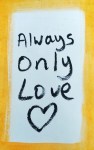
But for many, like me in my own way, it is much more: it is a call to action, a respectful and heartfelt request that I embark upon the quest for a more authentic way of living that has love, compassion, service, and truth at the centre of all I do.

This is my aspiration. This is my prayer.

Peace from me to you

Mind Your Own Business and Save the World

Namaste friends

Welcome to another post. Just a little note before we get into it: This one picks up where the last one left off. Kind of. No need to read that one first, unless you want to.

And that’s the whole thing in one sentence, or at least in part of a sentence: unless you want to: none of it is any of my business. What do I mean when I say ‘none of it’? Just that. None of it. Or we can say it in another way: the only thing that is your business is you.

But, all of us are bound to ask, how can I simply mind my own business in a world torn by endless war? How can I ignore the environment I live in and that it’s dying before my eyes? How can I turn away from the evils of racism, injustice, greed, and cruelty?

Well, the simple answer is we can’t and we shouldn’t. Of course, in order to reconcile this apparent contradiction, it would be helpful to clarify exactly what we mean by minding our own business.

In essence my business (or yours or anyone’s) is anything that has to do with me: what I do; how I behave; what I think, feel, and believe; my behaviour and attitudes towards others; and—and this is the key—how I interact with and respond to the world as I experience it as I go about living my life.

So, it isn’t completely accurate to say that the wars, racism, injustice, and the killing of the environment (and everything else) is none of my business; my business is limited to my interaction with and response to all of it. And that has to be determined by a range of factors like my nature, my abilities, my circumstances, and so on.

Above all, and as Susan Sontag, American writer, philosopher, and political activist, said in a speech in 2004:

To be a moral human being is to pay, be obliged to pay, certain kinds of attention.

While the theme of that speech had to do with the writer’s responsibility to truth, I think her assertion applies here and may provide a solution to the seeming contradiction between minding our own business while at the same time stating that our business can, should, and does indeed include what goes on outside of ourselves (actually as we shall see, in reality there is no outside or inside)

How we utilise our own personal resources is in the end for each of us to decide. In the sense of our engagement with the world, the most precious of these resources are arguably time and attention.

Each of us possesses these things in our own unique quantities, just as we all have our own unique qualities, so each of us has the opportunity to decide how we use our time, and what we pay attention to.

It is so very easy to be overwhelmed by the constant torrent of information detailing the horrors threatening to consume and destroy our poor Earth and the life she supports. It is so very tempting to throw up our hands in defeat, and shrug our shoulders as we turn away exclaiming ‘It’s none of my business’.

While none of us would blame anyone for retreating in this way, a great many of us realise that for us this is not an option. Well, as the Buddha taught, there is a middle way. A way that allows us to avoid this kind of ‘none of my business’ denial, at the same time as protecting us from being overwhelmed and beaten down by the scale of it all.

The first step involves surrender. Surrender to the idea that there is no ‘me’; there is no ‘you’. There is no ‘them’, no ‘us’. There is only ‘I’. Surrender to the notion that not only is all life ‘connected’ or linked, but to the thought that all life—human, other animals, plant, mineral — everything —  is one. There is no separation.

Easy eh? Hardly. But this is where the paying attention thing comes in. Rather than being swamped by the never-ending tsunami,  choose where to put your attention. Ask yourself, where am I able to place my attention? How can I—how am I able to—use my time so that I avoid drowning yet still contribute to the well-being of the whole of which I am a part?

Obviously, as I hinted at above, the answers will be different for each and every one of us. For some, the kind of attention they pay will involve being on the literal front lines, working in the political field, or with activist groups working for social justice.

Then there will be those whose nature compels them to  choose to put their attention on a life of prayer, meditation, and contemplation.

For these people this requires the quiet and solitude of monastery, ashram, or cave (whether it be in forest, mountain, or suburban home). And along the huge spectrum in between, there is a a unique spot for every one of us.

Each of us is a part of the whole. Everything we do affects the whole. Remember that saying that goes something like: A butterfly flutters it’s wings in the forest and the sun rises? Okay, maybe I’m pushing it a bit, but you know what I mean.

Never underestimate what (you perceive of as the little) you’re able to do; no one can say what impact it will have. All that is required of you is that you mind your own business.